
TL;DR:
- Evidence acquisition is a controlled, verifiable process that ensures digital data remains legally admissible by maintaining integrity and proper documentation. Different methods, such as physical, logical, live, and cloud acquisition, are selected based on source and legal authority, with hashing and chain of custody being critical to preserving evidence integrity. Proper procedural adherence, especially in remote and cloud environments, is essential for the forensic soundness and legal defensibility of digital evidence.
Evidence acquisition is one of the most misunderstood concepts in digital forensics. Many assume it is simply copying files from a device. In practice, it is a rigorous, technically controlled process that determines whether digital evidence will stand up in court. Understanding what is evidence acquisition matters enormously for legal professionals and investigators, because a single procedural misstep can render otherwise damning data inadmissible. This guide unpacks the definition, methods, integrity principles, and real-world challenges of acquiring digital evidence, with particular focus on the legal and procedural standards that govern modern forensic practice.
Table of Contents
- Key takeaways
- What is evidence acquisition and why does it matter?
- Evidence collection methods used in acquisition
- Maintaining evidence integrity during acquisition
- Challenges in remote and cloud evidence acquisition
- Applying evidence acquisition principles in practice
- My perspective on evidence acquisition
- Professional forensic acquisition support
- FAQ
Key takeaways
| Point | Details |
|---|---|
| Acquisition is not simple copying | Evidence acquisition is a controlled, documented process designed to preserve data integrity for legal proceedings. |
| Method selection is critical | Physical, logical, live, and cloud acquisition each suit different evidence sources and legal contexts. |
| Hashing underpins admissibility | Cryptographic hash values verify that acquired data matches the original, making them indispensable for court use. |
| Chain of custody is non-negotiable | Contemporaneous documentation from acquisition through to court appearance protects evidential value. |
| Cloud and remote sources require legal authority | Preservation requests and strict scope management are prerequisites before acquiring cloud-based evidence. |
What is evidence acquisition and why does it matter?
Evidence acquisition, the term used across the digital forensics profession, is a controlled process that captures data from original digital sources with minimal alteration, so it can be analysed and presented as legally defensible evidence. The more informal phrase “evidence collection” is often used interchangeably, but in professional forensic contexts, acquisition carries a specific technical meaning: it refers to creating a verifiable copy of digital data under conditions that preserve its original state.
The sources targeted during acquisition span a wide range:
- Storage media: hard drives, solid-state drives, USB devices, and optical discs
- Volatile memory: RAM, CPU cache, and running processes on live systems
- Mobile devices: smartphones and tablets, including their internal memory and SIM data
- Cloud environments: data hosted on third-party platforms such as email providers, file storage services, and social media
Why does this matter so much? Because data integrity begins at acquisition. Unreliable sources or careless copies produce inadmissible evidence. Judges and opposing counsel scrutinise how data was obtained just as closely as what the data actually shows. A forensically sound acquisition proves that nothing was added, deleted, or altered between collection and presentation. Without that assurance, even the most incriminating digital records can be excluded from proceedings entirely.
The concept of forensic soundness sits at the heart of evidence acquisition. It means that the acquisition process itself does not meaningfully alter the source data, that any unavoidable changes are documented, and that the acquired copy can be independently verified against the original.
Evidence collection methods used in acquisition
Understanding how to acquire evidence requires familiarity with the main acquisition methods, because no single approach suits every situation. Forensic professionals select their method based on the evidence source, its accessibility, and the legal authority granted.
-
Physical acquisition creates a bit-for-bit image of the entire storage device, including deleted files, unallocated space, and file system metadata. This is the most thorough method and is preferred where legal authority permits full device access. Hardware write blockers are mandatory here to prevent any data being written back to the original device during the imaging process.
-
Logical acquisition copies only the active, accessible files and folders rather than the entire device image. It is faster and suits situations where a full physical image is not possible or legally authorised. The trade-off is that deleted files and unallocated space data may be missed.
-
Live acquisition captures volatile data from a running system. RAM contents, active network connections, running processes, and encryption keys in memory are all lost the moment a device is powered off. Volatile data collection must follow the order of volatility, a principle that prioritises the most transient data first. CPU registers and cache go first, then RAM, then network state, before progressing to persistent storage.
-
Remote endpoint acquisition involves connecting to a device across a network, identifying data by its volatility, performing the acquisition, and verifying the result with validated forensic tools. This method is increasingly common in corporate investigations where physical access to devices is impractical.
-
Cloud acquisition does not involve imaging a device at all. Instead, preservation requests under legal statutes are submitted to service providers, and collected data is verified against provider-supplied hashes to confirm its integrity.
Pro Tip: Always use forensically validated tools alongside hardware write blockers for physical acquisitions. Validated tools and write blockers are considered mandatory to maintain evidentiary integrity and will be scrutinised during any legal challenge to your process.
One important nuance: focused acquisition can risk excluding relevant evidence, including potentially exculpatory material, if it is not carefully managed under clear legal authorisation. Defence teams and prosecutors alike need to understand the implications of what was included and excluded during collection.
Maintaining evidence integrity during acquisition
The technical process of acquisition only retains its legal value if evidence integrity is maintained throughout. This section covers the practical mechanisms that protect acquired data from acquisition through to court.
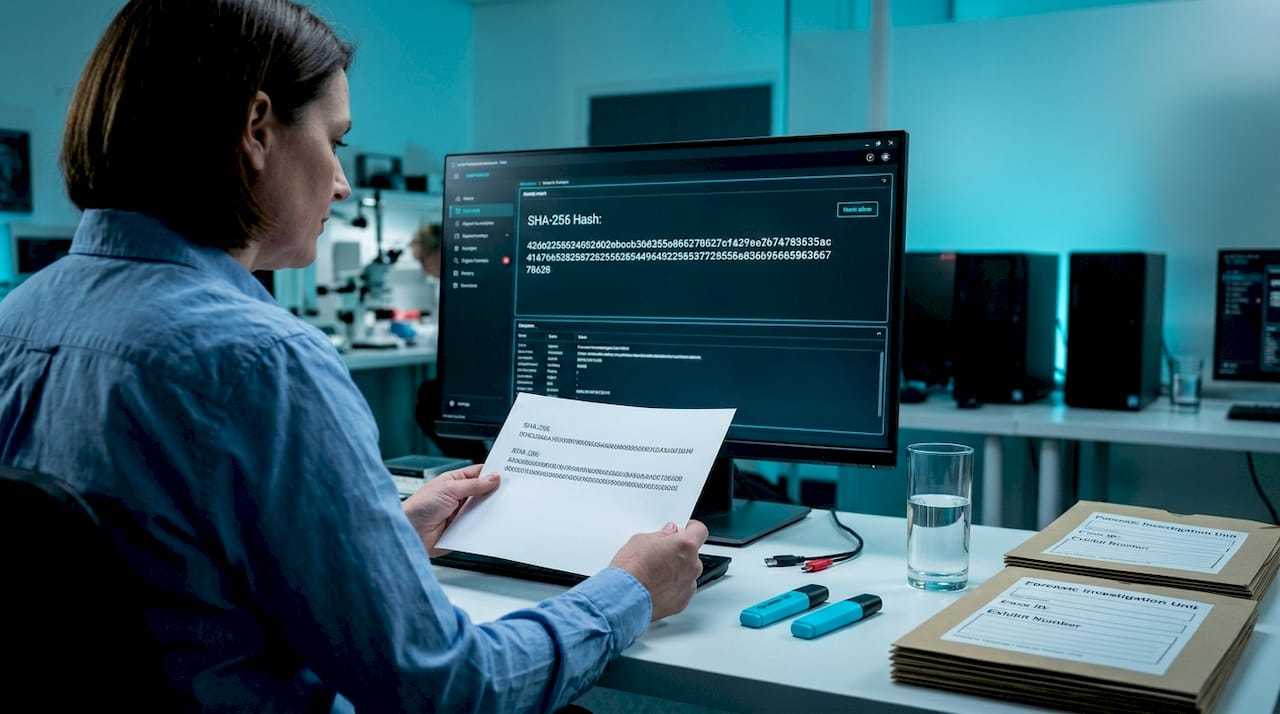
The most fundamental tool is the cryptographic hash. Before and after acquisition, forensic examiners compute hash values (typically MD5, SHA-1, or SHA-256) of both the original source and the acquired copy. Using multiple hashing algorithms reduces the risk of hash collisions, where two different data sets produce the same hash value. If the hash of the acquired image matches the original at the moment of collection, the copy is proven to be identical.
| Integrity mechanism | Purpose | When applied |
|---|---|---|
| Cryptographic hash (acquisition) | Proves copy matches original | Immediately after imaging |
| Write blocker | Prevents writes to source device | Throughout physical acquisition |
| Chain of custody documentation | Records every person who handled evidence | From collection to court |
| Tool and version documentation | Establishes forensic validity of method | During and after acquisition |
| Error logging | Records anomalies or acquisition issues | Throughout the process |
Chain of custody documentation is equally critical. Contemporaneous documentation covering unique device identifiers, tool details, hash values, personnel information, and any errors must accompany evidence through every stage of the case lifecycle. The Computerforensicslab article on chain of custody protection explains how these records directly influence forensic defensibility in legal proceedings.
Key integrity principles to follow:
- Record every individual who handles, transfers, or accesses the acquired evidence
- Store forensic images on write-protected or dedicated forensic media
- Never conduct analysis on original evidence; work only from verified copies
- Log any deviations, errors, or unexpected findings during acquisition immediately
Practitioners treat forensic images as two evidentiary layers: the original device state and the acquired working copy. Documentation must prove that the working copy matched the original at the precise time of acquisition. Without this, opposing counsel has grounds to challenge the entire evidential basis of a case.
Challenges in remote and cloud evidence acquisition
Modern investigations rarely involve sitting in front of a single local device. Remote endpoints and cloud platforms present the most significant challenges in contemporary forensic practice.
Remote endpoint acquisition requires careful scope management from the outset. The workflow follows a structured path: establish connectivity, identify data by order of volatility, perform acquisition, and verify results. Minimising changes to source data while thoroughly documenting unavoidable alterations is the central challenge. Every connection made to a remote device leaves traces, so those traces must be recorded rather than obscured.
| Challenge | Risk | Mitigation |
|---|---|---|
| Data outside legal scope encountered | Legal authority exceeded; case compromised | Halt acquisition; seek legal counsel |
| Proprietary cloud formats | Hash verification complicated | Request native format exports and provider hash |
| Volatile data loss during remote connection | Critical evidence destroyed | Prioritise RAM and active processes first |
| Multi-jurisdictional cloud data | Different legal frameworks apply | Engage specialist legal advice before acquisition |
Pro Tip: If you encounter data that falls outside the boundaries of your legal authority during remote or cloud acquisition, stop immediately. Cloud and remote scope management demands that acquisition halts and legal counsel is consulted before proceeding. Pressing on can invalidate everything you have already collected.
For cloud evidence, acquisition is inseparable from legal preservation and authority. Missteps at the legal authority stage can invalidate crucial evidence before a single byte is collected. Preservation requests must cite the correct legal basis, whether that is a production order, court order, or statutory provision. The provider’s own hash values should be obtained alongside the data and independently verified.
The importance of evidence acquisition is perhaps most apparent in cloud investigations, where the forensic examiner has no physical access to the underlying infrastructure and must rely entirely on the legal process and the provider’s cooperation to obtain defensible data.
Applying evidence acquisition principles in practice
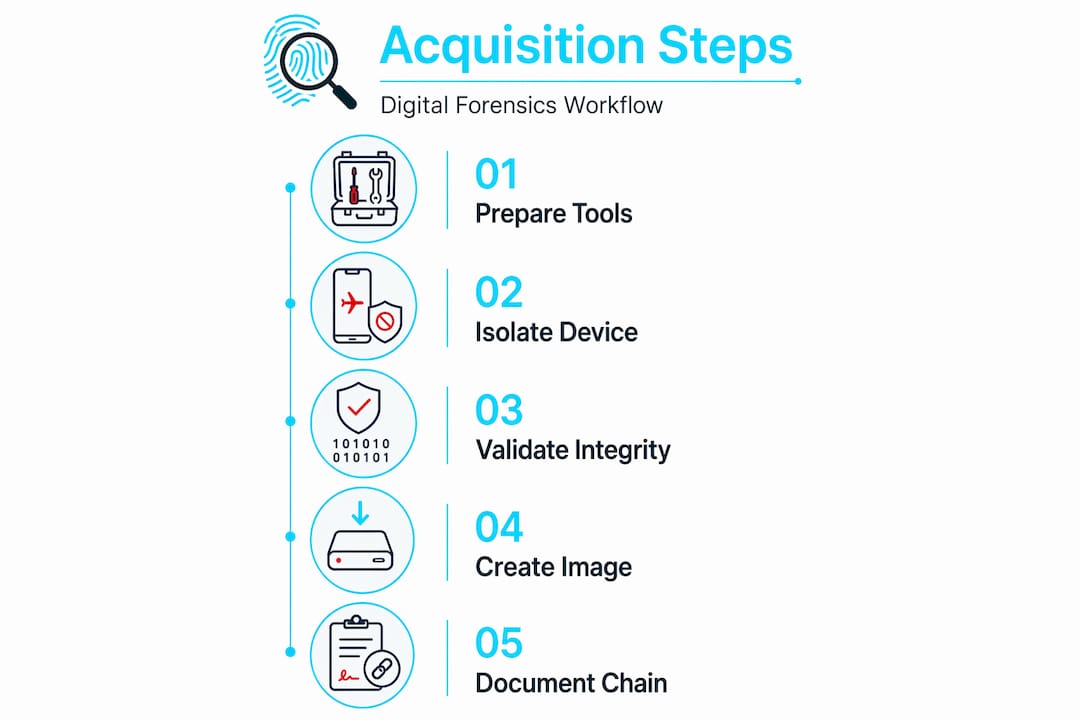
Translating principle into practice requires preparation, clear communication, and disciplined documentation. The following steps reflect the standards used by experienced forensic investigators.
-
Prepare before acquisition begins. Confirm legal authority, clarify the scope of the investigation with legal counsel, and select acquisition methods suited to the evidence types involved. Review the digital evidence checklist relevant to your case type before attending a scene.
-
Communicate with the investigative team. Investigators, legal representatives, and forensic examiners must align on priorities. Knowing which data is most likely to be relevant guides method selection and order of volatility decisions.
-
Execute acquisition with validated tools. Use only validated forensic software and hardware. Record tool names, versions, and settings in your contemporaneous notes. Capture cryptographic hashes immediately after imaging.
-
Document errors and unexpected findings immediately. If acquisition software reports read errors, logs anomalies, or flags unexpected data types, these must be recorded at the time. Proper documentation enables clear traceability and supports admissibility should errors arise at trial.
-
Store acquired evidence securely. Forensic images should be stored on write-protected media in a controlled environment, with access restricted to authorised personnel. The step-by-step evidence collection process at Computerforensicslab outlines how professional storage and handling protocols translate directly into legal robustness.
My perspective on evidence acquisition
Having worked across hundreds of digital investigations, what strikes me most is how many legal cases are compromised not by a lack of evidence, but by how that evidence was obtained. I have seen courts exclude entire datasets because an examiner skipped hash verification, or because chain of custody records had a gap that could not be explained. The technical rigour of evidence acquisition is not bureaucracy. It is the difference between a conviction and a collapsed case.
What I find increasingly concerning is how quickly cloud and remote acquisition has become standard practice, without a corresponding rise in procedural literacy among those commissioning investigations. Legal professionals who understand what forensic soundness actually requires are far better positioned to instruct examiners correctly, challenge opposing evidence effectively, and preserve chain of custody from the outset. The cases that hold up are those where someone understood what the process required before it began, not after the fact.
Modern technologies will keep evolving. The principles will not.
— Computer
Professional forensic acquisition support
When the outcome of a case depends on digital evidence, the acquisition process cannot be an afterthought. Computerforensicslab provides professional digital forensic investigations for legal professionals, law enforcement, and corporate clients across the UK, with rigorous adherence to forensic soundness, chain of custody, and legal defensibility at every stage. From physical device imaging to remote endpoint collection and cloud evidence preservation, every acquisition is conducted by accredited examiners using validated tools and comprehensive documentation. If you are managing a case where digital evidence plays a role, contact Computerforensicslab to discuss how specialist acquisition support can protect your case from the ground up.
FAQ
What is the difference between evidence acquisition and evidence collection?
Evidence collection is a broad term covering the identification and seizure of potential evidence. Evidence acquisition, in digital forensics, refers specifically to the technical process of creating a verified, forensically sound copy of digital data for analysis and legal use.
Why is hashing so important in forensic acquisition?
Cryptographic hashing produces a unique digital fingerprint of acquired data. If the hash of the forensic image matches the original at the time of collection, it proves the copy has not been altered, which is critical for legal admissibility.
Can cloud data be acquired as forensic evidence?
Yes, but it requires legal preservation requests submitted to the service provider under the appropriate statutory authority. Provider-supplied hash values must be obtained and independently verified to establish the integrity of the data.
What happens if evidence acquisition is conducted improperly?
Improperly acquired evidence risks exclusion from legal proceedings. Courts may reject data where integrity cannot be verified, chain of custody is broken, or the acquisition exceeded the legal authority granted by warrant or order.
How does the order of volatility affect acquisition decisions?
The order of volatility guides practitioners to collect the most transient data first. CPU registers, RAM, and active network connections disappear when a device is powered off, so these are prioritised before imaging persistent storage media.