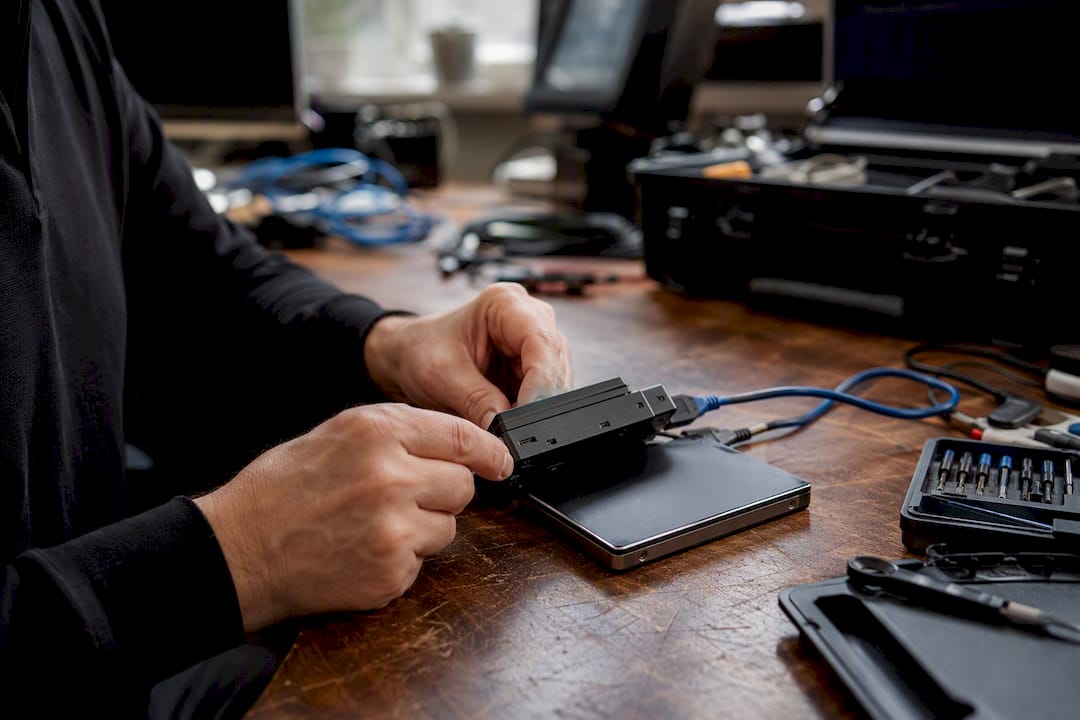
Forensic data recovery is the process of retrieving deleted, corrupted, or hidden files from digital storage media so they can serve as admissible evidence in litigation or investigation. If a device is central to a legal matter, act immediately: preserve it, avoid switching it on wherever possible, document who has handled it, and instruct a specialist forensic laboratory before anyone attempts a DIY fix.
- Definition: recovering deleted, corrupted, or hidden files as evidential material for court or investigative use.
- Immediate action: preserve the device, minimise handling, log chain of custody from the moment of discovery.
- Defensibility markers: methods aligned with NIST and SWGDE standards, examined by a Certified Digital Media Examiner or a specialist provider such as Computer Forensics Lab.
Key Takeaways
Forensic data recovery succeeds when preservation happens immediately, acquisition is hashed and documented, and the resulting report can withstand cross-examination.
| Point | Details |
|---|---|
| Definition matters | Forensic data recovery means retrieving deleted, corrupted, or hidden files as evidential material for legal use. |
| Preserve before anything else | Isolate the device, avoid powering it on, and document chain of custody from the moment of discovery. |
| Hashing proves integrity | Documented acquisition and verification hashes are the baseline any credible lab must provide. |
| Limits are real | Overwritten sectors, unbroken encryption, and severe physical damage can all block full recovery. |
| Instruct a specialist early | Computer Forensics Lab offers documented imaging, hashing, and court-ready expert witness reporting for legal and investigative instructions. |
Table of Contents
- What does forensic data recovery actually cover?
- How does the forensic data recovery process actually work?
- Why are deleted and corrupted files sometimes recoverable and sometimes not?
- What are the limits and risks of forensic recovery?
- How long does forensic data recovery take and what drives the cost?
- What should you give a lab and what should you ask first?
- What makes a forensic report defensible in court?
- Why specialist forensic labs matter more than DIY recovery
- Ready to instruct a forensic data recovery specialist?
- Which standards should you cite for methodology defence?
- Sources
What does forensic data recovery actually cover?
The discipline spans a wide range of hardware and data types, and understanding its scope helps you judge quickly whether your matter fits.
Devices commonly submitted for examination include:
- Spinning hard disk drives and solid-state drives
- USB sticks, memory cards, and camera media
- Mobile phones and tablets
- Physically damaged or water-affected media
Examiners typically look for deleted files, partially overwritten files, file system metadata, application logs, and artefacts left behind by cloud synchronisation where a local copy still exists on the device. These are the building blocks of most digital investigations.
Forensic data recovery is instructed across a broad range of legal contexts: criminal investigations, civil litigation and disclosure, employee misconduct and intellectual property theft, data breach response, and preparation for expert witness testimony. Each use case demands the same underlying discipline. Recovery must be defensible, not merely successful.
How does the forensic data recovery process actually work?
A properly run engagement follows a fixed sequence, and any laboratory proposal that skips a step deserves scrutiny.
- Evidence intake and chain of custody documentation begins the moment the device arrives.
- Scene preservation confirms the device’s condition and prevents further changes.
- Forensic acquisition and imaging creates a bit-for-bit copy of the original media.
- Verification hashing confirms the image matches the source exactly, a step NIST’s scientific foundation review identifies as standard practice for proving data integrity.
- Write-blocking ensures all further work happens on a protected working copy, never the original.
- Extraction and recovery uses file carving, file system repair, and lawful decryption where applicable.
- Analysis and correlation places recovered material into its proper context within the case timeline.
- Reporting documents findings in a form suitable for disclosure and court.
Recovery of deleted or corrupted data relies on several established techniques: file system analysis to trace deleted entries, file carving to rebuild files from raw data patterns, metadata reconstruction, and, in severe cases, physical sector-level recovery from damaged media.
Pro Tip: Ask any prospective lab for its documented acquisition hashes before you sign off on a report, and confirm explicitly whether a human examiner reviews the results or whether the findings rest entirely on automated parsing. SWGDE’s own guidance notes that automated tools do not always extract every piece of relevant metadata, so manual review often catches what software misses.
Why are deleted and corrupted files sometimes recoverable and sometimes not?
Deletion rarely erases anything outright. When a file is deleted, the file system typically just marks its storage space as available for reuse rather than wiping the underlying content, which is why data often remains recoverable until something else overwrites it. That window can close in seconds on an active system or persist for months on a rarely used drive.
Spinning hard drives and solid-state drives behave differently here. SSDs use wear-levelling and TRIM commands that can proactively clear marked space to maintain performance, which sometimes shortens the recovery window compared with older mechanical drives.
Corruption is a separate problem entirely, usually caused by file system damage, an interrupted write during a power failure, or a firmware fault. Recovery tools attempt reconstruction by reading surrounding structures and rebuilding what they can, though results vary by damage severity.
- Deletion marks space as reusable; content often survives until overwritten.
- SSD wear-levelling and TRIM can accelerate permanent loss compared with spinning disks.
- Corruption stems from file system damage, interrupted writes, or firmware faults.
Pro Tip: If you suspect a device holds evidence, document any live collection you were forced to perform before a specialist arrived. Practitioners consistently find that early preservation is the single biggest factor in successful recovery, since once sectors are overwritten, the data is usually gone for good.
What are the limits and risks of forensic recovery?
No laboratory can promise full recovery in every case, and legal teams should treat any claim that overpromises with caution. Technical ceilings include overwritten sectors, full-disk encryption without available keys, severe physical damage to storage media, obscure or proprietary firmware, and deliberate anti-forensic measures designed to frustrate examination.
There are evidential risks too, distinct from the technical ones. Recovered material can include extraneous or unrelated data conflated with genuinely relevant files, incomplete metadata that weakens provenance, and interpretive differences between examiners working from the same raw data.
There are at least 11,000 digital forensic laboratories operating in the United States alone, a scale that reflects both strong demand and inconsistent practice quality across the field. That inconsistency is precisely why NIST’s own scientific foundation review stresses that digital forensic methods, while grounded in established computer science, still carry defined limitations around missing evidence and examiner interpretation.
- Hash verification of both acquisition and working copies.
- A written methodology describing every step taken.
- An explicit limitations statement covering what could not be recovered or verified.
How long does forensic data recovery take and what drives the cost?
Timescales vary sharply by case complexity. A straightforward triage or logical recovery from an undamaged device might return results within days, while complex physical recovery involving damaged media, large-capacity drives, or encrypted volumes can extend into weeks.
Several factors lengthen both time and cost:
- Physical damage requiring clean-room or chip-off techniques
- Very large storage capacities requiring more processing time
- Encrypted data requiring lawful decryption efforts
- Manual review layered on top of automated parsing
Cost drivers mirror these factors closely: skilled labour hours, specialist equipment for physical recovery, legal deliverables such as expert reports and court attendance, and any rework triggered by an expanded scope partway through. Ask for staged deliverables. A triage estimate followed by a separate quote if escalation to physical recovery becomes necessary keeps budgets predictable and avoids surprise invoices.
What should you give a lab and what should you ask first?
Preserving evidence correctly before instruction matters as much as choosing the right laboratory afterwards.
Immediate scene preservation steps:
- Isolate the device from networks and avoid powering it on.
- Photograph the device’s physical condition and connections.
- Secure chargers, cables, and peripherals alongside the device.
- Collect passwords only where you hold lawful authority to do so.
What to provide the laboratory:
- Completed chain of custody documentation from the point of seizure.
- A clear incident timeline and defined scope of analysis.
- Confirmation of legal authority and any disclosure limits.
- Relevant case numbers or existing credentials for the matter.
Before instructing, ask suppliers directly about their evidence handling and hashing procedures, examiner qualifications, whether manual review supplements automated parsing, their standard reporting format, and their availability and fee structure for expert witness testimony. A lab that hesitates on any of these points is one to reconsider.
What makes a forensic report defensible in court?
A report that cannot withstand cross-examination is worse than no report at all, because it invites challenge on methodology rather than substance.
A defensible report typically includes the original request, evidence identifiers, the acquisition method with hashes, the specific tools and versions used, each analysis step taken, findings with clear provenance, a limitations section, and appendices containing logs and images for independent verification.
A forensic examiner’s core value lies in being able to explain methods and limitations in plain English, reproduce key steps on demand, and defend the methodology by reference to recognised standards rather than personal assertion.
Expert witnesses must be able to do exactly that under questioning, ideally citing NIST or SWGDE frameworks where relevant. Ask for a written methodology and a raw data index well before disclosure deadlines. It removes most of the surprises that otherwise surface during rounds.
Why specialist forensic labs matter more than DIY recovery
A specialised laboratory earns its fee through documented methods, accredited personnel, secure chain of custody, and reporting built to survive cross-examination, not through recovery success rates alone. Timely preservation and a clearly defined scope from the outset consistently reduce both cost and risk of failure. Computer Forensics Lab supports instructing counsel at exactly that early stage, when decisions made in the first hours often determine whether evidence remains usable months later.
Ready to instruct a forensic data recovery specialist?
Where a general IT technician might attempt a quick fix, Computer Forensics Lab works to forensic standards from the first touch, with documented imaging, verified hashes, and reporting built for disclosure and cross-examination rather than convenience. That distinction is what separates recoverable data from admissible evidence.
Our services cover forensic data recovery, documented acquisition and hashing, and full expert witness reports with court attendance where required. Sample reports and capability notes are available on request, alongside adherence to recognised chain of custody practices throughout every engagement. If a device connected to your case needs examining, request an initial triage through our digital forensic investigations team before any further handling risks the evidence.
Which standards should you cite for methodology defence?
Legal teams challenging or defending methodology should reference NIST’s scientific foundation review for the underlying evidence base, SWGDE’s evidence collection guidance for acquisition standards, and recognised examiner certifications such as Certified Digital Media Examiner for practitioner credibility.
This article is general information, not a substitute for advice from a qualified lawyer. Consult a qualified legal professional about your own circumstances before acting on anything here.