Formatted hard drives can often yield recoverable artefacts, but only when the device is preserved immediately and processed using validated forensic methods. Legal and investigative teams should treat a formatted drive as potential evidence: stop using it, log custody, and instruct a forensic lab to image and examine it under standards such as ISO/IEC 27037 and NIST guidance, as practised by Computer Forensics Lab.
TL;DR:
- Formatting rewrites the file system metadata but often leaves underlying data recoverable unless overwritten by subsequent drive activity.
- Immediately after discovery, isolating the device, documenting its state, and acquiring a bit-for-bit image are crucial to maximize evidence preservation.
- SSDs’ TRIM and garbage collection routines significantly limit recovery chances for overwritten data compared to traditional spinning drives.
- Proper chain-of-custody, verified hashing, and storage in standard formats are essential to uphold legal admissibility of recovered digital evidence.
- Validated forensic methods, transparent limitations, and detailed documentation determine whether recovered data can be used in court.
Table of Contents
- Defensible workflow: first actions and acquisition priorities
- Forensic recovery techniques for formatted drives: what works and why
- Evidence handling, hashing, storage formats and retention
- Method validation, limitations and how courts weigh recovered data
- When to instruct a forensic lab and what to include in instructions
- Practical perspective from Computer Forensics Lab
- How Computer Forensics Lab can help and how to instruct us
- Sources
- FAQ
Defensible workflow: first actions and acquisition priorities
The period immediately after formatting is discovered determines how much evidential value survives. Every action taken before a forensic examiner arrives either preserves or erodes recoverability, so the sequence matters as much as the intent.
- Photograph the device and its surroundings, noting serial numbers, visible damage, and the circumstances in which it was found.
- Isolate the device from power and network connections where this can be done safely, to prevent remote wiping or automated processes from altering the contents.
- Stop all further use of the drive; even a brief boot cycle can write to the disk and overwrite recoverable sectors.
- If seizure is not possible, for example on a live production server, document the reason and the alternative steps taken instead.
- Apply a hardware write-blocker, or use a validated live-acquisition method, before any data is touched.
- Acquire a bit-for-bit image as early as practicable, since imaging captures unallocated space that holds the remnants of formatted files.
- Record the tool name and version, the hash algorithm used, the examiner’s identity, timestamps, and any errors or verification results from the acquisition.
- Seal and store a Master Copy of the image, then create Working Copies for all subsequent analysis, logging every transfer between people or locations.
This structure mirrors the approach set out in our guide to recovering data from hard disks for legal admissibility, which covers documentation and imaging in more depth.
Pro Tip: Never connect a formatted drive to a personal laptop “just to check” what is on it; that single action can overwrite the very sectors a forensic examiner needs.
Forensic recovery techniques for formatted drives: what works and why
Formatting rewrites the file allocation table or equivalent metadata structure rather than erasing the underlying data immediately, which is why recovery is often possible. The technique chosen depends on the drive’s condition and the type of formatting applied.
- Logical recovery works from a forensic image and includes scanning unallocated space, file carving based on known file signatures, and reconstructing metadata to rebuild file names and timestamps.
- Physical recovery is reserved for damaged media and covers platter or head repairs, cleanroom operations, and chip-off extraction when the drive cannot be read through standard interfaces, as detailed in our damaged hard drive evidence recovery guidance.
- Quick format versus secure overwrite matters enormously: a quick format leaves data largely intact until overwritten. In contrast, a secure overwrite or multiple-pass wipe is designed specifically to defeat recovery.
- SSD behaviour differs from spinning media because TRIM and garbage collection routines actively clear marked blocks, which NIST’s scientific foundation review notes makes quick recovery of overwritten SSD data unlikely compared with a traditional hard drive.
A key data point for legal teams: NIST IR 8354 confirms that deleted-data recovery is genuinely possible but carries risks of incompleteness and extraneous material, which is precisely why imaging the entire drive, rather than extracting only the files that appear relevant, preserves the unallocated space needed for proper analysis.
Recovered items, whether documents, images, email fragments, or deleted registry entries, are artefacts that require interpretation. A recovered file fragment is not automatically proof of use, access, or intent; that inference belongs to the examiner’s report and, ultimately, to the court. Typical evidence recoverable from a formatted drive includes deleted documents, browser history remnants, email artefacts, and partial database records, depending on how much of the disk has been overwritten since formatting.
Evidence handling, hashing, storage formats and retention
Legal teams should know exactly what documentation to demand before instructing or accepting a report, because the paperwork around the recovery often matters as much as the recovery itself.
- A proper chain-of-custody package records the device’s identifiers, every transfer between handlers, the hash values generated at acquisition, detailed acquisition notes, and the access controls applied to the stored image.
- Hashing should use NIST-approved algorithms, and the resulting hash values should be stored separately from the image itself and generated as close to the point of collection as possible, as recommended in NIST IR 8387.
- Master Copies and Working Copies are typically stored in formats such as E01 or raw dd images; when a proprietary format is used, the acquisition software itself should be preserved so the image remains readable years later.
- When a hash comparison fails during verification, the lab should document every attempt made to explain the discrepancy and retain other copies rather than discarding the affected image.
This approach follows the UK’s Digital Imaging and Multimedia Procedure, which sets out Master and Working Copy practice in detail; our own data recovery workflow for legal evidence page expands on storage and retention choices.
Pro Tip: Ask any lab, including your own instructed expert, to confirm in writing which hash algorithm was used and when it was generated, not just what the final hash value is.
Method validation, limitations and how courts weigh recovered data
Courts do not simply accept that a tool produced a result; they weigh whether the method used was validated and fit for the purpose it was applied to. The Forensic Science Regulator’s 2024 guidance is explicit that a hash alone is not determinative of admissibility and that validation evidence should accompany any report relied upon in proceedings.
- Request the tool name and version, records of validation testing, and the quality controls applied during the examination.
- Common limitations include incomplete recovery, fragments from different files becoming mixed together, firmware or TRIM effects on SSDs, and proprietary formats that complicate future access.
- Examiners must separate what was directly observed on the disk from any interpretation drawn from it, and document areas of uncertainty explicitly in the report rather than implying certainty.
- Admissibility rules vary by jurisdiction, so specific questions about whether recovered data will be accepted in a given court should go to a qualified legal adviser.
When to instruct a forensic lab and what to include in instructions
Certain circumstances make specialist instruction necessary rather than optional: active or anticipated litigation, any risk of spoliation, physical damage to the drive, encryption, or a device that must remain live during examination.
- State the legal context and the deadline by which preservation or reporting is required.
- Provide any lawfully obtained account details or passwords relevant to the device.
- Define the scope of examination and the outputs needed, whether that is a triage report, a full technical report, or expert witness attendance.
A properly instructed lab will typically deliver a triage assessment, a forensic image, extraction of relevant artefacts, a technical report with hash values, and availability for expert witness work where required. Our forensic data recovery process guide sets out this sequence step by step. Solicitors preparing instructions may also find it useful to understand how a single missing signature can undermine chain-of-custody evidence before a case reaches disclosure.
Practical perspective from Computer Forensics Lab
Most instructing solicitors assume either that formatted data is gone for good or that any recovered file is automatically admissible. Neither is reliably true. Recoverability depends on timing, drive type, and what has happened to the device since formatting, and admissibility depends on validated method and honest disclosure of limitations, not on the mere existence of a recovered file. Expect a realistic turnaround that reflects triage, imaging, and verification rather than instant results.
— Computer
How Computer Forensics Lab can help and how to instruct us
Professional digital forensics providers offer Forensics Data Recovery, Advanced Data Recovery, Digital Evidence Acquisition, Analysis and Reporting, and Expert Witness Provision and Presentation, built around sound chain-of-custody practices. Where a drive has sustained physical damage rather than a simple format, specialist computer forensics services may extend to cleanroom and repair-based recovery.
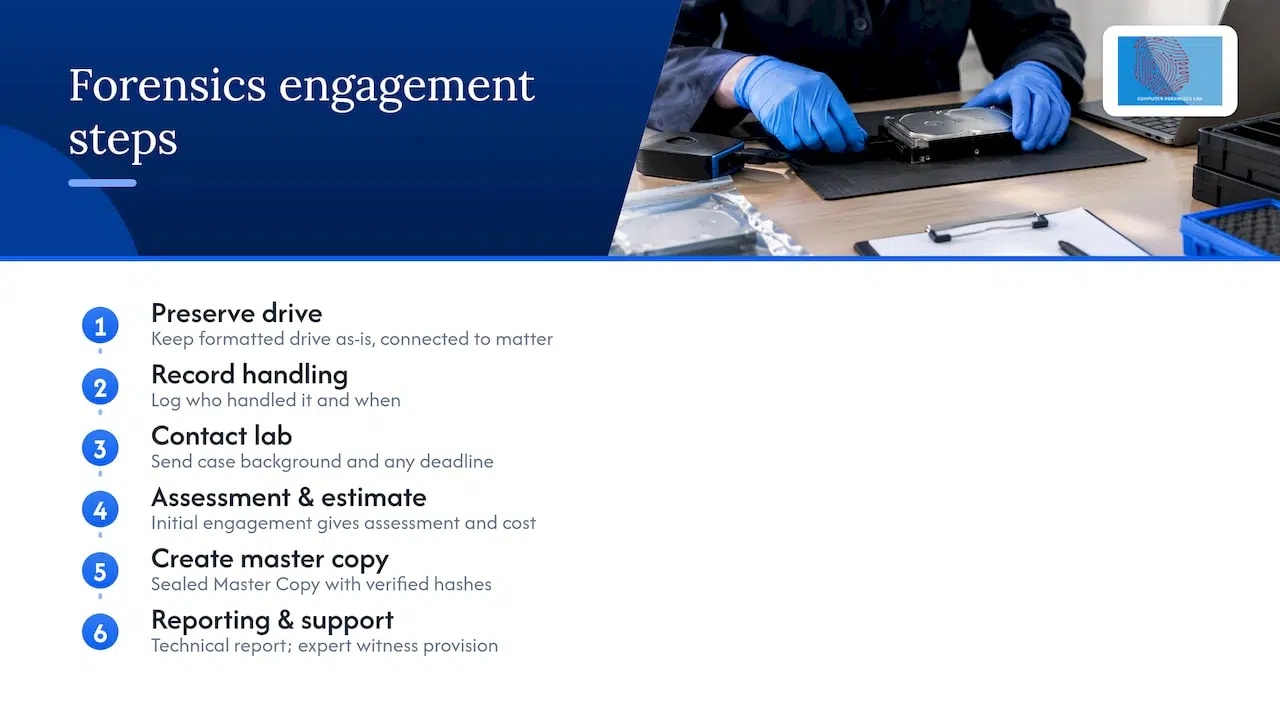
If you are holding a formatted drive connected to a live or anticipated matter, preserve it now, record who has handled it and when, and contact us with the case background and any deadline. An initial engagement typically delivers an assessment and estimate, a sealed Master Copy with verified hashes, and a technical report suitable for disclosure or litigation, depending on the forensic provider. Get in touch with Computer Forensics Lab to discuss your case, or review our full specialist computer forensics services for a detailed breakdown of what each engagement covers.
Sources
- ISO/IEC 27037:2012
- NIST imaging and acquisition guidance (SWGDE/NIST resources)
- Digital Evidence Preservation: Considerations for Evidence Handlers (NIST IR 8387)
- Digital investigation techniques: a NIST scientific foundation review (NIST IR 8354)
FAQ
Can data really be recovered after a hard drive is formatted?
Often, yes, because formatting typically rewrites the file allocation structures rather than erasing the data immediately. Recoverability depends on how much the drive has been used since formatting and whether the underlying sectors have been overwritten, as explained in NIST’s scientific foundation review.
What is the first thing I should do if a formatted drive might be evidence?
Stop using the device immediately and avoid connecting it to any computer for casual checking. Document the device, its condition, and the circumstances of discovery, then contact a forensic lab to arrange preservation and imaging under ISO/IEC 27037 principles.
Does quick formatting affect recovery differently to a secure wipe?
Yes, a quick format generally leaves the underlying data largely intact until it is overwritten, whereas a secure overwrite or multiple-pass wipe is specifically designed to prevent recovery. This distinction significantly affects how much a forensic examination can retrieve.
Will recovered data automatically be accepted as evidence in court?
No single recovered file is automatically admissible; courts weigh whether the recovery method was validated and whether limitations were properly disclosed, as set out in the Forensic Science Regulator’s 2024 guidance. Admissibility rules vary by jurisdiction, so case-specific questions should go to a qualified legal adviser.
What does Computer Forensics Lab provide during a recovery instruction?
Computer Forensics Lab provides Forensics Data Recovery and Advanced Data Recovery services, including imaging, hashing, chain-of-custody documentation, and technical reporting suitable for litigation. Expert Witness Provision and Presentation is also available where a case requires testimony on the findings.