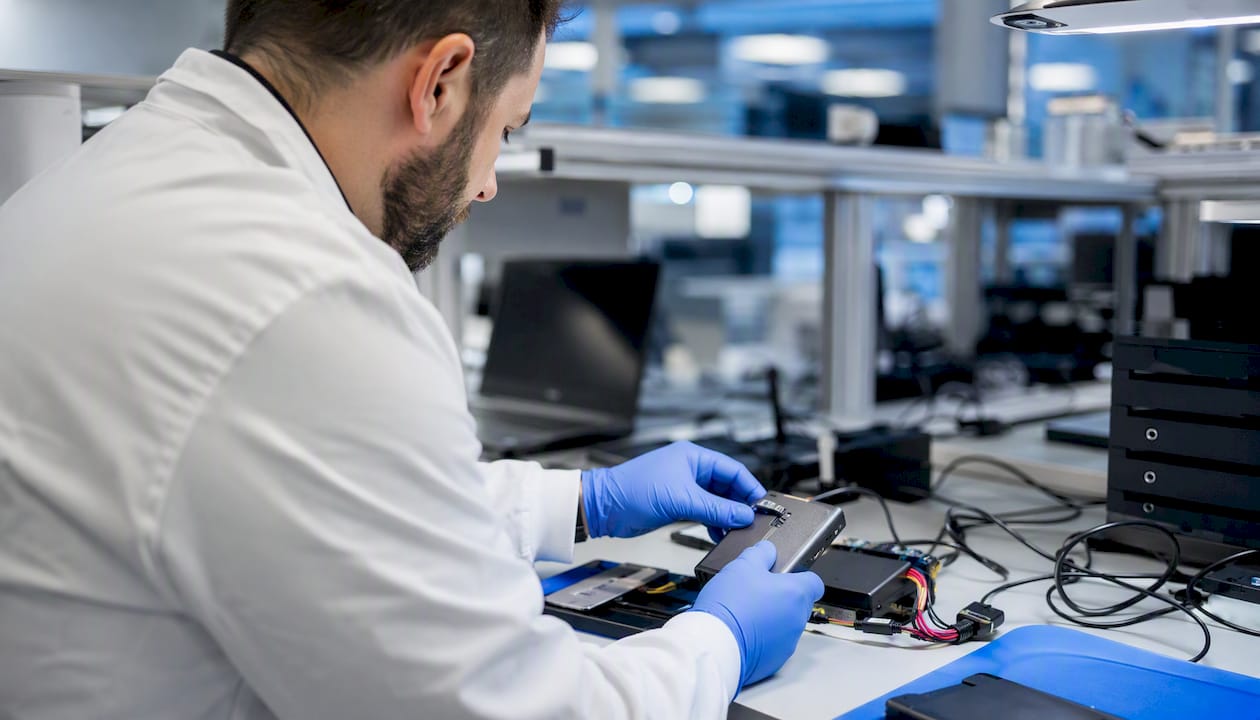
Cybercrime investigators find, preserve and analyse digital evidence so that crimes can be prosecuted, civil disputes resolved, or organisational harm contained. The role sits at the intersection of law enforcement procedure, technical forensics and legal process, and it is formally defined by frameworks such as the NICE/CISA work-role standard, which describes the function as a systematic cycle of scene assessment, evidence identification, forensic collection, analysis and formal reporting. Practitioners operate across law enforcement agencies, corporate security teams and private laboratories such as Computerforensicslab, tackling case types that range from ransomware and phishing to supply-chain compromise, as catalogued in the ENISA Threat Landscape 2023.
The core activities, in brief, are:
- Scene assessment and triage — determining what devices and data sources are relevant
- Evidence identification and preservation — securing items before they are altered or lost
- Forensic acquisition — creating verified, write-protected copies of storage media and memory
- Analysis and correlation — reconstructing events from artefacts, logs and metadata
- Reporting and legal handover — producing court-ready documentation and supporting prosecution
Key takeaways
Cybercrime investigators find, preserve and analyse digital evidence to support prosecution, civil litigation or organisational incident response, operating under strict legal and procedural constraints at every stage.
| Point | Details |
|---|---|
| Core function | Investigators manage the full case cycle: triage, evidence acquisition, analysis, reporting and legal handover. |
| Legal rigour is non-negotiable | Chain of custody, warrant specificity and forensic imaging standards determine whether evidence is admissible. |
| Role distinctions matter | Investigators manage cases and legal outcomes; forensics specialists handle technical extraction; incident responders focus on containment. |
| Career entry routes | Degrees in forensic computing or cybersecurity, combined with certifications such as GCFA or EnCE, are the most direct paths into the role. |
| Computerforensicslab | Provides accredited digital forensic investigations, expert witness reports and evidence collection for legal teams, law enforcement and businesses. |
Table of Contents
- What do cyber crime investigators do day to day?
- How does a cybercrime investigation actually proceed?
- Which tools and techniques do investigators rely on?
- What skills does an effective investigator need?
- What qualifications and career path lead into this role?
- Where do investigators work and who do they work with?
- What are the legal responsibilities around evidence handling?
- How does a cybercrime investigator differ from a digital forensics specialist?
- When should you hire a professional digital forensics firm?
- A practitioner’s view of the role
- Computerforensicslab: professional digital forensics for legal and corporate clients
- Sources
What do cyber crime investigators do day to day?
The daily workload of a cybercrime investigator is rarely uniform. A morning may begin with reviewing overnight alerts from a corporate SIEM, while the afternoon is spent preparing a witness statement for a fraud prosecution. The NICE/CISA framework identifies the principal responsibilities as evidence collection, forensic analysis and formal reporting, but practitioners consistently add that non-technical duties consume a significant share of their time.
Typical responsibilities include:
- Incident triage — assessing the scope and urgency of a reported breach or offence, categorising it by severity and allocating resources accordingly
- Evidence identification and preservation — locating relevant devices, accounts and data sources, then securing them before data can be overwritten or remotely wiped
- Forensic imaging — producing bit-for-bit copies of storage media using write-blocking hardware to prevent any modification of the original
- Log and network analysis — examining firewall logs, authentication records and packet captures to reconstruct attacker behaviour
- Malware examination — identifying malicious code, understanding its function and tracing its origin where possible
- Interview and statement work — speaking with witnesses, system owners and suspects, then recording findings in legally defensible form
- Chain-of-custody documentation — recording every handling step so that evidence integrity can be demonstrated in court; see Computerforensicslab’s guidance on preserving chain of custody for the procedural detail
- Court report preparation and expert testimony — translating technical findings into language a judge or jury can follow
Time-sensitive tasks, particularly volatile-data capture and device containment, demand immediate action. Documentation work, by contrast, is methodical and ongoing throughout a case.
How does a cybercrime investigation actually proceed?
The IACP Cyber Center describes cybercrime investigation as a multidisciplinary process that pairs traditional investigative questioning (who, what, when, where, why, how) with technical artefact analysis. In practice, cases follow a recognisable sequence, though the depth of each phase varies with complexity.
- Initial report and triage — the investigator receives a complaint or alert, confirms that a crime or policy violation has likely occurred and decides whether immediate containment is needed.
- Scene preservation — physical or virtual access to affected systems is controlled; devices are isolated from networks to prevent remote wiping or further compromise.
- Legal authority — warrants or other lawful authorisations are obtained before any search or analysis begins. Seizing a device to prevent evidence loss is legally distinct from searching it; UK legislation and equivalent national codes set the boundaries for each step.
- Forensic acquisition — write-blocking hardware is attached and forensically sound images are created, with cryptographic hash values recorded to prove integrity. Volatile data (RAM contents, active network connections) is captured first, before any shutdown.
- Analysis and correlation — the investigator or a specialist examines the image: recovering deleted files, building timelines, correlating log entries and identifying indicators of compromise. Recorded Future’s incident-response guidance outlines how this phase maps artefacts to a coherent narrative.
- Specialist escalation — complex malware, encrypted volumes or cross-border data may require specialist support from a forensic laboratory, a cloud provider’s legal team or an international law-enforcement partner.
- Reporting and handover — findings are compiled into a formal report, with methodology, tool versions and chain-of-custody records documented so that conclusions withstand cross-examination. The report is handed to prosecutors, legal counsel or the commissioning organisation.
Low-complexity cases (a single device, a clear offence) may move from triage to report in days. Multi-jurisdictional investigations involving encrypted infrastructure can run for months, with analysis and legal coordination as the most resource-intensive phases. For a detailed breakdown of the cybercrime investigation steps for legal cases, Computerforensicslab provides practitioner-level guidance.
Which tools and techniques do investigators rely on?
Investigators draw on a layered toolkit, selecting instruments appropriate to the device type, operating system and nature of the alleged offence.
| Tool category | Representative examples | Primary use |
|---|---|---|
| Forensic imaging | EnCase, FTK Imager, Autopsy | Bit-for-bit disk and memory acquisition |
| Mobile extraction | Cellebrite UFED, MSAB XRY | Data recovery from smartphones and tablets |
| Network and log analysis | Wireshark, Splunk, Elastic SIEM | Traffic capture, log correlation, timeline building |
| Malware analysis | Cuckoo Sandbox, Any.run, IDA Pro | Behavioural and static malware examination |
| OSINT and blockchain | Maltego, Chainalysis | Attribution, financial tracing, open-source intelligence |
| Cloud forensics | Native provider APIs, Magnet AXIOM | Extraction of cloud-stored data under legal process |
Beyond the tools themselves, the techniques that define professional practice include:
- Disk and memory imaging with cryptographic verification (MD5/SHA-256 hashes)
- Timeline analysis — correlating file system timestamps, log entries and registry artefacts to reconstruct a sequence of events
- Log correlation across multiple sources to identify lateral movement or data exfiltration
- Malware reverse engineering at a basic level (dynamic sandboxing, string extraction) to characterise threat behaviour
- OSINT — open-source intelligence gathering to identify actors, infrastructure or financial flows
- Blockchain analytics for cryptocurrency-linked offences such as ransomware payments
NIJ practitioner guidance stresses that tool versions, command lines and timestamps must all be documented so that findings are reproducible and admissible.
Pro Tip: Capture volatile data — RAM contents and active network connections — before powering down any suspect system. Once a machine is switched off, that data is gone permanently. A live acquisition takes minutes; recovering from its absence can take weeks of additional analysis.
What skills does an effective investigator need?
Technical proficiency is necessary, but investigators who progress to senior roles consistently demonstrate a combination of analytical rigour and clear communication.
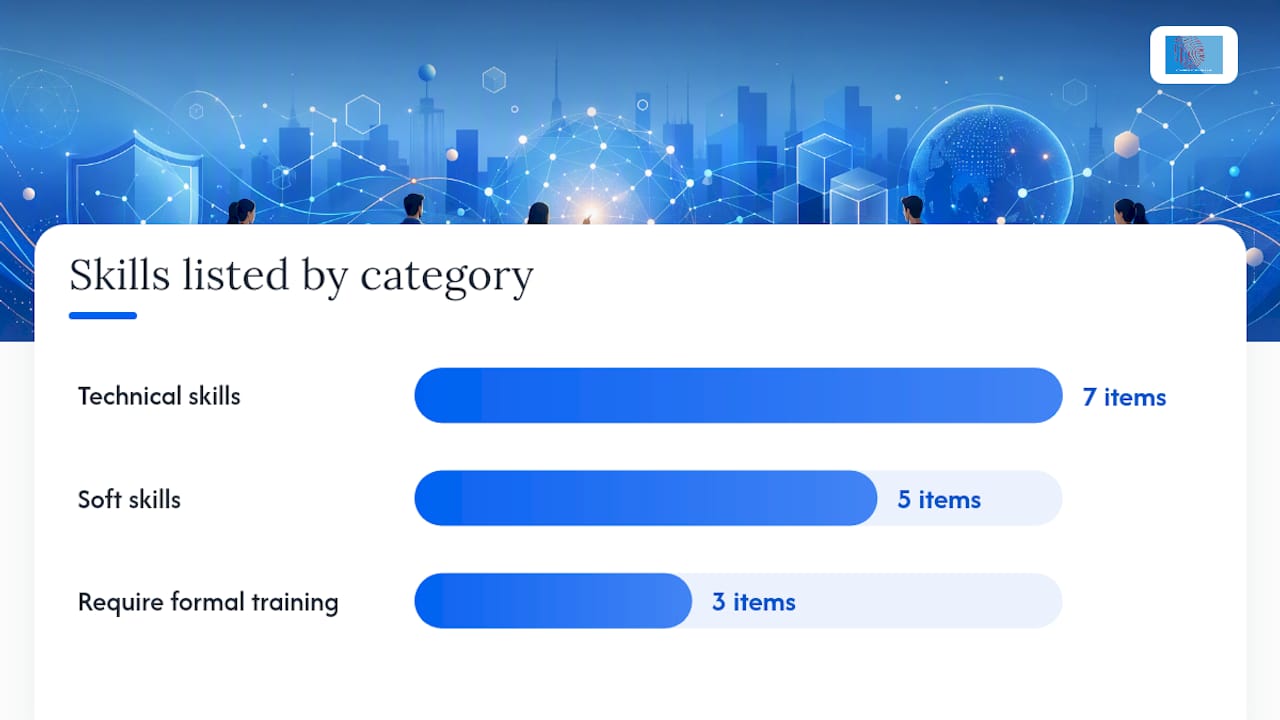
Technical skills:
- Solid grounding in operating systems (Windows, Linux, macOS) and their artefact locations (registry, event logs, prefetch files)
- Understanding of file systems (NTFS, ext4, APFS) and how deletion and overwriting actually work at a low level
- Networking fundamentals: TCP/IP, DNS, HTTP, VPN protocols and how traffic is captured and interpreted
- Scripting ability (Python, PowerShell or Bash) to automate repetitive analysis tasks
- Memory forensics: extracting process lists, network connections and encryption keys from RAM images
- Cloud forensics: understanding data residency, provider APIs and the legal process for obtaining cloud records
- Familiarity with at least one major forensic suite and the ability to validate findings independently
Soft skills and professional competencies:
- Investigative reasoning structured around the classic who/what/when/where/why/how framework, as the IACP emphasises
- Report writing that is precise, jargon-free and structured for a legal audience
- Expert witness capability: the ability to present findings clearly under cross-examination without overstating certainty
- Stakeholder communication with solicitors, prosecutors, HR departments and senior management
- Project and case management: tracking multiple exhibits, deadlines and legal obligations simultaneously
Most technical skills can be developed progressively on the job. Memory forensics, cloud extraction and expert witness work typically require formal training or certification before an investigator is trusted to handle them independently.
What qualifications and career path lead into this role?
There is no single mandatory qualification, but employers consistently look for a combination of academic grounding, industry certification and demonstrable practical experience.
Entry routes:
- Degree-level study in computer science, cybersecurity, forensic computing or information security provides the strongest academic foundation and is preferred by many law-enforcement and corporate employers
- Non-degree routes include higher apprenticeships in cyber security, transferable experience from IT support or network administration, and prior service in policing or the armed forces with a technology specialism
- Self-study and bootcamps can supplement either route, particularly for candidates building a portfolio of practical skills
Key certifications and what they signal:
- GCFA (GIAC Certified Forensic Analyst) — demonstrates hands-on competence in host-based forensic analysis and incident response
- EnCE (EnCase Certified Examiner) — validates proficiency with EnCase, one of the most widely used forensic platforms in law enforcement
- CISSP (Certified Information Systems Security Professional) — signals broad security management knowledge; valued at senior and consultancy levels
- NICE/CISA work-role alignment — increasingly used by public-sector employers to map roles and required competencies to a common framework
Typical career progression:
| Stage | Role | Focus |
|---|---|---|
| Entry | Junior forensic analyst / apprentice | Tool operation, evidence handling, supervised casework |
| Mid-level | Incident responder / digital investigator | Independent case management, report writing, court attendance |
| Senior | Senior investigator / forensic consultant | Complex cases, expert testimony, team leadership, policy input |
Salary and demand vary by sector and geography, but the discipline is broadly regarded as a growth area given the sustained rise in cybercrime volume and sophistication.
Where do investigators work and who do they work with?
Cybercrime investigators are employed across a wide range of organisations, and the priorities of the role shift considerably depending on the setting.
Common employers:
- Law enforcement units — dedicated cybercrime teams within national police forces, regional organised crime units and agencies such as the FBI, which emphasises public-private partnership as central to tackling transnational cybercrime
- Corporate incident response and security teams — in-house investigators who handle breaches, insider threats and intellectual property theft
- Private digital forensics firms and specialist consultancies — organisations such as Computerforensicslab that serve legal teams, businesses and private clients requiring independent, accredited analysis
- Government and intelligence agencies — national cyber agencies and signals intelligence bodies with classified remits
Key collaborators:
- Prosecutors and solicitors who need evidence packaged in legally admissible form
- IT and information security teams who manage the affected infrastructure
- External forensic laboratories providing specialist analysis
- Cloud service providers whose legal teams process data-preservation requests
- International law-enforcement partners, coordinated under frameworks such as the Budapest Convention, which governs cross-border evidence sharing
Public-sector investigators operate under statutory powers and are primarily accountable to the criminal justice system. Private-sector practitioners work under contractual obligations to clients, with confidentiality and commercial considerations shaping how findings are disclosed. Both settings demand the same standard of evidence integrity; the audience for the final report differs.
What are the legal responsibilities around evidence handling?
Evidence that cannot be shown to have been collected and preserved lawfully will not be admitted in court, regardless of how compelling it appears technically. This is the reason procedural rigour is treated as non-negotiable in professional practice.
Core legal principles include:
- Chain of custody — every person who handles an exhibit must be recorded, with timestamps and reasons documented; Computerforensicslab’s complete guide to digital forensics chain of custody sets out the procedural requirements in detail
- Warrant specificity — a warrant to search a device for one offence does not automatically authorise searching it for a different offence on the same device; investigators must obtain separate legal authority for each distinct allegation
- Seizure versus search — seizing a device to prevent evidence loss is a legally distinct act from analysing its contents; both require appropriate authority under applicable legislation
- Data-protection obligations — UK data-protection guidance requires that personal data accessed during an investigation is handled lawfully, with access limited to what is necessary and proportionate
- Forensic imaging standards — original media must not be altered; write-blocking hardware and verified forensic images are the accepted method of ensuring the original remains pristine
- Extraction codes of practice — UK government guidance on extraction of information from electronic devices sets procedural standards for lawful data access
Pro Tip: When preparing an expert witness report, document not just what you found but exactly how: tool name and version, command syntax, timestamps and hash values at every stage. A defence barrister will probe methodology as vigorously as conclusions, and reproducibility is the only defence against a challenge to admissibility.
How does a cybercrime investigator differ from a digital forensics specialist?
The two roles are closely related and frequently confused, yet they carry distinct responsibilities that become clearer as organisations grow and specialise.
A cybercrime investigator manages the case from first report to legal handover. They decide what evidence is needed, obtain legal authority to collect it, liaise with prosecutors and legal counsel, conduct or oversee interviews, and produce the final report. Their primary accountability is to the legal outcome of the case.
A digital forensics specialist focuses on the technical extraction and validation of evidence within the laboratory environment. They operate forensic tools, interpret artefacts, and produce technical findings that the investigator then contextualises within the broader case narrative. As the University of West Florida’s practitioner analysis notes, specialists supply the technical evidence while investigators manage the case and decide what evidence is needed for prosecution.
An incident responder, by contrast, is primarily concerned with containment and service restoration. Their goal is to stop the bleeding, not to build a prosecution case, and their actions may inadvertently compromise evidence if forensic considerations are not built into the response plan from the outset.
In smaller teams and private practice, one person often performs all three functions. On a CV, it is worth distinguishing between case-management and legal-liaison experience (investigator) and hands-on tool operation and artefact analysis (forensics specialist), since employers recruit for each separately at senior levels.
When should you hire a professional digital forensics firm?
Certain scenarios consistently exceed what an in-house team or a generalist IT department can handle reliably, and the consequences of procedural error in those situations are severe.
Situations that warrant professional laboratory engagement:
- Legal proceedings where evidence must withstand cross-examination and chain-of-custody challenges
- Complex malware incidents requiring reverse engineering beyond basic sandboxing
- Cross-jurisdictional matters involving cloud data held by overseas providers
- Insider threat investigations where the integrity of the process must be demonstrably independent
- Regulatory investigations where an accredited, documented methodology is required by the regulator
What a professional laboratory delivers differently:
- Accredited processes — validated procedures that satisfy court and regulatory standards
- Controlled forensic environments — dedicated hardware and software configurations that prevent contamination
- Expert witness reports — formal documentation structured for legal proceedings, with reproducible methodology
- Independent verification — findings produced by a party with no stake in the outcome of the investigation
Consider a scenario where a business suspects a departing employee has exfiltrated client data to a competitor. An internal IT team may identify suspicious file transfers, but without forensically sound imaging, documented chain of custody and an independent expert report, that evidence is unlikely to survive a civil disclosure challenge. A professional laboratory such as Computerforensicslab would acquire the relevant devices under controlled conditions, produce verified forensic images, analyse the data exfiltration artefacts and deliver a report suitable for use in employment tribunal or High Court proceedings.
A practitioner’s view of the role
The work rarely follows a predictable pattern. A case that begins as a routine phishing complaint may reveal a months-long intrusion once log analysis begins; a device submitted for a straightforward data-recovery request may contain evidence of a separate, more serious offence. Attention to detail is not optional in this discipline: a single mislabelled exhibit or an undocumented handling step can unravel weeks of analysis in court. The satisfaction, when it comes, is specific: seeing a well-constructed evidence chain support a prosecution, or watching a business recover from a breach because containment was swift and the forensic record was clean. Teams working under that kind of pressure develop a particular discipline around documentation and methodology that becomes second nature.
Computerforensicslab: professional digital forensics for legal and corporate clients
When a case demands independent, court-ready analysis, Computerforensicslab provides the full range of digital forensics services that legal teams, law enforcement, businesses and private clients require. The laboratory handles digital forensic investigations, mobile and cloud data extraction, malware analysis, data breach investigation and expert witness report preparation, all under documented chain-of-custody procedures.
To begin an enquiry, contact Computerforensicslab with a brief description of the device types involved, the nature of the alleged offence or dispute, and any relevant deadlines (court dates, regulatory response windows). The team will confirm scope and turnaround at initial contact. For cases already in litigation, the laboratory can advise on evidence preservation steps to take before formal instruction. Start by reviewing the digital forensic investigations service page, or contact the team directly to discuss your case.
Sources
Readers seeking deeper policy, technical or legal guidance will find the following authoritative references useful:
- Cybercrime Investigation NICE Framework Work Role | NICCS
- Gov
- ENISA threat landscape 2023
- FBI — cyber investigations
- Legislation
Jurisdiction-specific rules on admissibility, search powers and data-protection obligations vary considerably. Always verify the applicable national legislation and codes of practice for the jurisdiction in which a case will be heard before commencing any investigative action.