TL;DR:
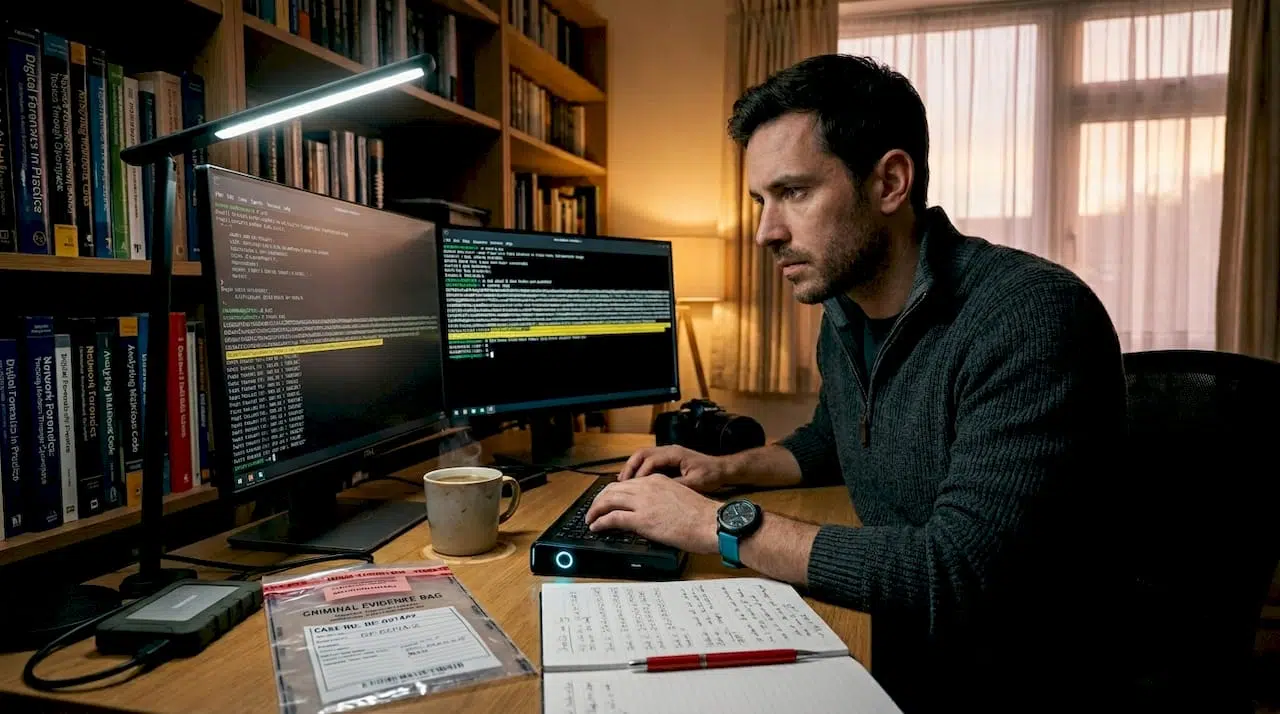
- Hashing generates unique digital fingerprints to verify data integrity and prevent evidence tampering. It forms the backbone of forensic workflows, ensuring each step—from acquisition to courtroom presentation—is documented and verifiable. Relying solely on hashes without proper procedural documentation compromises their legal value and admissibility.
Hashing is the process of generating a unique digital fingerprint of data to verify its integrity and authenticity, and the role of hashing in digital forensics is to prove, beyond reasonable doubt, that evidence has not been altered from the moment of acquisition to the point of courtroom presentation. Every byte of a forensic image, every file extracted from a seized device, every piece of digital evidence submitted in legal proceedings depends on this mechanism. Algorithms such as SHA-256, developed and recommended by the National Institute of Standards and Technology (NIST), produce fixed-length outputs that change entirely if even a single bit of the underlying data is modified. For legal and technical professionals, understanding how hash functions operate within structured forensic workflows is not optional. It is the foundation of defensible, admissible digital evidence.
How does hashing ensure data integrity in forensic investigations?
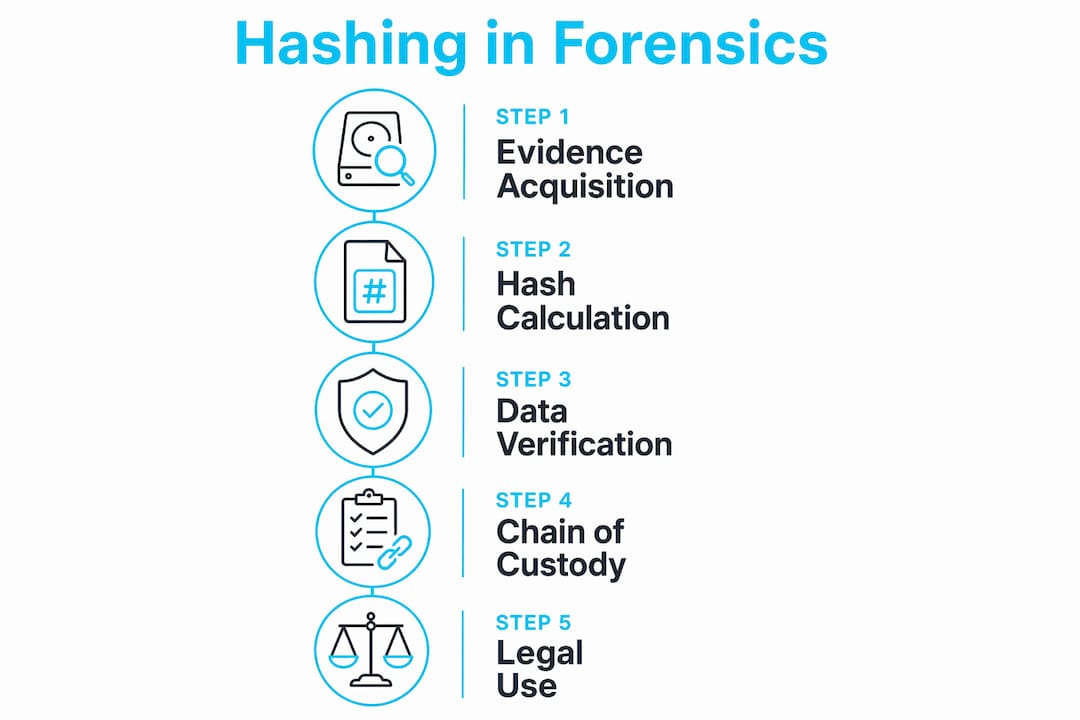
Hash values are computed at every stage of digital evidence handling to verify integrity and support a defensible chain of custody. This means that from the moment a device is seized, a forensic examiner generates a hash of the original media before any analysis begins. If the hash computed after analysis matches the original, the evidence is provably unaltered.
The process follows a structured sequence:
- Acquisition. The examiner creates a bit-for-bit forensic image of the original storage media using tools such as FTK Imager or Cellebrite. A SHA-256 hash is computed for both the original and the copy simultaneously.
- Verification. The two hash values are compared. A match confirms the forensic copy is identical to the source. Any discrepancy signals a problem that must be resolved before the investigation proceeds.
- Transfer. When evidence moves between custodians, the hash is recalculated and recorded. Recalculation at every custody transfer is critical to detect alterations and maintain credibility in court.
- Analysis. Examiners work exclusively on the verified copy, never the original. The hash of the working copy is checked again before any findings are documented.
- Presentation. Hash records accompany the evidence report, giving legal counsel and the court a verifiable audit trail.
ISO/IEC 27037 specifies the creation of bit-for-bit forensic copies verified using cryptographic hashes to preserve original evidence integrity. This international standard, alongside NIST guidelines, formalises what practitioners already know from experience: undocumented hashing is worthless in court.
Pro Tip: Always record hash values in a contemporaneous log with timestamps, the name of the tool used, and the operator’s identity. A hash value without this context carries significantly less weight under cross-examination.
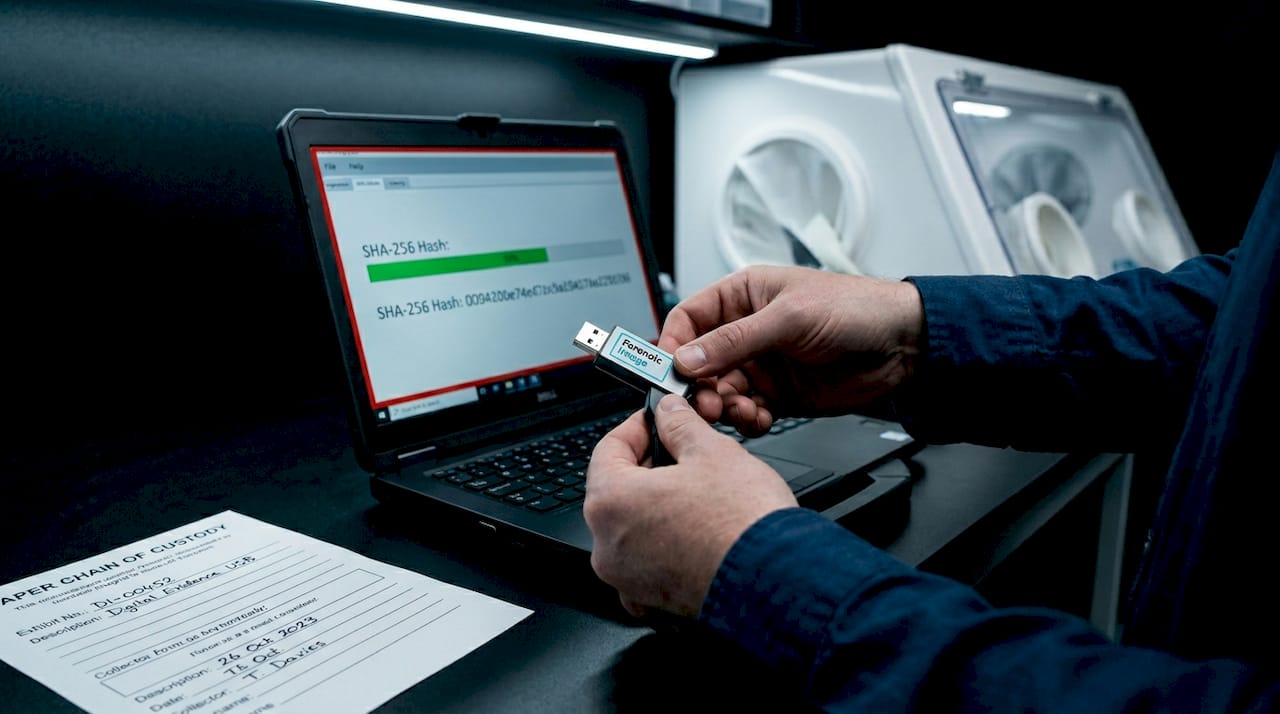
The preference for SHA-256 over MD5 or SHA-1 is not arbitrary. SHA-256 is the preferred algorithm in forensic imaging due to its 256-bit length and collision resistance, while MD5 and SHA-1 have known vulnerabilities and are discouraged as sole proofs. Modern forensic practice uses SHA-256 as the primary algorithm, sometimes running MD5 in parallel for legacy compatibility.
What role do hash databases play in efficient forensic analysis?
Hash databases transform hashing from a verification tool into a triage mechanism. The most significant example is NIST’s National Software Reference Library (NSRL). The NSRL maintains millions of fingerprints for known software files that investigators can use to exclude non-relevant evidence quickly. This matters enormously when a seized hard drive contains hundreds of thousands of files.
The practical benefits for forensic teams are substantial:
- Noise reduction. Operating system files, commercial software, and standard applications all generate known hashes. Matching against the NSRL removes these from the active investigation pool immediately.
- Focus on pertinent evidence. Once known-good files are excluded, examiners concentrate on files with no match in the database. These are the files most likely to be relevant to the investigation.
- Consistency across cases. Using a standardised reference database means two examiners working independently on the same evidence will reach the same triage conclusions. This repeatability is critical for peer review and legal challenge.
- Speed. Hash-based triage reduces time spent analysing irrelevant files, allowing investigators to focus on probable evidence and assemble court-ready cases faster.
The table below illustrates how hash database matching works in practice:
| File type | Hash match found in NSRL | Investigative action |
|---|---|---|
| Windows system DLL | Yes | Excluded from active review |
| Installed commercial software | Yes | Excluded from active review |
| Encrypted archive with no match | No | Flagged for detailed analysis |
| Modified system file | No (hash differs) | Flagged as potentially tampered |
This approach is not limited to law enforcement. Corporate investigators handling data breach cases or intellectual property theft use the same principle to isolate genuinely suspicious files from the background noise of a standard corporate device.
What are the limitations and risks of relying solely on hashing?
Hashing is a powerful tool, but treating it as a complete forensic solution is a professional error. Hash collisions, although rare with modern algorithms like SHA-256, are possible, and older algorithms like MD5 are demonstrably vulnerable. A collision occurs when two different files produce the same hash value. In adversarial legal contexts, a skilled defence counsel can exploit this vulnerability to challenge the integrity of evidence authenticated solely by MD5.
The limitations practitioners must account for include:
- Collisions in legacy algorithms. MD5 collisions have been demonstrated in academic research. Using MD5 as the sole authentication method for critical evidence is indefensible in modern proceedings.
- No proof of origin. Hashing confirms binary equality but not file origin or user behaviour. A hash match proves a file is unchanged. It does not prove who created it, who accessed it, or when it was placed on a device.
- No proof of intent. Courts require evidence of context and authorship. Hashing provides neither. Metadata analysis, timeline reconstruction, and witness evidence must accompany hash verification.
- Undocumented hashing is inadmissible. Relying on undocumented hashing undermines provable integrity. Hashing must be integrated in controlled, well-documented procedures by qualified operators.
Pro Tip: Run SHA-256 and MD5 simultaneously during acquisition. This provides redundancy and satisfies legacy requirements in jurisdictions or systems that still reference MD5 records, without compromising the strength of your primary verification.
The strongest forensic position combines hash verification with structured chain of custody documentation, metadata analysis, and a clear audit trail maintained by qualified examiners. Hashing is the foundation, not the entire structure.
How are hashing techniques applied in forensic workflows and legal cases?
The practical application of hash functions in digital forensics follows a documented workflow that courts have come to expect. Deviation from this workflow, even if the underlying evidence is genuine, creates grounds for challenge. The forensic imaging process for creating verified copies is the most critical stage.
A standard forensic acquisition and verification workflow proceeds as follows:
- Write-block the original media. A hardware write-blocker prevents any modification to the source device during imaging. This is the first line of defence against inadvertent alteration.
- Image the device. Tools such as FTK Imager, EnCase, or X-Ways Forensics create a sector-by-sector copy of the original media.
- Compute hashes of both source and image. SHA-256 values are generated for the original and the forensic copy. Both are recorded in the case log with timestamps.
- Verify the match. If the hashes match, the image is confirmed as an exact replica. This record is submitted as part of the evidence package.
- Seal and store the original. The original device is packaged, labelled, and stored securely. All subsequent analysis is conducted on the verified copy.
- Repeat verification at each transfer. Every time the evidence changes hands, the hash is recalculated and the result is logged. This creates a verifiable chain of custody.
Chain of custody practices must accompany hashing to prove legal admissibility. Hashing alone only verifies bitwise sameness, not context or ownership. Legal professionals reviewing forensic reports should look for hash values recorded at each stage, the algorithm used, the tool version, and the examiner’s credentials. Absence of any of these elements is a red flag.
Understanding why digital evidence verification matters in legal proceedings helps practitioners appreciate why this level of documentation is non-negotiable rather than procedural excess.
Comparing hashing algorithms used in digital forensics
Not all hash functions carry equal evidentiary weight. The forensic community has largely converged on SHA-256 as the standard, but MD5 and SHA-1 remain present in legacy systems and older case records. Understanding the differences is an evidentiary strategy issue, not merely a technical one.
| Algorithm | Bit length | Collision risk | Current forensic use |
|---|---|---|---|
| MD5 | 128-bit | High (demonstrated) | Legacy compatibility only |
| SHA-1 | 160-bit | Moderate (theoretical) | Being phased out |
| SHA-256 | 256-bit | Negligible (current standard) | Primary verification algorithm |
Modern collision-resistant hashes like SHA-256 are essential to counter adversarial challenges in legal contexts. The 256-bit output space makes finding two files with the same hash computationally infeasible with current technology. NIST formally recommends SHA-256 and the broader SHA-2 family for cryptographic applications, including forensic verification.
MD5 retains a role in practice, but only as a secondary check alongside SHA-256. Running both simultaneously during acquisition satisfies legacy database requirements whilst ensuring the primary verification is collision-resistant. Relying on MD5 alone in a 2026 proceeding would be difficult to defend under technical cross-examination.
Key takeaways
Hashing is the technical foundation of digital evidence integrity, but its legal value depends entirely on how it is embedded within documented, standardised forensic procedures.
| Point | Details |
|---|---|
| SHA-256 is the current standard | Use SHA-256 as the primary algorithm; MD5 is acceptable only as a secondary legacy check. |
| Hash at every custody stage | Compute and record hash values at acquisition, transfer, and analysis to maintain a defensible chain of custody. |
| Hash databases accelerate triage | NIST’s NSRL allows rapid exclusion of known-good files, focusing investigative effort on genuinely suspicious data. |
| Hashing alone is insufficient | Hash verification proves bitwise integrity, not authorship, intent, or origin. Combine with metadata analysis and documentation. |
| Documented procedures are mandatory | Undocumented hashing carries no evidentiary weight. Every hash record must include the tool, algorithm, timestamp, and operator. |
Why hashing without process is just a number
After working on digital forensic cases across criminal, civil, and corporate contexts, the pattern I see most often is not technical failure. It is procedural failure. Examiners compute correct hashes using the right algorithms, then fail to document the process in a way that survives legal scrutiny. A SHA-256 value sitting in an undated, unsigned spreadsheet is not evidence. It is a number.
The NIST evidence handling report published in late 2025 confirms what experienced practitioners already know: embedding hashing within standardised, documented acquisition and preservation workflows is what gives it evidentiary value. The hash itself is the easy part. The discipline around it is where cases are won or lost.
I have seen defence teams successfully challenge evidence not because the hash was wrong, but because the chain of custody log had a gap between the seizure and the first hash computation. That gap, however brief, created reasonable doubt. The technical integrity of the evidence was never in question. The procedural integrity was.
My view is that legal professionals reviewing forensic reports should be as rigorous about the documentation surrounding hash values as they are about the values themselves. Ask for the tool version, the operator’s qualifications, the timestamp, and the custody log. If any of those are missing, the hash value is weaker than it appears.
— Computerforensicslab
How Computerforensicslab supports evidence integrity
Computerforensicslab provides professional digital forensics services from its London base, supporting legal professionals, law enforcement, and corporate clients with forensic imaging, hash verification, and chain of custody management that meets the standards courts expect. Every investigation follows documented acquisition protocols using SHA-256 verification, with full audit trails suitable for expert witness reports and litigation support. For cases involving data breaches, employee misconduct, or criminal proceedings, the team applies the same rigorous hashing and verification procedures described in this article. Explore Computerforensicslab’s forensic investigation services to understand how evidence integrity is maintained from seizure to courtroom.
FAQ
What is a hash value in digital forensics?
A hash value is a fixed-length string generated by a cryptographic algorithm that acts as a unique digital fingerprint for a file or dataset. If any part of the data changes, the hash value changes entirely, making it a reliable integrity check.
Why is SHA-256 preferred over MD5 in forensic investigations?
SHA-256 produces a 256-bit output with negligible collision risk, whereas MD5 has demonstrated vulnerabilities that allow two different files to produce the same hash. NIST recommends SHA-256 for forensic verification as it withstands adversarial legal challenge far more reliably.
Can hashing prove who created or accessed a file?
No. Hashing confirms that a file is unchanged but provides no information about authorship, user intent, or access history. Establishing those facts requires metadata analysis, timeline reconstruction, and corroborating evidence alongside hash verification.
What is the NSRL and why does it matter for forensic triage?
The National Software Reference Library (NSRL), maintained by NIST, holds hash values for millions of known software files. Investigators match evidence hashes against the NSRL to exclude standard system files quickly, reducing the volume of data requiring detailed analysis.
How does hashing support chain of custody in legal proceedings?
Hash values computed and recorded at each custody transfer create a verifiable audit trail proving evidence was not altered between stages. Courts expect this documentation as part of the evidence package, and gaps in the hash record can create grounds for admissibility challenges.