
TL;DR:
- Encryption has transformed digital evidence collection by necessitating live acquisition and detailed documentation, often hindering traditional dead-box imaging. Cryptographic hashing and reference libraries like NIST NSRL enable rapid filtering of benign files, reducing review time in large encrypted datasets. Successful forensic access relies on understanding device-specific vulnerabilities, capturing volatile memory swiftly, and thorough legal compliance during evidence collection.
Encryption is the process of converting readable digital data into an unreadable format, and its widespread adoption has fundamentally reshaped how forensic investigators collect, preserve, and analyse digital evidence. Where early digital forensics relied on straightforward disk imaging, modern investigations must contend with full-disk encryption on iOS devices, FileVault on macOS, and BitLocker on Windows. The role of encryption in forensics is not simply a technical obstacle. It is a factor that transforms every stage of the investigative workflow, from acquisition planning to courtroom admissibility. Understanding this distinction separates investigators who recover usable evidence from those who return ciphertext.
How does encryption alter forensic evidence acquisition?
Encryption forces a fundamental choice at the point of acquisition: live collection or dead-box imaging. Dead-box forensics, the traditional approach of powering down a device and imaging its storage, produces an encrypted copy that is practically useless without the decryption key. Live acquisition, by contrast, captures data while the system is running and potentially decrypted, but it introduces its own complications.
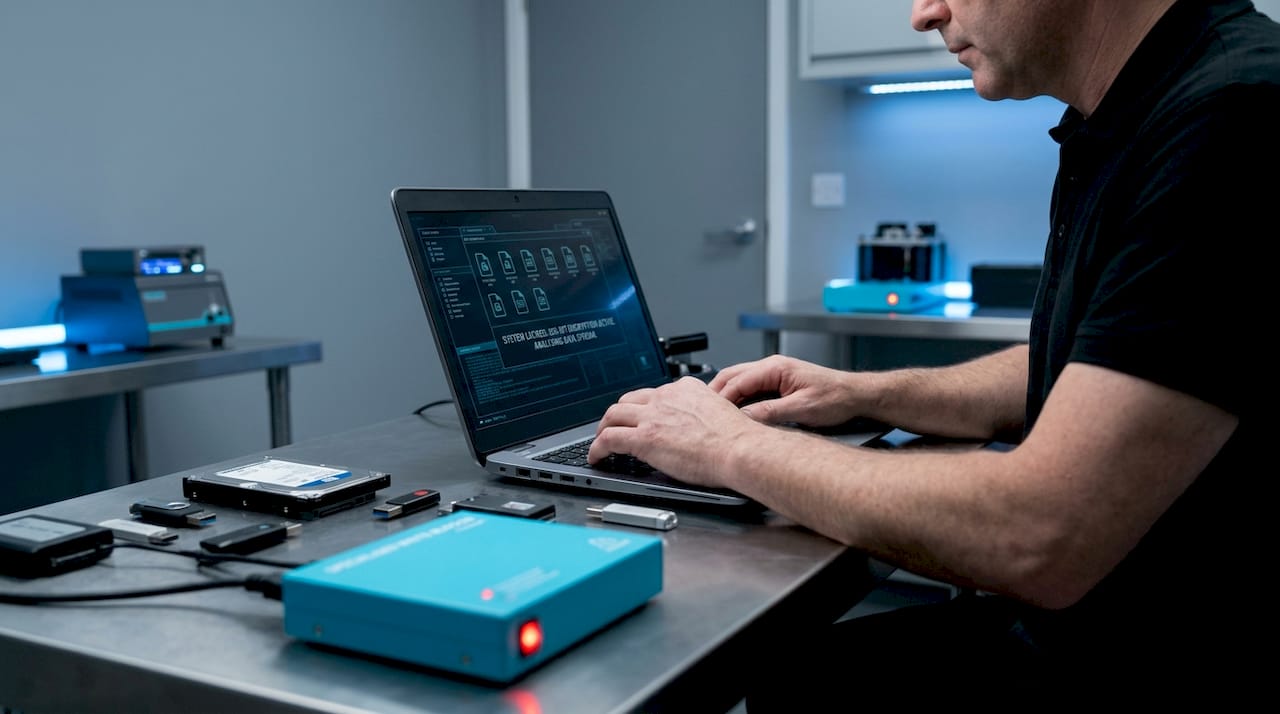
SWGDE best practices require forensic examiners to employ least-invasive techniques on live encrypted systems and to document any alterations or evidence creation that occur during the process. This is not a bureaucratic formality. Any undocumented change to a live system can be used to challenge the integrity of evidence in court, and judges have dismissed cases on precisely this basis.
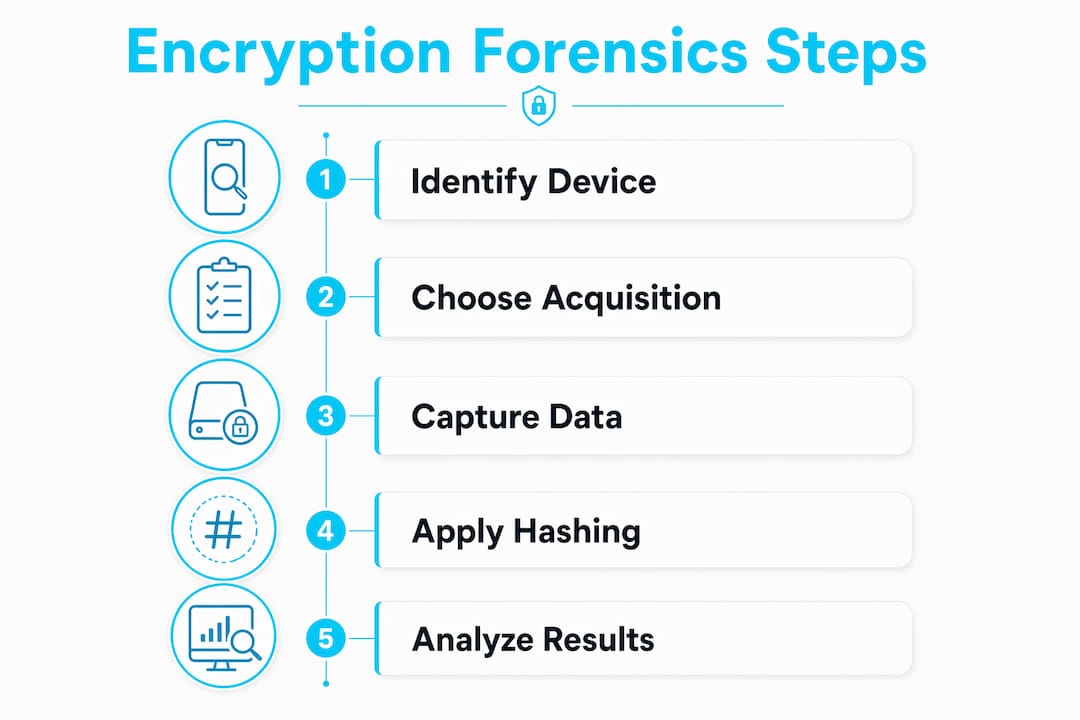
The practical implication is that investigators must arrive at a scene with a clear acquisition plan that accounts for encryption. That plan should include:
- Identifying whether the device is powered on and in what state (locked, unlocked, or in sleep mode)
- Locating any written passwords, recovery keys, or credentials near the device
- Deciding whether live memory capture is feasible before the system is shut down
- Documenting every action taken from the moment the device is first touched
Evidence handlers should identify usernames, passwords, recovery keys, and their physical location as early as possible, since access to this material directly determines whether decryption is achievable at all.
Pro Tip: If you arrive at a scene where a laptop is open and unlocked, do not close the lid. Sleep mode on a Mac with a T2 or M-series chip re-encrypts the drive immediately. Capture volatile memory first.
What cryptographic tools support forensic analysis despite encryption?
Cryptography’s role in digital forensics extends well beyond the challenge of defeating encryption. Cryptographic hash functions serve as one of the most practical tools available to investigators working through large volumes of encrypted or partially accessible data.
A cryptographic hash is a fixed-length digital fingerprint generated from a file’s contents. If two files produce the same hash value, they are identical. This property allows investigators to rapidly filter out known, benign files without needing to read their content, which is particularly valuable when dealing with partially encrypted storage.
| Technique | What it does | Forensic benefit |
|---|---|---|
| Cryptographic hashing | Generates a unique fingerprint for each file | Confirms file integrity and filters known benign data |
| NIST NSRL matching | Compares hashes against a reference library of known software | Eliminates millions of irrelevant files from review |
| Hash-based triage | Prioritises unknown files for manual examination | Reduces investigation time on large encrypted volumes |
The NIST National Software Reference Library uses cryptographic hashes to quickly exclude known benign files, enabling law enforcement to focus on unknown and potentially incriminating data. In practical terms, this means an investigator examining a 2TB drive can eliminate hundreds of thousands of operating system and application files in minutes, leaving a far smaller pool of files requiring manual review.
Cryptographic hashes serve dual roles in encrypted case handling: encryption restricts access to data content, while hashes help rapidly identify known benign files and prioritise review. The NIST NSRL approach operationalises this division of labour at scale.
Pro Tip: Run NSRL hash matching as early as possible in your triage workflow. On large volumes, this single step can reduce your review set by 40 to 60 per cent before you have touched a single encrypted file.
How do modern encryption technologies challenge forensic access?
Modern full-disk encryption with a strong password is currently infeasible to brute-force. Attempt-rate limits and secure hardware components such as the Secure Enclave on iOS devices restrict brute-force feasibility to the point where it is not a realistic investigative strategy for most cases. This is the single most important technical reality for any investigator or legal professional to internalise.
The practical consequence is that encrypted data access depends heavily on device model, OS version, and acquisition timing, making upfront investigative device modelling critical. A Samsung Galaxy running Android 13 presents a different set of vulnerabilities and access pathways than an iPhone 15 running iOS 17. Treating all encrypted devices as equivalent is a common and costly mistake.
| Device type | Encryption standard | Primary access challenge | Viable forensic approach |
|---|---|---|---|
| iPhone (iOS 17+) | AES-256, Secure Enclave | Hardware-enforced attempt limits | Exploit-based tools (e.g., GrayKey), live memory capture |
| Mac with T2/M-series chip | AES-256, hardware-bound key | Re-encrypts on sleep; dead-box imaging yields ciphertext | Live acquisition with on-the-fly decryption |
| Windows with BitLocker | AES-128 or AES-256 | Key stored in TPM; requires PIN or recovery key | Recovery key retrieval from Active Directory or Microsoft account |
| Android (varies by OEM) | AES-256 (FBE) | Fragmented OS versions create inconsistent vulnerabilities | Device and OS-specific exploit pathways |
Cellebrite and GrayKey are the two most widely deployed specialised forensic tools for encrypted mobile device access. Both rely on device-specific vulnerabilities rather than brute-force decryption, which is why their effectiveness varies by model and firmware version. Investigators who do not track firmware updates risk deploying a tool against a patched vulnerability and recovering nothing.
Live memory capture is the most reliable method when a device is already unlocked. Volatile memory and page files may hold encryption keys or decrypted data, but these are lost the moment the system is rebooted or powered down. IBM’s X-Force research confirms that timely action to secure volatile memory is often the only way to recover encryption artefacts. This is not a theoretical concern. In practice, a two-minute delay while waiting for a warrant can mean the difference between a successful acquisition and an encrypted dead end.
What legal considerations apply to encrypted evidence?
The challenges of encrypted data in forensics do not end at the technical layer. Every decision made during acquisition of an encrypted device carries legal consequences that extend into the courtroom.
Live acquisition, while technically necessary for encrypted systems, alters the device’s state. Live acquisition techniques on encrypted systems can alter or create evidence, creating legal sensitivities that require detailed auditing and documentation. Without a complete audit trail, defence counsel can argue that evidence was contaminated or fabricated during the acquisition process.
The following documentation standards apply to every encrypted evidence acquisition:
- Record the exact state of the device at first contact (powered on, screen locked, screen unlocked, sleep mode)
- Log every command executed during live acquisition, including timestamps
- Note any changes to file system metadata caused by the acquisition process
- Document the location and condition of any physical recovery keys or written credentials found at the scene
- Maintain an unbroken chain of custody from scene to laboratory to court
Timing is a legal consideration as well as a technical one. Forensic success with encrypted data hinges on capturing plaintext in volatile memory during live sessions and acquiring recovery keys early. Delayed imaging often yields only ciphertext, which is inadmissible not because it is unreliable but because it contains no usable evidence. Courts cannot convict on data no one can read.
For legal professionals managing disclosure obligations, the importance of encryption in investigations also extends to understanding what your forensic expert can and cannot access. An expert who cannot articulate why a particular device was inaccessible, and what steps were taken to attempt access, will face serious challenges under cross-examination.
Key takeaways
Encryption reshapes every stage of a forensic investigation, and the investigators who succeed are those who plan for it before they arrive at the scene.
| Point | Details |
|---|---|
| Live acquisition is often mandatory | Encrypted devices require live collection to capture decrypted data before the system is locked or powered down. |
| Brute force is not a viable strategy | Hardware-enforced attempt limits on iOS and modern Android devices make brute-force attacks practically infeasible. |
| Cryptographic hashing accelerates triage | NIST NSRL hash matching eliminates known benign files rapidly, reducing the manual review burden on large encrypted volumes. |
| Documentation protects admissibility | Every alteration caused by live acquisition must be logged in full to withstand legal challenge and preserve chain of custody. |
| Device modelling determines access pathways | Forensic success depends on identifying the specific device model, OS version, and firmware before selecting an access method. |
The uncomfortable truth about encryption and forensic timelines
Working with encrypted evidence has taught me one thing above all else: the window for successful acquisition is almost always shorter than investigators expect, and almost always longer than the legal process allows. The tension between technical urgency and procedural compliance is where most encrypted cases are won or lost, and it rarely gets the attention it deserves.
The instinct in many investigations is to secure the scene, wait for authorisation, and then begin acquisition. With unencrypted devices, that sequence is workable. With encrypted systems, it is frequently fatal to the investigation. Volatile memory holding decryption keys does not wait for paperwork. A laptop that enters sleep mode while an investigator is on the phone to a duty solicitor re-encrypts its drive and the opportunity is gone.
What I have observed across complex cases is that the teams who recover usable evidence from encrypted devices are those who have prepared their acquisition plans in advance, trained for live system scenarios, and established pre-authorised protocols for volatile memory capture. They do not improvise at the scene. They execute a rehearsed procedure.
The other overlooked factor is the human element. Recovery keys written on a Post-it note, a password stored in a browser on an unlocked second device, a cloud backup with weaker encryption settings than the primary device. These are the access points that actually open encrypted cases, far more often than any technical exploit. Investigators who focus exclusively on the device in front of them miss the broader evidence environment.
The role of cryptography in digital forensics is ultimately about preparation and speed. The technology is not going to become easier to defeat. The investigators who succeed will be those who build their workflows around that reality rather than hoping for a technical shortcut that does not exist.
— Computerforensicslab
How Computerforensicslab supports encrypted investigations
Computerforensicslab provides digital forensic investigations for legal professionals, law enforcement, and corporate clients across the UK, with specific expertise in acquiring and analysing encrypted devices. The team follows SWGDE best practices for live acquisition, maintains full audit trails for every case, and produces expert witness reports that withstand cross-examination. Whether you are dealing with a BitLocker-protected Windows machine, an iOS device with Secure Enclave protection, or a cloud environment with partial encryption, Computerforensicslab has the technical capability and legal understanding to maximise evidence recovery. For a structured approach to evidence collection on encrypted devices, contact the team directly.
FAQ
What is the role of encryption in forensics?
Encryption determines whether forensic investigators can access the content of digital evidence. It forces a shift from traditional dead-box imaging to live acquisition techniques, requiring detailed documentation and specialist tools to recover usable data.
Can forensic investigators break full-disk encryption?
Brute-force attacks against modern full-disk encryption are not feasible due to hardware-enforced attempt limits on devices such as iPhones. Investigators instead rely on device-specific vulnerabilities, live memory capture, and recovery key retrieval.
How does encryption affect evidence admissibility in court?
Live acquisition of encrypted devices alters the device’s state, which creates legal risk. SWGDE guidelines require full documentation of any changes caused during acquisition to preserve the chain of custody and support admissibility.
What is the NIST NSRL and why does it matter for encrypted cases?
The NIST National Software Reference Library provides cryptographic hash values for known software files. Investigators use it to rapidly exclude benign data from review, reducing the volume of files requiring manual examination on encrypted volumes.
How important is timing in encrypted forensic acquisitions?
Timing is critical. Volatile memory holding encryption keys is lost the moment a device is rebooted or enters sleep mode. IBM X-Force research confirms that delayed imaging of encrypted systems frequently yields only ciphertext with no investigative value.