TL;DR:
- Becoming a CSI requires targeted education, practical experience, and thorough vetting over several years.
- There are two main career paths: police officer and civilian forensic specialist, both demanding rigorous training and credentials.
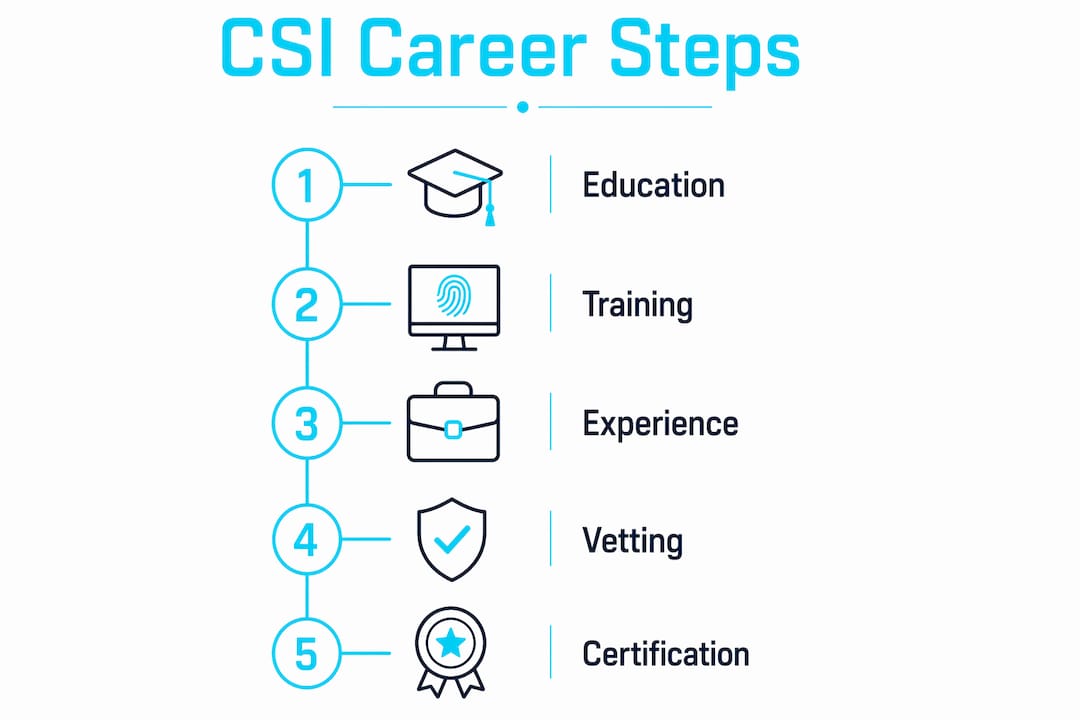
A crime scene investigator (CSI) is a forensic specialist who collects, documents, and analyses physical evidence at crime scenes to support criminal prosecutions. The steps to becoming a crime scene investigator follow a clear sequence: earn the right qualifications, gain hands-on experience, pass rigorous vetting, and complete accredited training. This is not a career you fall into. It demands deliberate preparation across several years, and the pathway differs depending on whether you pursue a sworn police officer route or a civilian forensic specialist role. Both routes are viable in 2026, and this guide covers each one in full.
What educational qualifications do you need to become a CSI?
The academic foundation for a CSI career is non-negotiable. A bachelor’s degree in forensic science, criminal justice, biology, or chemistry is the standard entry requirement for most positions. Candidates without a degree can qualify via an associate degree, but only if they supplement it with 2–5 years of relevant law enforcement or laboratory experience. That alternative route is harder and slower. Starting with a full degree is the more direct path.
In the UK specifically, minimum entry requirements for CSI training programmes are five GCSEs at grades 9–4, including English, maths, and a science subject, plus two A-Levels or equivalent qualifications. Science A-Levels in biology or chemistry carry the most weight. They demonstrate the analytical thinking that forensic work demands from day one.
Comparing qualification routes and career outcomes
| Qualification | Entry Level | Career Progression Advantage |
|---|---|---|
| Bachelor’s in Forensic Science | Direct CSI application | Fastest route to specialist roles |
| Bachelor’s in Criminal Justice | Direct CSI application | Strong foundation for police officer track |
| Bachelor’s in Biology or Chemistry | Direct CSI application | Preferred for laboratory-based forensic roles |
| Associate Degree + Experience | Requires 2–5 years prior experience | Slower progression, fewer senior openings |
| A-Levels + College of Policing Training | Entry to police-route CSI | Structured UK pathway with employer support |
A degree in forensic science from institutions such as King’s College London, the University of Strathclyde, or Anglia Ruskin University gives you direct exposure to evidence analysis, toxicology, and crime scene procedures. Studying criminal justice at degree level, meanwhile, builds contextual knowledge of the legal system that proves valuable when you eventually write reports or give court testimony. You can explore UK investigation courses to compare current qualification options relevant to your situation.
How can aspiring csis gain practical experience?
Qualifications open the door, but experience is what gets you hired. Many CSIs begin in support roles such as forensic lab assistant, evidence technician, or property clerk before advancing to full investigator positions. These roles provide direct exposure to evidence handling, chain of custody procedures, and the administrative rigour that defines professional forensic work.
Here are the most effective ways to build practical experience before applying for a CSI position:
- Apply for entry-level forensic support roles. Property clerk and evidence technician positions within police forces or forensic laboratories give you daily contact with physical evidence and case management systems.
- Pursue internships with police forensic units. Several UK constabularies offer structured placement programmes for students in their second or third year of a relevant degree.
- Volunteer with forensic science societies. Organisations such as the Chartered Society of Forensic Sciences run events, workshops, and mentoring schemes that build both skills and professional contacts.
- Shadow a working CSI. Direct observation of scene processing, photography, and evidence packaging is difficult to replicate in a classroom. Even a single week of shadowing changes how you think about the job.
- Complete the College of Policing training programme. UK-based CSI training typically lasts 6–12 months and combines classroom learning with supervised crime scene attendance and formal assessments.
The 6–12 month training window is significant. It means you will not be working independently for at least a year after joining. Plan your finances and expectations accordingly.
Pro Tip: Start networking at forensic science conferences and Chartered Society of Forensic Sciences events while still studying. The people you meet during your degree years are often the same people who later review your job applications.
What are the vetting and physical requirements for csis?
Vetting is the stage where many otherwise qualified candidates fail. Background investigations are exhaustive, and any minor criminal record or significant drug use history frequently results in disqualification. This applies equally to police officer and civilian CSI routes.
The standard vetting process for a UK CSI role includes:
- Criminal record check: Any conviction, caution, or pending prosecution is scrutinised. Minor offences from early adulthood can still disqualify you.
- Drug screening: Both historical drug use and current testing are assessed. Disclosure policies vary by force, but honesty is always the safer approach.
- Lie detector assessment: Some forces and agencies use polygraph testing as part of the security clearance process.
- Financial history review: Significant debt or financial irregularities raise concerns about susceptibility to corruption or bribery.
- Physical capability assessment: Physical requirements include meeting vision standards and demonstrating physical mobility, including tasks such as squatting at scene level for extended periods.
- Right to work in the UK: All applicants must hold the legal right to work in the UK and meet minimum age requirements, typically 18 years.
“The vetting process is among the most challenging barriers to entry in forensic careers. Impeccable conduct from early adulthood is not just advisable. It is a professional necessity.” — All Criminal Justice Schools
The practical implication is straightforward. If you are still a student considering this career, your conduct now matters. Avoid situations that could generate a criminal record or a documented history of drug use. Vetting investigators look back years, not just months.
What skills are critical for success as a crime scene investigator?
Technical knowledge alone does not make a competent CSI. Success in CSI roles depends on a visionary mindset: the ability to view a crime scene as an unsolved story and critically analyse evidence to reconstruct what happened. This skill is not taught in a single module. It develops through experience, mentoring, and deliberate practice.

The core skills needed for crime scene investigators fall into two categories: analytical and communicative.
Analytical skills:
- Critical thinking to evaluate physical evidence without jumping to conclusions
- Curiosity to question inconsistencies and pursue alternative explanations
- Spatial awareness to mentally reconstruct timelines and movements within a scene
- Attention to detail in documentation, photography, and sample collection
Communication skills:
- Written communication for producing clear, objective, and legally defensible forensic reports
- Verbal clarity to explain complex scientific findings to juries, judges, and legal teams in plain language
- Professional composure under cross-examination in court
CSI reports are legal documents. They can be scrutinised years after submission, and a poorly worded report can undermine an entire prosecution. Developing strong forensic report writing skills early in your career is one of the highest-return investments you can make.
Pro Tip: Read published forensic case reports and court transcripts during your studies. Seeing how experienced CSIs structure their findings and respond to legal challenge teaches you more than most textbooks.
What are the main career pathways within crime scene investigation?
Two distinct routes lead to a CSI career, and choosing between them early shapes your entire training timeline.
Some CSIs are sworn police officers who completed police academy training and served as constables before specialising in forensic investigation. Others are civilian forensic specialists who focus entirely on technical evidence collection and analysis without holding arrest powers. The civilian route is growing in the UK, with forces increasingly separating enforcement and forensic functions.
Comparing the two main CSI routes
| Route | Training Required | Arrest Powers | Typical Timeline to CSI Role |
|---|---|---|---|
| Sworn Police Officer | Police academy plus constable service | Yes | 3–5 years from joining |
| Civilian CSI Specialist | Degree plus College of Policing training | No | 1–3 years from graduation |
| Internal Transfer (e.g., from evidence management) | On-the-job plus supplementary training | Depends on prior role | 2–4 years |
The police officer route gives you broader investigative authority and a deeper understanding of criminal procedure. The civilian route lets you specialise faster and is increasingly common in metropolitan forces such as the Metropolitan Police and Police Scotland. Both routes require the same rigorous vetting and the same commitment to ongoing professional development.
Career progression within either route typically moves from junior CSI to senior CSI, then to specialist roles in areas such as digital forensics, fingerprint analysis, or major crime investigation. You can review current CSI career steps for 2026 to understand how these progression timelines are evolving.
Key takeaways
Becoming a crime scene investigator requires a structured combination of academic qualifications, practical experience, clean personal conduct, and specialist training across a minimum of three to five years.
| Point | Details |
|---|---|
| Education is the foundation | A bachelor’s degree in forensic science, criminal justice, biology, or chemistry is the standard entry requirement. |
| Practical experience accelerates progress | Entry roles such as evidence technician or forensic lab assistant build the hands-on skills employers require. |
| Vetting is the hardest barrier | Any criminal record or significant drug history typically disqualifies candidates from both police and civilian CSI roles. |
| Mindset matters as much as knowledge | The ability to read a crime scene as a narrative and think critically about evidence is what separates good CSIs from great ones. |
| Two routes exist | The sworn officer track and the civilian specialist track both lead to CSI roles, with different timelines and responsibilities. |
What working in forensics has taught me about this career path
Most people who ask about becoming a CSI underestimate two things: the administrative load and the vetting process. The glamour of television forensics bears almost no resemblance to the reality of writing detailed scene logs at midnight or spending weeks preparing documentation for a single court appearance.
From my perspective working in digital forensics at Computerforensicslab, the candidates who succeed in this field share one trait above all others: they are genuinely curious about how things connect. Not just about science, but about people, timelines, and the gaps between what evidence shows and what witnesses claim. That investigative instinct is not something a degree programme can fully teach. It comes from paying attention in every early-career role, no matter how administrative it seems.
The vetting stage also catches people off guard. Candidates who sailed through their degree and training programmes have been disqualified at the final stage because of something from years earlier. Start thinking about your professional reputation now, not when you are filling in the application form.
The role of forensics in legal cases is expanding, particularly as digital evidence becomes central to prosecutions. CSIs who develop competency across both physical and digital evidence domains will have a significant advantage in the years ahead.
— Computer
Explore professional digital forensic services and career resources
Modern crime scene investigation increasingly intersects with digital evidence. Devices, cloud accounts, and social media trails are now standard components of major investigations. Computerforensicslab provides professional digital forensics services covering data recovery, device analysis, and evidence collection for legal professionals, law enforcement, and private clients across the UK. Whether you are building your forensic career or need expert support on a live case, Computerforensicslab’s team brings court-ready expertise to every investigation. Explore the full range of digital forensic investigations to understand how digital evidence collection works in practice and how it complements traditional crime scene work.
FAQ
What qualifications do you need to become a CSI in the UK?
The minimum requirements are five GCSEs at grades 9–4 including English, maths, and science, plus two A-Levels. Most employers prefer a bachelor’s degree in forensic science, criminal justice, biology, or chemistry.
How long does CSI training take in the UK?
UK CSI training typically lasts 6–12 months and combines classroom instruction, supervised crime scene attendance, and formal assessments through the College of Policing.
Can you become a CSI without being a police officer?
Yes. The civilian CSI route allows forensic specialists to focus entirely on evidence collection and analysis without holding arrest powers. This pathway is growing across UK police forces.
What disqualifies you from becoming a CSI?
A criminal record, significant drug use history, or financial irregularities identified during vetting will typically disqualify a candidate. Background investigations are thorough and cover several years of personal history.
What skills are most important for a crime scene investigator?
Critical thinking, attention to detail, and strong written communication are the core skills needed for crime scene investigators. The ability to write clear, legally defensible reports is as important as any laboratory technique.