TL;DR:
- Forensic science cases rely heavily on meticulous documentation, transparency, and proper methodology to withstand legal scrutiny. Recent advances like genetic genealogy, non-destructive analysis, and metabolomics improve evidence accuracy but require careful presentation to courts. Effective legal handling depends on understanding evolving techniques, disclosure obligations, and maintaining thorough records for long-term evidentiary integrity.
Forensic science cases are defined as criminal or civil investigations in which scientific methods produce evidence that directly shapes legal outcomes. The most consequential examples from recent years share a common thread: techniques that did not exist at the time of the original crime ultimately delivered justice decades later. From investigative genetic genealogy to post-mortem metabolomics, the field is producing breakthroughs that every legal professional and law enforcement officer needs to understand. This article examines the most instructive cases and methods in detail, with direct implications for evidentiary standards and courtroom strategy.
1. DNA and genetic genealogy in landmark forensic science cases
Investigative genetic genealogy is the practice of building family trees from crime-scene DNA to identify unknown suspects or victims, and it has transformed cold-case resolution since its mainstream adoption around 2018. The technique does not produce a direct match to a named individual. Instead, it generates leads that investigators then verify through traditional DNA profiling.
The clearest recent illustration is the identification of “Chelsea Jane Doe.” Remains found in 2000 were identified as Tiffany Bradley in 2026, nearly 26 years after discovery, with the killer already serving a prison sentence for an unrelated offence. The case required two parallel workflows: generating a court-usable DNA profile from degraded biological material and converting genealogical leads into a legally defensible identification. That dual-track approach is now considered best practice for cold-case victim identification.
A comparable result came from Massachusetts, where forensic genealogy identified a suspect in a 1991 Brockton murder and a 1993 rape. The Othram laboratory processed the DNA, and investigators had linked the two cases as early as 2016, but a named suspect only emerged recently. The suspect died in 2025 before charges could be brought, which illustrates a recurring legal tension: genealogy moves faster than the justice system can always accommodate.
Key considerations for legal professionals working with genealogy evidence:
- Genetic genealogy functions as an investigative lead, not direct trial evidence, and disclosure obligations vary significantly by jurisdiction.
- The US DOJ interim policy restricts forensic genetic genealogy to federally funded investigations, meaning local agencies operate under inconsistent frameworks.
- Defence teams must request full documentation of the genealogical methodology, not merely the final DNA match report.
- Extended timelines demand thorough chain-of-custody records covering every transfer and retest of biological material.
Pro Tip: When reviewing a case involving genetic genealogy, request the complete family-tree construction records and the criteria used to narrow candidates. Courts increasingly scrutinise this reasoning, and gaps in documentation are a viable challenge point.
2. How the “gum ruse” advanced unconventional DNA collection
The “gum ruse” is an evidence-collection technique in which investigators arrange for a suspect to discard chewing gum or another biological item, then recover it for DNA analysis without the suspect’s knowledge. It is legally distinct from a compelled DNA sample and has survived defence challenges in multiple jurisdictions.
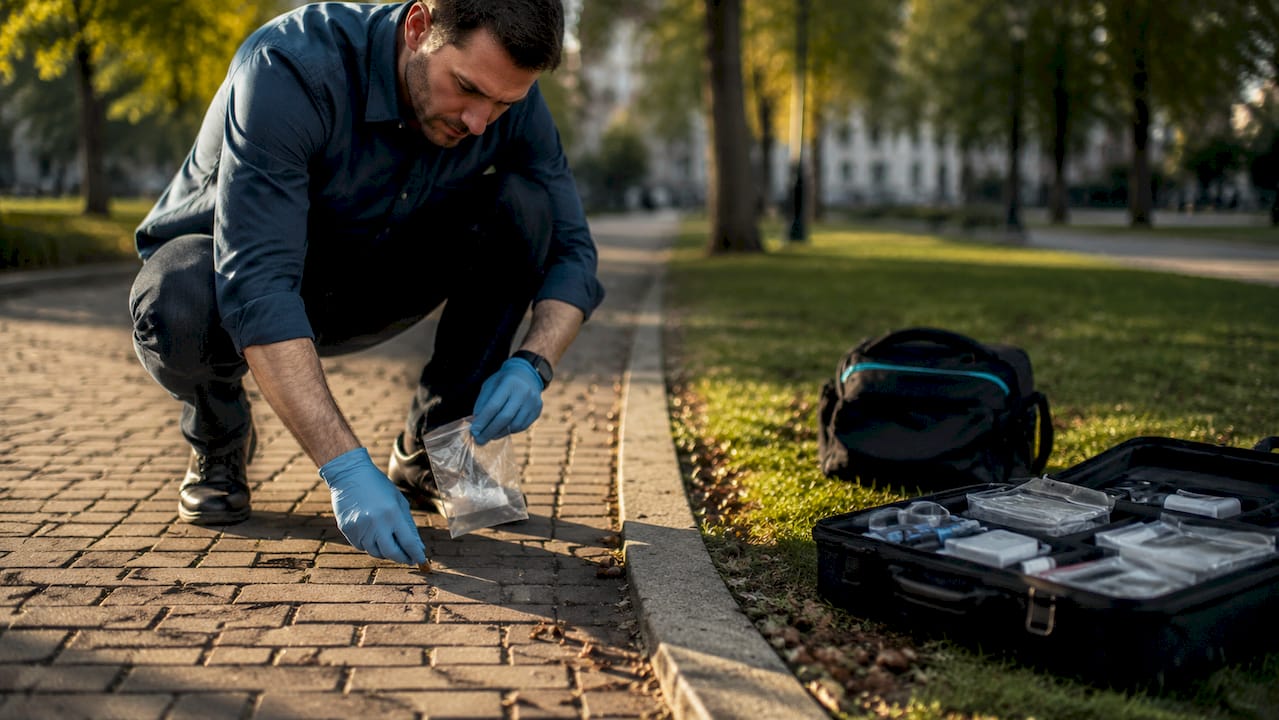
In one notable case, detectives used discarded chewing gum to confirm a suspect’s DNA profile in connection with crimes committed in 1984, a period when DNA profiling did not exist. The breakthrough began in 2023 and produced a confirmed match by 2026. That timeline illustrates how modern forensic science can revisit physical evidence collected under entirely different technological conditions and extract new probative value.
For this technique to withstand courtroom scrutiny, investigators must satisfy several requirements:
- Documented collection protocol. The precise moment and method of recovery must be recorded, including who collected the item and the chain of custody from that point forward.
- Contamination controls. The defence will challenge whether the biological material genuinely originated from the suspect or was transferred from another source.
- Laboratory accreditation. The testing laboratory must hold appropriate accreditation, and the analyst’s qualifications must be disclosed.
- Comparison profile provenance. The reference profile used for comparison must be independently verified, particularly in cold cases where original samples may have degraded.
The evolution from zero DNA capability in 1984 to confirmed cold-case matches in 2026 represents one of the most dramatic arcs in forensic science examples. It also raises a practical point for law enforcement: physical evidence from unsolved cases should be preserved even when current technology cannot exploit it, because future methods almost certainly will.
Pro Tip: If you are advising on a case involving surreptitiously collected biological material, examine whether the collection constituted a search under applicable law. In England and Wales, the Police and Criminal Evidence Act 1984 governs this area, and the answer is not always straightforward.
3. Emerging scientific methods improving forensic analysis accuracy
Post-mortem interval prediction and chemical imaging microspectroscopy represent two of the most significant recent advances in forensic investigation techniques, and both have direct implications for evidence admissibility.
Post-mortem metabolomics and machine learning
Post-mortem interval (PMI) estimation has historically relied on entomology, body temperature, and decomposition staging, all of which carry substantial uncertainty. A neural-network model using post-mortem metabolomics data predicted PMI with a mean absolute error of around 1.45 days, validated across independent datasets covering 4,876 forensic cases. That level of precision is a material improvement over traditional methods and could directly affect time-of-death arguments in homicide trials.
The study’s cross-platform validation is particularly significant. Quantified uncertainty in predictive outputs means courts can be given specific error margins rather than vague ranges, which strengthens both prosecution and defence arguments depending on the facts. Legal teams should treat a PMI estimate without a stated confidence interval as incomplete expert evidence.
Chemical imaging microspectroscopy
Chemical imaging microspectroscopy, including techniques such as micro-FTIR and O-PTIR, offers non-destructive forensic analysis of physical evidence. Because the sample is not consumed during testing, it remains available for independent re-examination by defence experts. This directly addresses one of the most persistent evidentiary complaints in forensic cases: that prosecution testing destroys the only available sample.
The comparison below illustrates how traditional and advanced methods differ across key evidentiary criteria:
| Criterion | Traditional methods | Advanced methods (metabolomics, micro-FTIR) |
|---|---|---|
| Sample consumption | Often destructive | Non-destructive; sample preserved |
| Error quantification | Qualitative or approximate | Quantified confidence intervals |
| Re-testing availability | Limited or impossible | Fully available for defence review |
| Courtroom validation | Long-established precedent | Emerging; requires Daubert scrutiny |
| Cold-case applicability | Dependent on sample condition | Applicable to degraded material |
Non-destructive methods are increasingly important to maintain evidence integrity for future analysis and courtroom challenges. Any forensic science article that discusses evidence preservation should treat this as a baseline expectation, not an optional enhancement.
4. Forensic genomics, trace DNA, and courtroom challenges
Integrative forensic genomics applies multiple analytical workflows to low-quantity or degraded DNA samples, extracting usable SNP profiles and whole-genome data where conventional STR profiling would fail. The approach was applied in a maritime cocaine trafficking case, where usable genomic profiles were captured despite contamination and minimal DNA quantities. The case demonstrates that genomic profiling is no longer limited to high-quality reference samples.
The evidentiary limitations are equally instructive. Reference panel representativeness directly affects the reliability of population frequency estimates, and gaps in reference data can undermine the statistical weight assigned to a match. Expert testimony must map these uncertainties to the specific facts of the case rather than presenting genomic evidence as categorical proof.
Best practices for legal professionals and forensic scientists presenting genomic evidence:
- Disclose the reference population used and its size. A match probability calculated against an unrepresentative panel is scientifically weaker than it appears.
- Quantify contamination risk explicitly. Courts should understand the probability that a profile originated from a secondary source.
- Present likelihood ratios with stated assumptions. Changing the assumed population changes the ratio, and defence experts will exploit undisclosed assumptions.
- Retain all raw data files. Defence teams have the right to independent re-analysis, and withholding raw outputs is a disclosure failure.
The forensic genomics evidentiary challenges00077-3/abstract) in complex cases require expert witnesses who can translate statistical uncertainty into language a jury can evaluate. This is a skill distinct from laboratory competence, and legal teams should assess it separately when instructing experts.
5. Legal and evidentiary lessons from recent notable cases
The most consistent lesson from recent forensic current events is that documentation quality determines whether a technically sound result survives courtroom challenge. The Chelsea Jane Doe case required thorough records covering every custody transfer across more than two decades. A single undocumented gap would have provided grounds to exclude the identification evidence.
The Daubert standard gives US federal judges broad gatekeeping responsibility over scientific evidence admissibility, requiring courts to assess methodology, peer review, error rates, and general acceptance. The older Frye standard, still applied in some US states, relies solely on general scientific acceptance. This distinction matters for genetic genealogy and metabolomics evidence, both of which have peer-reviewed support but limited trial history. Legal teams in Daubert jurisdictions should prepare detailed methodology affidavits from their forensic experts before any admissibility hearing.
Disclosure obligations around genetic genealogy remain inconsistent. The US DOJ interim policy applies only to federally funded investigations, and local agencies frequently operate without equivalent guidance. Defence practitioners should file specific discovery requests for genealogical search records, not rely on standard disclosure protocols to surface them.
The role of forensics in legal cases extends beyond producing a match. Non-destructive techniques such as micro-FTIR preserve the physical sample for independent testing, which is a concrete defence right. Prosecution teams that use destructive methods without prior notice to the defence risk exclusion applications that could derail otherwise strong cases.
Pro Tip: File a pre-trial motion requiring the prosecution to identify all forensic methods used and whether each was destructive. This creates a record that supports exclusion arguments if re-testing becomes impossible.
Key takeaways
Forensic science cases are decided as much by documentation rigour and methodological transparency as by the scientific result itself.
| Point | Details |
|---|---|
| Genetic genealogy is a lead, not proof | Genealogy evidence requires conversion to a court-usable DNA profile before it carries direct evidentiary weight. |
| Non-destructive methods protect defence rights | Techniques like micro-FTIR preserve samples for independent re-testing, which courts increasingly expect. |
| PMI metabolomics quantifies uncertainty | Neural-network PMI models validated across 4,876 cases produce specific error margins courts can evaluate. |
| Disclosure gaps are challenge points | Incomplete genealogical records, undisclosed reference panels, and missing chain-of-custody logs are all viable grounds for exclusion. |
| Daubert scrutiny applies to new methods | Genetic genealogy and metabolomics require detailed methodology affidavits in federal and Daubert-jurisdiction courts. |
Why forensic science cases demand more from legal practitioners
Working with forensic evidence across digital and physical investigations, the pattern that stands out most is not the sophistication of the science. It is how often legally sound results are undermined by process failures that were entirely avoidable.
The Chelsea Jane Doe identification and the Brockton genealogy case both succeeded because investigators maintained documentation across timelines that spanned decades. Most practitioners will never work a case that long, but the discipline required is identical. Every transfer, every retest, every analyst note needs to be recorded as if the case will be challenged in court 25 years from now, because occasionally it will be.
The emerging methods covered in recent forensic science articles, particularly metabolomics and genomic profiling, are genuinely impressive. The risk is that their novelty creates overconfidence. A PMI estimate with a 1.45-day mean absolute error is useful, but it is not a precise time of death. Courts should be told the difference, and legal teams that present it as the latter are setting themselves up for a damaging cross-examination.
The area needing the most attention right now is standardisation of genetic genealogy disclosure. The gap between DOJ-governed investigations and local agency practice is wide enough to produce materially different outcomes for defendants depending on geography. That is not a defensible position for a justice system, and it will eventually require legislative resolution.
— Computerforensicslab
How Computerforensicslab supports forensic investigations
Computerforensicslab provides digital forensic investigations for legal professionals, law enforcement, and corporate clients across the UK. The team specialises in evidence analysis, data recovery, and expert witness reporting, with the chain-of-custody rigour that modern courts demand. Whether you are dealing with a cold-case digital trail, a cybercrime matter, or complex electronic disclosure, Computerforensicslab delivers forensic outputs built to withstand scrutiny. Explore the full range of digital forensics services to find the right approach for your case, or review the data analysis best practices that underpin every investigation the team conducts.
FAQ
What is investigative genetic genealogy in forensic cases?
Investigative genetic genealogy builds family trees from crime-scene DNA to identify unknown suspects or victims. It functions as an investigative lead rather than direct trial evidence, and disclosure obligations vary by jurisdiction.
How does the Daubert standard affect new forensic methods?
The Daubert standard requires federal judges to assess methodology, peer review, error rates, and general acceptance before admitting scientific evidence. Emerging methods like metabolomics and genetic genealogy require detailed methodology affidavits to satisfy this gatekeeping role.
What is the “gum ruse” in forensic evidence collection?
The gum ruse involves recovering biological material a suspect has discarded, such as chewing gum, for DNA analysis without the suspect’s knowledge. It is legally distinct from a compelled sample but requires rigorous chain-of-custody documentation to survive contamination challenges.
Why are non-destructive forensic techniques legally significant?
Non-destructive methods such as micro-FTIR preserve physical evidence for independent re-testing by defence experts. Prosecution use of destructive methods without prior notice to the defence can support exclusion applications in court.
How accurate is post-mortem interval prediction using metabolomics?
Neural-network models using post-mortem metabolomics predicted PMI with a mean absolute error of around 1.45 days across 4,876 forensic cases. Courts should receive the stated error margin alongside the estimate, not a single figure presented as definitive.