Forensic IT, also called digital forensics, is the professional process of identifying, preserving, analysing and reporting digital evidence so it can withstand legal or regulatory scrutiny, a definition grounded in the NIST glossary; standards from NIST, SWGDE and the NIJ govern how that evidence must be handled. If litigation, a serious cyber incident or a regulatory inquiry is on the table, the priority is to preserve devices untouched and bring in a qualified investigator before anyone interacts with live systems, following the procedura păstrării probelor digitale to ensure proper evidence preservation.
TL;DR:
- Forensic IT requires securing and imaging evidence with cryptographic hash validation, especially when dealing with encrypted or damaged devices.
- Different specialisms, such as cloud, mobile, or network forensics, target specific evidence types and should be chosen based on the case specifics.
- Evidence collection must follow strict procedures to ensure admissibility, including proper chain of custody logs and documented analysis methods.
- Initial triage typically takes one to three days, but full analysis can extend from weeks to several months depending on scope and data volume.
- Instruct a specialist early, verify their accreditation, and avoid attempting self-recovery to prevent compromising the integrity of digital evidence.
Table of Contents
- What forensic IT covers: core services and specialisms
- The forensic IT process: from identification to reporting
- Legal standards, admissibility and the expert witness role
- Evidence types and the practical obstacles investigators face
- When to instruct a forensic IT specialist and what to ask first
- Timelines and cost drivers for a forensic IT engagement
- Our forensic IT capability and how we work
- What clients often get wrong about forensic IT
- Instructing us: preserving evidence and next steps
- FAQ
- Sources
What forensic IT covers: core services and specialisms
Digital forensics is not one discipline but several, each suited to a different type of evidence and dispute. Understanding which specialism applies to your situation helps you instruct the right supplier the first time, rather than restarting an investigation after evidence has already been handled incorrectly.
- Computer forensics examines laptops, desktops and storage media for deleted files, usage history and document metadata, commonly used in employment disputes and intellectual property theft cases.
- Mobile device forensics extracts calls, messages, app data and location history from phones and tablets, often central to harassment, fraud and family law matters.
- Cloud forensics retrieves evidence from hosted services and storage providers, where data may sit outside the jurisdiction of the requesting party.
- Network forensics analyses traffic logs and server activity to trace how an intrusion or data exfiltration occurred.
- Malware analysis examines malicious code to establish how a system was compromised and what it did once inside.
- Data recovery reconstructs lost or damaged files from failed drives, corrupted systems or deliberately wiped media.
- Expert witness reporting translates technical findings into evidence a court or tribunal can rely on.
Lawyers, HR teams, security staff and private individuals all draw on different combinations of these specialisms, and our IT forensic services page sets out how each applies in practice. Some suppliers focus narrowly on one area, such as mobile extraction, so matching the specialism to the actual problem matters more than picking the first provider you find.
The forensic IT process: from identification to reporting
A defensible investigation follows a sequence designed to protect evidence from alteration at every stage. Skipping or rushing a step is one of the most common reasons evidence is later challenged.
- Recognition: identifying which devices, accounts or logs are likely to hold relevant evidence.
- Seizure: securing the device physically, using Faraday bags for mobiles where signal interference could trigger a remote wipe, as SWGDE’s mobile evidence guidance sets out.
- Imaging: creating a bit-for-bit copy of the storage media using write-blocking hardware so the original is never altered.
- Hashing and fixity checking: generating a cryptographic hash of the image to prove it matches the source exactly, a practice SWGDE identifies as core to least-invasive acquisition.
- Analysis: examining the image, never the original device, for relevant artefacts.
- Reporting: documenting findings in a format suitable for disclosure or court.
- Disclosure: sharing findings with opposing counsel or regulators under the applicable procedural rules.
Live acquisition, capturing data from a running system, is sometimes necessary to catch volatile memory or active network connections, but it carries more risk than static acquisition from a powered-down device and should be used only when justified and documented. Warrants or subpoenas become relevant whenever evidence sits with a third party, such as a cloud provider or network operator, who will not release it voluntarily. Our forensic IT investigation lab page describes the equipment and controls used at each of these stages.
Pro Tip: Ask your investigator to log software versions, timestamps and tool configurations throughout the engagement. This makes the work reproducible, which is exactly what a court or opposing expert will want to test.
Legal standards, admissibility and the expert witness role
Evidence is only useful if a court will accept it, and admissibility depends on process as much as content. The NIJ’s first responder guide notes that a missing signature or an unclear custody entry is one of the most common reasons evidence gets excluded, which is why contemporaneous logs recording names, dates, times and reasons for every transfer matter as much as the technical work itself.
- NIST provides the scientific foundation for investigation techniques and acknowledges their limits, including that not all evidence is discoverable and that interpretation depends on the tool version used, a point its scientific foundation review makes directly.
- SWGDE sets best-practice guidance for collection, preservation and documentation across computer and mobile evidence.
- OSAC and NIJ contribute standards and training material that shape how laboratories and investigators are expected to operate.
- ISO 17025 accreditation, where held by a laboratory, demonstrates an independently audited quality management system for forensic testing.
A compliant expert witness report sets out the instructions received, the methodology followed, the findings, and the expert’s opinion, written so a non-technical judge or jury can follow the reasoning. Courtroom expectations include the expert being able to defend every step under cross-examination, which is why reproducibility matters so much throughout the process. Our digital forensics page for legal professionals sets out what solicitors should expect from a report before instructing an expert.
Evidence types and the practical obstacles investigators face
Digital evidence takes many forms, and each reveals something different about events in dispute.
- Metadata shows when a file was created, modified or accessed, often more revealing than the file’s content.
- System and application logs record who did what, and when, across a network or device.
- Chat and messaging data capture intent and communication patterns relevant to harassment or fraud cases.
- Geolocation data places a device, and by inference a person, at a specific location and time.
- Deleted files can sometimes be recovered intact, partially recovered as fragments, or be genuinely unrecoverable depending on how the storage was used afterwards.
Encryption remains one of the most significant barriers, since a properly encrypted device without the key may simply be inaccessible. Anti-forensic techniques, such as timestamp manipulation or secure deletion tools, are designed specifically to defeat analysis. Volatile memory disappears the moment a device is powered off, which is why live acquisition decisions matter. Cloud and distributed storage introduce jurisdictional hurdles, since providers in different countries apply different disclosure rules, a challenge NIST’s cloud forensic reference architecture addresses directly. Mitigation generally means acting fast, documenting everything, and being realistic that some data is permanently gone rather than merely hidden.
When to instruct a forensic IT specialist and what to ask first
Engagement is usually triggered by litigation, an HR disciplinary matter, a suspected data breach or a regulatory inquiry. In every case, the first action is the same: stop using the device, do not attempt your own recovery, and preserve it exactly as found.
- Ask whether the supplier holds relevant accreditation, such as ISO 17025, and request evidence of it.
- Ask them to describe their chain of custody process in concrete terms, not generalities.
- Request a sample, redacted report so you can judge clarity and structure before committing.
- Ask about courtroom and tribunal experience, since giving evidence under cross-examination is a distinct skill from laboratory analysis.
- Clarify turnaround times and whether urgent triage is available outside standard scheduling.
- Run a conflict check to confirm the supplier has no connection to the opposing party.
- Get a clear fee structure before work begins, including what happens if scope expands.
Vague answers about methodology, reluctance to name the standards followed, or an unwillingness to provide a sample report are all warning signs worth taking seriously. Our page on digital forensics for corporate investigations sets out further scenarios where early instruction changes the outcome.
Timelines and cost drivers for a forensic IT engagement
Initial triage, confirming what evidence exists and whether it is recoverable, typically takes 24 to 72 hours once devices are secured. Imaging can take anywhere from a day to several weeks depending on storage volume and encryption. Deep analysis is the most variable phase, ranging from weeks to months depending on scope and the volume of material requiring review.
- Number of devices in scope multiplies both imaging and analysis time directly.
- Encryption or physical damage requiring chip-off extraction adds specialist lab time.
- Cloud or third-party data requests depend on provider response times and any legal process required.
- Expert witness preparation and attendance adds time beyond the core analysis.
- Scope creep, where new questions arise mid-engagement is the single biggest driver of unplanned cost.
Pro Tip: Agree a tightly defined scope and a triage phase before committing to full analysis. Narrowing the brief early is consistently the most effective way to control both timeline and cost.
Our forensic IT capability and how we work
We provide the full range of services described above, from computer and mobile forensics through to cloud forensics, malware analysis and expert witness reporting, applying the same preservation and documentation principles that courts and regulators expect. Our work has included media projects reflecting the kind of casework our investigators handle. We align our processes with the chain of custody, documentation and reproducibility standards set out above, and our digital forensics services overview sets out how this applies to legal and corporate cases specifically.
What clients often get wrong about forensic IT
Three misconceptions come up repeatedly. First, recovering data is not the same as proving a fact: recovery establishes what exists, interpretation establishes what it means. Second, chain of custody is treated as paperwork rather than the thing that determines whether evidence survives a challenge at all. Third, clients often expect results within days when a genuinely contested case can take weeks. One case involving a disputed resignation turned entirely on a single recovered timestamp, not the volume of data recovered.
— Computer
Instructing us: preserving evidence and next steps
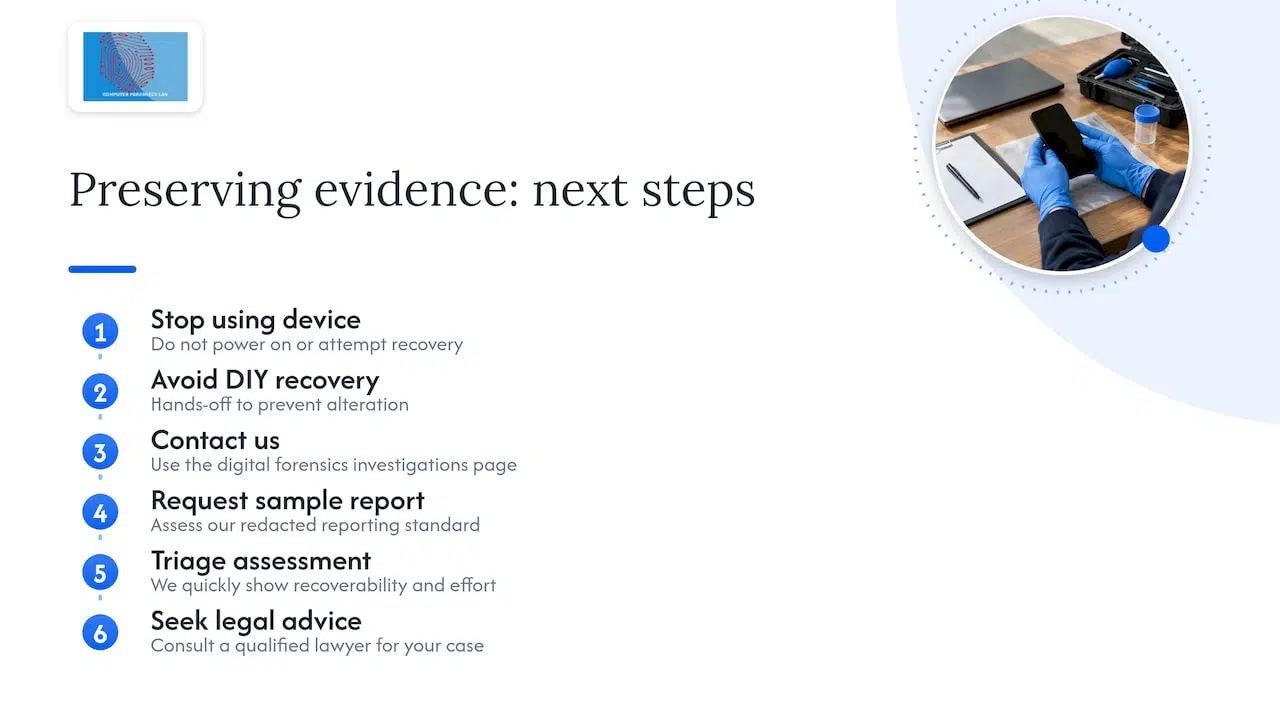
If you are facing a dispute involving digital evidence, the first step is simple: stop using the affected device and avoid attempting recovery yourself. We can provide a sample redacted report on request so you can assess our reporting standard before instructing us, and our triage process is designed to tell you quickly what is recoverable and what it will take. Get in touch through our digital forensics investigations page to discuss preservation and scope before evidence is at risk of being altered.
This article is general information, not a substitute for advice from a qualified lawyer. Consult a qualified legal professional about your own circumstances before acting on anything here.
FAQ
What is the salary of a forensic computer analyst?
Salary varies considerably by region, employer and experience level, and no single figure applies globally. Many roles require a bachelor’s degree in a computing discipline, with certifications such as CFCE or GCFA commonly preferred as evidence of competence, according to career guidance research.
What is forensic information technology?
Forensic information technology, more commonly called digital forensics, is the application of scientific methods to identify, preserve, analyse and report on digital evidence so it holds up under legal or regulatory scrutiny, as defined by NIST. It covers computers, mobile devices, cloud services and networks.
What qualifications do you need for computer forensics?
Most roles call for a degree in computer science, cybersecurity or a related field, combined with recognised professional certifications. According to career guidance, certifications such as CFCE and GCFA are commonly used to demonstrate practical competence beyond academic study.
What is forensic computing?
Forensic computing is another term for computer forensics, the branch of digital forensics focused specifically on laptops, desktops and storage media rather than mobile devices or networks. It involves imaging, hashing and analysing storage to recover files, metadata and usage history for use as evidence.
Can deleted files always be recovered?
No. Recoverability depends on how much the storage has been used since deletion and whether secure deletion or anti-forensic tools were applied, so some data is genuinely unrecoverable rather than simply hidden. A proper triage early in an investigation tells you realistically what can and cannot be retrieved before you commit to a full analysis.
Sources
- NIST glossary: digital forensics
- Electronic Crime Scene Investigation: A Guide for First Responders (NIJ)
- SWGDE best practices for digital evidence collection
- Digital investigation techniques: A NIST scientific foundation review
- SWGDE: Best practices for mobile device evidence collection