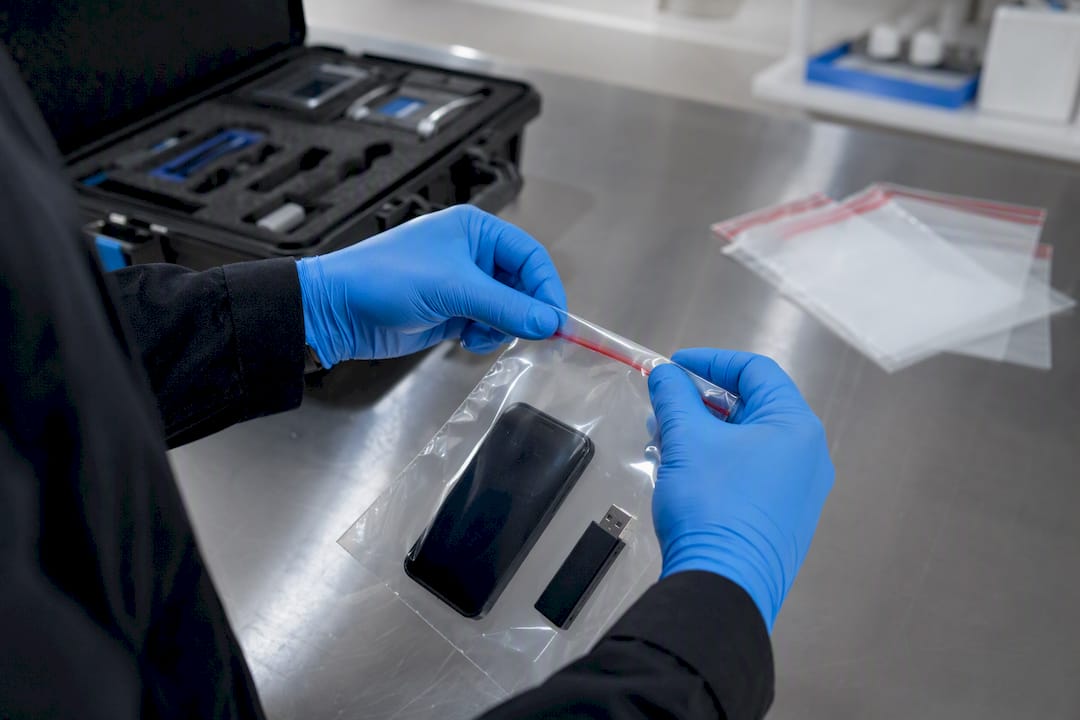
Chain of custody is the chronological, documented record of everyone who has handled a piece of evidence, from the moment it is collected to the moment it is presented in court or otherwise disposed of. Its purpose is to prove the evidence is authentic and has not been altered, lost or substituted. Without a continuous, auditable record, a court has no reliable way of confirming that the item examined in a laboratory or shown in a courtroom is the same item recovered at the scene.
- Definition: a documented trail of custody, transfer and storage
- Purpose: proves authenticity and legal integrity of evidence
- Requirement: records must be continuous, dated and auditable
Key Takeaways
Chain of custody protects evidence by documenting every handler, transfer and storage change from collection through to court, and any unexplained gap gives opposing counsel grounds to challenge admissibility.
| Point | Details |
|---|---|
| Definition matters | Chain of custody is the documented, continuous record proving evidence has not been altered or substituted. |
| Records need five fields | Identifier, description, date/time/location, handler names and transfer purpose must all appear. |
| Gaps carry real cost | Courts can exclude evidence or reduce its weight when continuity cannot be shown. |
| Fewer handlers, fewer risks | Each additional transfer is another potential point of failure and a possible witness requirement. |
| Digital evidence needs extra controls | Hashing, validated audit trails and metadata preservation protect against tampering claims. |
For deeper guidance on securing evidence in an active case, Computerforensicslab’s digital forensics services cover collection, imaging, expert witness reporting and chain-of-custody management for legal and corporate clients. You can also start with a direct enquiry through Computerforensicslab’s contact page.
This article is general information, not a substitute for advice from a qualified lawyer. Consult a qualified legal professional about your own circumstances before acting on anything here.
Table of Contents
- What is chain of custody meaning in a documented record?
- Why does chain of custody affect what a court will accept?
- How do you collect, seal, log and transfer evidence properly?
- What does breaking the chain of custody actually look like?
- How is chain of custody different for digital and cloud evidence?
- Which standards define good chain-of-custody practice?
- What should you check first to keep the chain unbroken?
- When should you bring in a digital forensics specialist?
- Sources
What is chain of custody meaning in a documented record?
A proper record answers five questions every time evidence changes hands: what is it, where was it, who had it, when did they have it, and why. Miss one of those answers and you have a gap a defence solicitor will find within minutes.
At minimum, a compliant record should capture the following, drawn from standard evidence-management guidance:
- A unique case and item identifier, plus a precise physical description.
- Date, time and exact location of collection.
- Full names or badge numbers of every handler, and the reason for each transfer.
- Storage location, container type, and the condition of any seal at each check.
- Confirmation of whether the record is paper, electronic or a hybrid of both, and whether it meets a minimum auditable standard.
Paper logs still work in smaller agencies, but electronic systems tend to catch gaps faster because they timestamp entries automatically rather than relying on someone remembering to write the time down.
Pro Tip: If you’re reviewing a chain-of-custody log for the first time, check the gaps between timestamps rather than the entries themselves. A missing hour between “collected” and “logged at station” is where most challenges begin.
Why does chain of custody affect what a court will accept?
Courts do not simply accept evidence at face value. A judge assesses whether the record shows unbroken continuity, meaning the item can be traced without interruption from the scene to the exhibit table, before deciding it can even be considered. The National Institute of Justice notes that a broken chain gives a court grounds to exclude the evidence entirely, or admit it with reduced weight, which can be just as damaging to a case as exclusion outright.
Chain of custody exists to assure the court that evidence was never unaccounted for, and documentation alone rarely settles the matter. Handlers are frequently called to testify about the condition of an item when they received it and when they passed it on, according to StatPearls’ clinical and legal overview of chain of custody.
A paper trail without a witness who can defend it in cross-examination is a weaker trail than one with both.
How do you collect, seal, log and transfer evidence properly?
The process starts the second an item is recovered, not when someone gets round to paperwork later. Every stage from collection to final disposition needs its own entry.
- Log at the point of collection. Assign a unique identifier, note the exact time, date and location, and describe the item before it moves anywhere.
- Seal with tamper-evident materials. Record the seal type and its condition, since a damaged or missing seal is one of the fastest ways to invite a challenge.
- Document every transfer. Each handover needs who received it, when, why, and where it went, following the same discipline laboratory evidence-management SOPs require of accessioning staff.
- Track subsamples separately. When an item is divided for analysis, the resulting child item inherits the parent’s identifiers but needs its own continuous record, logged by whoever held the item at the moment of division.
Pro Tip: Minimising the number of handlers is one of the simplest and most effective ways to protect an item’s evidential value; every additional pair of hands is another person who may eventually need to testify.
Our guide on preserving chain of custody for digital evidence walks through this same sequence adapted for forensic imaging and cloud extractions.
What does breaking the chain of custody actually look like?
Breaking the chain rarely happens through a single dramatic error. It is usually an accumulation of small omissions that, together, leave a gap nobody can explain.
- An item moves between rooms, evidence lockers or vehicles with no log entry recording the transfer.
- A seal arrives damaged, replaced, or simply missing, with no note explaining why.
- Evidence is repackaged without documenting the change in container or condition.
- A subsample is created without a new tracking record, so the derived item has no traceable history of its own.
Once any of these gaps appears, opposing counsel has a genuine opening to argue the item may have been tampered with or substituted, regardless of whether anything actually happened to it. The law does not require proof of tampering, only a plausible opportunity for it.
How is chain of custody different for digital and cloud evidence?
Digital evidence adds a layer physical evidence never faces: possession and access are not the same thing. Someone can copy a hard drive without ever touching it, which means the chain has to track logical access alongside physical custody.
- Forensic imaging with cryptographic hashing (commonly MD5 or SHA256) proves a copy matches the original bit for bit.
- An audit trail needs to link every action, view, copy, or export, to a specific individual, not just a shared login.
- Metadata and timestamps can shift during transfer or cloud synchronisation, so the record must note the original values before any handling begins.
- Cloud environments complicate this further, since data may sit across multiple jurisdictions and providers with their own retention and access logs.
Validated electronic systems built around unique logins, PINs or digital signatures produce an immutable audit trail; without that validation, an electronic record can become a weak point rather than a safeguard. Read more in Computerforensicslab’s breakdown of why chain of custody is crucial for digital evidence integrity.
Which standards define good chain-of-custody practice?
Several bodies set out what a defensible chain-of-custody process should contain, and it is worth knowing which one covers which stage.
- NIST OSAC publishes the Standard for On-Scene Collection and Preservation of Physical Evidence, covering how evidence should be documented and packaged from the moment of collection.
- NIJ provides legal training resources explaining how courts weigh admissibility and what documentation gaps mean for a case.
- Laboratory and agency SOPs, alongside broader documentation frameworks such as EMS documentation standards, govern day-to-day accessioning, storage and custodian responsibilities once evidence leaves the scene.
What should you check first to keep the chain unbroken?
If you only remember one sequence, remember this one.
- Record a unique ID, case number and full description the moment you collect the item.
- Seal it immediately and note the seal’s condition in writing.
- Log the date, time and handler ID for every single transfer.
- Get a signature and date on each handover, no exceptions.
- Record the storage location after every move.
- If something looks wrong, don’t fix it quietly. Document the inconsistency and secure the item immediately.
When should you bring in a digital forensics specialist?
Computerforensicslab has produced expert witness reports and supported cases featured on Discovery+’s 999 Murder Calling, and the recurring failure pattern is the same: gaps appear where non specialists handle digital devices without validated tools or logging discipline. Cross-jurisdictional transfers, encrypted devices and cloud data multiply that risk. Complex digital cases warrant a specialist from the point of seizure, not after a challenge is raised in court.
— Computer
Sources
- Chain of custody — NIST CSRC glossary
- Law 101: Legal Guide for the Forensic Expert — NIJ
- Chain of Custody — StatPearls (NCBI Bookshelf)