
An incident response plan is a written, formally approved document that tells an organisation exactly who does what, in what order, and with what authority the moment a security incident is confirmed. It is not a technical afterthought bolted onto an IT policy. It is a governance instrument that determines whether a breach becomes a contained inconvenience or a prolonged, litigated, headline-generating crisis.
Three benefits follow almost immediately from having one in place:
- Faster business continuity. Predefined containment steps and decision rights mean staff act rather than deliberate, cutting the time systems and services stay disrupted.
- Legal and regulatory readiness. A documented plan demonstrates due diligence to regulators and courts, and it structures the evidence-handling work that underpins any later litigation.
- Reputational control. A rehearsed communications workflow prevents the mixed messages and delayed disclosures that do more lasting damage than the incident itself.
Guidance from bodies including the Cybersecurity and Infrastructure Security Agency (CISA), the UK’s National Cyber Security Centre (NCSC), and the US National Institute of Standards and Technology (NIST) converges on the same point: an incident response plan works because it removes ambiguity before a crisis starts, not during one. That convergence matters, because it means the fundamentals of a good IRP aren’t a matter of opinion or vendor preference.
Key Takeaways
An effective incident response plan works because it replaces improvisation with predefined roles, tested playbooks, and a rehearsed communications and legal workflow.
| Point | Details |
|---|---|
| Definition anchors everything | An IRP is a written, leadership-approved document assigning roles like Incident Manager and Communications Manager. |
| Roles prevent crisis paralysis | Name an Incident Manager who coordinates rather than performs technical fixes during a live incident. |
| Two lifecycle models, one process | The 5-step and 7-step models describe the same phases; the 7-step version simply separates lessons learned and follow-up. |
| Testing exposes real gaps | Run quarterly tabletops, annual full simulations, and fold every finding back into the plan with an owner and deadline. |
| Evidence handling protects legal standing | Preserve volatile data, image devices, and maintain a single chain-of-custody log from the first minute of response. |
Table of Contents
- What is a cyber security incident response plan actually for?
- What core components should every incident response plan include?
- What are the steps in incident response, from prepare to recover?
- Who is responsible for each part of the response?
- How do you create an incident response plan step by step?
- How often should you test an incident response plan?
- How should evidence be documented and preserved?
- When should you bring in external forensics or legal specialists?
- How do you keep an incident response plan current?
- What are common incident types and how do you respond to each?
- What should you do next to put a plan in place?
- Why treating an incident response plan as a legal document changes everything
- Frequently asked questions
- Sources
What is a cyber security incident response plan actually for?
An incident response plan exists to prevent good people from making bad decisions under pressure. That is its entire purpose, stripped of jargon.
When systems go down or data starts leaving the network, the instinct is to act immediately, sometimes in ways that destroy evidence, tip off an attacker, or breach a regulatory notification window without anyone realising it. Microsoft’s own security guidance makes the mechanism explicit: high-stress incidents are where mistakes cluster, and a predefined response plan reduces those errors by clarifying roles and expected actions in advance, so the team executes rather than improvises.
The financial and reputational cost of skipping this step is rarely a single dramatic failure. It is usually a chain of small ones: a server pulled offline without imaging the disk first, a customer email sent before legal has reviewed the wording, a regulator missed by 48 hours because nobody owned that responsibility. Each is avoidable with a plan; each is common without one.
Beyond the immediate scramble, an IRP delivers benefits that compound over the following weeks and months:
- Faster containment, because responders follow a rehearsed sequence instead of debating one on the fly.
- Clearer decision authority, so nobody waits for a senior executive to wake up before isolating a compromised server.
- Compliance support, since most data protection regimes expect organisations to show they had a documented, tested response capability.
- Reduced legal exposure, because chain-of-custody and evidence-preservation steps are followed from minute one rather than reconstructed afterwards.
A well-run incident response process reduces mistakes made under pressure by defining, in writing, who does what and how, which lowers the odds of rash decisions that worsen damage or increase regulatory exposure. That single principle, drawn from Microsoft’s incident response framework, is arguably the strongest argument for building a plan before you need one rather than while you’re using it.
The NCSC’s board toolkit reinforces this from a governance angle: planning and recovery activity minimises operational impact precisely because it gives executives clear decision points instead of forcing them to invent a process mid-incident.
What core components should every incident response plan include?
A workable plan has five structural pillars. Miss one and the rest tend to unravel under real pressure.
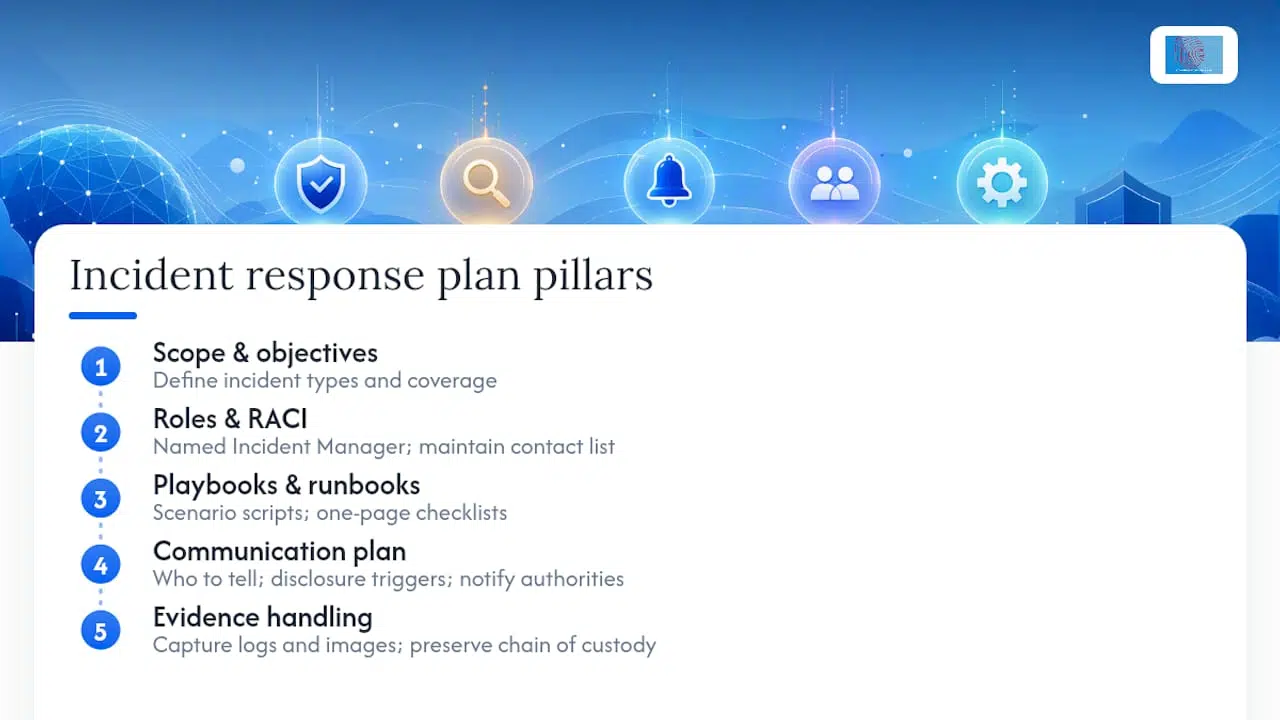
Scope and objectives. Define precisely what counts as an incident for your organisation, from a phishing click to a full ransomware encryption event, and state what the plan does and does not cover. A vague scope leads to arguments about jurisdiction while the clock is running.
Roles and RACI-style responsibilities. Every plan needs a named Incident Manager, a technical lead, a communications owner, and a legal contact, along with an up-to-date contact list that survives staff turnover. CISA’s guidance on incident response plan basics specifically calls out the Incident Manager and Communications Manager roles as non-negotiable fixtures.
Playbooks and runbooks. A playbook is a scenario-specific script, for ransomware, phishing, or a lost device, while a checklist is the generic backbone that applies regardless of incident type. Use a playbook when the incident type is predictable and recurring; fall back to the general checklist when you’re dealing with something novel.
Communication plan. Map out who gets told internally, what triggers external disclosure, and which regulators or law enforcement bodies need notifying, and within what timeframe. This section should name specific thresholds, not leave “serious enough to notify” to individual judgement mid-crisis.
Evidence handling and preservation. Basic rules for capturing logs, imaging affected devices, and maintaining chain of custody protect both the investigation and any future legal case. NIST SP 800-61r2 sets out the technical baseline most organisations build from, covering documentation standards and evidence-preservation practice in detail.
Pro Tip: Keep your playbooks to one page each. A responder under pressure at 2am will not read a ten-page procedure document, but they will follow a single-page checklist with numbered steps and a phone number at the bottom.
A short ransomware playbook, for instance, might read: isolate affected endpoints from the network, preserve volatile memory before shutdown where forensically possible, notify the Incident Manager and legal contact within 30 minutes, and do not pay or negotiate without executive and legal sign-off. That is the entire first page. Detail on eradication and recovery comes later, once containment is confirmed.
What are the steps in incident response, from prepare to recover?
Two lifecycle models dominate incident response guidance, and they describe the same process at different resolutions rather than genuinely competing frameworks.
The five-step model, popularised by Palo Alto Networks among others, runs:
- Prepare — build the plan, train staff, and stage tools before anything happens.
- Identify — detect and confirm that an incident is genuinely underway.
- Contain — stop the spread, whether that means isolating a network segment or disabling an account.
- Eradicate — remove the root cause, from malware to a compromised credential.
- Recover — restore systems to normal operation and confirm the threat is gone.
The seven-step model, closer to the structure in NIST SP 800-61r2, splits the tail end further:
- Preparation
- Identification
- Containment
- Eradication
- Recovery
- Lessons learned
- Follow-up (verifying that fixes stuck and closing outstanding actions)
The difference is not substantive. The seven-step model simply makes explicit what the five-step model treats as implied good practice: that recovery isn’t the end, and that a retrospective plus a follow-up check are where most of the long-term value actually gets captured. Organisations using the shorter model still need to do steps six and seven; they just fold them under “recovery” rather than naming them separately.
Timelines vary enormously by incident type, but rough expectations help set expectations with executives. Identification can take minutes for an obvious ransomware note, or weeks for a slow data exfiltration. Containment on a well-rehearsed plan typically happens within hours; without one, it commonly stretches into days. Executive escalation should trigger the moment containment estimates pass 24 hours, or the moment data exfiltration is suspected, whichever comes first. The NCSC’s planning guidance is explicit that board-level involvement at this stage reduces operational impact rather than merely adding oversight.
Who is responsible for each part of the response?
Role clarity is where most incident response plans quietly fail, usually because organisations assume everyone already knows their job. They don’t, particularly three hours into a stressful weekend incident.
The Incident Manager leads the response but does not perform technical remediation. This distinction matters more than it sounds: an IM who starts trying to fix the firewall themselves stops coordinating, and coordination is the one job nobody else in the room is doing. Their focus is decisions, timing, and communication flow, not keyboards.
The technical lead runs the actual containment and eradication work, translating the IM’s decisions into system-level action. The Communications Manager owns every external and internal message, ensuring nothing goes out that contradicts legal advice or understates the situation. Legal advises on notification obligations, evidence admissibility, and liability exposure, and should be looped in far earlier than most organisations instinctively do. HR gets involved when the incident touches an employee, whether as a victim of phishing or a suspect in insider misconduct. An executive sponsor holds ultimate accountability and approves major decisions like paying a ransom or issuing a public statement.
| Role | Primary responsibility | Typical evidence needs |
|---|---|---|
| Incident Manager | Coordinates the response, owns the timeline, makes non-technical calls | Incident log, decision record |
| Technical lead | Executes containment, eradication and recovery actions | System logs, forensic images, malware samples |
| Communications Manager | Manages internal and external messaging | Approved statements, distribution records |
| Legal advisor | Assesses notification duties and evidence admissibility | Chain-of-custody documentation, regulatory correspondence |
| HR | Manages employee-related aspects of the incident | Personnel records, disciplinary documentation where relevant |
In RACI terms, the Incident Manager is typically Accountable for the overall response, the technical lead is Responsible for execution, legal and HR are Consulted at key decision points, and the executive sponsor and wider leadership team are Informed throughout, escalating to Accountable only for the highest-impact calls, such as public disclosure or ransom payment.
Pro Tip: Choose an Incident Manager who is comfortable staying non-technical during a crisis. The best technical experts are often the worst Incident Managers, because their instinct is to solve the problem with their own hands rather than direct others to solve it.
How do you create an incident response plan step by step?
Building a plan is a sequence, not a single document-writing exercise. Skipping steps to get to a finished PDF faster tends to produce a plan nobody trusts when it actually matters.
- Secure executive sponsorship first. Without a named senior leader who will approve the plan and defend its authority during a crisis, the document has no teeth.
- Define scope and incident categories. Agree what counts as an incident and set severity tiers, since a low-severity phishing attempt and a ransomware outbreak demand very different response speeds.
- Assemble the response team and assign roles. Name individuals, not just job titles, and keep a backup contact for each role.
- Write the core plan document. Cover governance, escalation triggers, and the communication workflow before drafting individual playbooks.
- Build playbooks for your highest-likelihood incidents. Ransomware, phishing, and data breach playbooks cover the majority of real-world cases for most organisations.
- Establish evidence-handling procedures. Set out logging, imaging and chain-of-custody rules aligned with NIST SP 800-61r2.
- Get formal sign-off. Route the finished plan through senior leadership for approval, as CISA’s guidance recommends, and record the approval date.
- Distribute and train. Make sure everyone named in the plan has read it and knows where to find it, including a printed or offline copy in case systems are down.
- Schedule the first tabletop exercise. A plan that has never been tested is a hypothesis, not a capability.
A one-page IRP summary, useful as a quick-reference laminated sheet, should contain: incident severity definitions, the Incident Manager’s name and backup, the escalation contact chain, the first three containment actions for your most likely incident type, and the regulatory notification deadline that applies to your sector.
Ownership sits with a named plan custodian, usually the security or IT lead, who is responsible for keeping the document current between formal reviews. Approval authority should rest with an executive sponsor, not the custodian, to give the plan organisational weight. On resourcing, the main cost drivers are staff time for drafting and testing, logging and monitoring tooling such as a SIEM platform, staff training, and, for many organisations, a retainer with an external forensics or legal provider so that expert help doesn’t need to be sourced cold during an actual incident. TechTarget’s build guide sets out a similarly practical sequence, with sample templates worth reviewing alongside your own draft. Organisations building this out for the first time may also find a dedicated incident response procedures guide for legal teams useful for aligning the plan with legal review requirements from the outset.

How often should you test an incident response plan?
Testing is where most plans reveal their gaps, and it is also the step organisations most often skip once the document is signed off and filed away.
Tabletop exercises are discussion-based walkthroughs where the team talks through a scenario without touching any live systems. They’re cheap to run and should happen quarterly, involving the Incident Manager, technical lead, communications lead, and at least one executive so leadership feels the pressure of a live decision without any real risk attached.
Walk-throughs go a step further, having the technical team physically demonstrate the actions in the playbook, such as isolating a test server, without affecting production. Aim for these twice a year.
Red-team and blue-team exercises put an attacking team against the defending team in a controlled environment, testing detection and response capability under realistic conditions. Annual frequency is typical, and these exercises benefit from independent expertise where the internal team lacks offensive security skills, which is where structured penetration testing work overlaps directly with incident response readiness.
Full-scale simulations replicate an actual incident as closely as safely possible, involving every named role and often external stakeholders like a communications agency or legal counsel. Run one annually at minimum, ideally rotating the scenario each year between ransomware, data breach, and insider threat.
Evaluation should track concrete metrics: time-to-detect, time-to-contain, and whether communications went out accurately and on schedule. After every exercise, document what failed, assign an owner to each closure item, and set a deadline for fixing it. An exercise that produces no changes to the plan was not a rigorous exercise.
How should evidence be documented and preserved?
Documentation done badly is the single most common reason a genuine security incident becomes unusable in court or unreportable to a regulator with confidence. Cisco’s security guidance underscores a related point: organisation-wide staff awareness of basic security concepts materially reduces disruption during an incident, because staff who understand the basics don’t destroy evidence out of ignorance while trying to be helpful.
The core preservation checklist covers:
- Capturing volatile data (memory, active network connections, running processes) before any device is powered down.
- Creating forensic disk images rather than working directly on a live, potentially compromised machine.
- Preserving relevant logs, extending retention if an investigation looks likely to run long.
- Storing evidence on write-protected or read-only media with restricted access.
Chain of custody depends on discipline as much as tools. Record who collected each piece of evidence, exactly when, and where it has been stored or transferred since. Timestamp everything, and keep a single custody log rather than scattering records across email threads and chat messages, which is where custody chains typically break down under scrutiny.
Forensic readiness means having these capabilities in place before an incident, not scrambling to build them during one: pre-authorised collection tools, agreed logging retention periods, and a standing contact list for external forensic specialists. Good documentation from the outset feeds directly into the post-incident retrospective and any regulatory report, since reconstructing a timeline from memory weeks later is far less reliable than working from contemporaneous records. Organisations wanting a fuller walkthrough of this process may find the guide on investigating data breaches with legal and forensic steps a useful companion to this section.
When should you bring in external forensics or legal specialists?
Some incidents are within the competence of an internal team. Others require outside expertise the moment they’re confirmed, and knowing which is which before the incident happens saves critical hours.
Bring in external specialists when:
- Data exfiltration is suspected but not yet confirmed, since determining what left the network requires forensic techniques most internal IT teams don’t use routinely.
- Ransomware has already encrypted systems, particularly where the decision to pay, negotiate, or restore from backup carries legal and financial weight beyond IT’s remit.
- A regulator has issued a formal notice or information request, at which point legal counsel experienced in that specific regulatory regime becomes essential.
- The incident is likely to end up in litigation, whether that’s an employee dispute, an intellectual property theft claim, or a third-party lawsuit, because evidence gathered without proper forensic method risks being challenged or excluded later.
In cases involving suspected employee data theft or insider misconduct, external forensic examiners are often brought in specifically because internal staff investigating a colleague creates both a conflict of interest and a chain-of-custody vulnerability that a defence lawyer will exploit if the case reaches a tribunal or court.
Before making that call, have ready: a timeline of what’s known so far, a list of affected systems and their locations, any logs already captured, and clarity on who internally has authority to grant access to devices and accounts. Specialists work faster and more accurately when they’re not spending the first hour extracting basic facts from a disorganised internal team. Computerforensicslab’s digital forensic investigation services are built around exactly this kind of engagement, stepping in once an internal team has identified that a case needs independent, court-admissible evidence handling.
How do you keep an incident response plan current?
A plan that hasn’t changed in two years is not a mature plan. It’s an untested one, and it’s usually testing itself for the first time during a real incident, which is the worst possible moment to discover it’s out of date.
Track a small set of KPIs consistently: time-to-detect, time-to-contain, mean time to recovery, and the number of action items from the last tabletop exercise that have actually been closed. A plan with a growing backlog of unresolved tabletop findings is a plan quietly losing credibility.
- Run a quarterly tabletop exercise to keep the team’s muscle memory current.
- Conduct a full annual review of the entire document, checking contact details, tooling references, and regulatory requirements for accuracy.
- Trigger an immediate update after every real incident, folding the retrospective’s findings directly into the plan rather than letting them sit in a separate document nobody revisits.
Version control matters more than it might seem. Keep a single source of truth, ideally one document with a visible audit trail of who changed what and when, along with the approval stamp for each revision. Distribute the current version actively rather than assuming people will check for updates themselves; a plan sitting unread in a shared drive is functionally identical to no plan at all.
What are common incident types and how do you respond to each?
Recognising the incident type quickly shapes everything that follows, since ransomware, phishing, and a data breach each demand a different first move.
Ransomware. Indicator: files becoming inaccessible, often with a ransom note appearing on affected systems.
- Isolate affected devices from the network immediately.
- Preserve volatile memory and logs before any shutdown.
- Identify the ransomware variant if possible, to check for known decryption tools.
- Notify legal and executive leadership before any decision on payment or negotiation.
This category typically requires external escalation, both to specialist forensics and, in most jurisdictions, to a data protection regulator if personal data was affected.
Phishing. Indicator: a user reports a suspicious email, or unusual account activity follows a click.
- Disable or reset credentials for the affected account immediately.
- Check for lateral movement or further compromised accounts.
- Preserve the phishing email and any headers for analysis.
- Notify affected users if their data may have been exposed.
Data breach. Indicator: unauthorised access to, or exfiltration of, sensitive data is confirmed or strongly suspected.
- Contain the access point, whether a compromised account, an exposed database, or a misconfigured server.
- Determine the scope of data affected before making any public statement.
- Engage legal counsel to assess notification obligations.
- Preserve all relevant logs for forensic review.
Regulatory notification is almost always required here, often within a tight statutory window, making early legal involvement essential rather than optional.
Insider incident. Indicator: unusual data access patterns, unauthorised downloads, or a tip-off from a colleague.
- Preserve evidence discreetly before confronting the individual.
- Involve HR and legal from the outset, given the employment law dimension.
- Restrict the individual’s access without alerting them prematurely, where legally possible.
- Document everything meticulously, since these cases frequently proceed to tribunal or litigation.
DDoS attack. Indicator: a sudden, sustained spike in traffic that degrades or takes down a service.
- Engage upstream mitigation (ISP or a DDoS protection service) immediately.
- Communicate proactively with customers if the outage is visible externally.
- Monitor for a DDoS being used as a distraction for a separate, quieter intrusion.
- Log traffic patterns for post-incident analysis.
What should you do next to put a plan in place?
A functioning incident response plan requires a named Incident Manager, a tested playbook for your most likely incident type, and a rehearsed communications workflow to actually work under pressure. Everything else in this article supports that one core requirement.
Five actions to take this week, each with a clear owner:
- Draft the one-page plan summary — owner: IT or security lead, using the fields set out in the how-to-build section above.
- Name an Incident Manager and a backup — owner: executive sponsor, chosen for coordination skill rather than technical depth.
- Schedule the first tabletop exercise — owner: Incident Manager, within the next 90 days.
- Build the external contact list — owner: legal or security lead, including a forensic specialist retainer before you need one.
- Get executive sign-off on the draft plan — owner: plan custodian, formalising the document’s authority.
Whatever you find during your first tabletop exercise, treat the retrospective as strictly blameless. Punishing honest disclosure during a post-incident review guarantees that the next one gets less honest, not more careful. For templates and deeper technical reading, the sources listed below are a solid starting point.
Why treating an incident response plan as a legal document changes everything
Most guidance on incident response plans treats them primarily as IT documents with a legal appendix bolted on. That framing gets the priority backwards, and it’s the single biggest gap between what organisations are told to do and what actually protects them when something goes wrong.
An incident response plan is, first and foremost, a resilience and evidence document. The technical containment steps matter enormously, but they are the easier half of the problem. The harder half is whether the organisation can later prove, to a regulator, a court, or an insurer, that it acted reasonably, preserved evidence properly, and notified the right people within the right timeframe. A plan that contains excellent technical playbooks but weak chain-of-custody discipline will still fail an organisation when the dispute moves from the server room to the courtroom.
The conventional advice to “test your plan regularly” is correct but incomplete. What matters more is testing the plan’s weakest link, which for most organisations is the handoff between technical containment and legal or regulatory decision-making. Tabletop exercises tend to focus heavily on the technical sequence and treat the legal and communications elements as an afterthought, rehearsed in five minutes at the end. That’s backwards. The technical steps are usually well understood by the people running them; the legal and communications decisions are where hesitation, miscommunication, and costly delay actually happen.
If there’s one thing worth prioritising above all else, it’s this: get legal and communications leads into your tabletop exercises from day one, not once the plan feels “mature enough” to involve them. An incident response plan that has only ever been rehearsed by the technical team is a plan that will surprise everyone else the first time it runs for real.
Ready to make sure your incident response plan holds up under real scrutiny, not just in a tabletop exercise? Computerforensicslab provides digital forensics services built specifically for organisations that need evidence handling, chain-of-custody discipline, and expert witness capability behind their response plan, not just a document on a shelf.
This article provides general information and does not constitute legal advice. Confirm your specific regulatory notification obligations with qualified legal counsel and the relevant regulator for your sector and jurisdiction.
Frequently asked questions
What is an incident response plan in cyber security, specifically?
It is the documented, approved procedure an organisation follows to detect, contain, eradicate, and recover from a cybersecurity incident, covering technical steps, roles, communications, and evidence handling in one reference document.
What is incident management in cyber security compared to incident response?
Incident management is the broader governance function, covering policy, resourcing, and oversight, while incident response is the operational execution of the plan during an actual event.
How long should it take to build a first incident response plan?
A workable first draft typically takes two to four weeks for a small organisation, covering roles, scope, and one or two priority playbooks, with full maturity, including testing, developing over the following six to twelve months.
Do small businesses really need a formal incident response plan?
Yes. Regulatory notification duties and reputational risk apply regardless of company size, and a simple one-page plan with named contacts is far better than no plan at all.
What is the difference between a playbook and the overall incident response plan?
The plan is the governing document covering roles, scope, and communication rules; a playbook is a scenario-specific script, such as for ransomware or phishing, that sits underneath it.
Sources
- Incident Response Plan (IRP) Basics | CISA
- What is incident response? | Microsoft Security
- Planning your response to cyber incidents | NCSC
- Computer Security Incident Handling Guide (NIST SP 800-61r2)
Use these for official checklists and templates rather than relying on any single source in isolation; each covers a slightly different angle, from technical handling to board governance.