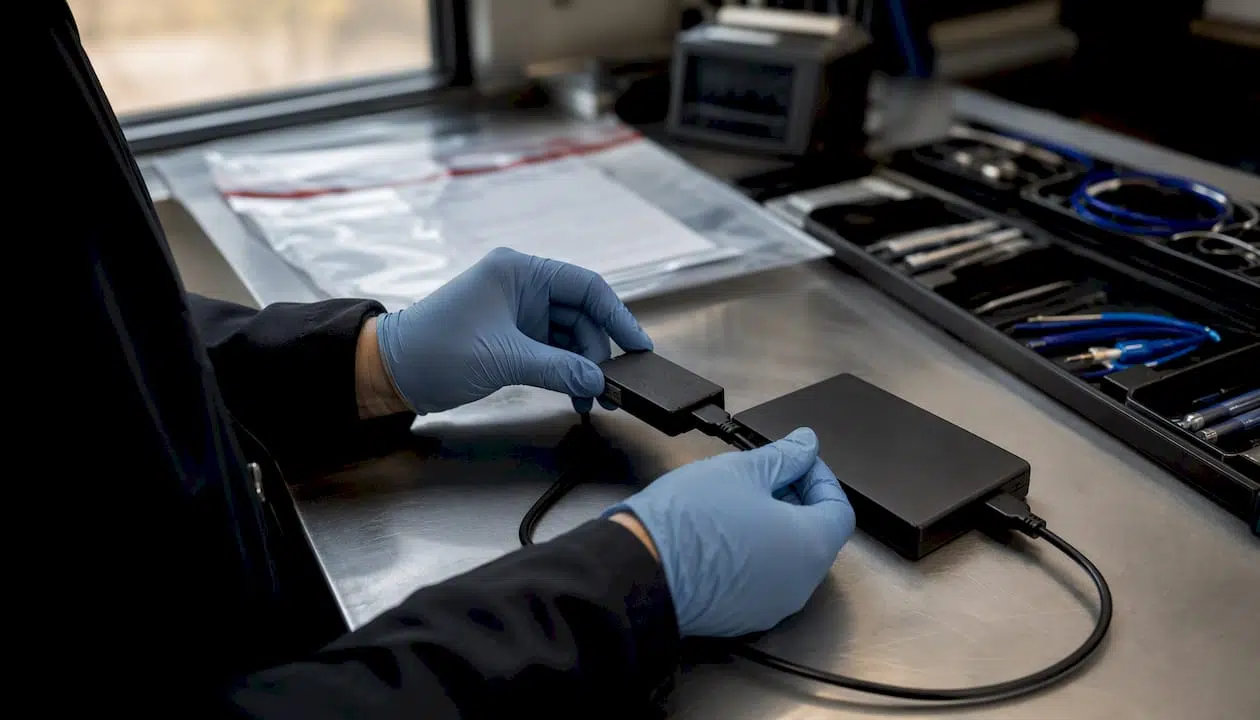
Digital evidence is any information stored or transmitted in binary form that may be relied upon in a court of law or formal investigation, encompassing everything from device logs and email records to cloud-stored files and network packet captures. NIST defines it as electronic information stored or transmitted in binary form, a formulation adopted across technical and legal contexts precisely because it is technology-neutral and jurisdiction-portable. Interpol describes digital forensics as the discipline of identifying, acquiring, processing, analysing and reporting on that electronic data for investigative and prosecutorial purposes.
For cybersecurity professionals and legal practitioners in the United Kingdom, understanding what digital evidence in cyber security actually comprises, how it is collected, and what makes it admissible is not an academic exercise. It determines whether a prosecution succeeds, whether a civil claim survives disclosure, and whether an organisation can demonstrate regulatory compliance after a breach. The sections below address types and sources, key properties, the standard forensic workflow, UK admissibility requirements, a first-responder checklist, common challenges, and guidance on when to engage a specialist laboratory.
Key takeaways
Digital evidence is binary-form information that, when properly acquired, preserved, and documented, can establish timelines, support attribution, and withstand scrutiny in UK legal proceedings.
| Point | Details |
|---|---|
| Definition is technology-neutral | NIST and Interpol define digital evidence as binary-form electronic information, covering devices, networks, cloud, and IoT sources. |
| Volatility drives collection priority | RAM, active connections, and encryption keys disappear on shutdown; assess live capture need before powering down any device. |
| Chain of custody is decisive | Hash verification, acquisition logs, and documented handling records are the foundation of any admissibility argument in UK proceedings. |
| Anti-forensics and encryption are real limits | Secure deletion, timestamp tampering, and full-disk encryption can constrain recovery; attribution requires corroborating evidence beyond device association. |
| Early specialist engagement matters | For litigation, breaches, or complex malware, an accredited laboratory engaged from the outset produces stronger, court-ready evidence. |
Table of Contents
- What counts as digital evidence — formal definitions and scope
- Key properties of digital evidence investigators must plan for
- Digital forensics workflow: from identification to reporting
- Admissibility and chain of custody in UK proceedings
- Immediate actions and an evidence preservation checklist for first responders
- Common challenges, anti-forensics techniques and limitations
- High-level categories of tools and techniques used in digital investigations
- When to engage a digital forensics provider and what to ask
- A practitioner’s perspective on digital evidence handling
- Sources
What counts as digital evidence — formal definitions and scope
Three authoritative bodies anchor the formal definition, and each adds a useful dimension.
- NIST treats digital evidence as electronic information stored or transmitted in binary form, keeping the definition deliberately broad so it applies equally to a hard drive image, a cloud storage export, or a memory dump.
- UNODC distinguishes between active footprints (data a user deliberately creates: sent emails, saved documents, browser bookmarks) and passive footprints (data generated automatically by systems: access logs, connection timestamps, GPS coordinates embedded in photographs). Both categories are recognised as digital evidence and both carry probative value.
- Interpol frames the scope operationally: evidence found on computers, mobile devices, networked systems, and cloud infrastructure, with the forensic goal of producing findings that withstand scrutiny in adversarial proceedings.
The practical scope is wider than most practitioners initially expect:
- Device-resident data: files, databases, application data, and operating system artefacts on endpoints, servers, and mobile devices.
- Network artefacts: packet captures, firewall logs, DNS query records, and proxy logs that record communication between systems.
- Cloud and SaaS data: stored objects, access logs, authentication records, and version histories held by third-party providers.
- Metadata and derived content: file creation and modification timestamps, geolocation tags, document authorship fields, and hash values.
- Device-generated artefacts: system event logs, registry entries, and audit trails produced automatically, independent of user intent.
The distinction between content (what a user wrote, sent, or saved) and device-generated artefacts (what the system recorded automatically) matters in court because the two categories attract different authentication arguments and, in some cases, different disclosure obligations.
Key properties of digital evidence investigators must plan for
Four properties shape every collection and preservation decision: volatility, fragility, reproducibility, and provenance.
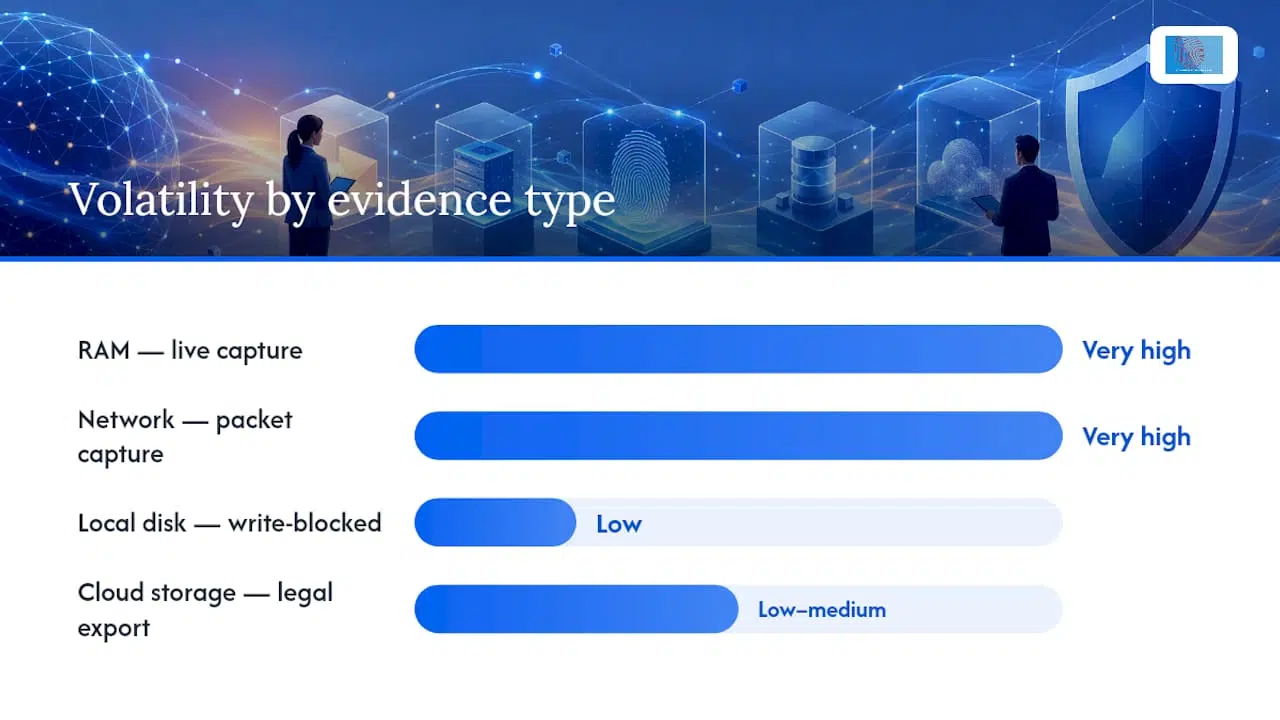
Volatility describes how quickly evidence disappears without active preservation. RAM contents, active network connections, and running process lists exist only while a system is powered and connected; they are gone the moment a device is shut down. Disk-resident data and cloud backups sit at the opposite end of the spectrum, persisting indefinitely unless deliberately overwritten.
Fragility is distinct from volatility. Even persistent data can be altered or destroyed by careless handling. Accessing a file updates its last-accessed timestamp; running antivirus software on a suspect device can overwrite deleted file remnants; booting from the original drive rather than a forensic image modifies the filesystem. SWGDE best practices require practitioners to minimise changes to source media, using hardware or software write-blockers and creating verified forensic images before any analysis begins.
Reproducibility is one of digital evidence’s genuine advantages over physical evidence. A forensic image is a bit-for-bit copy of the original; its integrity is verified by computing a cryptographic hash (typically SHA-256) of both the original and the copy. Matching hashes confirm that the copy is identical to the source, a property that supports both authenticity arguments in court and independent re-examination by opposing experts.
Provenance ties a piece of evidence to its origin. Metadata, acquisition logs, and chain-of-custody records collectively establish where data came from, who handled it, and what tools were used, which is the foundation of any authentication argument.
| Source type | Volatility | Typical preservation method |
|---|---|---|
| RAM / live memory | Very high | Live memory capture before shutdown |
| Active network connections | Very high | Packet capture during incident |
| Disk (local drive) | Low | Write-blocked forensic image with hash verification |
| Cloud storage / logs | Low to medium | Legal preservation request; export with hash |
Locard’s exchange principle, long applied in physical forensics, holds equally in digital environments: practically every interaction leaves a trace. The implication for investigators is that both active and passive footprints should be sought, because the absence of expected artefacts can itself be evidentially significant.
Digital forensics workflow: from identification to reporting
The standard digital forensics workflow, sometimes called the DFIR (Digital Forensics and Incident Response) process, proceeds through six stages. IACP guidance frames the discipline as focusing on identifying, acquiring, processing, analysing, and reporting on electronic data for investigative and prosecutorial use.
- Identification: Determine which devices, accounts, and data sources are in scope. Triage decisions at this stage — which systems are most likely to hold relevant evidence — shape the entire investigation.
- Acquisition: Capture data from identified sources using forensically sound methods. Live acquisition (capturing RAM and active connections from a running system) is necessary when volatile evidence is present; dead acquisition (imaging a powered-down device) is appropriate when volatility is not a concern. SWGDE acquisition guidance stresses that responders should assess whether a live capture is necessary before powering down any device, because shutdown without that assessment risks losing RAM contents, active connections, and encryption keys.
- Preservation: Compute and record cryptographic hashes of acquired images immediately after acquisition. Store originals in tamper-evident packaging with access restricted to documented personnel.
- Analysis: Examine forensic images and data exports for artefacts relevant to the investigation. Typical outputs include filesystem timelines, communication logs, browser history reconstructions, and malware indicators.
- Validation: Verify findings using independent tools or methods where possible. Reference datasets such as the NIST National Software Reference Library (NSRL) allow investigators to filter known, non-probative system files, reducing analysis time and focusing attention on genuinely relevant material.
- Reporting: Produce a written report that documents methodology, findings, and conclusions in terms accessible to a non-technical audience, including the court. The report must be reproducible: another qualified examiner following the same documented steps should reach the same conclusions.
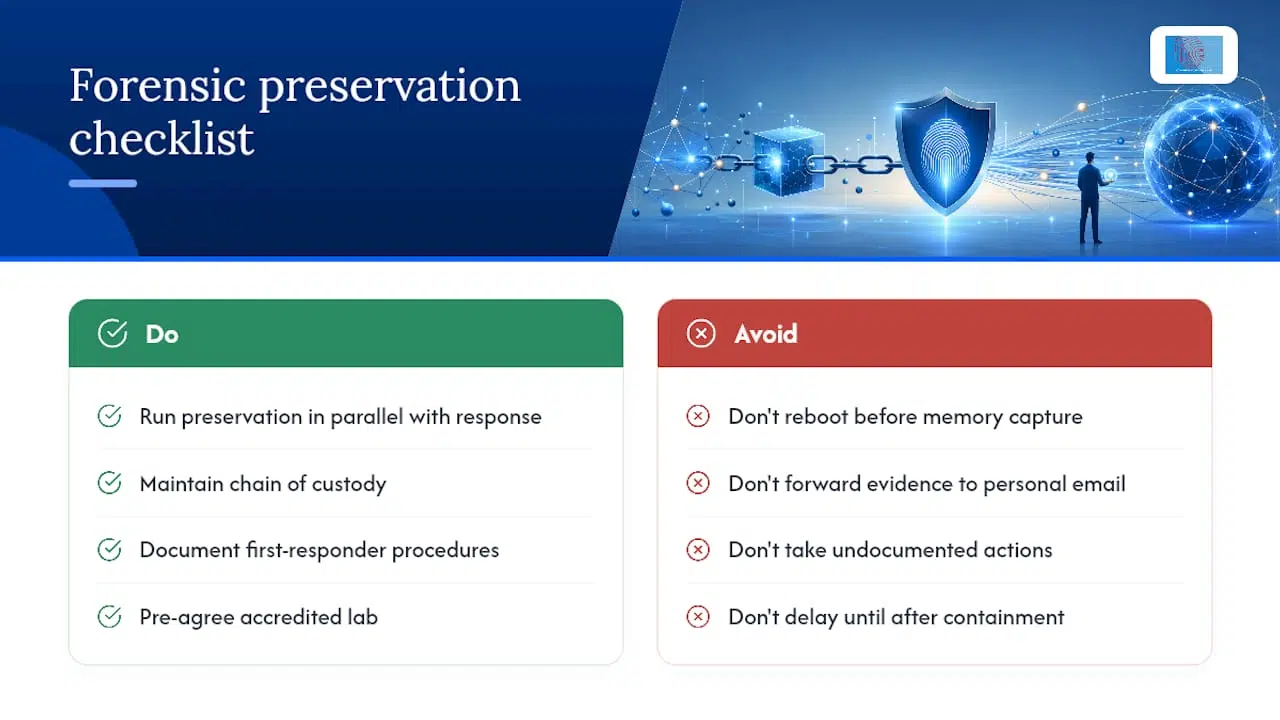
Throughout the process, DFIR coordination matters. Incident response activities (containing a breach, patching vulnerabilities) can overwrite or destroy forensic evidence if they proceed without coordination with the forensic examiner. Conversely, delaying containment to preserve evidence can extend harm. The two workstreams should run in parallel, with explicit agreement on which actions are permissible before forensic acquisition is complete.
Admissibility and chain of custody in UK proceedings
For digital evidence to be admissible in UK criminal and civil proceedings, it must satisfy four core requirements: authenticity, integrity, relevance, and compliance with best evidence principles.
- Authenticity: The evidence must be shown to be what it purports to be. Cryptographic hashing, acquisition logs, and documented chain of custody collectively establish this. UNODC guidance notes that authentication requires establishing provenance and demonstrating the integrity of the tools and processes used.
- Integrity: No unauthorised modification since acquisition. Write-blocking, hash verification, and restricted access logs demonstrate integrity.
- Relevance: The evidence must bear on a fact in issue. This is a legal determination, but forensic examiners should document the connection between each artefact and the alleged conduct.
- Best evidence: UK courts expect original data or a verified forensic copy. A screenshot or informal export, without accompanying acquisition documentation, will face challenge.
The chain of custody is the documentary record of every person who handled the evidence, when they handled it, and what they did with it. For UK proceedings, the digital chain of custody record should capture:
- Exhibit reference number and unique identifier
- Device description, make, model, and serial number
- Date, time, and location of seizure or acquisition
- Name and role of each person who handled the exhibit
- Storage conditions and location at each stage
- Hash values (pre- and post-acquisition) and the tool used to compute them
- Any actions taken on the device and the justification for each
The Police and Criminal Evidence Act 1984 (PACE) and its Codes of Practice govern the seizure of electronic devices in criminal investigations. The Forensic Science Regulator sets quality standards for forensic science providers operating in England and Wales, and the Crown Prosecution Service (CPS) expects disclosure of all material that may undermine the prosecution case or assist the defence, including acquisition logs and tool validation records.
Pro Tip: Engage legal counsel before beginning acquisition in any matter that may lead to litigation. Early liaison prevents spoliation — the inadvertent destruction of evidence through well-intentioned but undocumented actions — and ensures that preservation steps align with disclosure obligations from the outset. See the digital evidence admissibility guide for UK-specific procedural detail.
Immediate actions and an evidence preservation checklist for first responders
The decisions made in the first minutes at an incident scene frequently determine whether evidence survives to court. The following checklist reflects recognised first-responder guidance.
Triage decision first:
- Is the device powered on? If yes, assess whether volatile evidence (RAM, active connections, encryption keys) is present and relevant before deciding whether to perform a live capture or shut down.
- If live capture is required, use a validated memory acquisition tool and document the process before touching anything else.
- If the device is already powered off, do not power it on. Image the storage media using a write-blocker.
Scene documentation and device securing:
- Photograph the scene before touching any device, capturing screen contents, cable connections, and physical layout.
- Note the system time displayed on screen and compare it to a trusted time source; record any discrepancy, as timestamps in forensic analysis will need to be adjusted accordingly.
- Do not use the suspect’s credentials to log in, access accounts, or browse files. Doing so modifies artefacts, creates new access timestamps, and may constitute unauthorised access under the Computer Misuse Act 1990.
- Disconnect devices from networks (unplug Ethernet, disable Wi-Fi) only after live capture decisions have been made, to prevent remote wiping.
Labelling, sealing, and chain-of-custody documentation:
- Label each exhibit with a unique reference number, device description, and seizure details before placing it in an anti-static, tamper-evident bag.
- Complete a chain-of-custody form capturing: exhibit reference, device details, date and time of seizure, seizing officer or examiner name, and storage location.
- Record hash values as soon as a forensic image is created and attach them to the custody record.
Pro Tip: The most common first-responder errors are powering down a running device without assessing volatile evidence first, and connecting suspect media directly to an analysis workstation without a write-blocker. Both are avoidable with a brief triage checklist. Refer to chain-of-custody preservation guidance for a template form.
Common challenges, anti-forensics techniques and limitations
Digital evidence is not infallible, and practitioners should be candid about its limits.
- Anti-forensics: Suspects increasingly use tools designed to defeat examination. Secure deletion utilities overwrite file content and metadata; timestamp tampering alters apparent creation and modification dates; file extension spoofing disguises file types; steganography conceals data within innocuous files. Awareness of these techniques shapes the analytical approach, but they do not always succeed — residual artefacts in log files, registry entries, or unallocated space often betray their use.
- Encryption: Full-disk encryption and end-to-end encrypted messaging applications can render data inaccessible without the decryption key. Live capture, when legally authorised and technically feasible, may recover keys from RAM. Legal process (production orders under the Investigatory Powers Act 2016) can compel key disclosure in appropriate circumstances.
- Data volume: Large-scale investigations routinely involve terabytes of data across dozens of devices. Filtering using the NSRL hash set eliminates known system files, but the residual volume still demands triage discipline and, frequently, automated processing tools.
- Cloud jurisdiction: Data held by cloud providers may be subject to the laws of multiple jurisdictions. Obtaining it lawfully requires mutual legal assistance treaties (MLATs), production orders, or voluntary preservation requests, each of which takes time and may not succeed before data is overwritten or deleted.
- Attribution versus association: Digital evidence can establish that a particular device or account was used to perform an action; it rarely proves, on its own, who was physically operating that device at the time. Attribution arguments require corroborating evidence: access logs, witness accounts, or physical evidence placing an individual at the device.
- Deleted data recovery constraints: Deleted files are recoverable only if the storage sectors have not been overwritten. On solid-state drives using TRIM, overwriting can occur almost immediately after deletion, significantly reducing recovery prospects compared with traditional hard drives.
High-level categories of tools and techniques used in digital investigations
A conceptual map of tool categories helps practitioners understand what each stage of a digital investigation can and cannot produce.
- Acquisition tools: Hardware write-blockers prevent any write operation reaching the source media during imaging. Software acquisition tools create verified forensic images and compute hash values automatically. Both categories are subject to validation testing; SWGDE and NIST publish test results that practitioners can cite when defending methodology in court.
- File carving and recovery tools: These tools reconstruct files from unallocated disk space using file header and footer signatures, without relying on filesystem metadata. They are particularly valuable when a filesystem has been corrupted or when deleted files are sought.
- Memory forensics tools: Dedicated memory analysis frameworks parse RAM captures to extract running processes, open network connections, loaded kernel modules, and decrypted data structures. The output frequently includes artefacts that never touched disk.
- Network capture and analysis tools: Packet capture tools record network traffic at the interface level; protocol analysers decode captured traffic into human-readable form. Together they support timeline reconstruction and data exfiltration analysis.
- Log aggregation and SIEM/DFIR platforms: Security information and event management (SIEM) platforms aggregate logs from multiple sources and apply correlation rules to identify suspicious patterns. In a DFIR context, they accelerate triage by surfacing relevant events across large datasets.
Tool validation matters as much as tool selection. Using a tool whose output has been independently tested and published — through NIST’s Computer Forensics Tool Testing (CFTT) programme, for example — strengthens the chain-of-custody argument and reduces the risk of a successful challenge to methodology in adversarial proceedings.
When to engage a digital forensics provider and what to ask
Internal security teams handle many routine incidents effectively. Several circumstances, however, make engagement of an accredited external laboratory the prudent course.
- Legal proceedings are anticipated or underway: chain-of-custody requirements, expert witness reporting, and disclosure obligations demand a level of documentation and independence that internal teams are rarely positioned to provide.
- Complex malware or advanced persistent threat (APT) activity: sophisticated intrusions require specialist memory forensics, reverse engineering, and threat intelligence correlation that exceed the tooling and expertise of most in-house teams.
- Large-scale data breaches: the volume of affected systems and the regulatory reporting timelines (72 hours under UK GDPR to the ICO) create simultaneous pressure that benefits from specialist resource.
- Cross-border data or cloud jurisdiction issues: obtaining data from overseas providers lawfully requires familiarity with MLAT processes and provider-specific legal preservation mechanisms.
- Chain-of-custody needs for prosecution: any matter where criminal prosecution or civil litigation is a realistic outcome should involve an external laboratory from the outset, not as a retrospective exercise.
When selecting a provider, ask:
- Is the laboratory accredited to ISO/IEC 17025 or operating under the Forensic Science Regulator’s quality framework?
- Can the examiner provide expert witness reports and, if required, give oral evidence in court?
- What is the typical turnaround for triage, acquisition, and full analysis, and how does the laboratory handle urgent matters?
- How is client data stored, transmitted, and destroyed after the engagement?
- What experience does the laboratory have with the specific device types or platforms involved?
Pricing typically follows one of three shapes: a fixed-fee triage and acquisition stage, hourly rates for analysis and reporting, or a blended fixed-price engagement for defined scope matters. Clarifying scope and deliverables before instruction avoids cost disputes and ensures the laboratory’s output aligns with what counsel or the court actually needs. For cases involving recovering deleted data or complex device analysis, early specialist involvement consistently produces better evidential outcomes than late-stage engagement.
A practitioner’s perspective on digital evidence handling
The gap between understanding what digital evidence is and handling it in a way that survives adversarial scrutiny is where most organisations discover they are underprepared. The formal definitions from NIST, UNODC, and Interpol are clear and well-established. The harder discipline is operational: maintaining an unbroken chain of custody from the moment a device is identified, through acquisition, analysis, and into the witness box.
What the guidance documents do not always convey is how quickly evidential value is destroyed by well-intentioned but undocumented actions. A security engineer who reboots a compromised server to restore service, without first capturing memory and active connections, may eliminate the only record of how an attacker maintained persistence. A solicitor who asks a client to forward suspicious emails to a personal account, rather than preserving them through a formal acquisition process, creates an authenticity problem that opposing counsel will exploit. These are not edge cases; they are routine occurrences in matters that later proceed to litigation.
The organisations that manage this well share a common characteristic: they treat forensic preservation as a parallel workstream to incident response, not a sequential one. They have documented procedures for first responders, pre-agreed relationships with an accredited laboratory, and legal counsel who understand disclosure obligations before an incident occurs, not after. For matters where criminal prosecution, regulatory investigation, or civil litigation is a realistic outcome, the digital forensic investigations process should begin at the same moment as containment, not once containment is complete.
Computerforensicslab works with legal professionals, law enforcement, and corporate clients across the United Kingdom on matters ranging from cybercrime and data breach investigation to employee misconduct and intellectual property disputes. The laboratory’s work includes expert witness reporting, chain-of-custody documentation, and court-ready analysis across computing devices, mobile phones, cloud platforms, and social media. Involvement in productions such as Discovery+’s 999 Murder Calling reflects the breadth of case types the laboratory handles and the standard of documentation those cases demand.
This article is general information, not a substitute for advice from a qualified lawyer. Consult a qualified legal professional about your own circumstances before acting on anything here.
Sources
The following sources provide authoritative, publicly accessible guidance on digital evidence and forensic practice:
- Cybercrime Module 4 Key Issues: Digital Evidence
- NIST glossary: digital evidence
- Digital forensics
- SWGDE best practices for computer forensic examination
- Understanding Digital Evidence – Law Enforcement Center Cyber