
TL;DR:
- Investigative case management provides a structured system from intake to resolution, ensuring legal compliance and evidence integrity. It improves investigation quality through standardized workflows, automation, and comprehensive documentation, reducing errors and legal risks. Proper case management differs from incident management by supporting the build of legal proof with chain of custody and decision logs, which are critical for court cases.
Investigative case management is defined as the structured, end-to-end framework that governs an investigation from initial intake through to final resolution, ensuring legal compliance, accountability, and evidence integrity at every stage. The role of case management in investigations goes far beyond simple record-keeping. It replaces fragmented, manual workflows with a centralised investigative framework that covers intake, triage, analysis, and adjudication. Standards such as 28 CFR Part 23 set the procedural baseline that well-designed case management systems are built to meet. For legal professionals and investigators, understanding how this framework operates is the difference between a defensible case and a costly evidential failure.
How does case management improve investigation quality and compliance?
Standardised workflows are the foundation of legally compliant investigations. Consistent lifecycle management enables investigators to produce evidence that meets prosecution-ready standards, because every step from witness contact to document collection follows a defined, repeatable process. Without that structure, quality varies by individual investigator, and courts notice.

Automation within case management systems prevents the oversights that derail prosecutions. Automated alerts flag aging tasks, trigger custody tracking reminders, and route assignments to the right team member at the right time. This means chain of custody is maintained not through memory or habit, but through system-enforced checkpoints. The result is evidence that withstands scrutiny.
Centralised documentation supports audit trails that satisfy regulatory frameworks. The EU Whistleblowing Directive and DOJ guidance both demand documented investigative rigour. A case management system creates that paper trail automatically, logging every action, every decision, and every file access. Investigators do not need to reconstruct a timeline after the fact.
Key compliance benefits include:
- Automated task routing that prevents missed deadlines and procedural gaps
- Chain of custody tracking built into evidence handling at each stage
- Audit logs that record who accessed what, and when
- Alerts that flag case aging before it becomes a legal liability
- Centralised storage that eliminates fragmented, siloed information
Pro Tip: Set automated case aging alerts at 30, 60, and 90 days. Investigations that sit without documented progress are the ones most likely to face defensibility challenges in court.
What are the operational benefits of case management systems?
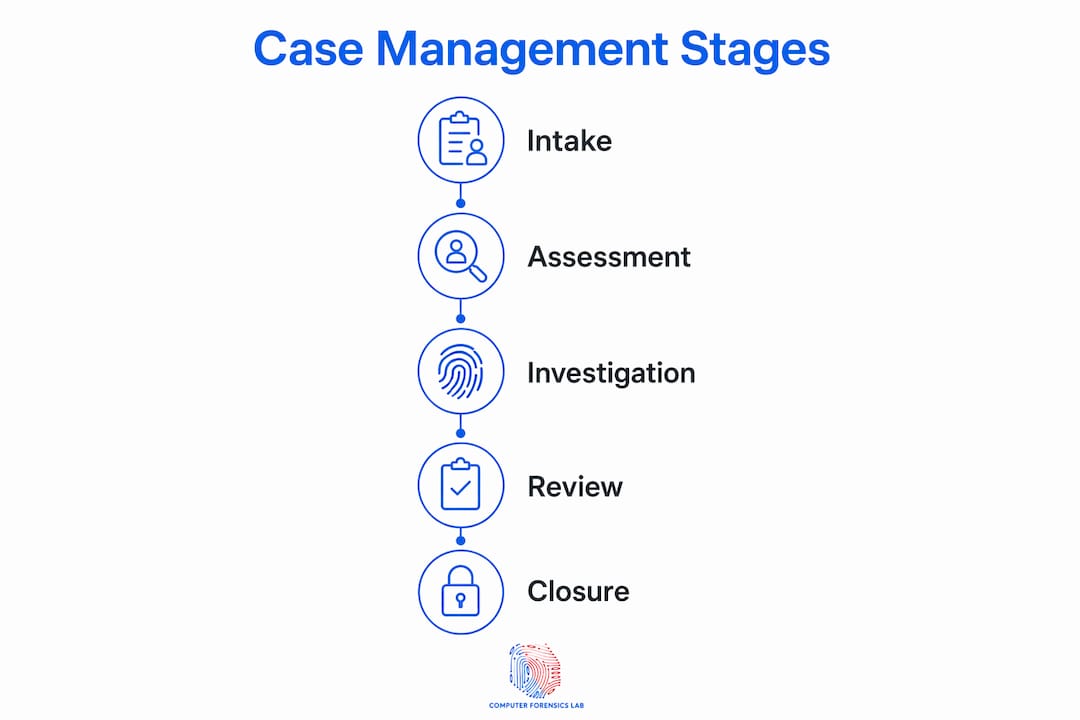
Centralised case management platforms reduce the risk of lost information and improve collaboration across investigative teams. Eliminating manual re-entry and fragmented storage removes the single biggest source of operational error in complex investigations. When every investigator works from the same case file, discrepancies shrink and accountability increases.
The operational improvements follow a clear sequence:
- Intake and triage: Cases are logged consistently, with priority levels assigned based on defined criteria rather than individual judgement.
- Task routing: Assignments are distributed automatically, with visibility across the team so no task falls through the gaps.
- Collaboration: Investigators share notes, evidence, and updates within a single system, reducing the risk of parallel, contradictory work streams.
- Progress tracking: Managers see case status in real time, allowing early intervention when a case stalls.
- Closure review: A formal sign-off process confirms all required steps are complete before a case is closed.
Machine learning is now extending these operational gains further. Random Forest models trained on a decade of case data achieve a mean Precision@300 of 0.74 in identifying cases likely to close within six months. That level of predictive accuracy means investigators can triage their workload based on evidence, not instinct. Backlog management becomes a data-informed process rather than a reactive one.
The practical effect on throughput is significant. When investigators spend less time chasing paperwork and more time on substantive analysis, case resolution rates improve. Efficient case management techniques do not just save time. They directly affect the quality of outcomes.
How does investigative case management differ from incident management?
Incident management and case management are not interchangeable. Incident management records what happened. Case management builds the proof required for prosecution or civil recovery. Treating an investigation as an incident is one of the most common and costly mistakes legal teams make.
The distinction matters because the two systems are built for different purposes. Incident platforms capture events quickly and efficiently. They are not designed to hold formal witness statements, maintain chain of custody, or log the metadata that courts examine. Using an incident platform for a criminal or regulatory investigation creates gaps that opposing counsel will find.
| Feature | Incident management | Investigative case management |
|---|---|---|
| Primary purpose | Record and resolve events | Build legal proof and case file |
| Evidence handling | Basic logging | Chain of custody, formal exhibits |
| Workflow type | Linear and sequential | Flexible, evolving with case facts |
| Decision logging | Minimal | Full metadata and rationale records |
| Regulatory compliance | General operational | 28 CFR Part 23, DOJ, EU Whistleblowing Directive |
| Legal defensibility | Limited | Designed for court and regulatory scrutiny |
Linear, sequential workflows create defensibility gaps in complex investigations. Real cases evolve. New witnesses emerge. Evidence changes the direction of an inquiry. A case management system built for investigations accommodates that evolution. An incident platform does not. For legal professionals, the choice of system is itself a legal decision. You can read more about incident response in a legal context to understand where the boundary sits.
What best practices optimise case management effectiveness?
The single most effective control in any investigation management process is a manager-led review before case closure. Mandatory managerial sign-off ensures consistent evidential quality regardless of individual investigator experience. Without it, case quality varies, and that variability is a direct legal risk.
Beyond the closure checkpoint, the following practices define well-run investigative case handling:
- Log every decision with its rationale. Metadata on investigative decisions, such as why a witness was excluded or why a line of inquiry was dropped, is as important as the evidence itself. Courts examine process integrity, not just outcomes.
- Never use an incident-only platform for formal investigations. The absence of chain of custody features and formal evidence handling creates gaps that are difficult to close retrospectively.
- Apply evidential handling protocols from the first contact. Evidence collected without a defined protocol at the outset is harder to defend at the end.
- Maintain transparent, auditable logs throughout. Every file access, every status change, and every communication should be time-stamped and attributed.
- Review case management infrastructure regularly. Systems that worked for simpler investigations may not support the complexity of regulatory or criminal cases.
Pro Tip: Document the reason for every investigative decision, not just the decision itself. “Witness excluded as not present at the time” is defensible. “Witness not interviewed” with no rationale is not.
The importance of case management becomes clearest when things go wrong. Investigations that fail in court rarely fail because the evidence was absent. They fail because the process that gathered the evidence cannot be demonstrated to have been fair, consistent, and legally compliant. Secure evidence storage is one component of that process. Structured case management is the framework that holds all the components together.
Key takeaways
Investigative case management is the infrastructure that determines whether an investigation produces legally defensible outcomes or costly evidential failures.
| Point | Details |
|---|---|
| Case management defines the process | It governs every stage from intake to closure, replacing fragmented manual workflows. |
| Automation protects evidence integrity | Automated alerts and custody tracking prevent the oversights that undermine prosecutions. |
| Incident management is not a substitute | Incident platforms lack chain of custody and decision-logging features required for legal investigations. |
| Manager review is the critical checkpoint | Mandatory sign-off before closure ensures consistent evidence quality across all investigators. |
| Decision logging is as important as evidence | Courts examine why decisions were made, not just what evidence was collected. |
Why case management infrastructure matters more than most investigators realise
Working in digital forensics, I see the consequences of poor case management regularly. The pattern is consistent: an investigation begins with good intentions, the evidence is there, but the process that gathered it cannot be demonstrated to have been fair or consistent. By the time a case reaches court or a regulatory hearing, the gap is irreparable.
The most common mistake I encounter is conflating incident management with investigative case management. Organisations invest in incident response tools, assume they cover investigations, and discover too late that they do not. The legal distinction between the two is not a technicality. It is the difference between a case that holds and one that collapses under cross-examination.
Emerging technologies, including machine learning triage and AI-assisted analysis, are genuinely useful. But they augment a solid process. They do not replace it. I have seen AI-assisted prioritisation improve throughput significantly. I have also seen it applied to investigations with no formal case management structure, and the result is faster production of evidence that cannot be used. Speed without structure is not progress.
The organisations that handle investigations well share one characteristic: they treat case management as infrastructure, not administration. They build it before they need it, not after something goes wrong. That shift in thinking is the most valuable change any legal team or investigative unit can make.
— Computerforensicslab
How Computerforensicslab supports your investigative case management
Computerforensicslab provides digital forensic investigations designed to integrate directly with formal case management workflows. Every engagement maintains chain of custody, produces court-ready evidence, and follows the evidential handling standards that legal proceedings require. The team supports legal professionals, law enforcement, and corporate investigators across cybercrime, data breaches, employee misconduct, and intellectual property cases. Expert witness reports are produced to withstand regulatory and judicial scrutiny. For investigators who need specialist forensic support that meets the standards your case management framework demands, Computerforensicslab’s digital forensics services are available for consultation.
FAQ
What is investigative case management?
Investigative case management is a structured, end-to-end framework that manages investigations from intake through resolution, covering triage, evidence handling, analysis, and adjudication. It replaces fragmented manual workflows with a centralised system that ensures legal compliance and accountability.
How does case management aid investigations in practice?
Case management aids investigations by standardising workflows, automating task routing and custody tracking, and logging every decision with its rationale. These features ensure evidence is collected and handled in a way that withstands legal and regulatory scrutiny.
Why is case management in crime different from incident management?
Case management builds the legal proof required for prosecution, including chain of custody and formal witness statements. Incident management records what happened but lacks the evidential infrastructure needed for criminal or regulatory proceedings.
What is the most important case management best practice?
A manager-led review and approval checkpoint before case closure is the single most effective control for maintaining evidence quality. It ensures consistency across investigators regardless of individual experience levels.
How does machine learning improve the investigation management process?
Machine learning models trained on historical case data can identify cases likely to close within six months with a mean Precision@300 of 0.74, enabling investigators to triage workloads based on data rather than instinct.