
TL;DR:
- Expert witness testimony in digital forensics involves qualified interpretation beyond raw data.
- The expert’s duty is to the court, ensuring impartial, unbiased opinions regardless of instructing party.
- Proper instructions, early engagement, and understanding legal rules are essential for effective digital evidence presentation.
Not all evidence speaks for itself. When a case turns on deleted files, encrypted communications, or metadata trails, the court needs more than raw data. It needs qualified interpretation. Expert witness testimony is opinion evidence provided by a qualified specialist to assist the court in understanding technical matters beyond ordinary knowledge. For solicitors and law firms handling digital evidence, understanding how this testimony works, what governs it, and how to use it effectively is not optional. It is central to building a sound legal strategy.
Table of Contents
- Defining expert witness testimony in digital forensics
- Legal duties, rules and codes for digital forensic experts
- How expert evidence is presented in UK digital forensics cases
- Best practice for instructing and challenging digital forensic experts
- A fresh perspective: What most lawyers miss about digital expert testimony
- How Computer Forensics Lab supports legal professionals
- Frequently asked questions
Key Takeaways
| Point | Details |
|---|---|
| Expert testimony is opinion-based | Only qualified specialists may give opinion evidence on technical digital matters in court. |
| Impartiality is essential | An expert’s primary duty is to the court, requiring objectivity and independence at all times. |
| Strict legal procedures apply | Permission, clear instructions, and CPR Part 35 rules govern the use of digital expert witnesses in UK civil cases. |
| Practical steps boost success | Choosing, instructing, and questioning experts carefully can significantly impact legal outcomes. |
Defining expert witness testimony in digital forensics
Digital forensics cases rarely involve simple, self-explanatory evidence. A recovered file, a server log, or a chain of device activity requires expert analysis before it can carry weight in court. This is precisely where expert witness testimony becomes indispensable.
Under UK law, expert testimony is opinion evidence provided by a qualified specialist whose knowledge, training, or experience enables them to interpret technical matters the court could not otherwise assess. This is fundamentally different from lay witness evidence, which is limited to what a person directly observed or experienced. A lay witness can say they saw a laptop being used. An expert can say what that laptop contained, when files were accessed, and whether data was deliberately wiped.
In digital forensics, the legal impact of expert witnesses is significant. Experts are routinely called upon to address matters such as:
- Attribution of device activity to a specific user
- Recovery and authentication of deleted or encrypted data
- Analysis of metadata to establish timelines
- Examination of mobile phones, cloud accounts, and social media activity
- Detection of malware, unauthorised access, or data exfiltration
Each of these tasks requires specialist knowledge that goes well beyond what a judge or jury can independently evaluate. The expert’s role is not to advocate for a party. It is to educate the court.
“The function of an expert witness is to provide the court with the information and assistance it needs to evaluate the evidence, not to advance the case of the instructing party.”
For solicitors, understanding this distinction matters enormously. Instructing a digital forensics expert who understands their duty to the court, rather than to the client, is what separates admissible, persuasive evidence from testimony that undermines your case.
Legal duties, rules and codes for digital forensic experts
Knowing what expert testimony is only takes you so far. The rules that govern it are equally important, and failing to follow them can result in evidence being excluded or experts being discredited.
The overriding duty of an expert witness is to the court, providing independent, unbiased opinions. This duty overrides any obligation to the instructing party. An expert who acts as a partisan advocate risks having their evidence dismissed and may face professional consequences.
In civil proceedings, CPR Part 35 governs expert evidence, and court permission is required before an expert can be instructed. This is a critical procedural step that solicitors sometimes overlook until it is too late. Criminal proceedings operate under separate rules, primarily the Criminal Procedure Rules, though the underlying duty of independence remains the same.
| Aspect | Civil proceedings | Criminal proceedings |
|---|---|---|
| Governing rules | CPR Part 35 | Criminal Procedure Rules |
| Court permission | Required before instruction | Not always required |
| Report format | Strictly prescribed | Prescribed but varies |
| Duty to court | Explicit and paramount | Explicit and paramount |
| Joint experts | Common practice | Less common |
An admissible expert report in digital forensics must include the expert’s qualifications, a clear statement of the facts relied upon, the methodology used, the opinion reached, and a declaration of the duty to the court. Reports that lack these elements are vulnerable to challenge.
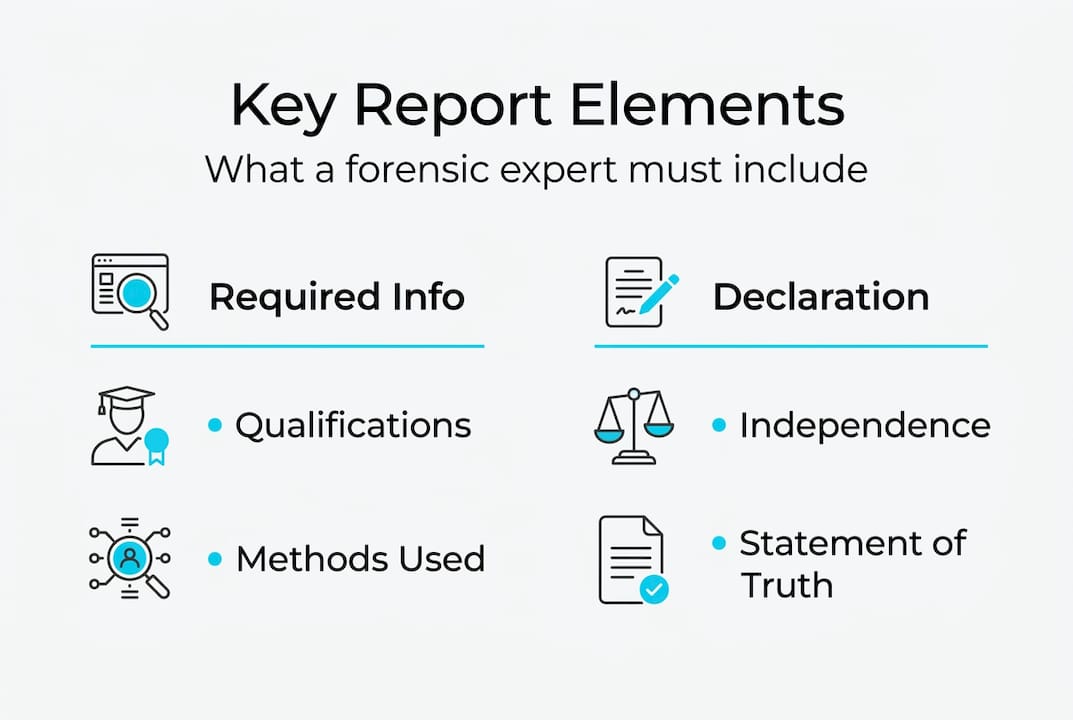
Pro Tip: When creating digital evidence reports, ensure your expert includes a signed declaration of independence. Courts take this seriously, and its absence is a red flag during cross-examination.
Solicitors should also be aware that experts who stray into advocacy, by overstating conclusions or selectively presenting findings, can damage the credibility of an entire case. Reviewing forensic expert witness tips before instructing an expert is time well spent.
How expert evidence is presented in UK digital forensics cases
Understanding the procedural pathway for expert evidence helps solicitors plan effectively and avoid costly delays.
The typical process for submitting expert evidence in a civil digital forensics matter follows these steps:
- Obtain court permission to rely on expert evidence under CPR Part 35
- Draft clear, written instructions to the expert outlining the issues to be addressed
- Receive and review the expert’s written report
- Exchange reports with the opposing party
- Facilitate a joint statement if directed by the court
- Prepare the expert for oral testimony if required
Expert reports in civil cases must follow specific mandated contents, including a statement of truth. This is not merely a formality. A false statement of truth can expose an expert to contempt proceedings.

In practice, many digital forensics cases involve single joint experts and concurrent evidence, also known as hot-tubbing, where experts from both sides give evidence simultaneously before the judge. This approach is increasingly favoured in technical cases because it allows the court to directly compare expert opinions and probe disagreements in real time.
| Procedure | Purpose | When used |
|---|---|---|
| Written report | Core evidential document | All cases |
| Joint statement | Narrow areas of dispute | Post-report exchange |
| Single joint expert | Cost-efficient neutral opinion | Lower-value civil cases |
| Hot-tubbing | Direct comparison of opinions | Complex technical disputes |
| Oral testimony | Cross-examination and clarification | High-value or contested cases |
For matters involving mobile phone evidence, the expert’s report must clearly explain extraction methods, chain of custody, and the limitations of the data. Judges increasingly scrutinise these details. Presenting reliable forensic evidence requires methodological rigour from the outset, not just polished testimony at trial.
Best practice for instructing and challenging digital forensic experts
The quality of expert evidence depends heavily on how solicitors instruct and manage their experts. Poor instructions produce poor reports. And poor reports lose cases.
When selecting a digital forensic expert, focus on the following:
- Qualifications and accreditations: Look for membership of recognised bodies such as the Chartered Institute of Forensic Sciences or equivalent professional organisations
- Relevant casework experience: An expert who has testified in similar matters will understand court expectations
- Impartiality: Review past reports if possible. Experts who consistently favour the instructing party are a liability
- Clarity of communication: Technical findings must be explained in plain language the court can follow
Written instructions are not just good practice. They are a legal requirement under CPR Part 35. Vague or verbal instructions create ambiguity about the scope of the expert’s opinion and can be exploited during cross-examination.
Pro Tip: Obtain court permission early and provide written instructions that specify the precise technical questions to be answered. This protects the integrity of the report and limits scope for challenge.
When the opposing party’s expert produces findings you wish to contest, the options include submitting written questions to the expert under CPR Part 35.6, requesting a joint statement to identify areas of agreement and disagreement, or instructing your own expert to produce a counter-report. Understanding the role of digital forensics experts in this adversarial context helps solicitors deploy these tools strategically.
Avoid the temptation to brief your expert on the desired outcome. Courts are alert to coached testimony, and computer forensics experts in criminal justice are expected to reach conclusions independently, regardless of which party instructed them.
A fresh perspective: What most lawyers miss about digital expert testimony
After working across numerous digital forensics cases, one pattern stands out. The most damaging mistakes rarely happen in court. They happen weeks or months earlier, when solicitors treat the expert as a tool to be deployed rather than a specialist to be collaborated with.
The instinct to brief an expert towards a favourable conclusion is understandable but counterproductive. A truly independent expert, one who has clearly reached their conclusions through rigorous methodology, is far more persuasive to a judge than one who appears to be advocating. Courts are experienced at spotting the difference.
Early engagement also matters more than most firms realise. Bringing in a forensic expert at the investigation stage, rather than after proceedings have commenced, allows them to shape the evidence-gathering process itself. That means better preservation, cleaner chain of custody, and fewer vulnerabilities at trial.
Reviewing forensic testimony tips before you even select an expert is a practical first step that many solicitors skip. The firms that consistently get the best outcomes from digital evidence are those that treat expert witnesses as strategic partners from day one, not afterthoughts.
How Computer Forensics Lab supports legal professionals
If you are instructing a digital forensic expert or preparing digital evidence for litigation, Computer Forensics Lab provides specialist support tailored to legal professionals across the UK. Our experts produce court-compliant reports, maintain rigorous chain of custody, and are experienced in giving oral testimony in both civil and criminal proceedings.
From device examination and data recovery to cloud analysis and malware investigation, our digital forensics services cover the full range of evidential needs. We also assist with digital footprint investigations where online activity, social media, or metadata trails are central to a case. Contact us to discuss your matter and find out how we can support your legal strategy with objective, defensible expert evidence.
Frequently asked questions
What is the main difference between expert and lay witness testimony in UK courts?
Expert testimony provides specialised opinions based on qualifications and training, whereas lay witnesses are limited to factual evidence drawn from direct personal experience.
When is court permission required for expert testimony in civil digital forensics cases?
Under CPR Part 35, court permission is required before instructing an expert in civil proceedings, and this must be obtained before the expert is engaged.
How can a solicitor challenge an expert’s findings in digital evidence cases?
Solicitors can challenge via questions or joint statements, submitting written questions under CPR Part 35.6 or requesting a joint report to identify and narrow areas of disagreement.
What are ‘single joint experts’ in civil digital forensics litigation?
Single joint experts are appointed jointly by both parties to provide a single, independent opinion for the court, reducing cost and conflict in lower-value or less contested matters.
Recommended
- Expert Witness Role in Digital Forensics – Legal Impact
- Expert witnesses in digital forensics: roles and duties
- Computer forensics guide: digital evidence handling UK
- Creating Expert Witness Reports for Digital Evidence
- Le détective privé : Un outil clé dans l’environnement juridique actuel – Groupe Prometheus