
Evidence authentication is the legal process of establishing that a piece of evidence is genuine and is precisely what its proponent claims it to be. It functions as a condition precedent to admissibility, meaning a court will not consider evidence until its identity and integrity have been sufficiently demonstrated. Critically, authentication is distinct from admissibility itself: passing the authentication threshold does not guarantee that evidence will be admitted, because separate rules governing hearsay, relevance, or privilege may still operate to exclude it.
The legal rationale for authentication is grounded in fairness. Preventing tampered evidence from influencing legal decisions protects both parties in a dispute and preserves the integrity of the tribunal. Without authentication, a court has no reliable basis for connecting a piece of evidence to the facts it is supposed to prove. Authentication is therefore best understood as a specialised application of relevance: evidence that cannot be identified is logically incapable of supporting any case inquiry.
In practice, authentication applies to a broad range of evidence types:
- Written documents, contracts, and correspondence
- Photographs, video recordings, and audio files
- Physical objects such as weapons or seized property
- Electronic communications including emails and text messages
- Digital files, databases, and device-extracted data
Computerforensicslab, a London-based digital forensics specialist, supports legal professionals and private clients through the authentication process, particularly where digital evidence demands forensic acquisition, chain of custody documentation, and expert witness testimony.

What are the legal requirements for evidence authentication in the UK?
The UK does not operate under a single codified evidence statute equivalent to the United States Federal Rules of Evidence, but a coherent framework emerges from several primary sources. The Police and Criminal Evidence Act 1984 (PACE) and its associated Codes of Practice govern the collection and handling of evidence in criminal proceedings, establishing procedural requirements that bear directly on authenticity. The Civil Evidence Act 1995 addresses admissibility in civil proceedings, including documentary evidence and hearsay. The Criminal Justice Act 2003 further regulates the admissibility of hearsay and documentary evidence in criminal courts.
Under UK evidentiary principles, the party seeking to rely on a piece of evidence bears the burden of laying a sufficient foundation for its authenticity. This is a preliminary question of fact: the court must be satisfied, on the balance of probabilities, that the evidence is what it purports to be before it is placed before the fact-finder. The judge acts as gatekeeper at this stage, and the opposing party retains the right to challenge the foundation laid.
Authentication is not a mere formality. It is the mechanism by which courts verify that the evidence before them has not been tampered with, fabricated, or misidentified. Without it, the entire evidentiary basis of a case is open to legitimate attack.
Self-authenticating evidence represents a recognised exception to the general requirement for extrinsic proof. Certain categories of evidence carry sufficient indicia of reliability on their face that no additional foundation is needed. Under UK law and by analogy with Rule 902 of the Federal Rules of Evidence, these categories include:
- Official government publications bearing an official seal
- Notarised documents accompanied by a certificate of acknowledgement
- Certified copies of public records
- Newspapers and periodicals in general circulation
- Trade inscriptions and labels affixed in the ordinary course of business
- Certified electronic records meeting prescribed technical standards
Authentication interacts with, but does not replace, other admissibility requirements. A document may be authenticated as genuine yet still be excluded as hearsay if it is tendered to prove the truth of its contents without a recognised exception applying. Relevance, privilege, and the court’s discretion to exclude prejudicial evidence under section 78 of PACE each operate independently of authentication.
Failure to authenticate properly carries real consequences. Exclusion of critical evidence can result in lost cases, adverse costs orders, and, in criminal proceedings, the collapse of a prosecution or an unsafe conviction. Courts have little appetite for remedying authentication failures after the fact, particularly where the deficiency reflects inadequate evidence handling from the outset.
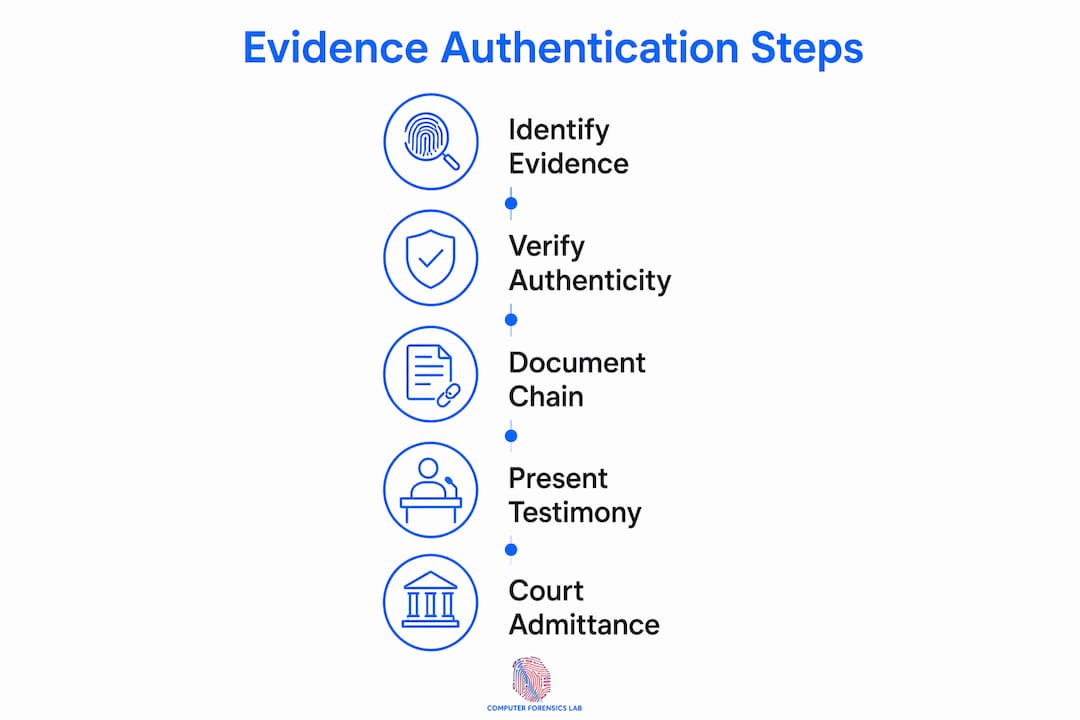
How is evidence authenticated? Methods and practical examples
Authentication methods vary according to the type of evidence in question, and courts accept a range of approaches provided the foundation laid is sufficient for a reasonable fact-finder to conclude the evidence is genuine.
Common authentication methods
- Witness testimony with direct knowledge: A witness who observed the creation of a document, was present when a photograph was taken, or handled a physical object can testify that the item is what it purports to be. This remains the most straightforward and frequently used method.
- Distinctive characteristics and content: A document may be authenticated by its internal content, such as references to facts known only to a particular person, a distinctive writing style, or a reply to a previously authenticated communication. Federal Rule of Evidence 901(b)(4) codifies this approach, and UK courts apply equivalent reasoning.
- Chain of custody documentation: For physical and digital evidence alike, a documented record of every person who handled the item, when, and under what conditions, provides strong circumstantial authentication. Gaps in this record invite challenge.
- Process or system evidence: Where evidence is generated by a mechanical or electronic process, testimony or certification that the process produces accurate results can authenticate the output. CCTV footage, for example, is typically authenticated by evidence about the recording system’s reliability and the procedures used to preserve the footage.
- Circumstantial evidence: Courts accept authentication by a combination of circumstances even without direct witness testimony. The content of a text message, the device on which it was found, and the account credentials associated with it may together satisfy the authentication requirement.
Evidence types and practical examples
Documents. A contract is authenticated by testimony from a signatory, a witness to the signing, or a handwriting expert. Where the document is a certified copy of a public record, it may be self-authenticating.
Photographs and video. A photograph is authenticated by a witness who can confirm it fairly and accurately represents what they observed. Surveillance footage requires evidence about the recording system and storage procedures, though circumstantial evidence alone can suffice where direct testimony is unavailable.
Audio recordings and telephone calls. Voice identification by a person familiar with the speaker, combined with evidence about the circumstances of the call, satisfies the authentication requirement. A mere assertion of identity by the person speaking is not sufficient on its own.
Text messages and emails. Authentication of electronic communications does not require exclusive access to the device or expert testimony in every case. Confirming circumstances, such as the content of the messages, the registered account details, and the device on which they were stored, can collectively establish authenticity. The evidence verification process for electronic communications is well established in UK case law.
Physical objects. Items such as weapons or seized drugs are authenticated by testimony from the officer who recovered them, supported by exhibit labels and continuity records maintained throughout the investigation.
Pro Tip: For text messages and photographs, the authentication process follows a repeatable three-step approach: have a witness identify the item, confirm it remains substantially unaltered since they observed it, and establish the circumstances in which it was created or received. This foundation satisfies the requirement in the vast majority of cases without the need for expert evidence.
Understanding who presents evidence first in a trial is also relevant here, as the burden of laying the authentication foundation falls on the party seeking to rely on the evidence, typically the prosecution in criminal proceedings or the claimant in civil matters.
Authenticating digital evidence: standards and best practices
Digital evidence authentication demands a higher degree of procedural rigour than most other evidence types, because digital files are inherently susceptible to alteration, deletion, and fabrication without visible trace. A simple file copy is insufficient for forensic purposes. Proper forensic acquisition involves validated tools that generate cryptographic hash values and qualified timestamps at the point of collection, creating a verifiable record that the data has not been altered from acquisition through to trial.
Forensic acquisition is the gold standard for digital evidence precisely because it produces a mathematically verifiable proof of integrity. A hash value generated at collection and recalculated at trial either matches or it does not — there is no ambiguity.
Recognised standards and regulatory framework
Two international frameworks are particularly relevant to digital evidence authentication in UK legal proceedings:
- ISO/IEC 27037 sets out guidelines for the identification, collection, acquisition, and preservation of digital evidence, providing the procedural baseline that courts and practitioners expect forensic examiners to follow.
- eIDAS Regulation (EU) No 910/2014, retained in UK law post-Brexit as the Electronic Identification and Trust Services Regulation, governs qualified electronic signatures and timestamps, which carry a presumption of integrity and can satisfy authentication requirements for electronic documents without additional extrinsic proof.
Core best practices for digital evidence authentication
- Forensic acquisition using validated tools: Use write-blocking hardware and forensically validated software to capture data without modifying the source. Tools must be capable of generating cryptographic hash values (typically SHA-256 or MD5) at the point of acquisition.
- Hash value verification: Generate and record hash values immediately upon acquisition. Recalculate them at each subsequent stage of examination to confirm the data remains unaltered.
- Qualified timestamps: Apply qualified electronic timestamps at the point of acquisition and at each significant handling stage. Under eIDAS-derived UK standards, a qualified timestamp carries a legal presumption of accuracy.
- Chain of custody documentation: Record every person who accesses the evidence, the tools used, the date and time of each action, and the storage conditions. Incomplete chain of custody records are among the most common reasons digital evidence is challenged or excluded in UK courts.
- Secure storage and access controls: Store forensic images in encrypted, access-controlled environments. Log all access attempts, successful or otherwise.
- Expert witness reports: Where the authentication process involves technical complexity, a qualified forensic examiner should produce a written report explaining the acquisition methodology, the tools used, and the findings. The expert witness role in digital forensics is well established in UK courts, and judges place considerable weight on properly prepared forensic reports.
Pro Tip: Certified automated forensic methods with documented audit trails can satisfy the authentication requirement without live expert testimony in straightforward cases, which reduces costs without compromising admissibility. Reserve expert witnesses for cases where the methodology is likely to be contested or where the technical complexity genuinely requires explanation.
Computerforensicslab provides digital forensics services covering forensic acquisition, hash verification, chain of custody management, and expert witness reporting, supporting legal professionals at every stage of the evidence authentication process. The firm’s examiners work to ISO/IEC 27037 standards and produce court-ready reports that address the authentication requirements of both criminal and civil proceedings.
Key takeaways
Evidence authentication is a condition precedent to admissibility in UK courts, requiring the proponent to establish that evidence is genuine before it can be considered by the fact-finder, with digital evidence demanding forensic acquisition, hash verification, and documented chain of custody to meet the required standard.
| Point | Details |
|---|---|
| Authentication precedes admissibility | A court will not consider evidence until its identity and integrity are established by the proponent. |
| Self-authenticating evidence exists | Official sealed documents, notarised records, and certified electronic records require no extrinsic proof of authenticity. |
| Failure carries serious consequences | Exclusion of unauthenticated evidence can result in lost cases, adverse costs orders, or collapsed prosecutions. |
| Digital evidence demands forensic rigour | Cryptographic hash values, qualified timestamps, and chain of custody records are the accepted standard for digital authentication. |
| Expert testimony is not always required | Certified automated forensic methods with documented audit trails can satisfy authentication requirements in straightforward cases. |