
TL;DR:
- Deep web investigation involves accessing non-indexed data sources, such as private databases and government records, to gather legally admissible intelligence. It requires a structured methodology, operational security measures, and detailed documentation to ensure accuracy and legal compliance. Proper understanding of deep versus dark web environments and combining automated tools with human oversight enhances investigation effectiveness.
Deep web investigation is defined as the structured process of accessing and analysing non-indexed digital content to gather intelligence for legal, law enforcement, and corporate inquiries. Unlike surface web research conducted through Google or Bing, deep web content includes private databases, government records, academic archives, and login-protected portals that standard search engines cannot reach. The industry term for this discipline is Open Source Intelligence, or OSINT, though deep web investigation extends beyond publicly available sources into credentialled and restricted environments. Understanding the methodology behind this process is what separates admissible, court-ready intelligence from unreliable data.
What is deep web investigation and what content does it cover?
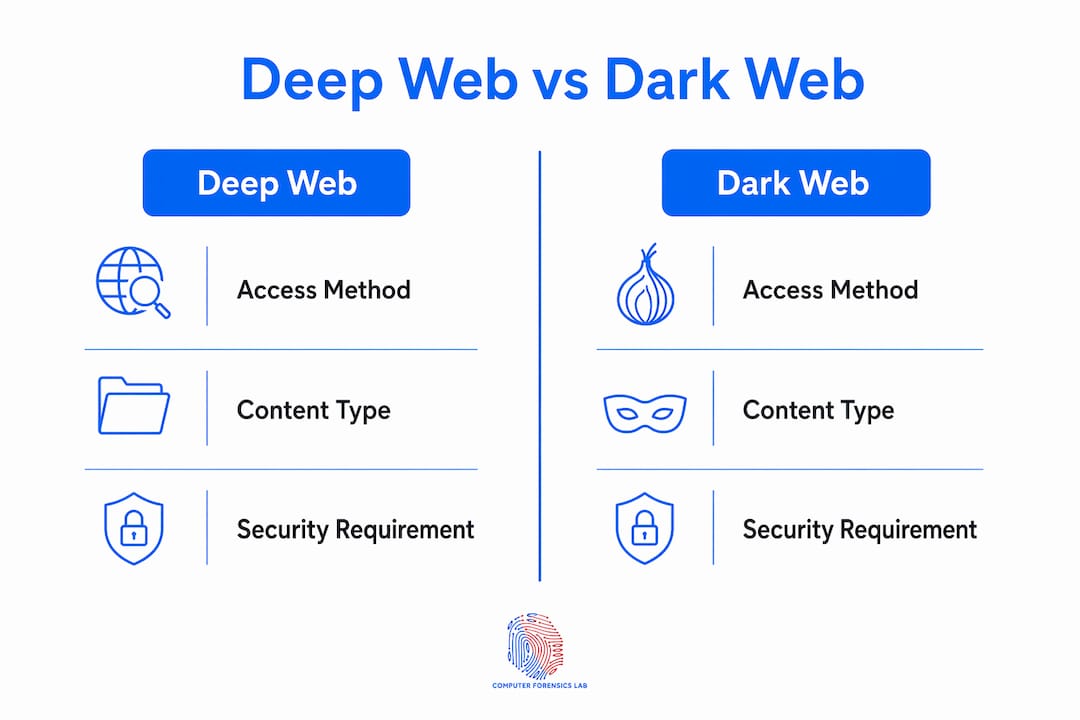
Deep web investigation covers a far broader range of content than most professionals expect. The deep web constitutes the vast majority of internet content, most of it legitimate and accessible through standard browsers when valid credentials are available. The dark web, by contrast, requires special anonymising tools such as Tor Browser to access. This distinction matters enormously for investigators, because the methodology, risk profile, and legal framework differ between the two environments.
The types of content relevant to a professional investigation include:
- Private corporate networks and intranets: Internal portals, employee directories, and proprietary databases not exposed to public indexing.
- Government and regulatory databases: Court records, company filings, land registry data, and law enforcement intelligence systems accessible through authorised channels.
- Academic and scientific archives: Subscription-based repositories such as PubMed, JSTOR, and institutional libraries holding research not indexed by public search engines.
- Secure messaging platforms and non-indexed forums: Communities operating outside standard web infrastructure, relevant in fraud, extremism, and misconduct investigations.
- Medical and financial records: Protected under legislation such as the UK GDPR and accessible only through lawful authority or subject consent.
The volume and diversity of this content directly affects the breadth of any investigation. An investigator who limits their search to indexed sources misses the majority of the digital record. For legal teams, this gap can mean overlooking evidence that is decisive in litigation. Computerforensicslab regularly encounters cases where critical data existed in non-indexed repositories that a surface-level search would never have surfaced.
What methodologies and tools are used in deep web investigation?
Effective deep web intelligence gathering follows the Intelligence Cycle, a five-phase framework standard in law enforcement and intelligence workflows. The phases are planning, collection, processing, analysis, and dissemination. Each phase builds on the last, and skipping any one of them compromises the integrity of the final product.
- Planning: Define Priority Intelligence Requirements (PIRs) before any collection begins. PIRs focus the investigation, prevent scope creep, and ensure that every data point collected serves a specific evidentiary purpose.
- Collection: Access target sources using appropriate tools and credentials. This phase involves both automated extraction and manual review of non-indexed content.
- Processing: Organise raw data into structured formats. This includes deduplication, translation, and metadata extraction using tools such as ExifTool to reveal file origin and modification history.
- Analysis: Apply technical fingerprinting and relational discovery techniques to identify patterns, connections, and hidden identities. Relational discovery consistently outperforms simple keyword searches for revealing infrastructure and attribution.
- Dissemination: Produce a structured report with chain-of-custody documentation suitable for legal proceedings or law enforcement briefings.
The most effective current approach combines automated tools with human oversight. Hybrid methodologies integrating AI-driven reasoning agents with manual verification produce the highest accuracy in complex investigations. Frameworks using modular, multi-agent architectures allow specialised tools to handle varied data extraction tasks simultaneously, reducing both error rates and investigation time. Tools such as Maltego CE support link analysis and entity mapping, while OnionScan identifies infrastructure relationships on anonymised networks. Hunchly captures and timestamps web pages automatically, creating a verifiable audit trail.
Pro Tip: Never rely on a single automated tool for evidence collection. Cross-reference every significant finding manually before including it in a legal report. Courts scrutinise digital evidence closely, and a single unverified data point can undermine an entire submission.

Operational security during collection is non-negotiable. Investigators must route all traffic through Tor and a VPN, use anonymising operating systems, and work on hardware dedicated solely to the investigation. Any deviation creates attribution risk.
How does deep web investigation differ from dark web investigation?
The deep web and the dark web are not the same environment, and conflating them is a common error that leads to both methodological mistakes and legal exposure. The table below clarifies the key distinctions.
| Factor | Deep web | Dark web |
|---|---|---|
| Access method | Standard browser with credentials | Tor Browser or equivalent anonymising software |
| Content type | Legitimate databases, private portals, archives | Anonymised forums, marketplaces, privacy networks |
| Legal risk | Low when access is authorised | Higher; requires careful legal authority review |
| Primary investigative use | Corporate, legal, and regulatory intelligence | Cybercrime, trafficking, and extremism investigations |
| Operational security need | Moderate | High |
A critical misconception is that the dark web is exclusively illicit. Investigators must recognise that it also hosts privacy-focused activism, academic networks, and journalism platforms operating under authoritarian regimes. Misidentifying a legitimate privacy community as a criminal network can produce flawed intelligence and, in a legal context, a damaging expert report. Cultural and technical fluency is therefore as important as tool proficiency.
For legal teams handling cases involving digital footprints in divorce or financial misconduct, the distinction between deep and dark web sources also affects how evidence is characterised in court. Evidence sourced from the deep web through authorised access carries a very different legal weight than material extracted from anonymised dark web environments.
The appropriate safety protocol for dark web investigation requires dedicated virtual machines running Tails OS or Whonix, with all traffic routed through Tor. Deep web investigation in credentialled environments requires strong access controls and documented authorisation, but the anonymisation layer is less critical.
What steps should professionals take for a safe, compliant investigation?
A legally compliant deep web investigation requires preparation before any data collection begins. Professionals who skip the planning phase routinely produce evidence that fails admissibility tests or exposes their organisation to liability.
The core steps are:
- Define PIRs in writing: Document exactly what intelligence is needed, why it is needed, and what legal authority supports the collection. This record protects the investigator and the client.
- Use dedicated, segregated hardware: Never conduct an investigation on a device used for other work. Cross-contamination of data is a chain-of-custody failure. Use a dedicated machine running an anonymising operating system such as Tails OS or Whonix within a virtual machine.
- Maintain a detailed search journal: Record every query, timestamp, source URL, and result. A comprehensive search journal ensures the investigation is reproducible and defensible in legal proceedings.
- Access authoritative sources directly: Go directly to government portals, academic databases, and official registries. Avoid third-party deep web search engines, which carry significant security risks and often return unverified or manipulated data.
- Verify every source independently: Cross-reference findings across at least two independent sources before treating any data point as confirmed intelligence.
- Integrate with broader forensic workflows: Deep web findings gain evidential weight when combined with device forensics, social media analysis, and cloud data examination. Isolated deep web intelligence rarely stands alone in court.
Pro Tip: Before submitting any deep web findings to a legal team, run the evidence through a structured investigation workflow that includes peer review. A second investigator checking your methodology catches errors that are invisible to the original analyst.
Privacy hygiene extends beyond the investigation itself. Investigators must also consider how their findings are stored, transmitted, and disclosed. Encrypted storage, access-controlled case management systems, and secure communication channels are minimum standards for any professional practice.
Key takeaways
Deep web investigation requires a structured methodology, operational security, and meticulous documentation to produce intelligence that is both accurate and legally admissible.
| Point | Details |
|---|---|
| Deep web vs dark web | The deep web is non-indexed but largely legitimate; the dark web requires Tor and carries higher legal and security risk. |
| Intelligence Cycle | Follow all five phases: planning, collection, processing, analysis, and dissemination, without skipping any step. |
| Hybrid methodology | Combine AI-driven automated tools with manual verification for the highest accuracy in complex investigations. |
| Operational security | Use dedicated hardware, anonymising operating systems such as Tails or Whonix, and route all traffic through Tor and a VPN. |
| Documentation | Maintain a detailed search journal with timestamps and source identifiers to ensure legal admissibility of findings. |
What I have learned from years of deep web investigation work
The biggest mistake I see from professionals entering this field is treating deep web investigation as a technical problem rather than an analytical one. The tools are learnable in weeks. The judgement required to interpret what you find takes years.
Cultural fluency is the skill that separates a useful intelligence product from a dangerous one. A forum thread that looks like criminal coordination may be activists using coded language to avoid state surveillance. Misreading that context produces a report that harms innocent people and exposes the investigator to serious professional consequences. I have seen this happen, and it is entirely avoidable with proper training and peer review.
The shift towards hybrid AI-human workflows is real and significant. Automated agents now handle data extraction at a scale no human team can match. But the AI does not understand legal admissibility, cultural context, or the difference between correlation and causation. Human oversight at the analysis and dissemination phases is not optional. It is the point where the investigation either becomes evidence or becomes noise.
Continuous learning about operational security is also non-negotiable. The threat environment changes faster than any single training course can track. Investigators who treat their OPSEC knowledge as fixed will eventually make an error that compromises both themselves and their client. Treat every investigation as an opportunity to audit and improve your own procedures.
— Computer
How Computerforensicslab supports deep web intelligence work
Computerforensicslab provides professional digital forensic investigations that extend well beyond surface-level data collection. The team applies structured Intelligence Cycle methodology, operational security protocols, and forensic-grade documentation standards to every case. For legal teams and law enforcement requiring intelligence from non-indexed environments, Computerforensicslab delivers findings that meet chain-of-custody requirements and withstand court scrutiny. The service covers deep web intelligence gathering, device forensics, social media analysis, and expert witness reporting. Professionals seeking a full picture of a subject’s digital forensics services will find a team with the technical depth and legal awareness to make that intelligence count.
FAQ
What is the difference between the deep web and the dark web?
The deep web includes all non-indexed internet content accessible through standard browsers with valid credentials, such as private databases and academic archives. The dark web is a subset requiring Tor Browser or equivalent software to access, and it carries a higher legal and security risk profile.
Is deep web investigation legal in the UK?
Deep web investigation is legal when conducted with proper authorisation, lawful access to data, and compliance with UK GDPR and the Computer Misuse Act 1990. Investigators must document their legal authority before collecting any data.
What tools are used in professional deep web investigations?
Professional investigators use tools including Tor Browser, Tails OS, Whonix, Maltego CE, OnionScan, Hunchly, and ExifTool, combined with manual verification and structured Intelligence Cycle workflows.
How is deep web evidence made admissible in court?
Admissibility depends on a documented chain of custody, a detailed search journal recording every query and source, and independent verification of findings. Evidence collected without this documentation is routinely challenged and excluded.
Why is operational security critical in deep web investigations?
Operational security prevents investigators from being identified by subjects, infected by malware, or having their methods compromised. Using dedicated hardware, anonymising operating systems, and encrypted communications protects both the investigator and the integrity of the evidence.