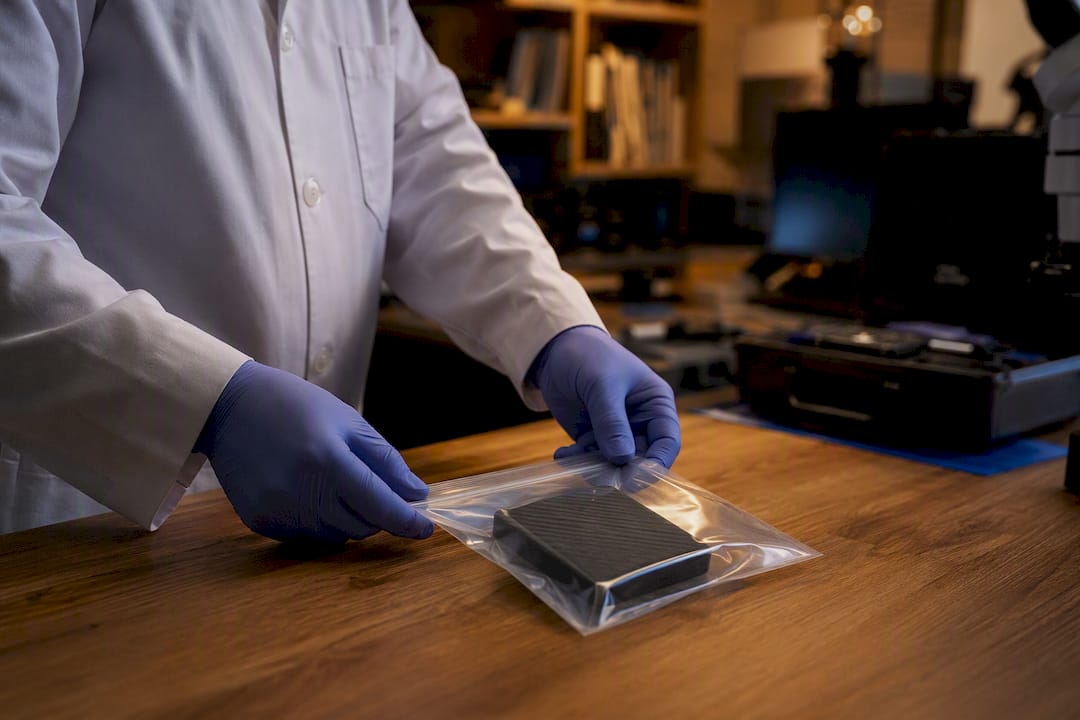
A chain of custody is the chronological, documented record that proves who handled a piece of digital evidence, when they handled it, and why. It is the mechanism that turns a hard drive or a memory image from “something an investigator found” into evidence a court or regulator can actually rely on. The lifecycle runs from collection through safeguarding, transfer, and analysis to final disposition, and every stage must be traceable back to a named individual.
NIST’s own definition treats chain of custody as inseparable from evidence integrity: without it, admissibility is at risk regardless of how technically sound the underlying analysis is.
- Proves continuity of possession from seizure to courtroom
- Underpins admissibility in litigation and regulatory proceedings
- A discipline that firms such as Computerforensicslab builds into every engagement
Key Takeaways
A defensible chain of custody combines contemporaneous documentation with cryptographic hashing, because either one alone leaves evidence open to challenge.
| Point | Details |
|---|---|
| Definition anchors everything | Chain of custody is the documented, chronological record of who handled evidence, when, and why, per NIST’s own glossary. |
| Two proofs, not one | Documentary signatures and SHA-256 hash verification must work together to withstand a court challenge. |
| Gaps cause exclusion | Missing signatures or unexplained time gaps are among the most common reasons digital evidence gets excluded. |
| Cloud evidence needs new habits | Provider access logs and API request records must be folded into the chain, since write-blockers don’t apply to remote acquisition. |
| Computerforensicslab builds this in | The lab applies write-blocked imaging, independent hash storage, and expert witness ready reporting across every case, not just the ones headed to court. |
Table of Contents
- What does chain of custody mean in digital forensics?
- How do you build a chain of custody for digital evidence?
- Why does chain of custody matter for legal and regulatory cases?
- What should a chain of custody form record?
- What digital-specific controls protect evidence integrity?
- What common mistakes break a chain of custody?
- How does Computerforensicslab maintain chain of custody in practice?
- What chain of custody problems are unique to cloud and remote evidence?
- What tools help automate chain of custody in cyber security?
- What legal cases reinforce chain of custody requirements?
- What is often misunderstood about chain of custody?
- Get Professional Chain of Custody Support From Computerforensicslab
- Sources
What does chain of custody mean in digital forensics?
Digital forensics borrows its chain of custody principles from physical evidence handling, but the medium changes what “proof” looks like. A sealed evidence bag containing a seized laptop relies on documentary proof: a signed label, a tamper seal, a log entry. A forensic image of that laptop’s hard drive needs the same paperwork plus mathematical proof that the data has not changed since acquisition.
That is where cryptographic hashing enters the picture. ISO/IEC 27037 formalises this dual requirement, setting out identification, collection, acquisition, and preservation processes that demand auditability and repeatability. NIST’s own glossary reinforces the same point: records must show identity, date, time, reason for handling, and condition at every stage.
- Documentary proof: signatures, logs, timestamps, tamper-evident seals
- Cryptographic proof: hash values that confirm bit-for-bit integrity
- A sealed drive without a hash is just a sealed box; a hash without a signed log is just a number nobody can vouch for
Neither proof works alone. A defensible digital chain of custody needs both running in parallel from the moment evidence is touched.
How do you build a chain of custody for digital evidence?
The process follows a fixed order, and skipping a step rarely gets noticed until a defence solicitor asks about it in cross-examination.
- Isolate and secure the scene. Disconnect the device from networks where appropriate, photograph it in situ, and label it with a unique identifier before anyone touches the keyboard.
- Image before you analyse. Attach a write-blocker, create a forensic image of the original media, and compute a cryptographic hash the moment acquisition finishes. This hash becomes the evidentiary anchor for everything that follows.
- Transport and store under control. Move the original device and its image using tamper-evident seals, record every handover with a signature, and log storage location and access in a system nobody can quietly edit.
- Analyse the image, not the original. Work exclusively from the verified copy, re-hashing at key checkpoints to confirm nothing has drifted.
- Report, release, and dispose. Document findings, release exhibits only against a signed record, and close the file with a final disposition entry showing where the evidence ended up.
Each handover is a potential weak point. NIST’s legacy guidance on digital evidence handling recommends storing hash values separately from the evidence itself, precisely because a single compromised repository should never be able to fake both the data and its proof of integrity at once.
Pro Tip: Rehash before every exhibition of the evidence, not just at acquisition. A mismatch caught early becomes a documented anomaly; one caught in court becomes a credibility problem for the entire case.
Computerforensicslab’s step-by-step guidance on preserving chain of custody walks through each of these stages with the practical detail a working investigator needs.
Why does chain of custody matter for legal and regulatory cases?
A broken chain can invalidate a case by removing the evidence from consideration, which is a very different problem for a solicitor to explain to a client.
Forensic and clinical literature is clear that chain of custody proves continuity of possession, and missing signatures or unexplained time gaps can often cause evidence to be excluded from court, according to the chain of custody entry in NCBI’s StatPearls.
The risk is not purely legal. CISA’s guidance on critical infrastructure evidence handling warns that poor chain-of-custody practice creates room for evidence to be tampered with or its integrity questioned, and it recommends routine audits of the process rather than a one-off checklist at the start of an investigation.
There is an operational dimension too. Incident response teams increasingly work under the assumption that any artefact collected during a breach investigation might end up in litigation, regulatory review, or an insurance dispute. NIST SP 800-86 explicitly integrates forensic rigor into the incident response lifecycle for this reason: treating every log file and memory dump as potential evidence from the first hour, rather than retrofitting documentation once lawyers get involved, is what keeps a strong technical case from collapsing on a paperwork technicality.
What should a chain of custody form record?
A chain of custody form is only as good as its weakest field. Vague entries, missing initials, or a condition note that just says “fine” all create openings for challenge later.
- Unique identifier for the item, tying every subsequent entry back to one specific piece of evidence
- Description detailed enough that nobody could confuse it with a similar item
- Date and time of every collection, transfer, and access event
- Handler identity, recorded by full name, not initials or a job title alone
- Reason for transfer or access, however routine it seems
- Condition at each handover, noted before and after
- Signatures from both the person releasing and the person receiving custody
| Field type | What it captures |
|---|---|
| Core identifiers | Unique ID, item description, seizure location |
| Handling record | Handler name, date/time, reason, signature |
| Technical proof | Hash value, imaging tool used, timestamp of acquisition |
| Supporting evidence | Photographs, tamper-seal numbers, storage location |
Corrections happen. When they do, strike through the error, initial it, and add the correct entry with its own timestamp rather than erasing anything. Legal teams organising related paperwork often find structured case file practices useful for keeping these records consistent across a large investigation.
What digital-specific controls protect evidence integrity?
Paperwork proves who touched the evidence. Cryptography proves the evidence itself never changed, and the two need to work together rather than as separate exercises.
- Hash at acquisition. Compute a SHA-256 hash the moment a forensic image is created, then rehash before analysis and again before any court exhibition.
- Image, don’t handle the original. Use a write-blocker during acquisition and analyse only the verified copy, keeping the source device untouched in storage.
- Store hashes apart from the evidence. NIST’s guidance on evidence preservation recommends recording hash values in a separate system or printed report, so a single compromised repository cannot alter both the data and the record of its integrity together.
- Use immutable storage and logging. WORM (write-once, read-many) storage and access logs that cannot be edited retroactively give an auditor a clean trail of every touch.
Practitioner guides consistently point to the same conclusion: documentary logs paired with cryptographic controls form the most defensible combination against tampering challenges, because a hash mismatch with no corresponding log entry is just as suspicious as a perfect log with no hash to back it.
What common mistakes break a chain of custody?
Most broken chains are not the result of dramatic tampering. They come from ordinary carelessness that nobody notices until it matters.
- Too many handovers. Every additional person who touches the evidence is another signature that can go missing.
- Vague or backdated entries. Never fill in a timestamp from memory after the fact; an approximate entry is worse than an honest gap.
- Concealing handling errors. Disclose any mishap immediately rather than hoping it goes unnoticed. Practitioner guidance consistently finds that judges respond better to transparent disclosure than to evidence that later turns out to have an undocumented gap.
- Poor labelling. An item description that could apply to three different devices in the same case file invites confusion at the worst possible moment.
- Skipping audits. CISA’s recommendation to trial and regularly audit chain of custody processes exists precisely because small procedural drift is invisible day to day and glaring in retrospect.
Pro Tip: Train every team member who might touch evidence, not just the forensic specialists. A well-meaning IT administrator who copies a file “just to check” before the imaging team arrives has already compromised the chain, however good their intentions.
Computerforensicslab’s practical tips on protecting evidence integrity cover several of these failure points in more depth for teams building their own internal procedures.
How does Computerforensicslab maintain chain of custody in practice?
Lab-grade chain of custody looks like the process described above, applied consistently across every case rather than reserved for the ones that look likely to go to court.
- Forensic imaging with write-blockers, followed by SHA-256 hashing recorded independently of the case file
- Tamper-evident storage with logged access, so every touch of an exhibit has a name and a timestamp attached
- Expert witness reports written with courtroom scrutiny in mind from the first day of an engagement, not retrofitted afterwards
- Media credibility built through involvement in productions such as Discovery+’s 999 Murder Calling, which required the same evidential rigor as any client case
Readers wanting the full procedural detail behind these controls can consult Computerforensicslab’s complete guide to digital forensics chain of custody, which sets out templates and forms alongside the standards referenced throughout this article.
What chain of custody problems are unique to cloud and remote evidence?
Cloud storage and remote acquisition break several assumptions that traditional chain of custody practice was built around. There is no physical device to seal in a bag, no single location to log as “secure storage,” and often no way to be certain which jurisdiction’s servers actually hold the data at any given moment.

Remote acquisition compounds the problem. Pulling data from a suspect’s cloud account or a remote endpoint means the investigator rarely has hands-on control over the source at the point of collection, so the write-blocker protections that work for a physical drive have no direct equivalent. Instead, investigators depend on API-level access logs, provider-issued audit trails, and their own contemporaneous documentation of exactly what request was made, when, and by whom.
Multi-tenant cloud environments add a further wrinkle: evidence often sits alongside other customers’ data on shared infrastructure, and a provider’s standard retention or deletion policy can quietly destroy relevant material before an investigator even knows it existed. Cross-border storage raises jurisdictional questions about which country’s evidentiary standards apply, particularly when servers holding the data sit in a different territory to the offence being investigated.
None of this makes cloud evidence indefensible. It does mean the documentation burden shifts from “who touched this physical item” to “who authorised this access, on what legal basis, and what did the provider’s own systems record about it.” Investigators who fold cloud provider logs into their own chain of custody records, rather than treating them as a separate afterthought, tend to produce evidence that holds up far better under challenge.
What tools help automate chain of custody in cyber security?
Manual paper forms still have a place, but most working forensic teams now rely on case management software that timestamps every action automatically and makes tampering with the record itself far harder.
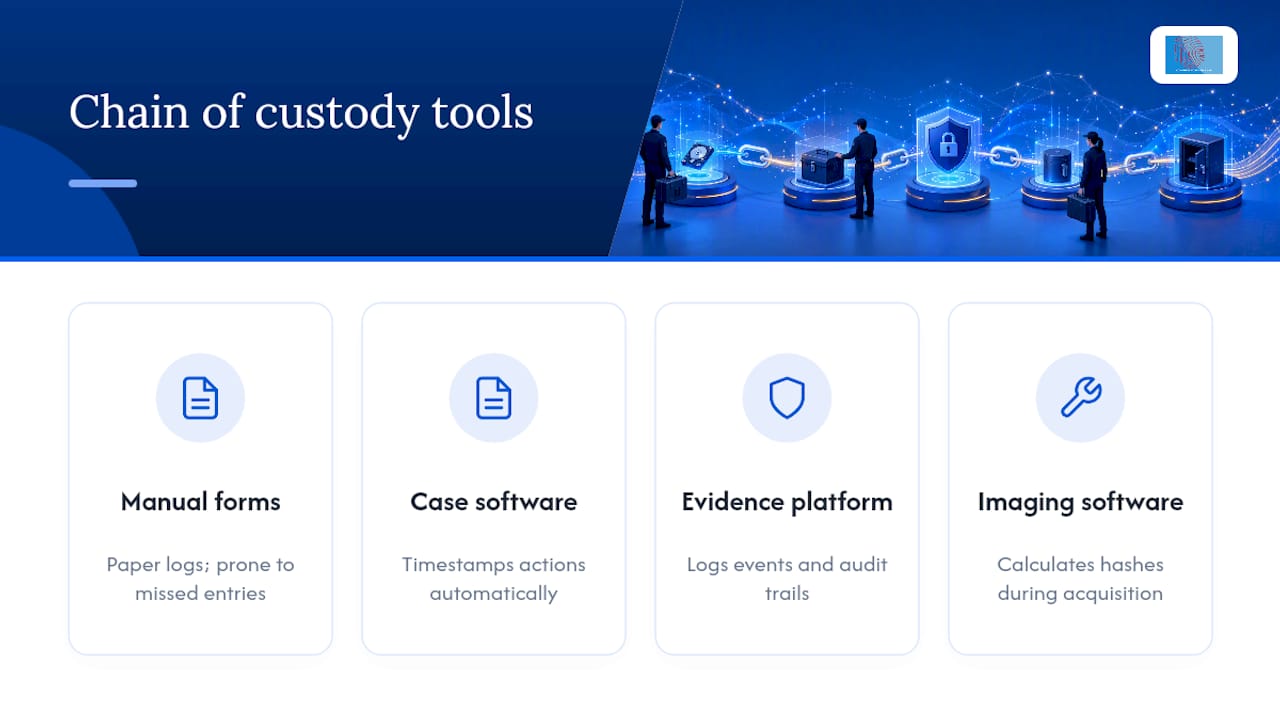
Purpose-built evidence management platforms log chain of custody events, generate audit trails, and attach hash values to case files without relying on a human to remember to write anything down. Forensic imaging software typically calculates hashes as an automatic step in the acquisition process rather than a separate manual task, which removes one of the most common sources of human error: forgetting to hash before the evidence is moved.
Digital evidence management systems that log every user action create an immutable record of access, satisfying the same principle NIST sets out for separating hash storage from the evidence repository. Write-blocker hardware, paired with imaging software, remains the standard combination for acquisition regardless of how automated the surrounding case management becomes.
The common thread across all of these tools is that automation reduces opportunities for the small human errors, a missed signature, an unrecorded timestamp, that account for most chain of custody failures in practice. Software cannot replace judgement, but it closes the gaps that manual logging tends to leave open.
What legal cases reinforce chain of custody requirements?
Courts across common law jurisdictions have repeatedly treated a broken chain of custody as grounds to question, and sometimes exclude, digital evidence, even when the underlying forensic analysis was technically sound. The recurring pattern in reported cases is not dramatic evidence tampering. It is undocumented gaps: a device that changed hands without a signature, a hash that was never recorded at acquisition, or a delay between seizure and imaging that nobody explained.
Forensic and legal literature on evidence handling consistently identifies the same failure mode as the one most likely to sink an otherwise strong case: a defence team does not need to prove evidence was altered, only that the chain of custody left room for it to have been altered. That distinction shapes how prosecutors and corporate legal teams now brief forensic investigators before evidence is even collected, insisting on documentation standards that anticipate a challenge rather than react to one.
Regulatory bodies have followed a similar logic. Data protection and cybercrime enforcement increasingly expect the same evidentiary discipline from corporate incident response teams that courts expect from law enforcement, which is part of why NIST’s SP 800-86 explicitly folds forensic rigor into the incident response lifecycle rather than treating it as a separate legal afterthought. The practical lesson for anyone handling digital evidence is straightforward: build the paperwork and the hashing into the process from the first hour, because retrofitting a chain of custody after the fact rarely satisfies a court that is already inclined to be sceptical.
What is often misunderstood about chain of custody?
The most persistent misconception is that chain of custody is a paperwork exercise, something a junior analyst fills in after the real forensic work is done. That gets the priority backwards. A single undocumented access, someone opening a file “just to check” without logging it, can be enough to compromise admissibility even when the technical analysis behind it is flawless.
The conventional advice on this topic tends to over-index on forms and under-index on culture. Organisations that treat chain of custody as a compliance checkbox produce beautiful paperwork with quiet gaps in it. Organisations that treat it as a discipline, where every person who might touch evidence understands why a five-minute shortcut can unravel months of investigation, produce the kind of record that survives cross-examination.
If there is one place to prioritise effort, it is training the people outside the forensic team: the IT administrators, the incident responders, the managers who arrive on scene before the specialists do. They are the ones most likely to create an undocumented gap, usually with good intentions and no idea what they have just done to the case.
— Computer
Get Professional Chain of Custody Support From Computerforensicslab
Building a defensible chain of custody without dedicated forensic infrastructure is difficult even for experienced IT teams, who rarely have write-blockers, case management logging, or expert witness experience sitting on hand for the day a serious incident occurs. Computerforensicslab provides exactly that infrastructure: forensic imaging, SHA-256 hash verification, tamper-evident storage, and expert witness reporting built around the same NIST and ISO/IEC 27037 standards covered throughout this guide, for law firms, corporate legal teams, and private clients who need evidence to survive scrutiny rather than just look thorough.
If a device, account, or dataset needs to be preserved as evidence, review Computerforensicslab’s digital forensics services and get in touch before anything is touched. Acting early, before the first handover happens, is the single biggest factor in whether the resulting chain of custody holds up later.
Sources
- chain of custody – Glossary | NIST
- Chain of custody and critical infrastructure systems | CISA (2023)
- Chain of custody – StatPearls | NCBI Bookshelf (2023)
- NIST Special Publication 800-72 (legacy) / related NIST guidance