
TL;DR:
- Website content forensics involves capturing web evidence with certified chain of custody and cryptographic seals to ensure court admissibility.
- Legal standards like ISO/IEC 27037 and eIDAS require comprehensive, timestamped, and securely sealed evidence, especially for dynamic content.
Website content forensics is the systematic process of capturing, preserving, and analysing web-based digital evidence with certified chain of custody and forensic integrity, so that evidence holds up in court. The recognised industry term for this discipline is “forensic web content acquisition,” though “website content forensics” is the phrase most legal professionals and corporate clients use when commissioning investigations. Standards such as ISO/IEC 27037 and the EU’s eIDAS regulation define the technical and legal requirements that make this evidence admissible. Computerforensicslab applies these standards to every website investigation it undertakes, from online defamation cases to intellectual property disputes.
What does website content forensics actually capture?
A forensic copy of a website is far more than a saved page or a screenshot. Court-admissible forensic copies must include the full HTML source from both the live browser and the server, HTTP traffic logs in HAR format, DNS resolution records, SSL/TLS certificate chains, and cryptographic hashes sealed with SHA-512. Each of these components serves a distinct evidential purpose. The HTML source proves what content was published. The DNS and TLS records confirm the domain and server identity at the moment of capture.

RFC 3161 qualified timestamps are the mechanism that locks all of this together. A qualified timestamp proves that a specific set of data existed at a specific point in time, and it cannot be backdated. Without it, opposing counsel can argue that any captured content was created or modified after the fact.
The difference between static and dynamic content acquisition matters enormously in practice. A static capture records the page as it appeared at one moment. Dynamic content acquisition, by contrast, records JavaScript execution, server-side rendering, and user-interaction states. Many legally significant pages, including those containing defamatory posts or fraudulent product listings, only reveal their full content after scripts execute.
Pro Tip: Never rely on the Wayback Machine or a basic browser “Save As” function as your primary evidence. Judicial reluctance to accept non-certified archives is well documented, and courts have rejected such captures for lacking qualified timestamps and chain of custody.
Here is a summary of the core technical components required for a legally sound forensic website copy:
| Component | Evidential purpose |
|---|---|
| Full HTML source (live and server) | Proves published content at time of capture |
| HTTP traffic logs (HAR) | Records all requests and responses |
| DNS resolution records | Confirms domain identity |
| SSL/TLS certificate chain | Verifies server authenticity |
| SHA-512 cryptographic hash | Detects any post-capture alteration |
| RFC 3161 qualified timestamp | Proves time of capture beyond dispute |
How is website content authenticity verified in forensic examinations?
Content authenticity verification is the process of proving that captured web content has not been altered since acquisition. The most common misconception is that a hash value alone is sufficient. Hash-only verification fails to prove content origin. A hash confirms that a file has not changed, but it says nothing about where that file came from or who created it.
True verification requires COSE_Sign1 signatures backed by trusted certificate chains. These cryptographic structures bind the content to a specific origin, making it possible to prove both integrity and provenance. This distinction is critical in adversarial proceedings, where opposing parties will challenge every weak link in the evidence chain.
Automated authenticity scanners add a further layer of analysis. These tools use multi-engine approaches that combine character-level Unicode checks with structural pattern analysis, producing tiered risk scores: scores of 90–100 indicate low risk, 65–89 indicate medium risk, and 0–64 indicate high risk. A score alone is not evidence. It is a signal that directs the examiner toward areas requiring deeper scrutiny.
Effective forensic analysis demands combining structural, metadata, and behavioural signals rather than relying on a single automated score. This is especially true for complex manipulations, where a page may score well on surface checks but reveal anomalies in its DOM structure or resource loading patterns.
Pro Tip: When reviewing a forensic authenticity report, check whether it documents chain of custody from the moment of capture through to delivery. A report without this documentation is contestable regardless of its technical findings.
The key elements of a multi-layered authenticity verification process include:
- Unicode and character-level analysis to detect encoding anomalies
- Structural pattern analysis of the DOM and resource tree
- Metadata examination of HTTP headers and server responses
- Behavioural signals from JavaScript execution logs
- COSE_Sign1 signatures with trusted certificate chains
- Qualified electronic seals under eIDAS Article 42
What standards and legal frameworks govern forensic website content acquisition?
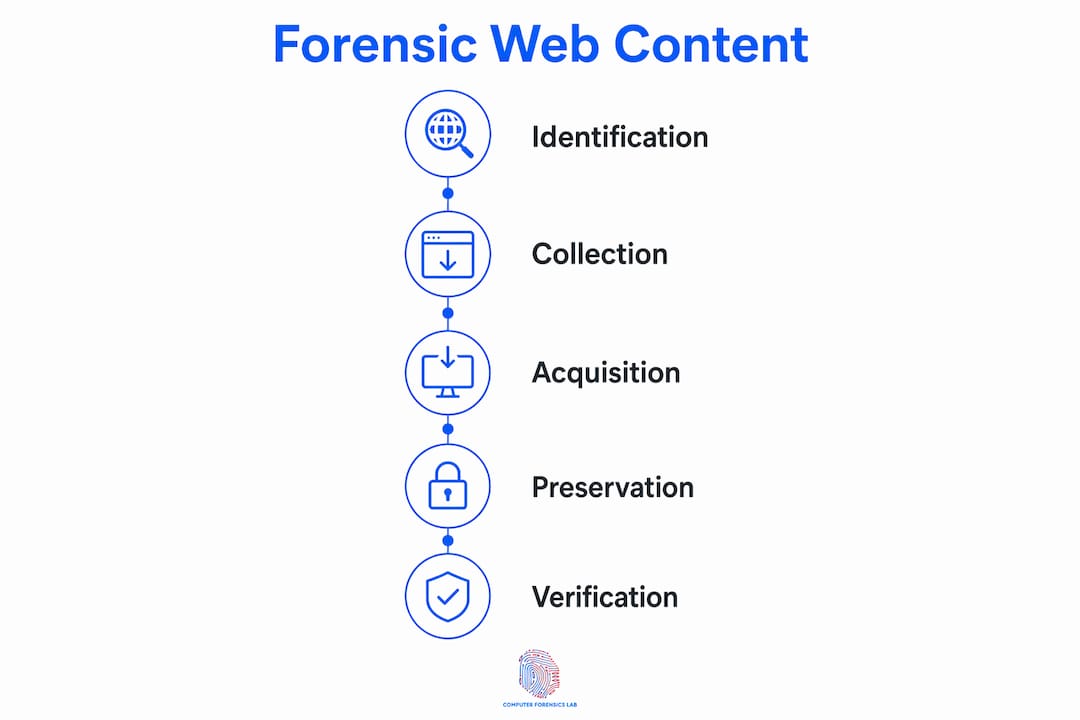
ISO/IEC 27037 is the primary international standard for digital evidence handling. It defines four mandatory phases: identification, collection, acquisition, and preservation. Each phase must be fully documented with traceable operations, so that any examiner can reconstruct exactly what was done and when. This traceability is what separates admissible evidence from contested material.
The eIDAS regulation adds a further layer of legal certainty for proceedings within the EU and for cross-border matters. Article 42 of eIDAS grants a legal presumption of accuracy to qualified timestamps, and the qualified electronic seal ensures the origin and integrity of digital evidence across all 27 EU member states. For UK practitioners, eIDAS-equivalent standards remain relevant in cross-border litigation, and UK courts apply similar principles when assessing digital evidence integrity.
The Budapest Convention on Cybercrime establishes international obligations for the preservation and disclosure of electronic evidence in criminal proceedings. It requires that evidence be preserved in a form that maintains its integrity, which aligns directly with the ISO/IEC 27037 acquisition model.
“Judicial reluctance to accept non-certified archives like the Wayback Machine highlights the critical need for qualified timestamps and chain of custody. Courts have found such captures inadmissible precisely because they lack the forensic sealing that ISO/IEC 27037 and eIDAS require.”
The practical implication for legal professionals is straightforward. Evidence gathered outside these frameworks is vulnerable to challenge at every stage of proceedings. A well-documented forensic acquisition, by contrast, is difficult to attack because every action is recorded, timestamped, and signed.
The four ISO/IEC 27037 phases in practice:
- Identification: Locate and document all relevant web content, including URLs, subdomains, and linked resources.
- Collection: Record the technical environment, including server details, DNS configuration, and SSL/TLS certificates.
- Acquisition: Capture the full technical package using a certified forensic browser, including video recording of the live session.
- Preservation: Seal the evidence package with SHA-512 hashes and RFC 3161 qualified timestamps, then store it with an unbroken chain of custody record.
What are the practical applications and challenges of forensic web investigations?
Website content forensics applies across a wide range of legal and corporate matters. Online defamation cases require proof of what was published and when. Intellectual property disputes need evidence of infringing content before it is removed. Contract verification cases rely on capturing the exact terms displayed on a website at the time of agreement. Cybercrime investigations demand a complete forensic trail of malicious pages, phishing sites, and fraudulent listings.
The most common challenge is the speed at which web content changes. A defamatory post can be deleted within minutes of a complaint. A fraudulent product listing can be altered before a solicitor has time to instruct a forensic examiner. This is why web page certification services that deliver forensic reports in under 60 seconds are operationally significant. Speed of acquisition directly affects the evidential value of the capture.
Dynamic content presents a separate technical challenge. Pages that load content via JavaScript, that display different material to different users, or that require authentication to access, cannot be captured by simple archiving tools. A certified forensic browser records the live browsing session as video, logs all interactions, captures multiple page states, and packages everything with qualified seals. This approach produces a complete forensic trail that reflects the actual user experience.
Pro Tip: For high-value disputes, commission multiple capture points at different times. A single capture proves content existed at one moment. Multiple captures demonstrate a pattern, which is often more persuasive in proceedings involving ongoing conduct.
Common pitfalls in web-based digital evidence collection include:
- Relying on screenshots without certified metadata or timestamps
- Using consumer archiving tools that lack chain of custody documentation
- Failing to capture dynamic content states, including post-login pages
- Neglecting to record DNS and TLS data alongside the page content
- Submitting evidence without a qualified forensic report explaining the acquisition methodology
The importance of maintaining evidence integrity throughout the investigation cannot be overstated. A single break in the chain of custody can render an otherwise technically sound evidence package inadmissible.
For corporate clients, the practical benefit of a structured forensic approach extends beyond litigation. A properly documented website content audit creates a defensible record of what competitors, employees, or third parties published online, which supports both legal action and regulatory compliance. Understanding why content protection matters is increasingly relevant for organisations managing intellectual property online.
Key takeaways
Website content forensics produces admissible evidence only when acquisition follows ISO/IEC 27037, uses RFC 3161 qualified timestamps, and maintains an unbroken chain of custody from capture to court.
| Point | Details |
|---|---|
| Screenshots are not evidence | Screenshots lack certified metadata, timestamps, and chain of custody, making them contestable in court. |
| ISO/IEC 27037 is the standard | All four phases, identification, collection, acquisition, and preservation, must be fully documented. |
| Qualified timestamps are mandatory | RFC 3161 timestamps and eIDAS electronic seals prove time and origin beyond reasonable challenge. |
| Hash verification alone is insufficient | COSE_Sign1 signatures with trusted certificate chains are required to prove both integrity and provenance. |
| Dynamic content requires specialist capture | Forensic browsers with video recording and interaction logs are necessary for JavaScript-rendered pages. |
The shift I have seen in how courts treat web evidence
Judicial attitudes towards digital evidence have changed markedly over the past decade, and the direction of travel is clear. Courts are becoming less tolerant of informal captures and more demanding about forensic methodology. I have seen cases where perfectly accurate screenshots were excluded simply because the acquiring party could not demonstrate how, when, or by whom they were taken. The content was genuine. The process was not.
What concerns me most is the gap between what legal professionals assume is sufficient and what courts actually require. Many solicitors still instruct clients to take their own screenshots as a first step. That instruction, while well-intentioned, can contaminate the evidence trail before a forensic examiner is ever involved.
The shift towards AI-driven integrity systems in forensic analysis is real, but it introduces its own risks. Automated scoring tools are useful for triage. They are not a substitute for a qualified examiner interpreting structural, metadata, and behavioural signals together. A page that scores 92 on an authenticity scanner can still contain manipulated content if the manipulation is sophisticated enough to evade pattern detection. The examiner’s judgement remains the final layer of verification.
My advice to legal professionals and corporate clients is this: treat web content as perishable evidence. Commission forensic acquisition at the earliest opportunity, use a methodology that aligns with ISO/IEC 27037 and eIDAS, and ensure your forensic report explains the acquisition process in terms a judge can follow. The technology exists to do this properly. The question is whether it is deployed in time.
— Computer
How Computerforensicslab supports forensic web content investigations
Computerforensicslab provides digital forensics services to legal professionals, law enforcement, and corporate clients across the UK, with website content acquisition forming a core part of its investigation capability. Every engagement follows ISO/IEC 27037 and eIDAS-aligned protocols, from initial identification through to the delivery of a court-ready forensic report. The team maintains full chain of custody documentation throughout, and expert witness support is available for civil and criminal proceedings. For organisations that need to capture, preserve, or analyse web-based digital evidence, Computerforensicslab offers consultations to assess the scope of the investigation and recommend the appropriate acquisition methodology. Contact Computerforensicslab to discuss your case.
FAQ
What is website content forensics?
Website content forensics is the process of capturing and preserving web-based digital evidence with certified chain of custody, qualified timestamps, and cryptographic integrity seals, so that the evidence is admissible in legal proceedings.
Are screenshots admissible as evidence in UK courts?
Screenshots are generally contestable because they lack certified metadata, qualified timestamps, and chain of custody documentation. ISO/IEC 27037 requires a comprehensive forensic acquisition to meet legal standards.
What does ISO/IEC 27037 require for web evidence?
ISO/IEC 27037 requires four documented phases: identification, collection, acquisition, and preservation. Each phase must be fully traceable, with cryptographic hashes and qualified timestamps applied to the final evidence package.
Why is a qualified timestamp important in web forensics?
A qualified timestamp, compliant with RFC 3161 and recognised under eIDAS Article 42, proves that specific digital content existed at a specific point in time and cannot be backdated or disputed.
Can the Wayback Machine be used as legal evidence?
Courts have shown reluctance to accept Wayback Machine captures as primary evidence because they lack qualified timestamps and chain of custody documentation. A certified forensic acquisition is required for reliable admissibility.