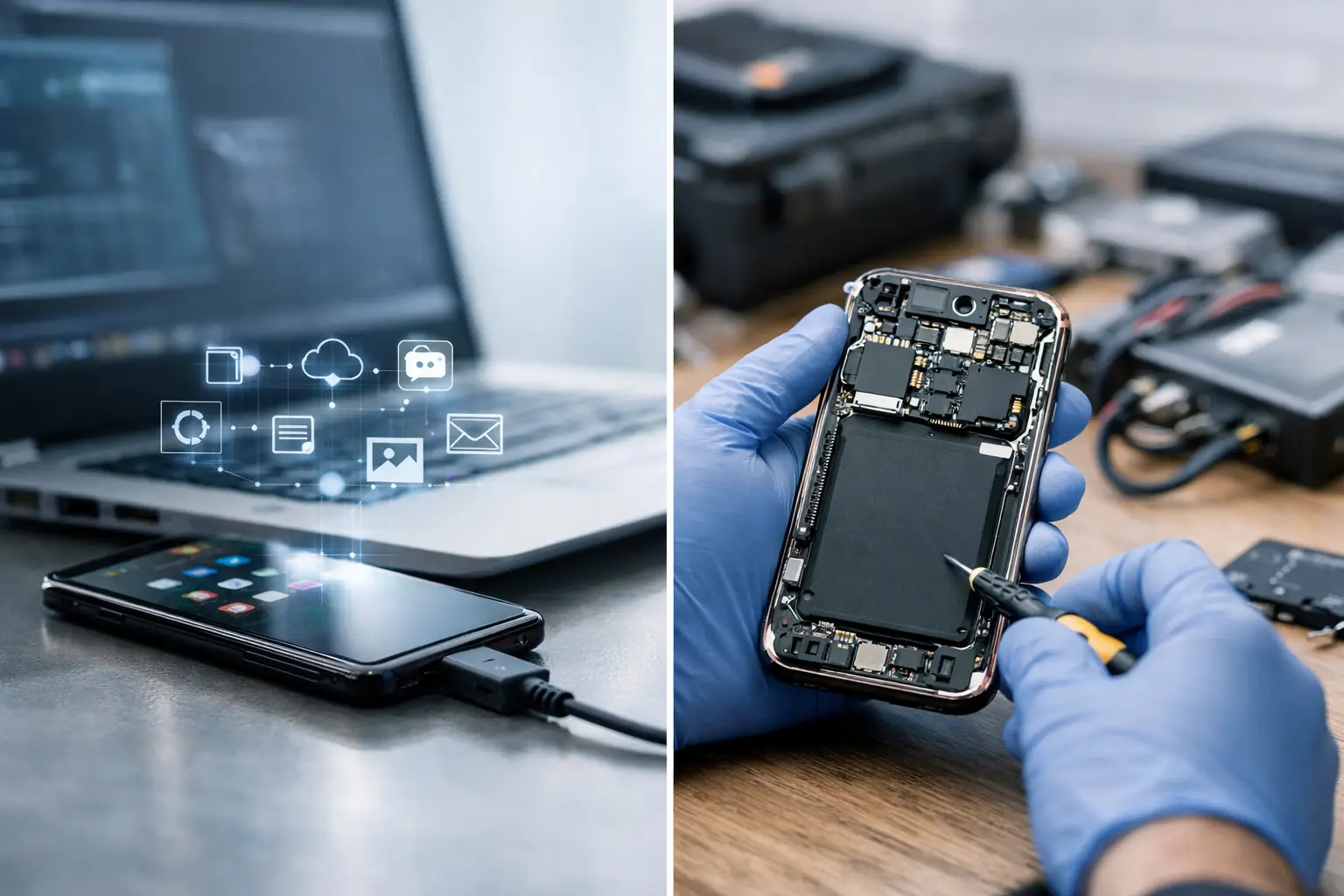
A mobile phone arrives in the middle of a fraud enquiry. Messages are missing, the client wants answers quickly, and the court timetable is already moving. At that point, the difference between logical extraction vs physical extraction is not academic. It can determine what evidence is recovered, what remains invisible, and whether the examination will answer the questions that matter.
In digital forensics, extraction method is a strategic decision. It affects scope, time, risk, and evidential value. For solicitors, investigators, and organisations handling contested digital evidence, understanding that distinction helps when framing instructions, managing expectations, and deciding whether a device needs a more intrusive forensic approach.
What logical extraction vs physical extraction means
A logical extraction collects data through the device’s operating system or through approved interfaces exposed by the device. In practical terms, the forensic tool asks the phone, tablet, or computer for the data it is permitted to provide, such as active call logs, contacts, messages, media files, application data, and configuration information. The extraction is often efficient and less invasive, but it is constrained by what the operating system makes available.
A physical extraction is different. It aims to acquire a bit-for-bit copy of the underlying storage, or as close to that as the device and security controls permit. Rather than relying only on the logical view presented by the operating system, it seeks access to the raw data layer. That can expose deleted material, remnants of historical activity, hidden artefacts, and data structures not visible through standard system queries.
The phrase logical extraction vs physical extraction is therefore really about visibility and access. One approach gathers what the device will readily disclose. The other attempts to preserve and inspect what is actually stored at a lower level.
Why the distinction matters in legal and investigative work
In ordinary IT support, recovering live user data may be enough. In forensic work, the question is broader. You may need to establish whether a message existed before deletion, whether an app was used at a critical time, whether a user attempted concealment, or whether a device contains evidence inconsistent with an account given in interview or witness evidence.
That is where extraction method matters. A logical extraction may be perfectly suitable in a case focused on current user data, particularly where speed and proportionality are central. But where allegations involve deletion, anti-forensic behaviour, hidden activity, or disputed timelines, a physical approach may be necessary if the device supports it.
This does not mean physical extraction is always better. It means the right method depends on the issues in dispute, the device itself, and the proportionality of the examination.
What a logical extraction can recover
Logical extraction is often valuable because it can obtain substantial evidence quickly and with less technical intervention. On many devices, it can recover active text messages, call history, contact lists, photographs, videos, notes, calendar entries, installed application data, and some cloud-linked metadata.
In a civil dispute, employment matter, or internal investigation, that may be enough to establish communications between key individuals, confirm file transfers, or identify patterns of contact. It is also commonly used when access credentials are available and the device is co-operative.
The limitation is that logical extraction usually reflects the device’s current state as interpreted by the operating system. If a user has deleted relevant content, cleared chat history, or used applications that restrict local storage, the logical acquisition may show far less than the underlying device once contained.
What a physical extraction can recover
A physical extraction can, where technically possible, provide a far richer evidential picture. Because it targets the raw storage layer, it may reveal deleted artefacts, unallocated space, file fragments, database remnants, and system records not exposed through normal user interfaces.
This can be crucial in cases involving deliberate deletion, suspicious device wiping, covert communications, or timeline reconstruction. A physical image may allow the forensic examiner to analyse application databases directly, inspect system logs, identify traces of prior usage, and test whether activity has been concealed.
Even so, there are constraints. Modern devices increasingly use encryption, secure enclaves, hardware-backed protections, and operating system controls designed to prevent low-level access. In many current smartphones, a full physical extraction is not available in the classic sense, or only available on certain models, operating system versions, or after highly specialised procedures. Any serious forensic provider should be candid about those limits.
Logical extraction vs physical extraction in modern devices
The older assumption that physical extraction is always achievable no longer holds. Mobile forensics has changed significantly as device manufacturers have strengthened security. On some handsets, the examiner may obtain only a file system extraction or another partial acquisition that sits between classic logical and full physical imaging.
That matters because clients sometimes expect deleted data recovery simply because a device has been seized. In reality, recoverability depends on encryption, whether the device has been powered on or off, user activity after deletion, model-specific support, passcode status, and the forensic tooling lawfully available.
A disciplined examiner will explain not only what method is proposed, but what that method is likely to capture and what it may not. That clarity is essential if the findings may later be tested in court.
Choosing the right method for the case
The extraction method should follow the issues in dispute, not the other way round. If the case concerns current communications, recent photographs, contact between named parties, or live app content, a logical extraction may be proportionate and sufficient. It can often answer focused questions without unnecessary technical escalation.
If, however, there is reason to believe evidence has been deleted, altered, concealed, or partially overwritten, the case for a deeper acquisition becomes stronger. Allegations of harassment, conspiracy, employee misconduct, intellectual property theft, and post-incident clean-up frequently require closer scrutiny of the underlying storage and system artefacts.
There is also a legal and procedural dimension. Proportionality matters. The fact that a physical extraction may reveal more does not mean it is always justified. In family proceedings, employee investigations, or matters involving third-party privacy, the scope of examination must be carefully defined and defensible. Forensic capability does not remove the need for lawful authority, relevance, and minimisation.
Evidential integrity comes before extraction speed
A rushed extraction can create problems that are harder to repair than the original data loss. Devices should be handled under proper chain of custody, with contemporaneous records of receipt, condition, identifiers, and actions taken. The method used, tool versions, access conditions, and any limitations should be documented clearly.
That is especially important where the other side may challenge the process. If an examiner cannot explain how the data was acquired, what was and was not accessible, and whether the extraction altered the device state, the evidential weight of the findings may be reduced.
For that reason, the strongest forensic work is not defined by how much data is extracted. It is defined by whether the process is repeatable, transparent, and proportionate to the issues in the case.
Common misconceptions about logical and physical extraction
One common misconception is that logical extraction is somehow inferior. It is not. In many matters, it is the most appropriate route and produces reliable evidence efficiently. If the evidential questions relate to live user data, there may be no need for deeper intervention.
Another misconception is that physical extraction guarantees deleted data recovery. It does not. Deleted content may already have been overwritten, encrypted beyond forensic access, or never stored locally in a recoverable form. Some applications retain very little on-device data at all.
A third misconception is that extraction itself answers the case. It does not. Acquisition is only the first stage. The real value lies in forensic analysis, interpretation, chronology, and reporting that connects the data to the issues a court, solicitor, or investigator actually needs resolved.
What instructing parties should ask at the outset
When a case may turn on mobile or computer evidence, the better question is not simply, “Can you extract the data?” It is, “What type of extraction is suitable for these allegations, what are the likely limits, and how will the findings be presented?”
That shifts the focus from raw recovery to evidential utility. A good forensic instruction identifies the disputed facts, relevant date range, key applications, suspected deletion or concealment, and any urgency around preservation. It also recognises that some devices will support only limited forms of acquisition, however serious the allegation may be.
At Computer Forensics Lab, that assessment is treated as part of the forensic task itself. The objective is not to promise the impossible. It is to preserve the device properly, select the right method, and produce findings that remain credible under scrutiny.
The practical point is simple. When the stakes are high, choosing between logical and physical extraction should never be reduced to a technical preference. It is a forensic judgment that must align with the allegations, the device, and the standard of evidence the case will demand.