
TL;DR:
- Automated vulnerability scanners are fast but insufficient, as they miss many complex, business-logic flaws detectable only through manual penetration testing. Penetration testing involves simulated attacks, chaining weaknesses and actively exploiting vulnerabilities, unlike automated scans that only identify known signatures. Regular, manual-driven pen tests provide strategic security insights, prioritize effective remediation, and support ongoing resilience beyond mere compliance.
Automated vulnerability scanners are fast, repeatable, and tempting to treat as sufficient. They are not. 95% of applications show critical security issues that automated tools fail to detect, and the role of penetration testing is precisely to close that gap. Where a scanner checks for known signatures, a skilled tester thinks like an attacker, chains together minor weaknesses, and exposes the business-logic flaws that no algorithm can reliably spot. If your organisation is relying on automated scans alone, you are not measuring your real risk. You are measuring what a tool was programmed to find.
Table of Contents
- Key takeaways
- The role of penetration testing: what it is and what it is not
- Penetration testing methodology: phases, standards and effort
- Why penetration testing matters strategically
- Planning, scoping and embedding pen testing in your security programme
- My perspective on where pen testing really fails organisations
- How Computerforensicslab can support your pen testing needs
- FAQ
Key takeaways
| Point | Details |
|---|---|
| Manual effort is non-negotiable | Effective pen tests require at least 60% manual work to uncover complex, chained vulnerabilities. |
| Pen testing differs from audits | Security audits measure compliance; penetration testing actively exploits weaknesses to demonstrate real exposure. |
| Business logic flaws go unseen | Automated tools cannot reason about workflows, making human testers the only reliable way to find these gaps. |
| Frequency determines resilience | A single one-off test provides a snapshot; scheduled or continuous engagements build genuine security maturity. |
| Reports must drive remediation | Effective pen testing delivers prioritised, evidenced findings tied directly to business impact and remediation steps. |
The role of penetration testing: what it is and what it is not
Understanding what penetration testing actually means requires clearing up two persistent confusions: conflating it with vulnerability scanning, and treating it as equivalent to a security audit.
What is penetration testing? At its core, it is an authorised, simulated attack against a system, application, or network. A qualified tester receives a defined scope, then attempts to exploit weaknesses just as a real attacker would, documenting every step, every access gained, and every lateral movement possible. What is a pen test in software terms specifically? It means probing an application for injection points, authentication bypasses, insecure session handling, and business logic flaws that would allow an attacker to extract data, escalate privileges, or disrupt service.
A vulnerability scanner, by contrast, fires automated probes at known signatures. It tells you a version of Apache is out of date. It will not tell you that your forgotten staging subdomain, exposed password reset endpoint, and overly permissive API token can be combined into a full account takeover in four steps. Penetration testers perform vulnerability chaining to create those high severity exploits from multiple minor bugs. That is a fundamentally different capability.
The distinction from security audits matters equally. Security audits focus on compliance, checking whether controls are documented and policies are followed. Penetration testing is invasive. It does not ask whether a control exists; it tests whether the control actually stops an attacker. Passing an audit does not mean your systems are secure. It means your paperwork is in order.
| Approach | Method | Output | Compliance value |
|---|---|---|---|
| Vulnerability scanner | Automated signature matching | List of known CVEs | Low |
| Security audit | Policy and control review | Compliance report | High |
| Penetration test | Manual exploitation, chaining | Attack narrative and risk evidence | Moderate to high |
Penetration testing methodology: phases, standards and effort
Knowing what penetration testing in cyber security involves at a methodological level separates organisations that get real value from those that pay for a report and learn nothing new.
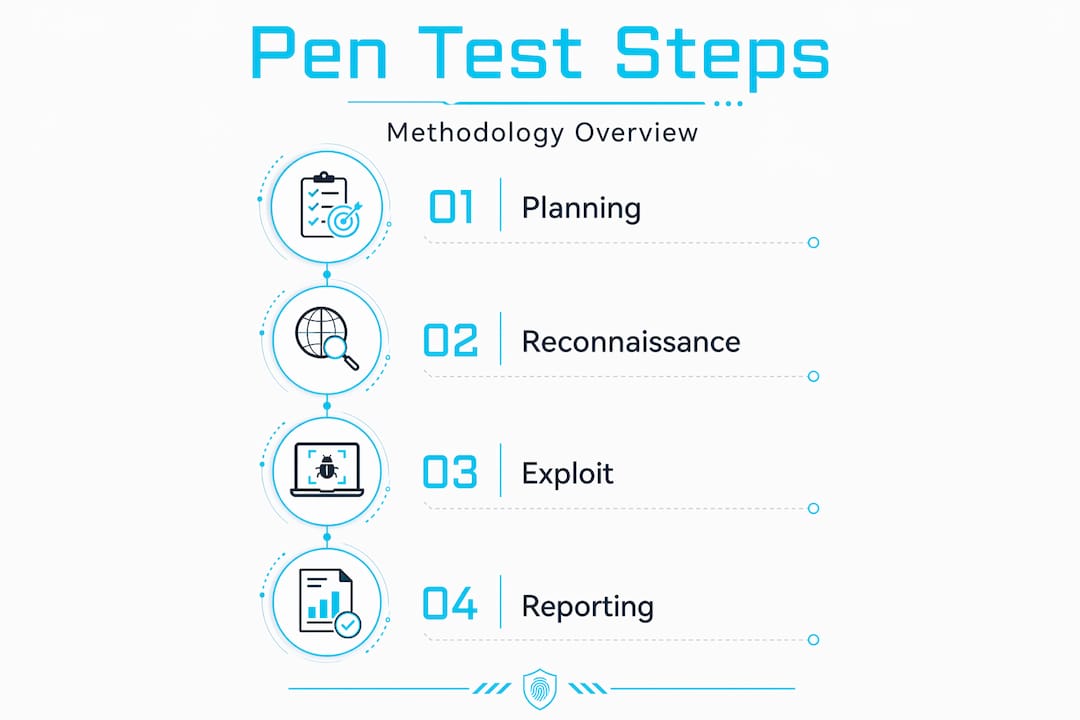
Recognised frameworks govern how professional engagements are structured. The Penetration Testing Execution Standard (PTES), NIST SP 800-115, and the OWASP Testing Guide each define structured phases that prevent testers from skipping straight to exploitation without understanding what they are attacking. Formal methodologies from scoping through reporting set mandated manual effort thresholds that distinguish genuine pen tests from glorified scan reports.
A properly structured engagement follows seven phases:
- Pre-engagement. Scope, rules of engagement, legal authorisation, and agreed timelines are defined. No reputable tester begins without written permission covering every system in scope.
- Reconnaissance. Passive and active information gathering maps the attack surface: subdomains, exposed services, employee data, technology stack, and supplier relationships.
- Threat modelling. The tester identifies which assets carry the most business risk and which attack paths are most plausible given the organisation’s profile.
- Vulnerability analysis. Automated tools contribute here, but their output is reviewed critically rather than taken at face value.
- Exploitation. This is where pen testing diverges sharply from scanning. The tester actively attempts to confirm and exploit findings, proving real impact rather than theoretical risk.
- Post-exploitation. Once access is gained, the tester maps how far an attacker could move laterally, what data they could reach, and whether they could persist undetected.
- Reporting. Effective reporting translates findings into attack narratives, evidence, business impact ratings, and remediation guidance that non-technical leadership can act on.
The balance between manual and automated effort defines the quality of the engagement. Professional methodology requires at least 60% manual effort, with scanning limited to 40% or less. Automated tools are fast at finding low-hanging fruit, but automated tools miss business logic flaws and complex workflows that only human reasoning can evaluate.
Pro Tip: When commissioning a pen test, ask your provider what percentage of engagement time is spent on manual testing versus automated scanning. If they cannot answer clearly, or if automated work dominates, the engagement will not reflect your real risk posture.

Why penetration testing matters strategically
The organisations that treat pen testing as a compliance checkbox tend to be the same ones whose breach post-mortems reveal that the exploited path was entirely predictable. The strategic value of penetration testing runs far deeper than satisfying a regulatory requirement.
Consider what a thorough pen test actually produces. Human creativity and reasoning uncover complex attack paths that no automated scanner comprehends. A misconfigured internal API, a forgotten developer account, and an overly trusting microservice are individually low-severity findings. Together, they may represent a path to your customer database. A tester who thinks like an attacker will find that chain. A scanner will log three medium severity issues and move on.
The concrete business benefits of regular pen testing include:
- Prioritised remediation. Rather than a flat list of CVEs, you receive findings ranked by real exploitability and actual business impact, so your team knows where to spend limited remediation hours.
- Validation of existing controls. Firewalls, WAFs, EDR tools, and MFA implementations all carry assumptions. A pen test confirms whether those assumptions hold under pressure.
- Discovery of hidden attack paths. Business logic flaws, insecure direct object references, and trust relationship abuses rarely appear in scan reports. They appear in pen test findings.
- Reduced cost of breach. Identifying and closing a vulnerability before an attacker exploits it is orders of magnitude cheaper than the incident response, legal, and reputational costs that follow a breach.
- Support for cyber insurance and contracts. Insurers and enterprise clients increasingly ask for evidence of regular pen testing as a condition of coverage or partnership.
“Leadership should recognise penetration testing as a strategic business safeguard, not a compliance checkbox. The question is not whether you’ve run a test. It’s whether the test was designed to find what would actually hurt your business.” (Beyond the checkbox)
What happens when organisations neglect pen testing? The consequences are not hypothetical. Attackers routinely exploit multi-stage paths that only became visible in post-breach forensic analysis. The attack surface that existed for months or years was never tested because leadership assumed automated scans and annual audits were sufficient. The human element in penetration testing is what separates organisations that discover their exposures first from those that discover them through a breach notification.
Planning, scoping and embedding pen testing in your security programme
Understanding why penetration testing matters is one thing. Implementing it in a way that generates lasting improvement requires deliberate planning.
The most common structural mistake is the one-off engagement. A single pen test produces a snapshot of your security posture at a specific moment. Your codebase changes, your infrastructure evolves, and new third-party integrations arrive. Treating pen testing as one-and-done creates false confidence in a security posture that no longer reflects reality. A structured pen testing schedule, even a modest quarterly or biannual cadence, separates proactive security from reactive damage control.
Practical considerations for embedding pen testing effectively include:
- Prioritise your attack surface. External facing assets, customer data stores, authentication systems, and any recently changed infrastructure should be tested first and most frequently.
- Integrate findings with vulnerability management. A pen test report is not a project to close. Findings should feed directly into your existing vulnerability management workflow, with tracking, ownership, and remediation deadlines assigned.
- Build retesting into the scope. Fixing a vulnerability and assuming the fix is correct is an assumption. Schedule retesting to confirm that remediations actually hold against the same attack vectors.
- Match tester skills to target. Web application testing requires different expertise from network infrastructure or cloud configuration review. Generalist testers conducting specialist assessments produce shallow findings.
- Manage budget without cutting depth. Narrowing scope is preferable to reducing manual effort. A thorough test of your three highest-risk systems provides more real value than a surface-level pass across your entire estate.
You should also think carefully about penetration testing for your IT infrastructure when selecting a provider. Ask for sample reports, request evidence of methodology, and confirm whether findings include attack narratives or just lists of CVEs. A report without an attack story cannot teach your team what an attacker would actually do.
Pro Tip: Tie pen testing cycles to your software release calendar. Running an assessment immediately after a major deployment, when new code and configurations are live but untested under adversarial conditions, produces significantly higher-value findings.
My perspective on where pen testing really fails organisations
I have seen the same pattern repeatedly. An organisation runs a pen test, receives the report, assigns tickets to remediate the critical findings, and considers the exercise complete. Twelve months later, they commission another test. Half the same issues resurface with different CVE numbers attached.
The failure is not the pen test. It is the mindset around it. Penetration testing is being used as a document to produce rather than a process to learn from. When retesting does not happen, when medium and low severity findings are never reviewed in aggregate, and when the report sits in a folder rather than informing architecture decisions, the exercise loses most of its value.
What I consistently find more useful is when security teams treat pen test findings as threat intelligence about their own environment. The attack chains a tester documents are the same chains a real attacker would use. Reading a pen test report the way an attacker would read your systems, and not as a compliance artefact, changes how thoroughly teams act on it.
For decision-makers balancing budget pressures, my honest view is that reducing frequency is far less damaging than reducing manual effort. A thorough biannual test of your most critical systems will protect you better than four annual scan-heavy reports that tell you what you already knew. The value is in the human judgement, not the page count. If you want to understand how this applies to legally sensitive environments specifically, the guide for UK legal teams addresses those considerations directly.
— Computer
How Computerforensicslab can support your pen testing needs
At Computerforensicslab, we approach penetration testing as part of a broader commitment to genuine security assurance, not report generation. Our engagements are grounded in recognised methodologies, with emphasis on manual exploitation and attack narrative reporting that security teams and leadership can both act on. We work with legal professionals, enterprises, and regulated organisations that need pen testing findings to stand up to scrutiny, whether for incident response, litigation support, or ongoing risk management. Explore our full range of digital forensics services to understand how penetration testing sits alongside forensic investigation, malware analysis, and expert witness support. When you need a provider whose findings are evidenced, methodical, and defensible, we are ready to assist.
FAQ
What does penetration testing involve?
Penetration testing involves an authorised tester simulating a real attack against systems, applications, or networks across seven structured phases: pre-engagement, reconnaissance, threat modelling, vulnerability analysis, exploitation, post-exploitation, and reporting. The process produces an attack narrative with evidence and prioritised remediation guidance.
How does pen testing differ from a vulnerability scan?
A vulnerability scan automates the detection of known issues using signature matching. Penetration testing uses manual reasoning and exploitation to chain multiple weaknesses together and prove real business impact, including flaws that automated tools cannot detect, such as business logic vulnerabilities.
Why conduct penetration testing regularly rather than once?
A single pen test reflects your security posture at one moment in time. As infrastructure and code change, new exposures emerge. Scheduled or continuous pen testing adapts to an evolving attack surface and provides the remediation tracking needed to build genuine resilience rather than a static snapshot.
What is the right balance of manual versus automated testing in a pen test?
Effective penetration testing requires at least 60% manual effort, with automated scanning limited to 40% or less. Manual work is what uncovers complex attack chains, business logic flaws, and multi-stage exploit paths that automated tools consistently miss.
What are penetration tests used for beyond compliance?
Beyond satisfying regulatory requirements, penetration tests validate existing security controls, uncover hidden attack paths, prioritise remediation by real exploitability, reduce the cost and likelihood of breaches, and provide evidence required by cyber insurers and enterprise clients.