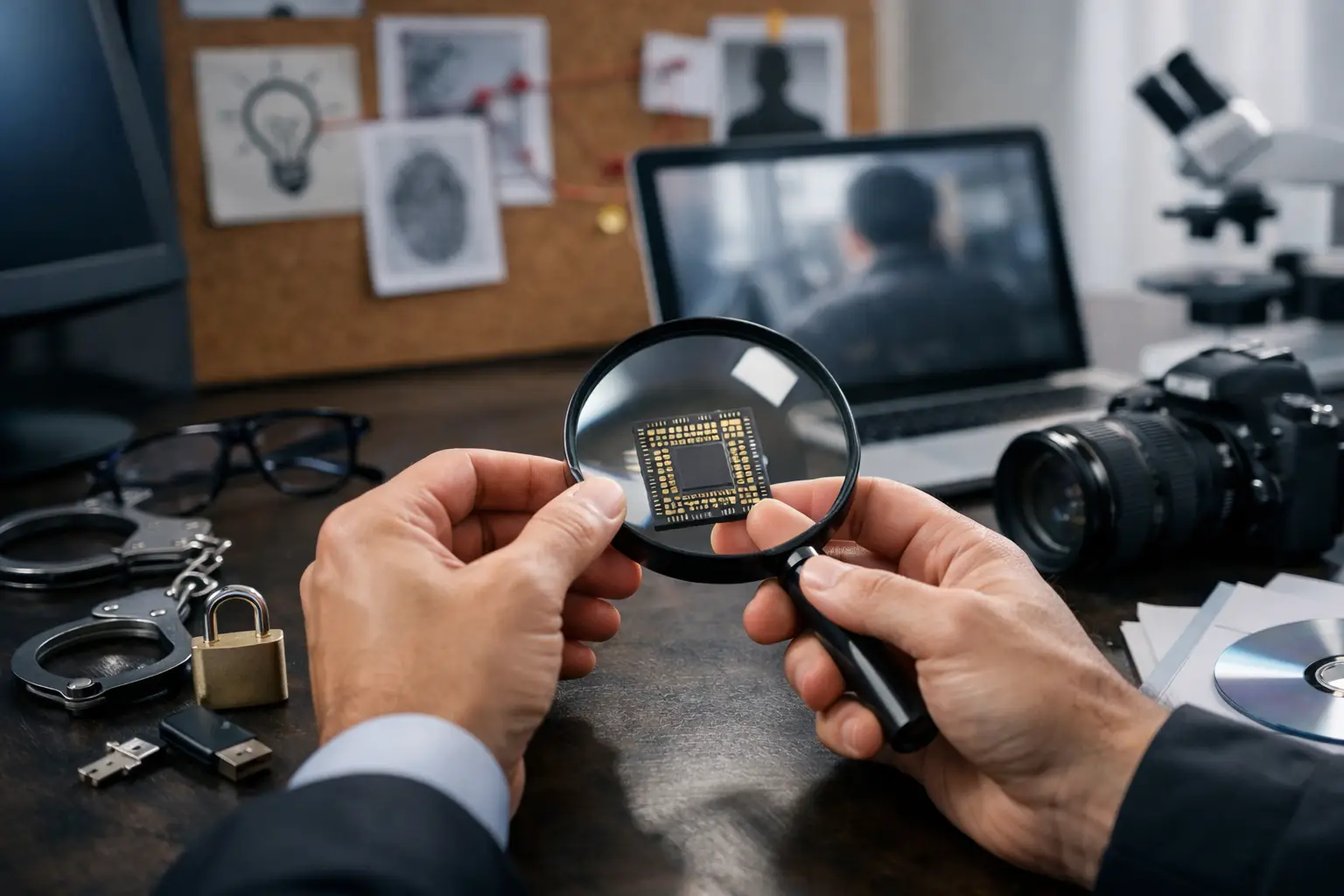
A suspected leak rarely begins with a neatly labelled confession. It may begin with a former employee joining a competitor, an unexplained fall in sales, a client receiving a familiar proposal from another supplier, or source files appearing outside the business. This intellectual property theft guide sets out how to respond when digital evidence may determine whether a concern becomes a defensible legal case.
The central challenge is not simply finding data. It is proving what happened, when it happened, who had access, and whether the material was copied, removed, disclosed or used. A rushed internal review can alter the very evidence needed to establish those facts. The first hours therefore require discipline as much as technical capability.
What intellectual property theft can look like
Intellectual property theft is a broad description rather than a single technical event. In practice, a dispute may concern confidential information, trade secrets, customer lists, product designs, source code, pricing models, business plans, research data, marketing assets or copyrighted work. The legal character of the information will depend on the facts and the rights relied upon, but the digital investigative questions are often similar.
A departing employee may export contacts from a CRM system, forward documents to a personal email account, sync files to consumer cloud storage, photograph screen content with a mobile phone, or copy folders to a USB device. A third party may gain unauthorised access to an account and exfiltrate data. In other matters, the issue is more subtle: a former contractor may retain access after an engagement ends, or a competitor’s material may bear signs of having been derived from internal documents.
Not every unusual activity proves theft. A file copied to a laptop may have been required for legitimate work. A cloud synchronisation event can arise automatically. A forensic investigation must distinguish technical possibility from evidence of intent and actual use. That impartial distinction is essential where findings may be challenged in litigation, disciplinary proceedings or criminal proceedings.
Intellectual property theft guide: the first response
When a concern is identified, organisations often face competing pressures. They need to contain a live risk quickly, but they must avoid destroying or contaminating evidence. The right balance depends on the threat. If an account remains compromised or a departing individual retains access, containment may be urgent. If the primary issue is historic copying, evidence preservation may take priority.
A defensible initial response should usually include the following actions:
- Preserve the relevant devices, accounts and cloud-linked assets, recording who took possession, when and from where.
- Restrict access proportionately, such as disabling accounts, resetting credentials and suspending external sharing where there is an ongoing risk.
- Instruct staff not to inspect, delete, rename, clean or continue using relevant devices unless necessary and authorised.
- Preserve available system logs, email audit records, cloud activity logs, access-control data and backups before normal retention periods remove them.
- Identify the likely sources of evidence, including employer-issued laptops and phones, collaboration platforms, email accounts, file servers, removable media and business applications.
Documentation begins immediately. Record the allegation, the systems involved, the people with relevant access, the action taken and the reason for it. This contemporaneous record may later explain why a device was isolated, why an account was disabled, or why a particular dataset was retained.
Avoid treating an employee’s personal device as if it were company property. The relevant legal authority, contractual position, privacy obligations and scope of any proposed examination must be considered. Over-collection can create avoidable legal and evidential problems, especially where personal data, legally privileged material or unrelated communications are involved.
Preserving evidence that can withstand scrutiny
A screenshot of an email or a copied folder may support an allegation, but it is rarely the whole evidential picture. Screenshots are selective and can omit metadata, context and system information. They can also be difficult to authenticate if the original account or device is later unavailable.
Forensic preservation aims to capture data in a way that is repeatable, transparent and minimally intrusive. Depending on the device and case objectives, this may involve a forensic image of a computer drive, a logical extraction from a mobile device, collection of cloud data with audit records, or targeted preservation of business-system exports. The method should be appropriate to the source, the urgency, the authority available and the questions the investigation must answer.
Chain of custody is not administrative paperwork. It is the record that allows another party to understand where an exhibit came from, how it was handled, what was done to it and whether its integrity can be relied upon. This includes unique exhibit references, collection details, secure storage, access records and cryptographic hash values where applicable.
A forensic examiner should work from preserved copies wherever possible, leaving original material protected. The examination process, tools used, search terms, recovery methods and limitations should be documented. If deleted material is recovered, the report should explain what was recovered, from where, and the degree of certainty attached to the finding.
Establishing the digital narrative
The value of digital forensics lies in connecting artefacts into an evidential narrative. A file’s existence alone does not establish theft. Investigators will look for a sequence of activity: access to a sensitive folder, file selection or compression, connection of a removable device, upload to a cloud service, external email transmission, deletion attempts, and subsequent use or possession.
Computer artefacts can reveal USB connection history, recently accessed files, shortcut records, browser activity, archive creation, cloud synchronisation traces, timestamps and deleted data. Email and collaboration records may establish recipients, attachment names, forwarding rules, download activity and message timing. Mobile devices can contain photographs, messaging applications, email accounts, cloud-storage applications and communications that put activity into context.
Timestamp evidence requires care. Time zones, clock changes, synchronisation processes and application behaviour can affect interpretation. Equally, a file’s creation date may describe when that particular copy was created, not when the underlying content was authored. A court-ready report should identify these limitations rather than overstate what the data proves.
Comparison analysis may also be required. Where a competitor’s document, codebase or sales material is suspected to derive from protected work, investigators can compare file properties, document revision history, shared phrasing, embedded metadata, image artefacts or code similarities. Similarity may be highly relevant, but it does not automatically establish the route by which material was obtained. The strongest cases combine technical findings with employment records, access rights, contractual obligations and witness evidence.
Scope, proportionality and disclosure
A focused investigation is generally more useful than an indiscriminate trawl. Agreeing a clear scope at the outset helps define relevant date ranges, custodians, devices, applications, keywords and data categories. It also helps legal teams manage privacy, confidentiality and disclosure obligations.
Scope may need to expand as evidence emerges. For example, a recovered personal email address may justify examining email audit logs; evidence of an archive file may justify reviewing removable-media activity; a previously unknown cloud account may require urgent preservation steps. Each expansion should be recorded and justified against the investigative objective.
In civil litigation, the distinction between collecting potentially relevant material and disclosing it is significant. Forensic collection should preserve potentially relevant evidence, while legal advisers determine relevance, privilege, confidentiality and disclosure strategy. Technical experts should remain independent, setting out the data and their interpretation without becoming advocates for either party.
When to involve a forensic specialist
Specialist assistance is particularly valuable where devices may contain deleted data, activity is disputed, personal and business data are intermingled, cloud services are involved, or proceedings are likely. It is also prudent where an internal IT team has already investigated but cannot explain how evidence was collected, whether originals changed, or whether the resulting findings can be independently tested.
Computer Forensics Lab can preserve and examine digital material, recover relevant evidence and produce transparent expert reporting for solicitors, businesses and private clients. The purpose is not to generate suspicion from technical noise. It is to establish a reliable account of the available evidence, including findings that may not support the original allegation.
An early, properly controlled response gives legal advisers more options. It may support urgent protective action, a disciplinary process, negotiation, civil proceedings or a decision that the available evidence does not justify further escalation. More importantly, it protects the integrity of the facts before routine use, retention policies or well-meaning intervention make them harder to prove.