
TL;DR:
- Police investigate cybercrime by combining legal powers, forensic methods, and technical analysis to produce court-ready evidence.
- Early evidence preservation within the first 48 hours is crucial to maintaining data integrity for prosecution.
Police investigate cyber crime by combining statutory legal powers, structured forensic methodology, and specialist technical analysis to transform digital evidence into court-admissible proof. The process is known formally as digital forensic investigation, and it follows a defined workflow that covers everything from the initial report through to expert testimony. UK law enforcement relies on legislation including the Police and Criminal Evidence Act 1984 (PACE) and the Investigatory Powers Act 2016 to authorise searches, seizures, and communications intercepts. Understanding how this process works matters whether you are a victim, a legal professional, or simply someone who wants to know what happens after a cybercrime is reported.
What legal powers do police use to investigate cyber crime?
PACE 1984 and the Investigatory Powers Act 2016 form the twin pillars of UK cybercrime investigation authority. PACE grants officers the power to search premises, seize digital devices, and arrest suspects. The Investigatory Powers Act 2016 governs the interception of communications and the acquisition of metadata, subject to oversight requirements of necessity and proportionality.
The Crime (Overseas Production Orders) Act 2019 extends this reach further. It allows UK law enforcement to compel overseas technology companies to hand over data stored on foreign servers, which is critical when suspects use cloud platforms hosted outside the UK.
Before any search or intercept takes place, officers must satisfy a magistrate or senior authorising officer that the action is both necessary and proportionate to the suspected offence. This is not a formality. Courts have excluded evidence obtained without proper authorisation, which means procedural compliance directly affects prosecution outcomes.
Key powers available to investigators include:
- Search warrants authorising entry to premises and seizure of devices
- Production orders requiring third parties such as internet service providers to disclose account data
- Overseas production orders for data held on foreign servers
- Communications data authorisations for metadata such as call records and IP address logs
- Interception warrants for the content of communications, subject to senior sign-off
Pro Tip: If you are a victim reporting a cybercrime, document every piece of evidence you can see without altering it. Changing settings, running antivirus software, or rebooting a device can destroy data that investigators need.
What are the seven phases of a cybercrime investigation?
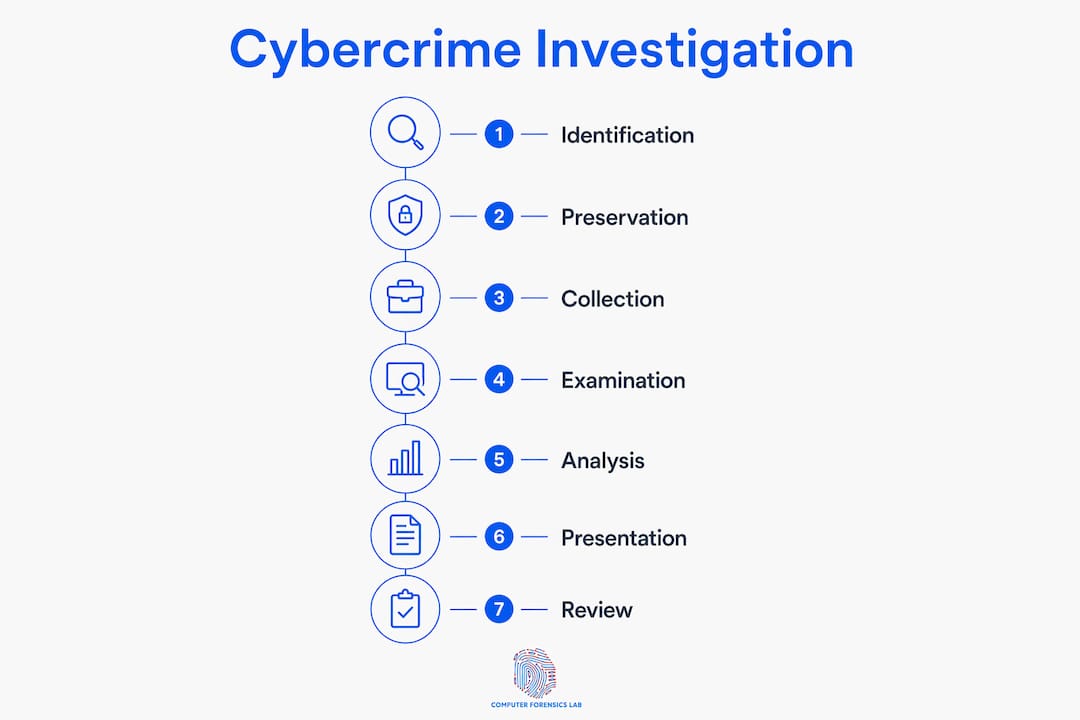
Digital forensic investigations follow a seven-phase process designed to maintain evidence integrity from the moment a device is seized to the moment findings are presented in court. Each phase builds on the last, and skipping any step risks the admissibility of the entire evidence set.
- Identification. Investigators locate all potential evidence sources: computers, mobile phones, cloud accounts, network logs, and IoT devices.
- Preservation. Data is protected from alteration. Devices may be placed in Faraday bags to block wireless signals, and legal holds are applied to prevent automatic deletion.
- Collection. Forensic analysts create bit-for-bit copies of storage media. The original device is never worked on directly.
- Examination. Analysts extract artefacts from the forensic copy: deleted files, browser history, application logs, and timestamps.
- Analysis. Investigators reconstruct timelines, identify attack paths, and correlate activity across multiple devices and accounts.
- Reporting. Findings are documented in a format that legal stakeholders can understand. Effective reporting translates complex technical data into clear, factual narratives for judges, juries, and regulators.
- Presentation. A qualified forensic expert presents findings in court and withstands cross-examination.
| Phase | Primary goal | Key output |
|---|---|---|
| Identification | Locate evidence sources | Evidence source register |
| Preservation | Prevent data loss or alteration | Legal hold confirmation |
| Collection | Capture forensic copies | Verified forensic images |
| Examination | Extract relevant artefacts | Artefact catalogue |
| Analysis | Reconstruct events | Timeline and attribution report |
| Reporting | Communicate findings | Expert witness report |
| Presentation | Support prosecution | Court testimony |
Pro Tip: Hash verification using SHA-256 is applied at the collection stage and again before analysis. If the hash values match, the copy is provably identical to the original. Any discrepancy signals tampering or corruption.

Why do the first 48 hours of a cybercrime investigation matter so much?
The first 24 to 48 hours after a cybercrime is reported are the most consequential for evidence integrity. Investigators focus on two priorities: containing the threat and securing evidence before it disappears.
A legal hold is one of the first formal actions taken. It instructs custodians of data, such as IT administrators or cloud service providers, to suspend any automatic deletion or overwriting processes. Without a legal hold, routine data retention policies can permanently erase logs that would have identified the attacker.
Capturing volatile memory before powering down a device is equally critical. RAM contains active processes, open network connections, and encryption keys that vanish the moment the machine is switched off. This is evidence that no forensic tool can recover after the fact.
Victims who reboot a compromised device or run an antivirus scan before investigators arrive can permanently delete artefacts that would have identified the attacker. Early victim actions are one of the leading causes of failed cybercrime prosecutions.
The chain of custody must be documented from the moment evidence is first touched. Every person who handles a device, every transfer between locations, and every access to a forensic copy must be recorded. Courts will scrutinise this record, and any gap creates grounds for a defence challenge.
Critical actions in the first 48 hours include:
- Issuing a legal hold to relevant data custodians
- Capturing volatile memory from live systems before shutdown
- Photographing and logging the physical state of all devices
- Bagging and tagging devices with tamper-evident seals
- Notifying the relevant specialist police unit or forensic provider
What technical methods do investigators use to analyse cyber crime evidence?
Technical analysis in a cybercrime investigation goes well beyond searching for suspicious files. Investigators correlate logs and timestamps across multiple devices, cloud platforms, and network infrastructure to reconstruct exactly what happened and in what order. Login times, network connection records, and UTC-based timestamps are cross-referenced to build a precise sequence of events.
Police submit seized devices to specialist forensic units, where skilled analysts extract evidence including deleted files, encrypted data, and network traffic records. The analysis phase relies on behavioural reconstruction as much as file recovery. Investigators look at what a user did, when they did it, and whether the pattern of activity matches the alleged offence.
Key technical methods used in cybercrime analysis include:
- Volatile memory analysis. RAM captures active processes, logged-in sessions, and encryption keys. Volatile data is the first target when a live system is encountered.
- Hash verification. SHA-256 hashing confirms that forensic copies are identical to originals, satisfying courts on evidence integrity.
- Deleted file recovery. File system analysis can recover data that a suspect believed was erased, including documents, images, and communication records.
- Network forensics. Packet captures and firewall logs reveal which IP addresses communicated with a target system and when.
- Malware analysis. Analysts examine malicious code to identify its origin, behaviour, and the attacker’s likely infrastructure.
- Cloud and social media forensics. Investigators use production orders to obtain account data from platforms, which can include social media posts used as evidence in criminal proceedings.
Pro Tip: Detailed incident reports that include specific timestamps, transaction IDs, and error codes help investigators narrow the scope of analysis immediately. The more precise your initial report, the faster the investigation moves.
Key takeaways
A successful cybercrime investigation depends on legal authority, forensic rigour, and early evidence preservation working together from the first moment a crime is reported.
| Point | Details |
|---|---|
| Legal powers are foundational | PACE 1984 and the Investigatory Powers Act 2016 authorise every search, seizure, and intercept in a UK cybercrime case. |
| Seven phases protect evidence integrity | The identification-to-presentation workflow ensures digital evidence survives legal scrutiny at every stage. |
| The first 48 hours are decisive | Volatile memory capture and legal holds in the first two days determine what evidence survives for prosecution. |
| Chain of custody is non-negotiable | Every person who touches evidence must be documented; any gap gives the defence grounds to challenge admissibility. |
| Technical analysis reconstructs intent | Timeline correlation and behavioural analysis reveal not just what happened, but who did it and why. |
What investigators know that most victims do not
The biggest misconception I encounter is that finding a suspicious file is the hard part of a cybercrime investigation. It is not. The hard part is proving who created it, when they accessed it, and what they intended to do with it. That requires timeline analysis, behavioural reconstruction, and a chain of custody that no defence barrister can unpick.
Victims consistently underestimate how much damage they cause by acting before investigators arrive. Rebooting a machine, running a scan, or even opening a file changes metadata. Those changes can make it impossible to prove the original state of the device. The role of forensic testimony in court depends entirely on the integrity of the evidence that precedes it.
The other thing that surprises people is how much of a cybercrime investigation happens in the reporting phase. A technically perfect analysis means nothing if the expert cannot explain it clearly to a judge who has no technical background. Translating SHA-256 hash values and network packet captures into a coherent narrative is a skill in its own right, and it is one that determines whether a prosecution succeeds.
My honest advice: call a professional before you touch anything. The earlier a qualified forensic team is involved, the better the evidence, and the stronger the case.
— Computer
How Computerforensicslab supports cybercrime investigations
Computerforensicslab provides digital forensics services for individuals, legal professionals, and organisations dealing with cybercrime incidents across the UK. The team handles evidence acquisition, chain of custody documentation, malware analysis, and timeline reconstruction, all following the legal standards required for court admissibility. Expert witness reports are prepared in plain language so that findings are clear to judges, juries, and regulators. Whether you are responding to a data breach, supporting a criminal prosecution, or gathering evidence for civil litigation, Computerforensicslab’s digital forensic investigations service provides the professional handling your case requires.
FAQ
What is cybercrime investigation?
Cybercrime investigation is the structured process of identifying, preserving, collecting, analysing, and presenting digital evidence to establish the facts of a computer-related offence. It combines legal authority with forensic methodology to produce court-admissible findings.
How do police obtain evidence from overseas servers?
UK police use the Crime (Overseas Production Orders) Act 2019 to compel foreign technology companies to disclose data held on servers outside the UK. This power is subject to judicial authorisation and proportionality requirements.
What happens if a victim tampers with evidence before police arrive?
Rebooting a device, running antivirus software, or opening files before investigators attend can permanently destroy volatile data and alter metadata. These actions are one of the leading causes of failed cybercrime prosecutions.
How is digital evidence kept secure during an investigation?
Chain of custody documentation records every person who handles evidence, every transfer between locations, and every access to forensic copies. Hash verification using SHA-256 confirms that forensic images remain identical to the original seized media throughout the process.
What does a cybercrime investigator actually do?
A cybercrime investigator locates digital evidence sources, creates forensic copies of devices, extracts and analyses artefacts such as deleted files and network logs, reconstructs event timelines, and prepares expert reports for use in legal proceedings.