
TL;DR:
- Cybersecurity for solicitors involves controls and policies to protect client data and meet regulatory standards. Nearly a quarter of law firms experienced a security breach in 2024, emphasizing the need for strong cyber defenses against threats like fraud and ransomware. Essential practices include implementing multi-factor authentication, conducting regular staff training, and maintaining tested backup protocols to reduce risks effectively.
Cybersecurity for solicitors is defined as the set of controls, policies, and processes a law firm implements to protect confidential client data from targeted cyber threats while meeting obligations set by the Solicitors Regulation Authority (SRA), the Information Commissioner’s Office (ICO), and quality standards such as Lexcel and the Conveyancing Quality Scheme (CQS). 29% of law firms reported a security breach in 2024, making cyber risk a business-critical priority rather than an IT afterthought. Conveyancing fraud, ransomware, and Business Email Compromise (BEC) are the dominant threats, and the financial and reputational consequences of a single incident can be severe. This guide gives solicitors and legal practice managers the specific controls, compliance steps, and budgeting benchmarks they need to act now.
What are the main cyber threats targeting solicitors?
Conveyancing fraud and BEC are the highest-impact threats facing UK law firms. Both attacks exploit email to redirect client funds, often by impersonating a fee earner or the firm itself. A BEC investigation example shows how attackers compromise a single mailbox, monitor live transactions, and send spoofed payment instructions at the critical moment of completion.
The most common attack types targeting solicitors include:
- Conveyancing fraud. Attackers intercept or spoof email chains to redirect completion funds. Losses per transaction can reach hundreds of thousands of pounds.
- Phishing. Emails impersonating HMRC, courts, opposing counsel, or clients trick staff into clicking malicious links or disclosing credentials.
- Ransomware. Malware encrypts practice management systems, halting case work and threatening client data exposure.
- Business Email Compromise. Attackers gain access to a senior partner’s or COLP’s mailbox and issue fraudulent instructions internally or to clients.
- Fake court notices. Spoofed documents create urgency, pressuring fee earners to act without verification.
Human error remains the largest vulnerability in legal practices. Staff clicking malicious links is the top threat vector, which means technical controls alone cannot close the gap.
Pro Tip: Before a phishing simulation, brief only the IT lead. Unannounced tests reveal genuine behaviour and produce far more useful data than announced ones.

Which cybersecurity tools and practices are essential for solicitors?
Multi-factor authentication (MFA) is the single most effective technical control a law firm can deploy. MFA on email and case management systems prevents BEC even when credentials are stolen, and it must be enforced on senior accounts including the COLP, COFA, and managing partner without exception.
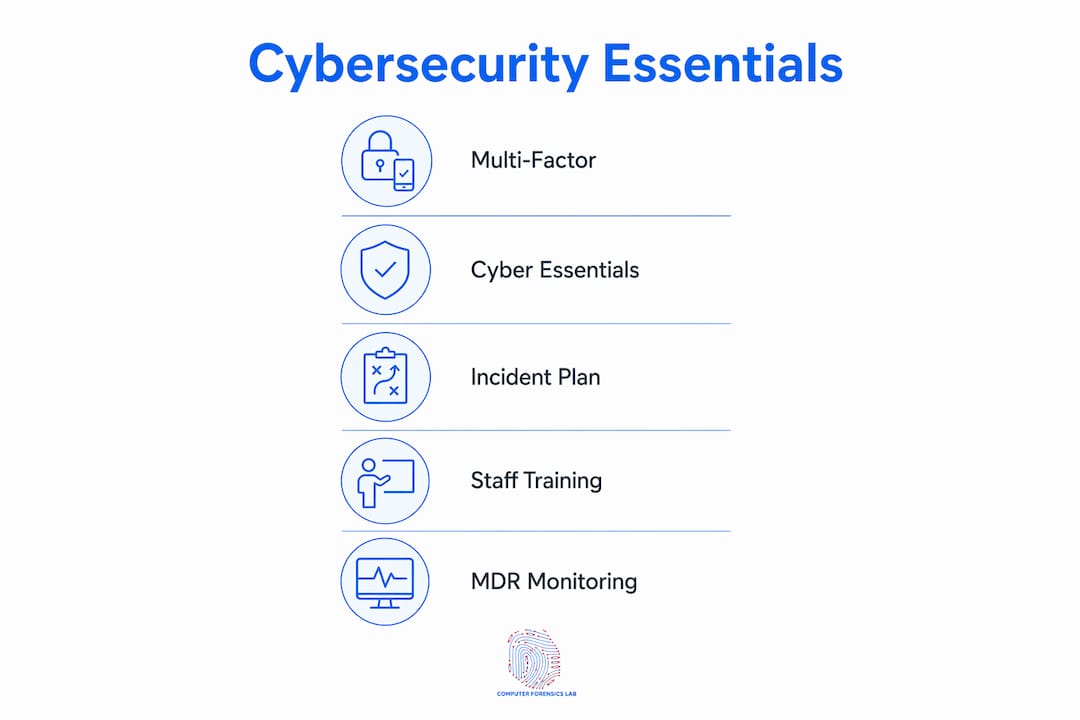
The core technical and procedural controls every firm should have in place are:
- MFA on all accounts. Apply to email, case management, and cloud storage. Senior roles are prime targets and must not be exempt.
- Cyber Essentials Plus certification. This government-backed scheme provides a tested baseline. Cyber Essentials v3.3 excludes home routers, so focus on software firewalls and managed device access for hybrid workers.
- DMARC enforcement. Configuring DMARC on your domain prevents attackers from spoofing your firm’s email address to clients or third parties.
- Secure client portals. Client portals with two-factor authentication reduce reliance on email attachments and support regulatory compliance for document exchange.
- Security awareness training. Run phishing simulations quarterly. Staff who fail simulations receive targeted retraining rather than generic reminders.
- Tested backup protocols. Maintain offline or immutable backups of all practice management data. Test restoration monthly so ransomware recovery is a procedure, not a crisis.
For firms assessing the full range of cybersecurity services available to the legal sector, managed security providers can bundle several of these controls under a single contract, which simplifies procurement and audit evidence.
Hybrid working adds complexity. When fee earners access practice management systems via a corporate single sign-on browser rather than a VPN, Cyber Essentials audit scope narrows considerably. That is a practical efficiency worth building into your IT architecture.
How do solicitors comply with data protection and SRA requirements?
The SRA Standards and Regulations require firms to have documented cybersecurity policies, and the Lexcel quality mark and CQS both include explicit cybersecurity criteria. Compliance is not satisfied by generic IT policies. Documented risk assessments and incident response plans are the minimum evidence regulators and insurers expect to see.
The key compliance obligations are:
- ICO breach notification. Notify the ICO within 72 hours of discovering a personal data breach. The clock starts at discovery, not at the end of the business day.
- Written risk assessments. Document threats specific to your practice areas, including conveyancing fraud risk if you handle property transactions.
- Incident response plan. Name the decision-makers: managing partner, COLP, and IT lead. The plan must be written, tested, and version-controlled.
- Staff training records. Keep evidence of who completed training and when. Regulators and insurers both request this during audits and claims.
- Cyber insurance review. Many insurers now require MFA and Cyber Essentials as conditions of cover. Confirm your policy reflects your actual controls.
Pro Tip: Treat your incident response plan as a living document. Review it after every near-miss, not just after a confirmed breach. Near-misses are free lessons.
The ICO’s 72-hour window is tighter than most firms realise. A breach discovered on a Friday afternoon still triggers the same deadline. Build out-of-hours escalation contacts into your plan before you need them.
What should UK law firms budget for cybersecurity?
UK law firms with five partners typically budget £20,000–£28,000 annually on cybersecurity. That figure covers Managed Detection and Response (MDR), Cyber Essentials Plus certification, staff training, penetration testing, and cyber insurance for a firm with 15–25 staff.
The recommended allocation is 5–7% of total IT spend dedicated to cybersecurity, reflecting the high data sensitivity and conveyancing fraud exposure that legal practices carry.
| Budget line | Typical annual cost | Notes |
|---|---|---|
| Managed Detection and Response (MDR) | £8,000–£14,000 | Includes 24/7 monitoring and alerting |
| Cyber Essentials Plus certification | £1,500–£3,000 | Audit requires approximately 6 working hours with scoped exclusions |
| Security awareness training | £1,200–£2,500 | Includes phishing simulations |
| Penetration testing | £3,000–£5,000 | Annual external test recommended |
| Cyber insurance | £2,500–£5,000 | Premiums vary by firm size and claims history |
Firms that have not yet achieved Cyber Essentials Plus often underestimate the audit preparation time. Scoping the assessment correctly from the outset, particularly around home working boundaries, reduces that time significantly. The cybersecurity best practices guide from Computerforensicslab provides further detail on aligning IT spend with risk.
How should solicitors respond to a cybersecurity incident?
A documented incident response plan is the difference between a contained breach and a regulatory crisis. Tested incident response plans build trust with clients and regulators and reduce reputational damage when an incident does occur.
The response sequence for a confirmed or suspected breach is:
- Activate the response team. The managing partner, COLP, and IT lead must be contactable at all times. Name deputies for each role.
- Contain the incident. Isolate affected systems immediately. Do not attempt to clean malware before preserving forensic evidence.
- Engage specialist support. Retain a digital forensics provider or activate your insurer’s incident panel before evidence degrades.
- Notify the ICO. Submit the breach notification within 72 hours of discovery. Incomplete notifications are accepted; supplement them as facts emerge.
- Communicate with clients. Be direct and factual. Tell affected clients what happened, what data was involved, and what you are doing about it.
- Conduct a post-incident review. Identify the root cause, update the incident response plan, and schedule retraining for any staff involved.
24/7 MDR monitoring is particularly important for conveyancing fraud scenarios, where attacks frequently occur outside office hours to avoid detection. Real-time alerting gives the response team a chance to intervene before funds are transferred.
Pro Tip: Run a tabletop exercise twice a year. Simulate a Friday-afternoon ransomware attack and a Monday-morning BEC discovery. The gaps you find in a simulation cost nothing to fix.
Key takeaways
Solicitors who combine MFA, Cyber Essentials Plus certification, documented incident response plans, and regular staff training meet the SRA’s standard of evidence-based compliance and significantly reduce their exposure to conveyancing fraud and ransomware.
| Point | Details |
|---|---|
| MFA is non-negotiable | Enforce multi-factor authentication on all accounts, especially COLP, COFA, and managing partner roles. |
| 72-hour ICO notification | Report personal data breaches to the ICO within 72 hours of discovery, including out-of-hours incidents. |
| Budget £20,000–£28,000 annually | A five-partner firm needs this range to cover MDR, Cyber Essentials Plus, training, pen testing, and insurance. |
| Document everything | Generic IT policies do not satisfy SRA or insurer requirements; written risk assessments and training records are mandatory. |
| Test your response plan | Tabletop exercises and phishing simulations reveal gaps before attackers do. |
What I have learned from working with law firms on cyber incidents
The most common mistake I see is firms treating “reasonable efforts” as a vague standard they can meet by purchasing a firewall and running one training session per year. Regulators and insurers do not accept that. They ask for evidence: dated training records, version-controlled policies, and tested response plans. Firms that cannot produce those documents face the same regulatory consequences as firms that did nothing at all.
The second pattern I see repeatedly is over-investment in perimeter defences and under-investment in email security. Firewalls matter, but email-based attacks are responsible for the vast majority of conveyancing fraud and BEC losses. A firm with a sophisticated network perimeter and no DMARC enforcement is protecting the wrong door.
The human factor is where most incidents begin and where most preventable losses occur. Cybersecurity effectiveness depends on the human processes behind the software. The firms I have seen recover fastest from incidents are those where every fee earner, not just the IT team, understands what a suspicious email looks like and knows exactly who to call. That culture does not come from a policy document. It comes from repeated, realistic training and visible commitment from the managing partner downward.
— Computerforensicslab
How Computerforensicslab supports solicitors after a cyber incident
When a breach occurs, the quality of the forensic investigation determines what evidence survives and whether the firm can demonstrate compliance to the ICO and SRA. Computerforensicslab provides specialist digital forensics services tailored to legal practices, including breach investigation, evidence preservation, chain-of-custody reporting, and expert witness support. The team works directly with solicitors, COLPs, and insurers to recover and analyse data from compromised systems, email accounts, and mobile devices. For firms facing a live incident or preparing for regulatory scrutiny, Computerforensicslab’s cybercrime investigation steps provide a structured path from containment to evidential reporting.
FAQ
What is cybersecurity for solicitors?
Cybersecurity for solicitors is the set of technical controls, policies, and training a law firm uses to protect client data and comply with SRA, ICO, and Lexcel requirements. It covers everything from MFA and email security to incident response planning.
How quickly must a law firm notify the ICO after a breach?
Firms must notify the ICO within 72 hours of discovering a personal data breach. The deadline applies regardless of when the breach occurred or whether it happened outside office hours.
What does Cyber Essentials Plus cost for a law firm?
Cyber Essentials Plus certification typically costs £1,500–£3,000 for a law firm and requires approximately six working hours for the audit submission, with home network boundaries excluded from scope under version 3.3.
Which accounts are most targeted in law firm BEC attacks?
Senior roles including the COLP, COFA, and managing partner are the primary targets for Business Email Compromise. MFA must be enforced on these accounts without exception to prevent credential-based access.
How much should a five-partner law firm spend on cybersecurity annually?
A five-partner UK law firm with 15–25 staff should budget £20,000–£28,000 per year, covering MDR, Cyber Essentials Plus, training, penetration testing, and cyber insurance, representing 5–7% of total IT spend.