
TL;DR:
- Expert witness reports in UK litigation must adhere to strict structural, ethical, and disclosure requirements.
- Clear separation of facts and assumptions, transparency of methodology, and impartial language are essential for compliance.
- Use of AI and joint expert instructions are evolving areas impacting digital forensic reporting standards.
An expert witness report can either anchor a complex cybercrime case or unravel it entirely. Many legal professionals assume these documents are simply technical summaries, produced by a specialist who examined a hard drive and wrote down their findings. That assumption is wrong, and it carries real risk. Under UK procedural rules, an expert witness report is a precisely regulated instrument of evidence governed by strict structural, ethical, and disclosure requirements. Whether you are instructing an expert in civil litigation or criminal proceedings, understanding what a compliant report must contain, and where things most commonly go wrong, could be the difference between admissible evidence and a dismissed opinion.
Table of Contents
- Defining an expert witness report in UK litigation
- What must a compliant expert report contain?
- Duties, independence and common pitfalls
- Edge cases and recent developments: AI, single joint experts and disclosure
- What most legal teams miss about expert reports
- Expert witness reports in action: leverage digital forensics services
- Frequently asked questions
Key Takeaways
| Point | Details |
|---|---|
| Clear definition required | An expert witness report provides an independent, objective opinion to UK courts in line with strict procedural rules. |
| Compliance is critical | Reports must include all mandatory sections and a statement of truth, or risk being disregarded by the court. |
| Independence over advocacy | An expert’s duty is to the court, not the instructing party, and bias can undermine their credibility. |
| Modern challenges | Edge cases such as using AI require proper disclosure and documentation as regulations evolve in 2026. |
| Leverage specialist support | Partnering with forensic providers ensures compliance, clarity, and robust digital evidence handling. |
Defining an expert witness report in UK litigation
Before you can use an expert report effectively, you need to understand exactly what it is in the legal sense. This goes far beyond recognising it as “a report from a technical person.”
CPR Part 35 defines the framework precisely: an expert witness report is a written document prepared by an independent specialist providing objective opinion evidence to assist the UK court in understanding complex technical matters, governed primarily by CPR Part 35 in civil cases and Criminal Procedure Rules Part 19 in criminal cases.
That distinction between civil and criminal proceedings matters enormously in practice. In civil cases, CPR Part 35 imposes an express requirement that expert evidence is only admissible with court permission. Courts actively limit the scope and number of experts to control costs and avoid satellite litigation. In criminal cases, CrimPR Part 19 sets similar expectations around independence and disclosure, but the stakes and timelines often differ considerably.
In digital forensics and cybercrime cases, the types of expertise courts commonly encounter include:
- Mobile device analysis: Recovering deleted messages, call logs, app data, and location histories.
- Computer forensics: Examining hard drives, memory artefacts, access logs, and browser histories.
- Network and log analysis: Reconstructing events from server logs, firewall records, and intrusion data.
- Malware and ransomware analysis: Attributing attacks, tracing propagation pathways, and identifying threat actors.
- Cloud and social media evidence: Extracting and authenticating data held by third-party platforms.
“The expert’s overriding duty is to the court, not to the instructing party. The report must be the expert’s own uninfluenced opinion.”
This objectivity requirement is non-negotiable. It is not a formality. Courts have struck out expert opinions where the language revealed clear advocacy for the instructing party’s position. For legal professionals, that risk begins at the moment of instruction, which is why understanding expert witness testimony obligations early is essential.
What must a compliant expert report contain?
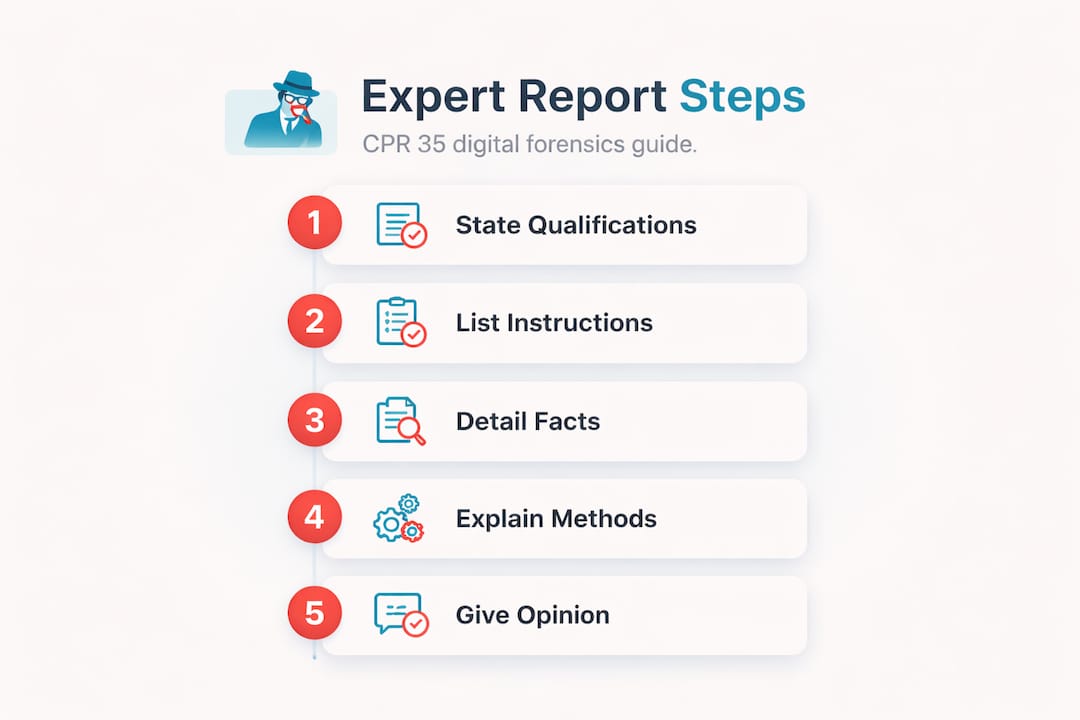
Structure is not optional. A report missing a required element is vulnerable to challenge, reduced weight, or outright exclusion. The CPR Part 35 Practice Direction sets out required contents clearly: the report must be addressed to the court; it must include the expert’s qualifications and experience; it must state the substance of instructions; list materials relied upon; distinguish facts within the expert’s knowledge from assumptions; explain methodology and reasoning; summarise conclusions; and include a statement of truth confirming the expert’s duty to the court and compliance with Part 35.
In practical terms, a compliant digital forensics expert report should follow this sequence:
- Title and addressee: The report must be explicitly addressed to the court, not to the solicitor or client.
- Expert’s qualifications: Include formal credentials, professional memberships, relevant experience, and prior court experience.
- Instructions received: A clear, neutral statement of what the expert was asked to do.
- Materials and data examined: Every device, dataset, log, or document the expert relied upon must be itemised.
- Facts within expert knowledge vs assumptions: These must be explicitly separated. Conflating them is a common and serious error.
- Methodology: Precisely how the analysis was conducted, including software tools, versions, and hash verification for forensic integrity.
- Findings and reasoning: The analytical substance of the report, written in plain language the court can follow.
- Summary of opinions: A concise, clear statement of conclusions without jargon or qualification by ambiguity.
- Statement of truth: Confirming the expert understands their overriding duty to the court.
| CPR Part 35 requirement | Practical example in digital forensics |
|---|---|
| Expert’s qualifications | MSc in digital forensics, 10 years in cybercrime investigations |
| Substance of instructions | “I was asked to determine whether the defendant accessed the claimant’s server” |
| Materials relied upon | Forensic image of HP laptop (hash verified), firewall logs from 14 March 2024 |
| Facts vs assumptions | “The timestamp reflects the system clock; I cannot confirm whether that clock was accurate” |
| Methodology | EnCase v22 used; write-blocker applied; SHA256 hash confirmed before and after imaging |
| Summary of conclusions | “On the balance of probability, the defendant’s credentials were used to access the server at 03:14” |
| Statement of truth | Signed declaration per CPR Part 35.3 |
Pro Tip: One of the most frequently challenged elements is the separation of facts from assumptions. Encourage your expert to use explicit labelling within the report body, such as “The following is established from the evidence” versus “The following is inferred from the available data.” This small structural choice makes cross-examination far less effective.
When preparing expert reports for digital forensics cases, clarity of methodology is as important as the conclusion. Courts are increasingly sophisticated about forensic processes, and a report that cannot explain exactly how a finding was reached will not survive scrutiny. Review expert witness roles to understand the full scope of what courts expect from experts in technical cases.
Duties, independence and common pitfalls
Compliance with structure is necessary but not sufficient. The expert’s fundamental duty, as set out in CPR Part 35, is an overriding duty to the court, overriding obligations to the instructing party. Experts must not act as advocates, prior involvement or conflicts must be declared, and success fees are prohibited.

The distinction between advocacy and impartial opinion is frequently misunderstood. A report that consistently selects the most favourable interpretation, downplays countervailing evidence, and adopts the same framing as the instructing solicitor’s case is an advocacy document, even if it never says so explicitly. Courts are alert to tone. They notice when an expert’s language tilts inexplicably in one direction.
| Compliant report | Non-compliant report |
|---|---|
| Addresses alternative explanations and reasons why they are less likely | Ignores alternative explanations entirely |
| Uses neutral language: “the data indicates” | Uses partisan language: “it is clear the defendant deliberately…” |
| Declares prior relationship with instructing party | No disclosure of repeat instruction arrangement |
| States limitations of the methodology used | Claims certainty beyond what the evidence supports |
| Statement of truth properly signed and dated | Statement of truth missing or undated |
Common pitfalls in digital forensics cases include:
- Undisclosed conflicts of interest: Experts who regularly work for one firm must declare that relationship. Failure to do so can result in the report being excluded.
- Overreaching conclusions: Stating certainty where the forensic evidence supports only probability. This is especially common in timestamp analysis and IP attribution.
- Inadequate methodology disclosure: Failing to name the forensic tools used, their version numbers, or whether write-blockers were employed during acquisition.
- Reliance on unverified data: Using materials that have not been authenticated or hash-verified as the basis for strong conclusions.
- Failure to address the opposing expert’s report: In cases where both sides have experts, the failure to engage with the other report weakens credibility significantly.
Pro Tip: Instruct your expert in writing. The instruction letter forms part of the disclosure obligations under CPR Part 35, and a clear, professionally framed instruction protects both the legal team and the expert from later challenges about the scope of the opinion. Review the expert’s overriding duties before finalising your instruction letter.
Edge cases and recent developments: AI, single joint experts and disclosure
Digital forensics is not a static discipline, and the procedural landscape around expert evidence is shifting to keep pace. Legal professionals commissioning reports in 2026 need to be aware of several evolving issues.
The use of artificial intelligence tools in expert analysis has moved from theoretical concern to practical reality. The CPR Part 35 Practice Direction now intersects with a rapidly changing technology context: use of AI in reports requires safeguards, documentation, and potential disclosure; courts may reject reports for non-compliance, advocacy, or unreliability; single joint experts are permitted for cost efficiency; and written questions post-exchange are allowed. The expert remains personally liable for every conclusion in the report, regardless of whether an AI tool contributed to the analysis.
“The CJC is consulting in 2026 on whether and how AI use should be disclosed in expert reports, with experts personally responsible for content even where AI-assisted analysis has been used.”
This has immediate, practical implications. If your expert used an AI-assisted tool to scan a large dataset, identify anomalies, or generate summaries, that use may need to be declared. The expert cannot simply present conclusions derived from an AI process without disclosing the methodology. The court’s ability to scrutinise the reasoning depends on knowing how it was produced.
There are several distinct edge cases that legal professionals encounter in practice:
- Single joint experts: In lower-value civil claims or costs-proportionate proceedings, courts increasingly direct that a single expert be jointly instructed by both parties. This removes the “battle of experts” dynamic but requires careful joint instruction to avoid disputes about the scope of the report.
- Late disclosure of expert evidence: Serving an expert report outside the court-directed timetable without permission is a serious procedural failure. Relief from sanctions is not guaranteed, and courts have excluded late expert evidence even in significant cases.
- Written questions after exchange: CPR Part 35.6 permits each party to put written questions to the other side’s expert after exchange. These must be for clarification only, not a second round of cross-examination. Experts are obliged to answer, and the answers form part of their evidence.
- Personal liability for report contents: Whether the expert worked with a team of analysts or used AI-assisted review tools, the name on the statement of truth is personally responsible. There is no delegation of that duty. This is particularly relevant in digital forensics, where large data volumes sometimes lead experts to rely heavily on automated processing.
Issues around data security in legal translation and handling are instructive parallels: wherever technical specialists process sensitive data on behalf of legal proceedings, the chain of custody, documentation standards, and personal accountability principles that underpin forensic work apply equally.
What most legal teams miss about expert reports
Compliance with CPR Part 35 is the floor, not the ceiling. In our experience at Computer Forensics Lab, the reports that genuinely influence outcomes share a quality that no procedural checklist can capture: they are written for the judge, not for the expert’s own satisfaction or the solicitor’s brief.
A 200-page forensic report that is technically impeccable but written in impenetrable technical language is not serving the court. The expert’s job is to translate complexity into clarity, and legal teams that treat length as a proxy for quality are setting themselves up for trouble. Judges are not IT specialists. They need reasoned, accessible explanations, not exhaustive catalogs of file metadata.
There is also a subtler risk that even experienced legal teams overlook. A report can be structurally compliant, carefully worded, and still functionally useless if the expert’s impartiality is compromised by tone. Advocacy creeps in through word choice: “obviously,” “clearly,” “undeniably.” It appears in what the report omits as much as what it includes. If an expert fails to address an alternative hypothesis that the opposing party will inevitably raise, the report has a credibility gap regardless of its formatting.
Our view is that the best use of expert witnesses effectively begins before a single line of the report is written. Legal professionals should actively question the expert’s proposed methodology at instruction stage, ask how they intend to address likely counterarguments, and request a structure outline before the full report is drafted. This is not interference with independence. It is intelligent instruction.
It is also worth recognising that the value of expert witness services extends well beyond the written report. An expert who can give clear, unshakeable oral evidence during cross-examination, who understands the court’s expectations and can explain forensic methodology to a non-technical judge, is worth considerably more than one who simply produces a polished document and disappears.
Expert witness reports in action: leverage digital forensics services
When digital evidence sits at the heart of your case, the quality of the expert witness report is inseparable from the quality of the underlying forensic investigation. At Computer Forensics Lab, we work with legal professionals across civil litigation, criminal defence, and corporate investigations to produce expert witness reports that are both forensically rigorous and court-ready. Our team understands CPR Part 35 and CrimPR Part 19 obligations not just as procedural requirements but as the framework within which compelling, credible evidence is built. Explore our digital forensics services to understand how we approach evidence collection, or review our insights into digital forensics data expertise and the scope of cyber investigation support we provide to legal teams at every stage of proceedings.
Frequently asked questions
Who can act as an expert witness in England and Wales?
An expert witness must possess relevant qualifications and experience in their specialist field and must act independently, with their primary duty owed to the court rather than to the instructing party.
What happens if an expert report does not comply with CPR Part 35?
Non-compliant reports can be excluded by the court or given reduced evidentiary weight, which may seriously damage the case of the party relying on that evidence.
Are there special rules for the use of artificial intelligence in expert reports?
Yes, AI tools must be disclosed and their use documented; the CJC is consulting in 2026 on formalising AI disclosure obligations, and experts remain personally responsible for all content regardless of AI involvement.
Can the same expert report serve both civil and criminal cases?
The structural principles are broadly similar, but each report must comply with the relevant procedural rules — CPR Part 35 for civil proceedings and CrimPR Part 19 for criminal cases — which differ in important respects.