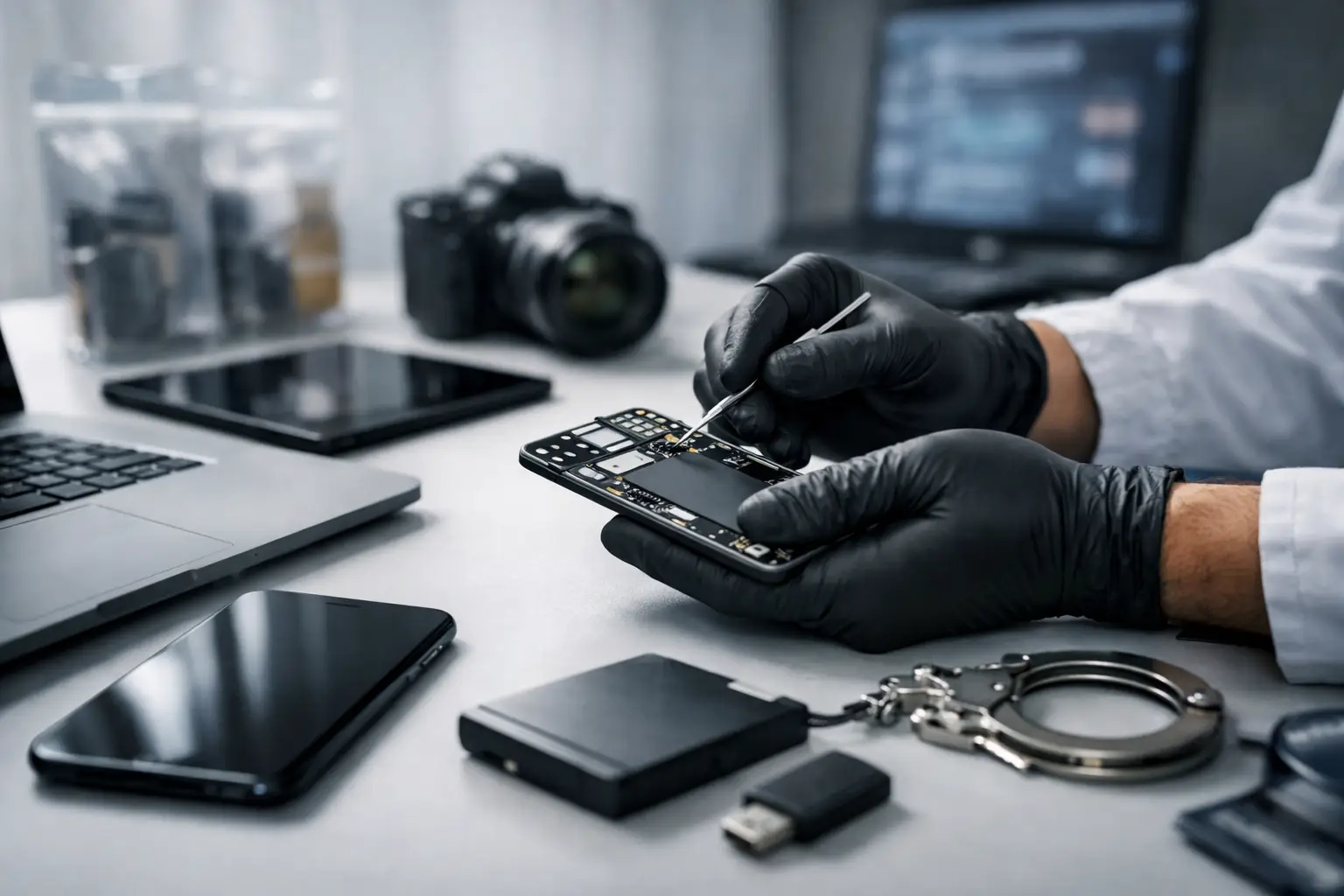
A phone taken from a suspect at arrest, a laptop removed during an employee misconduct inquiry, or a tablet handed over in a family dispute can become decisive evidence within hours. The device seizure forensic process exists to make sure that evidence is not damaged, altered, or rendered vulnerable to challenge before the real examination has even begun.
For solicitors, investigators, businesses, and private clients, the risk is rarely just technical. It is evidential. A poorly handled seizure can raise questions about integrity, continuity, contamination, and proportionality. Once those questions appear, they do not stay at the edge of the case. They move to the centre of it.
What the device seizure forensic process is designed to achieve
At its core, the process is not simply about taking possession of a device. It is about preserving the evidential state of that device in a way that can be explained, documented, and defended. That includes identifying the item correctly, securing it lawfully, recording its condition, preventing remote interference, and maintaining an unbroken chain of custody.
In practice, the right approach depends on the device, the environment, and the legal context. A live mobile phone in a fraud investigation presents different risks from an encrypted laptop in a civil disclosure matter. A company-owned workstation in an internal investigation must be handled differently from a privately owned handset produced voluntarily in matrimonial proceedings. The principles remain consistent, but the method is never one-size-fits-all.
Lawful authority and proportionality come first
Before any physical handling takes place, there must be a clear legal basis for seizure or collection. In criminal matters, that may arise from warrant powers, arrest powers, consent, or another statutory basis. In civil and corporate matters, the position often turns on ownership, contractual rights, employment policies, court orders, or informed voluntary production.
This stage matters because a technically competent seizure can still become problematic if the legal footing is weak. Courts and instructing solicitors will rightly ask whether the acquisition was necessary, proportionate, and within the scope of authority relied upon. Over-collection is a recurring problem, particularly where mixed personal and business data is involved. A disciplined forensic approach limits unnecessary intrusion and keeps the examination tied to the issues in dispute.
Securing the scene and stabilising the device
The first operational challenge is preserving the state of the device as found. Investigators should document where the item was located, whether it was powered on or off, whether applications were open, whether peripherals were attached, and whether the screen displayed notifications, messages, or active sessions.
That early record can become highly significant later. A live session on an encrypted machine may indicate immediate access opportunities. A phone receiving messages at the point of seizure may support a timeline. Equally, pressing the wrong button, allowing the battery to die, or letting a device reconnect to a network can result in lost evidence or a contested handling history.
Mobile devices often require particular care because of remote wipe risk, network interaction, and volatile data. Isolation from networks may be necessary, but it must be carried out properly. Placing a device into aeroplane mode, powering it down, or shielding it from signal each carries consequences. One option may preserve battery life; another may trigger encryption or lockout. The correct decision depends on the handset, the operating system, the state of the device, and the investigative objective.
Identification, labelling, and chain of custody
Once secured, the device must be uniquely identified and packaged so that no ambiguity arises later. Make, model, serial number, visible damage, SIM presence, connected media, and any associated accessories should be recorded. Packaging should protect against physical damage and, where relevant, network communication.
Chain of custody is not an administrative afterthought. It is the documented history of who had the item, when they had it, what they did with it, and why. Any gap can create avoidable evidential vulnerability. In contested proceedings, even a small inconsistency in dates, signatures, or exhibit references can be used to question the reliability of the wider examination.
For that reason, professional laboratories treat continuity as part of the evidence itself. Every transfer, storage event, and examination step should be contemporaneously documented. If multiple devices are seized together, the need for precision increases. Mix-ups between similar handsets or storage media are more common than many assume, especially in fast-moving incidents.
The role of forensic imaging after seizure
The device seizure forensic process does not end when the hardware reaches the laboratory. In many matters, the next critical stage is forensic acquisition. That usually involves creating a verified forensic image or other defensible extraction so analysis can proceed without unnecessary handling of the original exhibit.
The method of acquisition depends on the device and the questions being asked. A full physical acquisition may be possible in some cases and impossible in others. A logical extraction may recover relevant user data but not deleted artefacts. Cloud-linked content may sit outside the handset altogether. Encryption, damage, operating system restrictions, and application design all affect what can and cannot be acquired.
This is where unrealistic expectations often need to be managed. Seizure preserves opportunity; it does not guarantee recovery of every item a client hopes to find. Deleted messages may be recoverable, or they may have been overwritten. App data may exist locally, or only on a server. A locked device may yield substantial metadata, or very little. Proper forensic advice is careful with certainty and clear about limitations.
Why contemporaneous notes matter in the device seizure forensic process
A recurring weakness in challenged cases is poor note-taking at the seizure stage. If the examiner or officer cannot explain the condition of the device when first encountered, later findings become harder to interpret. Was the laptop already shut down? Was the phone unlocked? Was an external drive attached? Did the user provide credentials voluntarily, or were none available?
Contemporaneous notes reduce room for speculation. They also help experts distinguish between user activity, system activity, and handling after collection. In a disputed timeline, those distinctions are often pivotal. An unexplained change in power state or connection history may be innocent, but if it was caused during seizure and not recorded, it can complicate expert opinion and cross-examination.
Common points of challenge in contested matters
When digital evidence is tested under scrutiny, the seizure stage is often examined first. Opponents may question whether the right device was taken, whether it was left exposed to remote access, whether handling altered data, or whether the seizure exceeded lawful scope. In employment and shareholder disputes, arguments around privacy and proportionality are especially common. In criminal cases, the focus may fall on continuity, preservation, and the reliability of extraction methods.
These are not peripheral objections. They can affect admissibility, weight, and litigation strategy. A technically useful artefact may still carry reduced evidential value if the path from collection to reporting is poorly documented. By contrast, a carefully seized and recorded device gives the court a firmer basis for trusting the subsequent analysis.
The value of specialist forensic oversight
General IT handling is not forensic handling. A well-meaning manager, internal technician, or first responder can unintentionally compromise evidence by opening files, charging a device improperly, attempting password guesses, or allowing synchronisation to continue. Those actions may alter timestamps, generate new system artefacts, or trigger data loss.
Specialist oversight reduces that risk. A forensic team approaches the device as a source of evidence, not merely a piece of hardware. The objective is to preserve original data, minimise interaction, document every step, and align the work with the eventual reporting and disclosure requirements of the case.
For legal professionals, that discipline has practical value beyond the laboratory. It supports clearer instructions, better case assessment, and more defensible expert output. For businesses and private clients, it means the matter is handled with the seriousness that high-stakes evidence demands.
At Computer Forensics Lab, that principle guides the work from first collection through to reporting. The seizure stage is treated not as a routine handover, but as the foundation on which the entire evidential case may rest.
When speed helps and when haste harms
Urgency is real in digital matters. Devices can be wiped, overwritten, encrypted, replaced, or reissued quickly. Delay can close off lines of enquiry. Yet haste without procedure creates its own damage. The right balance is prompt action under controlled forensic conditions.
That may mean obtaining immediate advice before touching a live handset, arranging a documented collection from a workplace, or preserving associated chargers, SIM cards, and storage media that might otherwise be overlooked. Small decisions made in the first hour can shape what is recoverable weeks later.
A sound device seizure forensic process does more than secure electronics. It protects the credibility of the evidence, the position of the client, and the integrity of the case from the moment the device changes hands.