
The right methodology for penetration testing combines a standards-first lifecycle, PTES for engagement structure, OWASP Web Security Testing Guide (WSTG) for web-specific test cases, NIST SP 800-115 for regulated environments, and OSSTMM where attack-surface measurement matters most. Before any technical work begins, three things need to be settled: a signed Rules of Engagement (RoE) document, a defined scope including the Cardholder Data Environment (CDE) boundary where applicable, and an agreed testing approach (black, grey or white box). Clients should expect three deliverables at the end: an executive summary, a technical appendix, and a retest policy.
- Sign the RoE before any scanning tool touches the network.
- Fix the scope and testing approach in writing, not verbally.
- Confirm the report format and retest terms up front, not after findings land.
Pro Tip: Ask for a sample report before you sign anything. A tester who cannot show you an anonymised deliverable rarely produces one worth reading.
Key Takeaways
A defensible penetration test rests on signed RoE, a standards-based phase structure, and evidence handling rigorous enough to survive legal scrutiny.
| Point | Details |
|---|---|
| Standards first | Combine PTES for lifecycle, OWASP WSTG for web test cases, and NIST SP 800-115 for regulated evidence needs. |
| RoE before scanning | A signed Rules of Engagement with a stop-test asset list prevents most production incidents. |
| Validate scanner output | Automated tools give breadth; manual validation is required before findings go into a report. |
| Report for two audiences | Structure findings with an executive summary and a technical appendix with proof-of-concept evidence. |
| Forensic-aware testing | Computerforensicslab handles chain of custody and expert witness readiness for tests tied to legal disputes. |
Table of Contents
- Which penetration testing frameworks should you use, and when?
- What are the phases of the penetration testing process?
- How do test type and scope change the methodology?
- What belongs in the Rules of Engagement?
- How should findings be reported and remediated?
- What should you plan for before the engagement starts?
- What actually goes wrong in penetration testing engagements?
- How Computerforensicslab supports forensic-aware penetration testing
- Where to read the standards behind this methodology
- Frequently asked questions
- Sources
Which penetration testing frameworks should you use, and when?
No single standard covers every engagement type, which is why competent testers treat frameworks as building blocks rather than a fixed script. The Penetration Testing Execution Standard (PTES) governs the engagement lifecycle end-to-end, from pre-engagement interactions through reporting, and is the strongest reference for RoE and project management. OWASP’s WSTG supplies the granular test cases for web applications, authentication flaws, injection points, session handling, that PTES leaves undefined. OSSTMM focuses on measurement: it quantifies attack surface and operational security in ways that suit engagements where clients want a comparable score over time.
NIST SP 800-115 sits above the others as a technical assessment guide built for government and regulated sectors, with heavy emphasis on planning, evidence handling and validation. PCI guidance narrows the focus further, structuring testing into pre-engagement, engagement and post-engagement phases specifically for cardholder-data scope.
- Web applications: PTES process plus OWASP WSTG test cases.
- Regulated or government environments: NIST SP 800-115 for documentation rigour.
- Cardholder Data Environments: PCI guidance for scope and evidence requirements.
- Attack-surface benchmarking: OSSTMM for repeatable measurement.
In practice, the strongest engagements blend PTES’s process discipline with OWASP’s technical depth, then borrow NIST’s evidence standards for anything destined for a regulator or a courtroom. Frameworks are foundations to adapt with professional judgement, not checklists to tick blindly.
Pro Tip: If a report cites “OWASP compliance” but never names specific WSTG test case IDs, ask which ones were actually run.
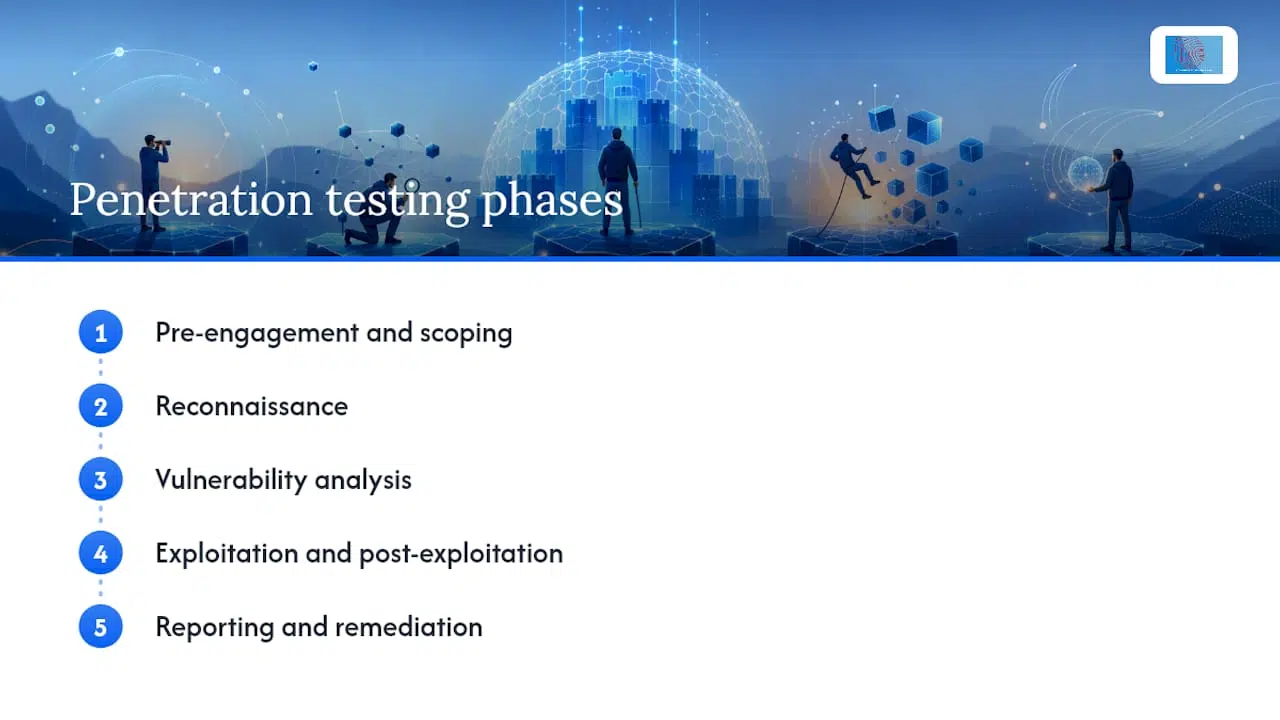
What are the phases of the penetration testing process?
PTES’s seven phases, pre-engagement, intelligence gathering, threat modelling, vulnerability analysis, exploitation, post-exploitation and reporting, map cleanly onto five practical stages most testers actually work through. Each phase needs its own objectives, tasks and sign-off criteria, not just a technical action.
Pre-engagement and scoping sets the legal and operational boundaries: asset lists, RoE, test windows. The acceptance criterion is a signed contract; the common failure mode is starting reconnaissance before scope is finalised.
Reconnaissance and intelligence gathering covers OSINT, DNS and subdomain discovery, port scanning and technology fingerprinting to map attack surface before touching a single exploit. Weak reconnaissance is the single biggest cause of missed findings later in the engagement.
Vulnerability analysis and enumeration turns scanner output into a validated target list. Automated tools give breadth, but findings must be manually confirmed; standards bodies are explicit that automation alone does not satisfy professional testing requirements.
Exploitation and post-exploitation proves impact, escalates privilege where authorised, and captures evidence at each step. This is where the BSI’s model recommends a mixed-stage approach, running a covert black-box pass first for realism, then an overt white-box pass to confirm coverage safely.

Reporting and remediation converts raw evidence into a client-usable document with risk ratings and retest criteria.
| Phase | Key output | Common failure |
|---|---|---|
| Pre-engagement | Signed RoE and scope | Scope agreed verbally, not in writing |
| Reconnaissance | Attack-surface map | Skipping OSINT to save time |
| Vulnerability analysis | Validated finding list | Trusting scanner output unverified |
| Exploitation | Evidence-backed proof of impact | No screenshots or logs captured |
| Reporting | Prioritised remediation plan | Findings with no business context |
Pro Tip: Track evidence capture as a KPI, not an afterthought. A finding with no proof-of-concept screenshot is a finding a client can legitimately dispute.
How do test type and scope change the methodology?
Testing approach depends on how much information the tester starts with. Black box testing simulates a real external attacker with no internal knowledge, useful for realism but slower and less thorough. White box gives full access to source code, credentials and architecture diagrams, maximising coverage and speed. Grey box sits between the two and is treated by US federal guidance as the practical standard for most commercial engagements, balancing efficiency against genuine attacker simulation.
Methodology shifts by target type too. Web application tests lean on OWASP test cases; network and infrastructure tests need port and service enumeration; cloud engagements require role-based access mapping across tenancy boundaries; social engineering needs a separate consent and disclosure framework entirely.
- Define CDE or cloud tenancy boundaries explicitly, not by assumption.
- List excluded assets and any that require special handling.
- Set live-production rules and stop-test conditions before day one.
Pro Tip: Ask which box model the tester defaults to and why. A tester who always recommends the same approach regardless of your environment isn’t scoping, they’re templating.
What belongs in the Rules of Engagement?
The RoE is the single document that protects both sides of an engagement, and well-defined RoE prevents more project failures than any technical safeguard. At minimum it should specify authorised source IPs, permitted test windows, exploitation depth limits, data handling and disclosure rules, and incident-response escalation triggers.
One clause matters more than the rest: an explicit list of assets that must never be tested, or only under strict conditions. This single stop-test clause reduces scope creep more reliably than any amount of extra tooling.
- Confirm tester authority to test, in writing, before scanning begins.
- Establish chain-of-custody procedures if findings might feed litigation.
- Coordinate with your IDS/IPS team so alerts aren’t mistaken for a real breach.
- Agree throttling limits to avoid disrupting production performance.
For engagements where testing intersects with an active dispute or investigation, legal teams need specific procedural safeguards that a standard commercial RoE often omits. Partner guidance on ethical testing boundaries can also help formalise safety controls before contracts are signed.
Pro Tip: Get the stop-test list reviewed by whoever owns production infrastructure, not just the security team. They know which systems can’t survive an aggressive scan.
How should findings be reported and remediated?
A usable report has six parts: executive summary, scope and RoE reference, methodology mapping, findings with proof-of-concept evidence, risk ratings, and a technical appendix with retest criteria. Skip any of these and the report becomes hard to action, or hard to defend if challenged later.
Severity ratings should combine exploitability with business impact, and CVSS scoring gives a common reference point, but a low-CVSS finding on a system holding regulated data can still warrant urgent remediation. Translate that nuance into the remediation timeline explicitly rather than leaving it implicit in a number.
- Hold a handover meeting to walk stakeholders through findings, not just email the PDF.
- Set a defined SLA for retesting fixed issues.
- Track every remediation back to its original test case and evidence file.
- Flag findings with legal exposure for chain-of-custody handling from the outset.
NCSC guidance is explicit that reporting should be tailored to the organisation reading it, not a generic template stretched across every client.
Pro Tip: Insist on a retest clause in the original contract, not as a paid add-on negotiated afterwards. Untested fixes are unverified fixes.
What should you plan for before the engagement starts?
Before kick-off, confirm: RoE signed, test accounts provisioned, network diagrams shared, log access granted, an escalation contact list agreed, and a clear stop-test path documented.
Timelines vary sharply by scope. A single web application test typically runs over several days to a brief period; a full network assessment across a mid-sized estate usually requires a few weeks; red-team style engagements with extended dwell time can run considerably longer. Scope breadth, environment complexity and required access levels are what stretch a schedule most.
Cost tracks the same drivers: how much needs testing, whether custom exploit development is required, how thorough the retest policy is, and how much documentation is needed for compliance evidence. Well-defined RoE remains the strongest single lever against both scope creep and budget overrun, more than any extra tool or headcount thrown at the problem.
- Confirm access levels and credentials before the clock starts, not on day one.
- Agree evidence-format requirements if results feed a compliance audit.
- Build in retest time from the outset rather than treating it as a surprise cost.
What actually goes wrong in penetration testing engagements?
The most common operational failure is not a missed vulnerability. It is a test that impacts production because scope and stop-test conditions were never pinned down in writing. Rigorous RoE, paired with an explicit exclusion list, prevents more of these incidents than any technical control applied mid-test.
When a penetration test intersects with a legal investigation, evidence handling stops being a nicety. Immutable logs, signed transfer forms and defined retention periods aren’t paperwork for its own sake, they determine whether a finding can stand up as admissible evidence later. Methodology that skips this step technically completes the test but fails the client who actually needed it.
How Computerforensicslab supports forensic-aware penetration testing
Computerforensicslab is the practical route for organisations that need penetration testing where the outcome might one day sit in front of a court, an insurer, or a regulator, not just an IT ticketing system. Where a standard testing vendor stops at a technical PDF, engagements handled with forensic-aware evidence capture preserve chain of custody from the first exploit attempt through to expert witness reporting if litigation follows.
- Penetration testing with evidence handling built to legal, not just technical, standards.
- Chain-of-custody procedures maintained throughout exploitation and post-exploitation.
- Retest and remediation validation tracked against original findings.
- Expert witness readiness for findings that end up in dispute.
If your next engagement could touch a data breach investigation, employee misconduct case, or intellectual property dispute, get in touch to discuss scoping a forensic-aware penetration test or request a sample deliverable through Computerforensicslab’s forensic data services before your next scope call.
Where to read the standards behind this methodology
- PTES for the full engagement lifecycle and RoE structure.
- NIST SP 800-115 for regulated-environment planning and evidence guidance.
- NCSC penetration testing guidance for scope and deliverable expectations.
Frequently asked questions
What is the best methodology for penetration testing?
There is no single “best” methodology; the strongest approach combines PTES for engagement structure, OWASP WSTG for web-specific test cases, and NIST SP 800-115 where regulatory evidence standards apply.
What are the main phases of the penetration testing process?
Pre-engagement and scoping, reconnaissance, vulnerability analysis, exploitation and post-exploitation, then reporting and remediation, mapping directly onto PTES’s seven-phase lifecycle.
What is the difference between black box, grey box and white box testing?
Black box testers get no internal information and simulate a real attacker; white box testers get full access to code and architecture; grey box sits between the two and is the accepted standard for most commercial engagements.
How long does a penetration test typically take?
A single web application test often takes days to a couple of weeks; full network assessments commonly run two to four weeks, depending on scope breadth and environment complexity.
Why does chain of custody matter in penetration testing?
When a test’s findings might support litigation or an internal misconduct case, immutable logs, signed evidence transfer forms and defined retention periods determine whether that evidence remains admissible later.
Sources
- Csrc
- Penetration Testing Guidance
- Conducting-Penetration-Test-Exercises-CIO-IT-Security-11-51-Rev-7-03-26-2024.pdf
- Penetration testing