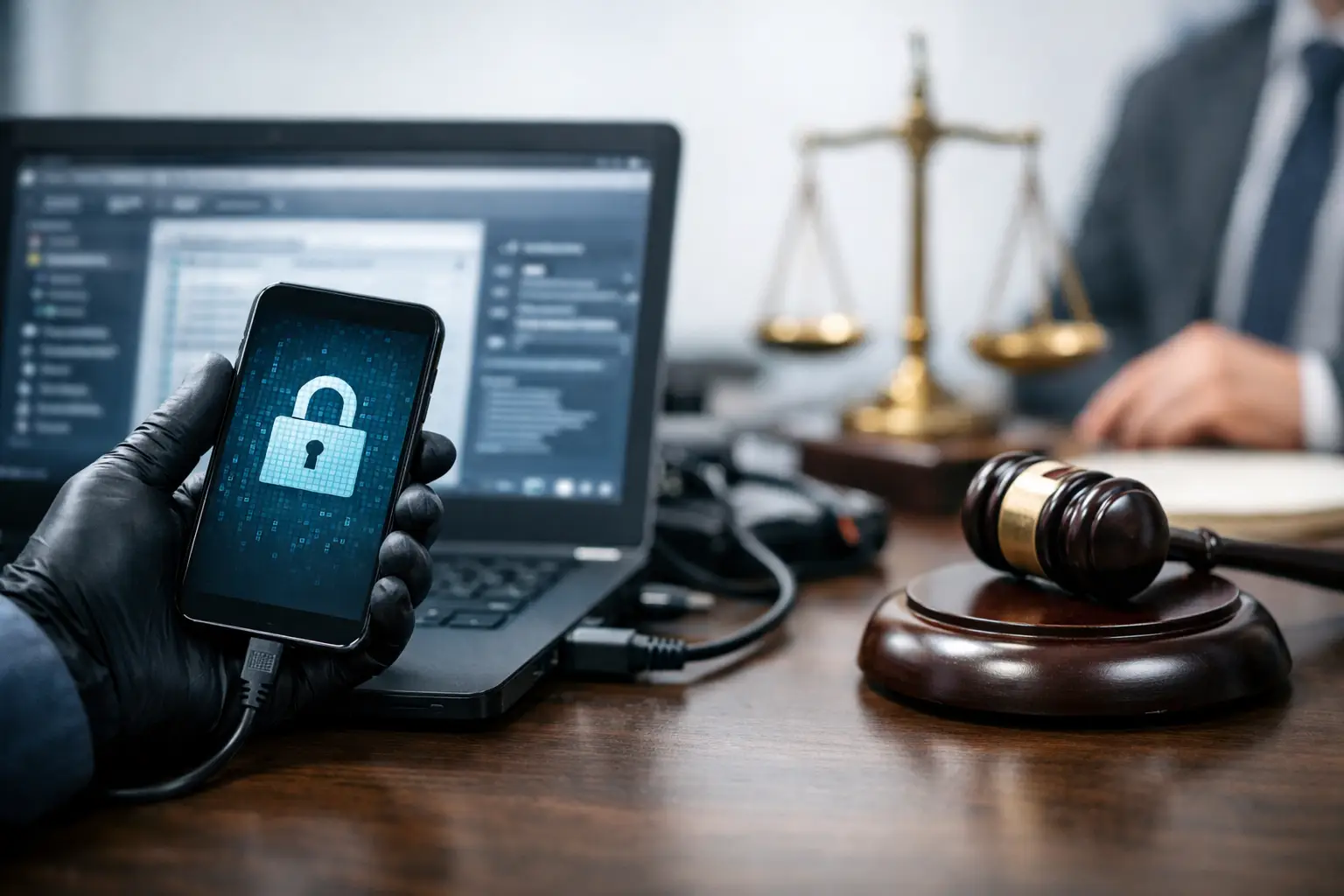
A phone can contain the most significant evidence in a case while revealing almost nothing on first inspection. Messages, call records, location history, photographs, application data and cloud-linked content may all sit behind device encryption, account security and privacy controls. Encrypted phone evidence recovery is therefore not a matter of simply obtaining a handset and attempting to view it. It is a controlled forensic process designed to establish what can be lawfully recovered, preserve it without alteration, and explain the findings in a form that can withstand scrutiny.
For solicitors, investigators and organisations, the difference is material. A technically capable extraction with an unclear chain of custody or unexplained methodology may create more questions than it answers. Conversely, a properly handled examination can clarify disputed communications, support or challenge a timeline, identify relevant account activity and provide a reliable evidential foundation for a civil, criminal or internal investigation.
What Encryption Changes in a Phone Examination
Modern smartphones are built to protect their owners’ data. On current iPhones and Android devices, encryption is closely tied to the device passcode, biometric security, hardware security features and, in some cases, account credentials. This security is valuable for privacy and data protection, but it changes the practical and legal considerations when a device becomes evidence.
Encryption is not the same as deletion
A locked or encrypted phone is not necessarily devoid of recoverable evidence. Depending on the device, operating system, condition, available credentials and authority for examination, relevant material may exist in accessible device storage, backups, paired computers, removable media, notification data, synced accounts or other linked sources.
Equally, deleted data is not automatically recoverable. Modern encryption, routine operating system activity and the way applications manage their own databases can substantially reduce the prospect of recovering deleted content. A forensic examiner should be clear about these limitations from the outset, rather than making promises that cannot be supported by the evidence.
Access is only the first issue
Even where a device can be accessed, the forensic task has only begun. The central questions are whether the data is original or derived, how it was acquired, whether it has been changed, what the relevant timestamps mean, and whether an alternative explanation exists. A screenshot of a conversation may be useful for intelligence, for example, but it is not a substitute for examining the underlying device data and reporting its provenance.
The evidential value of recovered material depends on context. A message may establish that words were sent, but not necessarily who held the phone at the time. Location artefacts may indicate where a device was, but their accuracy and source require careful interpretation. A disciplined examination identifies both the strength of the evidence and its proper boundaries.
Encrypted Phone Evidence Recovery: A Defensible Process
The correct method depends on the facts of the case. A phone involved in an allegation of harassment requires a different approach from a handset central to an employee misconduct investigation or a suspected cyber intrusion. The core principles, however, remain consistent.
Preserve the device before it changes
Phones are active systems. They can receive messages, synchronise cloud data, update applications and erase themselves after repeated failed passcode attempts. The first priority is to prevent avoidable change while recording the condition in which the device was received.
This includes documenting its make, model, visible state, power condition, SIM and storage configuration, damage and any displayed notifications. Appropriate isolation measures may be necessary to control network connectivity, but they must be selected carefully. Improvised handling can alter the evidence, compromise access or leave a gap in the audit trail.
A clear chain of custody should begin at seizure, collection or receipt. Each transfer, action and storage location should be recorded so that the party relying on the evidence can account for its handling. This is particularly important where the device has first been examined by a family member, employee, IT provider or investigator without forensic training.
Establish lawful scope and authority
Before acquisition, the instructing party should define the authority for the examination and the issues in dispute. In legal proceedings, this may involve the terms of an order, consent, disclosure obligations, a warrant or other lawful basis. In an employment matter, it may involve corporate ownership, acceptable-use policies, consent and data protection considerations.
Scope matters because smartphones commonly contain highly personal information unrelated to the case. A proportionate examination may use date ranges, named applications, relevant contacts, search terms or issue-specific categories to focus the work. This protects privacy while making the investigation more efficient and easier to defend.
Acquire without compromising integrity
Forensic acquisition is not a single technique. The appropriate method may range from a logical collection of available records to a fuller file-system acquisition or examination of encrypted backups and associated data sources. The method selected must be compatible with the device and justified by the objective of the examination.
Where credentials are available, their provenance should be recorded. Where they are not available, the examiner must assess realistic options without attempting actions that may trigger security protections, alter the device or exceed the lawful scope of instructions. Not every encrypted device can be accessed, and a professional conclusion that recovery is not technically possible is sometimes the most accurate and useful outcome.
Original evidence should be preserved wherever possible. Examiners work from verified forensic data sets, maintain contemporaneous notes and calculate appropriate integrity values so that acquired material can be checked for change. This provides a transparent basis for later review by another expert.
Analyse artefacts, not assumptions
Once data has been acquired, analysis should address the questions the case actually needs answered. Relevant artefacts may include communications, contact records, photographs and associated metadata, browser activity, app databases, location-related records, device usage events, Wi-Fi connections and cloud synchronisation information.
Interpretation requires caution. A timestamp can reflect creation, modification, transmission, download, viewing or synchronisation rather than the event alleged. An item in an application cache may show that content was displayed, rather than authored by the device user. The examiner should correlate sources, test the timeline and distinguish direct findings from reasonable inferences.
What May Be Recoverable From an Encrypted Phone?
The answer depends on the device and circumstances. In a suitable case, examination may identify communications and attachments, call activity, contact data, images, videos, application records, browsing artefacts, location-related information and evidence of account or device use. A linked computer, backup location or cloud account may also hold material that is not presently visible on the handset.
There are significant limits. End-to-end encrypted messaging services may restrict what is available from a provider. Remote deletion, factory reset activity, hardware damage and software updates can reduce the amount of recoverable data. Some data will be available only in a form that requires careful explanation, while other material may be unavailable altogether.
The right question is not whether every item can be recovered. It is whether the available evidence can reliably answer a defined issue, such as whether two parties communicated, whether a file was present on a given date, whether a device was used in a particular area, or whether claimed account activity is consistent with the artefacts found.
Reporting That Can Be Tested
A court-ready report should do more than present selected messages or photographs. It should identify the device examined, the chain of custody, the material received, the methodology used, relevant tools and versions, the limitations encountered and the findings reached. It should also separate factual observations from expert opinion.
Transparency is critical where the evidence may be challenged. The opposing party, court or another expert must be able to understand how a conclusion was reached and assess whether it is supported. A report that acknowledges uncertainty is often stronger than one that presents an overstated conclusion.
For legal teams, early instruction can preserve options. It allows the examiner to advise on preservation, proportional scope, likely evidential sources and the risks of allowing a device to remain in ordinary use. It may also prevent the common mistake of relying on incomplete screenshots, forwarded messages or informal exports when original evidence is available.
When a Phone Cannot Be Accessed
An inaccessible phone does not always end the enquiry. A forensic strategy may consider lawfully available alternative sources, including associated computers, device backups, corporate systems, telecommunications records, cloud-linked data, recipient devices and records held by relevant applications or service providers.
These sources are not interchangeable. They may answer different questions and carry different evidential weight. A recipient’s copy of a message may prove what they received, for instance, but it may not establish every action taken on the sender’s phone. The investigation should be structured around those distinctions rather than treating all digital material as equivalent.
Where evidence is urgent, the first decision is often the most consequential: preserve the device, record its condition, define the lawful purpose and obtain specialist advice before anyone attempts to search, charge, guess passcodes or reset it. Care at that point protects not only the data, but the credibility of the case built around it.