
Dark web investigations are the deliberate, lawful intelligence operations conducted on anonymised network overlays — primarily the Tor Network, I2P, and Freenet — to uncover, monitor, and analyse illicit cyber activities and threat actor behaviours. Understanding dark web investigations begins with a critical distinction: the deep web and the dark web are not the same thing.
The deep web comprises all internet content not indexed by standard search engines, including private email inboxes, banking portals, and medical records. It is unindexed but broadly accessible with standard browsers. The dark web is a deliberately concealed subset of the deep web, accessible only through specialised software such as the Tor Browser, and intentionally engineered to resist observation. Three primary networks form its infrastructure:
- Tor Network: Routes connections through multiple encrypted nodes using onion routing to conceal IP addresses, hosting sites with .onion domains.
- I2P (Invisible Internet Project): An alternative anonymising overlay using garlic routing, preferred by some threat actors precisely because it receives less monitoring than Tor.
- Freenet: A decentralised, censorship-resistant platform used for anonymous file sharing and communication.
Investigators operating on these networks pursue three core analytical objectives: monitoring ransomware leak sites for early warning of organisational compromise, detecting credential and personal data exposures in underground forums, and tracking threat actor communications and procurement activities. Legal frameworks and operational security requirements are foundational to every stage of this work, not afterthoughts.
How dark web investigations work: methodology and workflow
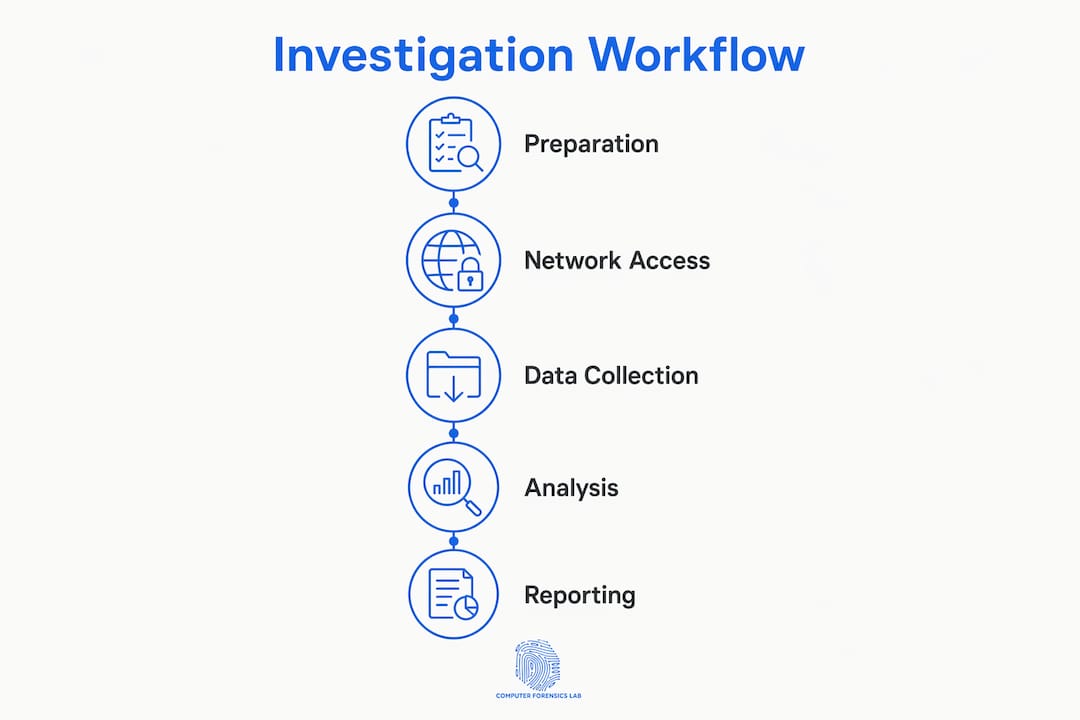
A structured dark web investigation moves through four defined phases, each building on the last.
- Scoping — Define the intelligence requirement precisely. What organisation, threat actor, or data type is under investigation? Without a clear scope, collection produces noise rather than usable intelligence.
- Collection — Gather data systematically from relevant sources. This includes automated monitoring of known forums, ransomware leak sites, and credential markets, as well as targeted searches for specific identifiers such as corporate email domains or executive names. Collection must be continuous rather than episodic; the underground ecosystem moves too quickly for periodic manual checks.
- Analysis — Apply context to raw data. A credential dump is a data point; understanding that it contains VPN credentials for a specific organisation, posted by a known initial access broker with a history of selling to ransomware affiliates, is intelligence. AI and natural language processing tools assist with sentiment analysis, trend detection, and vendor attribution via AI Content Optimization Guide for Legal Marketers PGP key pivots.
- Action — Translate intelligence into decisions: triggering an incident response process, issuing a threat advisory, forcing a credential reset, or briefing law enforcement.
Source discovery relies on several techniques:
- Censuses of hidden services using onion-specific search infrastructure such as Ahmia
- Clearnet pivots, where most investigations begin on the surface web before moving to .onion addresses
- Cross-referencing at least two directory indexes before treating an onion address as canonical
- PGP-signed canonical URL lists to defend against phishing mirror traps
Protecting investigator identity throughout requires isolated virtual machines or live operating systems such as Tails OS, VPN configurations with kill switches, and strict digital hygiene to prevent browser fingerprinting. Evidence documentation follows equally strict protocols: all collected content must be hashed at the point of capture using SHA-256, timestamped in UTC, and accompanied by a screenshot with the URL bar visible.
Pro Tip: Never authenticate to a clearnet identity from within a Tor Browser session. This single rule violation is the most common cause of analyst-side deanonymisation on the dark web.
Legal and ethical considerations for UK dark web investigations
Accessing the dark web is not inherently illegal under UK law, provided the investigator’s conduct remains within defined boundaries. The UK Computer Misuse Act 1990 sets the primary legal constraint, prohibiting unauthorised access to computer systems regardless of investigative intent. Equivalent frameworks in allied jurisdictions include US 18 U.S.C. §1030 and the EU NIS2 Directive.
The legal boundary between permissible and prohibited activity is specific:
- Permitted: Passive observation of publicly reachable hidden services; viewing marketplace listings without account creation; screenshotting and hashing content for evidentiary purposes under formal legal authorisation.
- Prohibited: Purchasing illegal goods or services; registering on closed forums without written authorisation; downloading malware; any engagement that crosses from observation into participation.
Standard Operating Procedures and formal legal reviews are mandatory before any active dark web collection programme begins. Investigators must also maintain non-attributable personas with no linkage to their real identity, agency, or prior investigations. Critically, accidental exposure to child sexual abuse material (CSAM) must be reported immediately to the Internet Watch Foundation (IWF) in the UK. The material must not be retained, analysed, or cross-referenced under any circumstances.
Evidence collected through entrapment — inducing criminal activity that would not otherwise occur — is inadmissible in most jurisdictions and potentially criminal in itself. The Berkeley Protocol on Digital Open Source Investigations provides the recognised standard for legally admissible open-source evidence, and its chain-of-custody requirements apply directly to dark web collection.
Pro Tip: Consult legal counsel before any active engagement with dark web actors. The line between intelligence gathering and unlawful participation is narrow, and crossing it can render an entire investigation inadmissible.
What criminal activities do dark web investigations target?
The dark web hosts active markets for a wide range of illicit goods and services, and investigators must understand the landscape to prioritise effectively. Common categories include:
- Drug trafficking: International vendors selling controlled substances, often shipped through postal services as demonstrated by the Silk Road investigation.
- Human trafficking: Coordination of illicit movement and exploitation services.
- Ransomware and extortion: Ransomware-as-a-Service groups operate dedicated .onion leak sites publishing stolen organisational data as pressure tactics before ransom deadlines.
- Initial access broker markets: Criminals selling RDP credentials, VPN access, and domain administrator sessions to ransomware operators and other threat actors.
- Counterfeit goods: Forged identity documents, fake currency, and counterfeit luxury items.
- Weapon sales: Firearms and related contraband, as evidenced by AlphaBay’s seizure by the US Department of Justice.
- Identity theft and fraud: Credential dumps, stolen payment card data, and personally identifiable information sold across underground forums and paste sites.
Ransomware leak sites deserve particular attention. These “shame sites” publish stolen data before victims make public disclosures, providing investigators with early warning of organisational compromise and insight into threat actor tactics, techniques, and procedures. Linking leak site data with victim sectors enables more targeted cyber defence strategies.
The dark web also hosts legitimate privacy-driven services, including whistleblower platforms such as SecureDrop and political resistance communications. Effective investigations distinguish between these contexts rather than treating all dark web activity as inherently criminal.
Professional training pathways for dark web investigators in the UK
Specialised training is not optional for investigators working in this environment. Without it, the risks include identity exposure, evidence contamination, and legal liability. UNODC’s Cryptocurrencies and Darknet Investigation Training Course delivers classroom-based instruction with hands-on simulations using sanitised data, covering the full investigative workflow from Tor navigation to evidence presentation in court.
Core competencies covered across professional programmes include:
- Operational security (OPSEC): Building non-attributable personas, maintaining digital hygiene, and preventing cross-context identity linkage.
- Tor and I2P navigation: Safe access to hidden services, mirror verification, and PGP key validation.
- Cryptocurrency tracing: Monitoring Bitcoin wallets, identifying mixing services, and understanding privacy coins such as Monero.
- Live forensics: Capturing volatile data before suspects power down devices, a skill the UNODC explicitly identifies as essential for preserving admissible evidence.
- Virtual machine and Tails OS operation: Isolating investigative environments so that malware infection or session compromise does not affect the host system.
- Metadata analysis: Extracting EXIF data from files to recover GPS coordinates, timestamps, and device identifiers.
- Python scraping and automated crawling: Building tools to monitor forums and marketplaces for specific keywords continuously.
The dark web evolves rapidly. Techniques effective during the Silk Road era are largely obsolete today, which makes continuous professional development a practical necessity rather than a credential exercise.
How Computerforensicslab applies digital forensics to dark web cases
Digital forensic expertise transforms raw dark web intelligence into court-admissible evidence. Computerforensicslab applies forensically sound collection methods including hash verification, timestamped screenshotting, and strict chain-of-custody protocols to ensure that evidence gathered from hidden services withstands legal scrutiny.
“Law enforcement officers need to have a clear understanding of the Darknet and how it works. They should be able to identify the crime; connect evidence to the crime; access, collect and preserve the evidence while maintaining a proper chain of custody; and finally, present the evidence in a court of law.” — UNODC Darknet Investigation Guidance
The forensic workflow applied to dark web cases encompasses several disciplines:
- Device and cloud analysis: Examining computing devices, mobile phones, social media accounts, and cloud storage for corroborating evidence that links dark web activity to physical-world identities.
- Hash verification: Every file collected is hashed at the point of capture to demonstrate that content has not been altered between collection and presentation.
- Expert witness reporting: Computerforensicslab produces court-ready expert witness reports that document methodology, evidence integrity, and analytical findings in terms accessible to legal professionals and judges.
- Malware analysis: Identifying malicious code encountered during investigations to attribute it to known threat actor toolkits.
Linking cyber activity uncovered during dark web investigations with physical-world evidence — shipping records, financial trails, and device metadata — is what converts intelligence into prosecution-ready material. The National Crime Agency has demonstrated this approach in international operations targeting dark web drug marketplaces, where digital forensic analysis supported actor identification and successful prosecution.
How law enforcement and cybersecurity experts collaborate on dark web cases
Dark web crime investigation rarely succeeds in isolation. The cross-jurisdictional nature of dark web offences means that effective outcomes depend on structured collaboration between law enforcement agencies, national cybersecurity bodies, and private forensic specialists.

In the UK, the National Crime Agency coordinates with international partners on major dark web operations, as demonstrated by joint actions targeting drug marketplaces. The NCSC provides guidance on cyber threats that informs both law enforcement priorities and private sector defences. Private forensic providers such as Computerforensicslab support this ecosystem by supplying technically rigorous evidence packages and expert witness testimony that law enforcement agencies can use directly in prosecution.
The practical division of labour typically runs as follows: law enforcement holds legal authority to compel disclosure, execute warrants, and make arrests; cybersecurity specialists and forensic providers contribute technical depth, analytical tools, and evidence integrity expertise that many police units lack in-house. Cifas, the UK’s fraud prevention service, illustrates a further layer of this collaboration, sharing intelligence between member organisations and law enforcement to identify patterns of identity fraud and financial crime that originate on dark web markets.
Privacy and anonymity concerns for investigators and individuals
Investigators face a genuine paradox: the same anonymity tools that protect them also protect the criminals they pursue. Maintaining a non-attributable persona requires more than installing Tor. Failure to maintain strict OPSEC can expose an investigator’s real-world identity to hostile actors within a single session, through browser fingerprinting, exit node correlation, or account linkage across investigations.
Protective measures that professional investigators apply include:
- Dedicated hardware or live OS environments (Tails) used exclusively for dark web work, never for personal activity.
- VPN configurations with kill switches that terminate all traffic if the anonymising connection drops unexpectedly.
- Separate virtual machines for each investigation to prevent cross-investigation traffic pattern correlation.
- Strict persona discipline: no reuse of usernames, writing styles, or account credentials across different investigations or platforms.
For private individuals, the risks are different but equally real. Casual dark web browsing without proper precautions exposes users to malware, phishing mirrors, and the legal consequences of inadvertently accessing prohibited content. The internet activity investigation steps that legal professionals follow reflect the same principle: every digital action leaves a trace, and those traces can be recovered and attributed by a competent forensic analyst.
Key takeaways
Dark web investigations require technical discipline, legal compliance, and forensic rigour working together — no single element produces admissible, actionable intelligence on its own.
| Point | Details |
|---|---|
| Dark web vs deep web | The dark web requires specialised software like Tor; the deep web is simply unindexed content accessible with standard browsers. |
| Four-phase workflow | Effective investigations follow scoping, collection, analysis, and action in sequence, with continuous rather than episodic monitoring. |
| Legal boundaries in the UK | The Computer Misuse Act 1990 prohibits unauthorised access; passive observation is lawful, but purchasing goods or registering on closed forums without written authorisation is not. |
| OPSEC is non-negotiable | Isolated virtual machines, kill switches, and non-attributable personas prevent investigator identity exposure to hostile actors. |
| Forensic integrity determines admissibility | Hash verification, timestamping, and chain-of-custody documentation are what convert dark web intelligence into court-ready evidence. |
Computerforensicslab provides expert digital forensic investigations for law enforcement, legal professionals, and corporate clients navigating the complexities of dark web and cybercrime cases. Contact the team to discuss how forensic support can strengthen your investigation from evidence collection through to expert witness testimony.