
TL;DR:
- A digital footprint is a permanent record of online activities and data generated through internet use. Managing both active and passive footprints is essential for protecting privacy, security, and reputation. Organizations face larger risks from misconfigured data and employee activity, requiring proactive monitoring and forensic analysis.
A digital footprint is defined as the total accumulation of traceable digital activities, communications, and data generated by an individual or organisation through internet and connected device use. Every search query, social media post, online purchase, and website visit contributes to this record. Your digital footprint is permanent, searchable, and accessible to employers, institutions, and cybercriminals alike. Understanding what a digital footprint means is the first step towards protecting your privacy and reputation online.
What is a digital footprint? Active and passive types explained
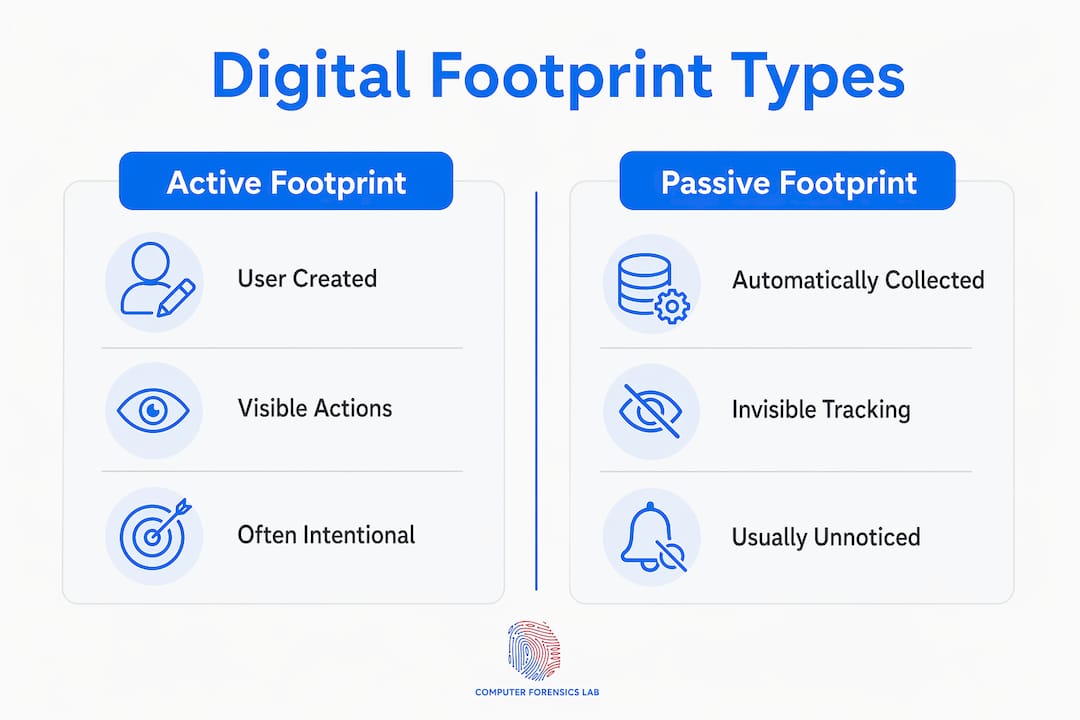
A digital footprint consists of two distinct types: active data you intentionally share, and passive data collected automatically without your direct input. Most people recognise the active kind. The passive kind is where the real surprises lie.

Active digital footprints
An active digital footprint is created whenever you deliberately share information online. Common examples include:
- Social media posts, comments, and profile updates on platforms such as Facebook, LinkedIn, or X
- Form submissions, newsletter sign-ups, and account registrations
- Blog posts, forum contributions, and product reviews
- Emails sent through web-based services such as Gmail or Outlook
Each of these actions leaves a traceable record tied to your identity. You chose to create it, which means you have at least some control over it.
Passive digital footprints
A passive digital footprint forms without any deliberate action on your part. Passive data is collected automatically, often without explicit consent, and includes:
- IP addresses logged by every website you visit
- Cookies placed on your browser to track behaviour across sites
- Location data gathered by mobile apps and devices
- Browsing history recorded by your internet service provider
The critical difference is visibility. You know when you post a comment. You rarely know when a cookie silently records your shopping habits across a dozen websites.
| Characteristic | Active footprint | Passive footprint |
|---|---|---|
| Created by | Deliberate user action | Automatic data collection |
| User awareness | High | Low or none |
| Examples | Posts, emails, form submissions | Cookies, IP logs, location data |
| Ease of removal | Moderate | Difficult |
| Control level | Significant | Minimal |
Why does your digital footprint matter for privacy and security?
Your digital footprint acts as a permanent online record accessible to employers, institutions, and malicious actors, creating real risks around reputation damage and identity theft. The scale of that risk is larger than most people realise.
The most underappreciated danger is the mosaic effect. Aggregated data points create comprehensive identity profiles that far exceed the privacy risk of any single piece of information. Your name on one site, your employer on another, your home suburb on a third, and your daily commute pattern from a fitness app combine into a profile a criminal can exploit. No single data point seems dangerous. Together, they are.
The consequences of an unmanaged footprint are concrete:
- Identity theft: Criminals use aggregated personal data to open fraudulent accounts or access existing ones.
- Targeted phishing: Detailed profile knowledge allows attackers to craft convincing, personalised scam messages.
- Reputational damage: Old social media posts, forum comments, or images resurface during job applications or legal proceedings.
- Professional consequences: Employers routinely search candidates online. A poorly managed footprint can cost you a role before an interview begins.
- Legal exposure: Digital activity records are admissible as evidence in court. Understanding digital footprints in legal contexts is increasingly relevant for both individuals and businesses.
Deleting content does not fully erase your digital footprint. Cached web pages, archive services, and third-party data harvesting mean that information you remove remains accessible in some form. Treat every online action as potentially permanent.
There is also a structural tension at play. Corporations collect passive footprint data proactively to fuel advertising revenue, often working against users’ privacy interests. This conflict between what individuals want and what platforms are incentivised to do defines the modern digital environment.
How can you manage and protect your digital footprint?
Managing your digital footprint requires action on both the active and passive sides. Neither is fully controllable, but both are reducible.
For your active footprint:
- Audit your social media profiles annually. Remove posts, images, or comments that no longer reflect your professional or personal values.
- Review privacy settings on every platform you use. Default settings almost always favour data collection over user privacy.
- Use separate email addresses for personal, professional, and commercial sign-ups. This limits cross-platform data aggregation.
- Search your own name regularly on Google and Bing. What you find is what employers and investigators find.
- Request data deletion from platforms where you no longer hold accounts, using rights granted under the UK GDPR.
For your passive footprint:
- Use a reputable VPN to mask your IP address from websites and your internet service provider.
- Manage cookie consent actively. Reject non-essential cookies rather than accepting all by default.
- Use privacy-focused browsers such as Firefox or Brave, which limit third-party tracking by default.
- Disable location permissions for apps that do not require them to function.
- Review your data broker exposure. Services such as data broker opt-out tools can help remove your details from aggregator databases.
The privacy-by-design mindset is the most effective long-term approach. Treat every online interaction as potentially public and permanent before you take it, not after. This single shift in thinking prevents more problems than any reactive clean-up effort.
Pro Tip: Set a quarterly calendar reminder to Google your full name and review the first two pages of results. What appears there is your public digital footprint, and it changes more often than most people expect.
Public databases used in law enforcement investigations frequently draw on digital footprint data gathered from both active and passive sources. Knowing this underlines why proactive management matters, not just for privacy, but for legal protection.
How do digital footprints affect organisations?
Organisations face a digital footprint challenge that is structurally different from the individual version, and considerably harder to manage. Corporate footprints grow through public cloud misconfigurations, developer metadata, and web scraping of employee profiles, creating an attack surface that no single person controls.
The sources of organisational footprint exposure include:
- Employee social media activity: Staff posts can inadvertently reveal internal systems, project names, or client relationships.
- Cloud misconfigurations: Publicly accessible storage buckets or misconfigured APIs expose sensitive data without any deliberate sharing.
- Developer metadata: Code repositories on platforms such as GitHub can contain API keys, internal URLs, or system architecture details.
- Job postings: Detailed technical job adverts reveal the software stack and infrastructure a company uses, giving attackers a roadmap.
- Domain and WHOIS records: Registration data, even when partially redacted, contributes to a traceable corporate profile.
The consequences for businesses are significant. A well-mapped corporate footprint gives attackers the intelligence needed to launch targeted intrusions, social engineering campaigns, or supply chain attacks. Privacy and reputation risks apply to organisations just as they do to individuals, often with greater financial and legal consequences.
Digital forensics plays a direct role in this space. When a breach or misconduct investigation occurs, forensic analysts reconstruct the digital footprint trail to establish what happened, when, and who was responsible. Computerforensicslab regularly supports corporate clients through exactly this process, examining cloud data, device logs, and communication records to build legally sound evidence.
Key takeaways
A digital footprint is a permanent, dual-natured record of online activity that carries real privacy, security, and reputational risks for both individuals and organisations.
| Point | Details |
|---|---|
| Two types of footprint | Active footprints are intentional; passive footprints are collected automatically and are harder to remove. |
| Permanence is real | Deleted content persists in caches, archives, and third-party databases, making full erasure effectively impossible. |
| The mosaic effect | Individually harmless data points combine into detailed identity profiles that criminals and investigators can exploit. |
| Organisations face unique risks | Cloud misconfigurations, metadata, and employee activity all expand the corporate attack surface without deliberate intent. |
| Proactive management works | Regular audits, privacy settings reviews, and a privacy-by-design approach reduce exposure before problems arise. |
The uncomfortable truth about digital footprints
Working in digital forensics gives you a particular perspective on this subject. When Computerforensicslab analysts reconstruct a person’s online activity for a legal case, the volume and detail of what exists is consistently surprising, even to the individuals involved. People genuinely do not know how much data they have generated, or how far back it goes.
The common assumption is that old data fades or becomes irrelevant. It does not. A forum post from 2009, a deleted LinkedIn profile, or a comment made on a news article a decade ago can all be retrieved and placed before a court. The internet does not forget, and neither do forensic tools.
The trade-off that frustrates me most is the passive footprint problem. You can make deliberate choices about what you post. You cannot easily opt out of the infrastructure that tracks your every click, location, and device interaction. The conflict between individual privacy and corporate data collection is not a technical problem with a technical solution. It is a structural one, and it requires both regulatory pressure and personal vigilance to manage.
My practical advice is this: stop thinking about your digital footprint as something to clean up after the fact. Build the habit of protecting your digital privacy before you act online, not after. The organisations and individuals who manage their footprints best are the ones who treat every online action as a permanent record from the moment they take it.
— Computer
How Computerforensicslab can help with digital footprint investigations
When a digital footprint becomes evidence, professional forensic analysis is required. Computerforensicslab provides digital forensic investigation services for individuals, legal professionals, and corporate clients across the UK. The team examines device logs, cloud data, social media records, and communication histories to reconstruct online activity trails with forensic rigour. Whether you need to investigate a data breach, gather evidence of employee misconduct, or understand the scope of your organisation’s online exposure, professional forensic support makes the difference between usable evidence and inadmissible data. Contact Computerforensicslab to discuss your case with a specialist.
FAQ
What does the term digital footprint mean?
A digital footprint is the total record of traceable data generated by an individual or organisation through internet and connected device use. It includes both information shared intentionally and data collected automatically.
What does a digital footprint include?
A digital footprint includes social media posts, emails, form submissions, browsing history, IP addresses, cookies, location data, and metadata from devices and applications.
Is it possible to delete your digital footprint completely?
Full deletion is not possible. Cached pages, archive services, and third-party data collection mean that removed content remains accessible in some form, making the footprint effectively permanent.
What is a digital footprint used for in investigations?
Digital forensics professionals use footprint data to reconstruct timelines of online activity, establish identity, and gather evidence for legal proceedings, corporate investigations, and cybercrime cases.
How is an organisational digital footprint different from an individual one?
An organisational footprint includes employee activity, cloud configurations, code repositories, and public business data, creating a larger and less controllable attack surface than a typical individual footprint.