TL;DR:
- Data preservation in investigations involves securing digital evidence in its original form to ensure authenticity and legal validity. Standards like ISO/IEC 27037 and cryptographic hashing techniques, such as SHA-256, guide best practices for evidence integrity and management. Proper documentation, technical controls, and timely capture of volatile data are essential to prevent evidence loss and ensure admissibility in court.
Data preservation in investigations is the disciplined process of securing digital evidence in its original state to guarantee authenticity, integrity, and legal admissibility throughout the investigative lifecycle. Known formally as digital evidence management, it encompasses every action taken from the moment evidence is identified to its final presentation in court. Standards such as ISO/IEC 27037 and technologies including SHA-256 cryptographic hashing define the minimum acceptable practice. Without rigorous preservation from the outset, evidence risks exclusion, and investigations collapse before they reach a verdict.
What standards govern data preservation in investigations?
ISO/IEC 27037 is the international benchmark for digital evidence identification, collection, acquisition, and preservation. It defines two key roles: the Digital Evidence First Responder, who secures the scene and collects initial data, and the Digital Evidence Specialist, who conducts deeper acquisition and analysis. The standard applies to all digital media, from mobile phones to cloud storage, making it universally relevant to law enforcement, legal teams, and corporate investigators alike.
The standard also establishes four quality principles that every preservation process must satisfy:
- Auditability: Every action taken on evidence must be recorded and open to independent review.
- Repeatability: The same process, applied to the same evidence, must produce the same result.
- Reproducibility: A different examiner, using the same method, must reach the same outcome.
- Justifiability: Every decision made during evidence handling must be defensible in court.
Chain of custody documentation is the practical expression of these principles. Courts scrutinise who collected, transferred, and stored data, along with the access controls applied at each stage. Missing or incomplete documentation risks evidence exclusion entirely. The ACPO (Association of Chief Police Officers) guide for the UK reinforces this, requiring that chain of custody records be detailed enough to allow independent reconstruction of evidence handling without returning to the original device.
NIST (National Institute of Standards and Technology) further recommends that organisations adopt standardised written policies to guide packaging, storage, and management of evidentiary items. Consistent policy reduces the risk of mismanagement across jurisdictions and organisations. For UK legal practitioners, aligning internal procedures with both ISO/IEC 27037 and NIST guidance represents the most defensible position when evidence is challenged.
Which methods and technologies preserve digital evidence integrity?
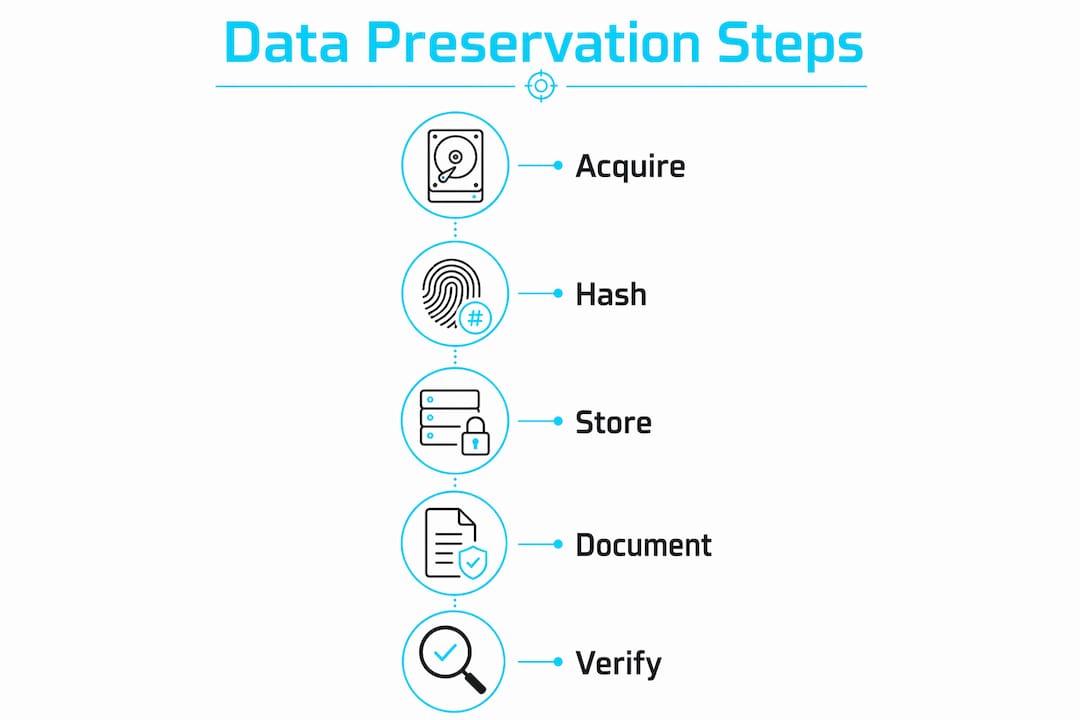
Cryptographic hashing is the foundation of technical evidence integrity. SHA-256 generates a unique fixed-length fingerprint of any digital file. If a single bit of data changes after acquisition, the hash value changes, and tampering becomes immediately detectable. Every forensic acquisition must record the original hash and verify it against subsequent copies at each transfer point.

Storage media selection directly affects preservation quality over time. NIST recommends offline media such as CD-R, DVD-R, magnetic tape, and dedicated hard drives for long-term digital evidence storage. Solid-state drives (SSDs) require periodic power to retain data and are not suitable as standalone long-term storage. This distinction matters for corporate clients managing large evidence repositories over multi-year litigation cycles.
| Method | Strengths | Limitations |
|---|---|---|
| SHA-256 hashing | Detects any data alteration instantly | Does not prevent access; requires procedural controls |
| Write blockers | Prevents modification during acquisition | Hardware dependent; requires trained operators |
| Offline media (CD-R, tape) | Stable long-term storage per NIST | Slower access; physical storage required |
| Role-based access control | Limits exposure to authorised personnel | Requires robust identity management infrastructure |
| Blockchain audit trails | Immutable, transparent chain of custody | Emerging technology; implementation complexity |
Forensic certification platforms such as TrueScreen integrate all ISO 27037 phases into a single automated process. TrueScreen certifies evidence at capture, recording GPS coordinates, timestamps, and device information alongside automatic hash generation. This removes the manual steps where human error most commonly occurs.
Blockchain-enabled frameworks combine decentralised ledger technology with cryptographic hash verification and role-based access control. The result is an immutable, transparent audit trail that prevents undetected tampering throughout the forensic lifecycle. For law enforcement agencies managing high-volume evidence, this technology offers a significant improvement over traditional paper-based custody logs.
Pro Tip: Always generate and record SHA-256 hashes immediately upon acquisition, before any analysis begins. Verify the hash again after every transfer. This two-point verification creates an auditable integrity record that satisfies both ISO/IEC 27037 and UK court requirements.
How should organisations implement legal holds?
A legal hold, also called a litigation hold, is a formal instruction to suspend all routine deletion and modification of data relevant to anticipated or active litigation. It is the first preservation control an organisation must activate when legal proceedings become foreseeable. Legal hold triggers include receipt of a demand letter, service of a subpoena, or notification of a regulatory inquiry.
Effective implementation follows a structured sequence:
- Identify the trigger. Confirm that litigation, investigation, or regulatory scrutiny is reasonably anticipated. Document the date and nature of the trigger event.
- Define the scope. Identify all relevant data categories, including emails, documents, databases, and communications, along with the custodians responsible for each.
- Issue hold notices. Notify all custodians in writing, specifying what data must be preserved and prohibiting deletion or alteration.
- Suspend automated deletion. Override system retention policies, auto-archive rules, and scheduled clean-up scripts that would otherwise destroy relevant data.
- Implement technical controls. Apply preservation locks at the system level to backstop custodian compliance. Do not rely solely on individual employees to self-preserve.
- Monitor and validate. Conduct regular audits to confirm that hold notices are being followed and that no relevant data has been lost.
Custodian self-preservation consistently fails as a standalone strategy. Employees forget, misunderstand scope, or inadvertently delete files through routine work habits. Automated technical controls are the necessary backstop. For corporate clients, this means integrating legal hold functionality directly into document management systems and email platforms rather than relying on manual compliance.
Pro Tip: Maintain a legal hold register that records every hold issued, its scope, the custodians notified, and the date technical controls were activated. This register becomes critical evidence of good-faith preservation efforts if spoliation is later alleged.
What are the biggest challenges in preserving investigative data?
Volatile data presents the most time-critical preservation challenge. RAM contents, active network sessions, and running processes disappear the moment a device loses power. Volatile data must be captured first, before any other acquisition activity, because its evidentiary value is irreplaceable once lost. This sequencing principle is fundamental to sound evidence handling in forensic investigations.
Common pitfalls that undermine investigative data security include:
- Automated deletion: Retention policies and scheduled clean-up scripts destroy evidence before holds are activated. Corporate email systems are particularly vulnerable during the gap between a triggering event and formal hold implementation.
- Human error: Custodians overwrite, move, or delete files without realising their relevance. Training reduces but does not eliminate this risk.
- Jurisdictional inconsistency: Evidence handling standards vary significantly across organisations and legal systems. Standardised written policies are the most effective tool for reducing this variability.
- Inadequate documentation: Tamper-evident records that omit hashes, timestamps, or handler identities fail to satisfy court scrutiny. The ACPO guide requires that documentation allow independent reconstruction of the entire handling process.
- Improper storage media: Using SSDs or consumer-grade cloud storage for long-term evidence retention introduces data integrity risks that NIST guidance specifically warns against.
Data quality and provenance have become central issues in digital policing, directly influencing judicial outcomes. A case involving employee misconduct or intellectual property theft can fail entirely if the digital evidence trail has gaps. Forensic certification and tamper-evident documentation are not administrative formalities. They are the difference between evidence that stands and evidence that falls.
For organisations managing cross-border investigations, aligning with ISO/IEC 27037 provides a common framework that most jurisdictions recognise. Pair this with a digital discovery workflow that sequences collection by volatility, and the most common preservation failures become preventable.
Key takeaways
Effective evidence preservation requires technical controls, documented standards, and legal hold procedures working together from the moment a trigger event occurs.
| Point | Details |
|---|---|
| Standards define the baseline | ISO/IEC 27037 sets the four quality principles every preservation process must satisfy for court admissibility. |
| Hash verification is non-negotiable | SHA-256 hashing at acquisition and at every transfer point is the minimum technical control for evidence integrity. |
| Legal holds need technical enforcement | Custodian self-preservation fails; automated system-level controls must suspend deletion from the trigger date. |
| Volatile data must come first | RAM and active session data disappears on power loss and must be captured before any other acquisition step. |
| Documentation must allow reconstruction | Chain of custody records must include hashes, timestamps, tools, and handlers to withstand independent scrutiny. |
What experience has taught me about evidence preservation
The most consistent failure I see is not technical. Organisations invest in forensic tools and then undermine everything with incomplete documentation. A SHA-256 hash means nothing if the chain of custody log does not record who generated it, on which device, and at what time. Courts do not accept gaps filled with good intentions.
The integration of blockchain into evidence workflows is genuinely significant, not as a theoretical improvement but as a practical answer to a real problem. Traditional custody logs are paper-based or held in systems that can be edited. An immutable ledger removes that vulnerability entirely. The implementation complexity is real, but it is decreasing as platforms mature.
What I find most underappreciated is the volatility sequencing problem. Legal teams often focus on document preservation and overlook RAM and active session data entirely. By the time a forensic examiner arrives, that evidence is gone. Building volatility-aware collection protocols into incident response plans, before an investigation begins, is the single most impactful procedural change most organisations could make.
Ongoing training matters more than most organisations acknowledge. Legal compliance audit logs and written policies only work if the people responsible for them understand why each step exists. The standard improves when practitioners understand the principle, not just the checklist.
— Computerforensicslab
How Computerforensicslab supports evidence preservation
Computerforensicslab provides end-to-end digital forensics services tailored to the specific requirements of UK legal proceedings, law enforcement operations, and corporate investigations. The team applies ISO/IEC 27037-compliant acquisition methods, SHA-256 integrity verification, and rigorous chain of custody documentation on every case. Whether you are managing a data breach, an employee misconduct matter, or complex litigation, Computerforensicslab delivers forensically sound evidence that withstands court scrutiny. Expert witness reports, tamper-evident storage, and full audit trails are standard. Contact Computerforensicslab to discuss your preservation requirements and receive guidance aligned with current UK legal standards.
FAQ
What is data preservation in investigations?
Data preservation in investigations is the process of securing digital evidence in its original, unaltered state from the point of collection through to court presentation. It encompasses hashing, chain of custody documentation, legal holds, and compliant storage to maintain admissibility.
Why is chain of custody critical for digital evidence?
Courts assess chain of custody to determine whether digital evidence has been tampered with or mishandled. Missing documentation risks evidence exclusion, regardless of its probative value.
When should a legal hold be issued?
A legal hold must be issued upon reasonable anticipation of litigation, investigation, or regulatory inquiry. Triggers include demand letters, subpoenas, and formal notices of inquiry, and the hold must suspend automated deletion immediately.
How does sha-256 protect evidence integrity?
SHA-256 generates a unique cryptographic fingerprint of a digital file at the point of acquisition. Any subsequent alteration to the file produces a different hash value, making tampering immediately detectable during verification.
Which storage media is best for long-term evidence retention?
NIST recommends offline media such as CD-R, DVD-R, and magnetic tape for long-term digital evidence preservation. SSDs require periodic power to retain data and should not be used as the sole storage medium for evidence held over extended periods.