TL;DR:
- Digital forensics has become essential in employee misconduct investigations, uncovering objective evidence across digital footprints. Proper evidence handling and early specialist involvement ensure findings are legally sound and prevent procedural vulnerabilities. Effective forensic integration enhances investigation credibility and helps organizations respond fairly and defensibly to workplace disputes.
Employee misconduct has changed. Where it once meant a paper trail of grievances and witness statements, it now leaves a digital footprint across emails, cloud storage, messaging apps, and corporate devices. The role of forensics in employee misconduct investigations has become central to how HR and compliance teams build defensible cases, protect the business, and treat employees fairly. Traditional methods alone simply cannot keep pace with the complexity of modern workplace disputes. This guide covers what forensic investigation in HR looks like in practice, why evidence integrity matters so much, and how to apply forensic findings without exposing your organisation to legal risk.
Table of Contents
- Key takeaways
- The role of forensics in employee misconduct investigations
- Principles of digital evidence handling
- Challenges in forensic misconduct investigations
- Applying forensic findings in practice
- My perspective on forensics and workplace investigations
- How Computerforensicslab supports workplace investigations
- FAQ
Key takeaways
| Point | Details |
|---|---|
| Forensics clarifies disputed facts | Digital forensic analysis uncovers evidence that witness accounts alone cannot reliably establish. |
| Evidence integrity is non-negotiable | Accuracy, consistency, and documented chain of custody determine whether findings hold up under legal scrutiny. |
| Metadata matters more than most realise | Transfer methods such as messaging apps can strip metadata, fundamentally altering the evidential value of files. |
| Misconduct cases are growing in complexity | 38% of employees face four or more distinct misconduct types, increasing legal exposure for employers. |
| Forensics must precede disciplinary action | Acting on incomplete evidence without forensic grounding creates serious procedural and legal vulnerabilities. |
The role of forensics in employee misconduct investigations
Digital forensics is the discipline of identifying, preserving, and analysing digital evidence in a way that withstands legal and regulatory scrutiny. In a workplace context, that means examining the devices, accounts, and communications of employees involved in alleged misconduct, whether that is intellectual property theft, financial fraud, data exfiltration, harassment conducted via messaging platforms, or policy violations that leave traces in system logs.
The types of misconduct where forensic evidence in the workplace proves decisive include:
- Intellectual property theft: Employees copying proprietary files to personal drives or cloud accounts before resignation
- Internal fraud: Manipulation of financial records, procurement fraud, or expense falsification uncovered through audit log analysis
- Data breaches: Identifying whether a breach was accidental, negligent, or deliberate, and tracing the precise path of data movement
- Harassment and bullying: Recovering deleted messages, establishing timelines from metadata, and verifying the authenticity of screenshots
- Unauthorised access: Determining which accounts accessed restricted systems and when
What distinguishes forensic evidence from the kind gathered through a standard HR inquiry is objectivity and reproducibility. A witness statement is fallible and open to challenge. A forensic artefact, correctly preserved, speaks to what actually happened on a device or network.
Pro Tip: If misconduct is suspected, contact your forensic provider before touching the device or account in question. Even routine actions like opening a file or logging into an account can alter timestamps and compromise the integrity of evidence.
The forensic investigation in HR context also demands speed. Early preservation of digital evidence before data is overwritten or devices are wiped or repurposed is fundamental to building a case that can withstand challenge.
Principles of digital evidence handling
Sound forensic practice is not only about what you find. It is about how you find it, document it, and maintain it through the full lifecycle of an investigation. Data integrity requires accuracy, consistency, and reliability from the moment evidence is identified right through to the final report.
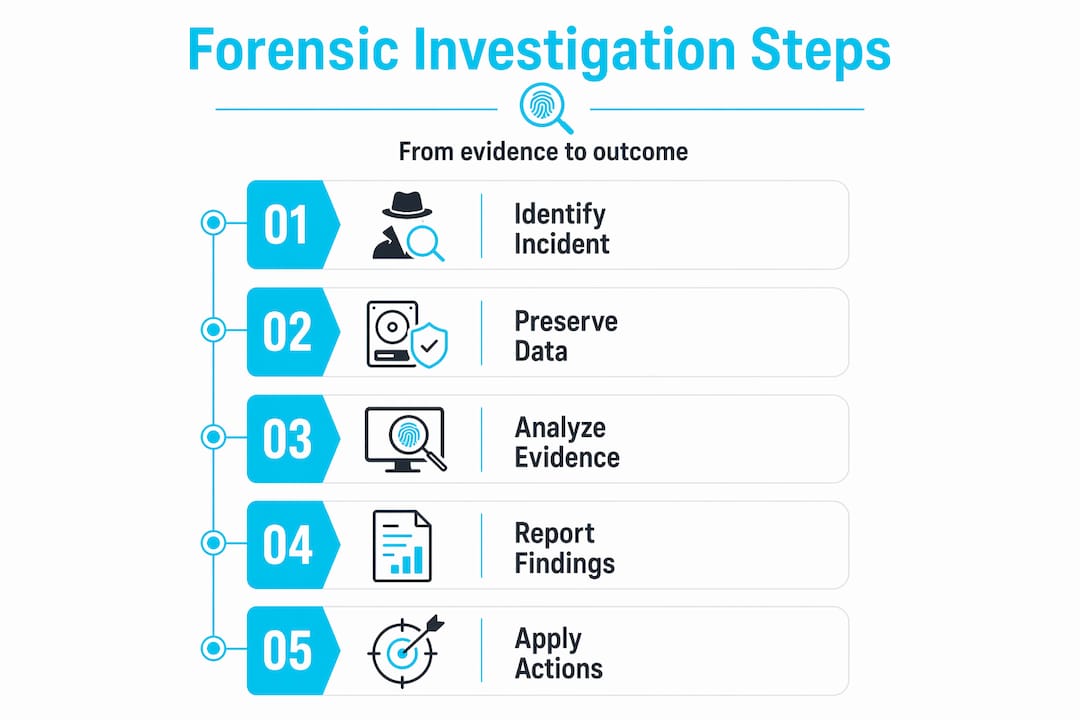
Here is how that lifecycle should unfold in a properly conducted workplace investigation:
- Identification: Establish what devices, accounts, platforms, or data repositories are relevant to the allegation. This prevents scope creep and ensures proportionality.
- Preservation: Create forensically sound copies of relevant data using write-blockers and verified imaging tools. Original evidence must never be worked on directly.
- Collection: Extract relevant data systematically, maintaining a full log of every action taken. This is where chain of custody begins.
- Analysis: Examine the collected data for relevant artefacts, including file access logs, deleted content, communication records, and metadata.
- Documentation: Record all findings, tools used, examiner credentials, and the condition of evidence at each stage.
- Reporting: Produce a clear, factual report that presents findings without overreaching conclusions, and which can be understood by non-technical decision-makers including employment tribunals.
The threats to this process are more common than most compliance teams appreciate. Human error, security breaches, and documentation lapses are the most frequently cited causes of compromised evidence integrity. Staff turnover during a long investigation, improper storage of physical devices, or sending files through compressed messaging platforms can all silently degrade the evidential value of what you have collected.
| Risk to evidence integrity | Common cause | Mitigation |
|---|---|---|
| Metadata loss | File transfer via messaging apps | Preserve and share original files only |
| Altered timestamps | Opening files on suspect devices | Use write-protected forensic images |
| Chain of custody gaps | Undocumented handovers between staff | Maintain a signed evidence log at every stage |
| Deleted data recovery failure | Delayed investigation start | Instruct forensic team before device reallocation |

Pro Tip: Chain of custody documentation is not bureaucratic box-ticking. It is the difference between evidence being admitted and evidence being dismissed. If you cannot account for every person who handled a piece of evidence, opposing counsel will exploit that gap.
The credibility of forensic findings rests entirely on the integrity of the process behind them. Getting the procedure right is not optional.
Challenges in forensic misconduct investigations
The practical reality of employee misconduct analysis is that cases rarely present cleanly. 38% of employees involved in misconduct allegations face four or more distinct issue types within a single case. That means a single investigation might simultaneously involve harassment, misuse of company data, and potential fraud, each requiring different forensic approaches and creating different legal exposures.
Some of the most significant challenges forensic investigators and HR teams face include:
- Metadata stripping by transfer platforms: Chat-based messaging apps compress files and remove metadata, which means a screenshot shared over a messaging platform may lack the EXIF data needed to verify its origin, timestamp, or authenticity. Absence of metadata is not proof of tampering, but it is a limitation that must be explicitly addressed in any forensic report.
- The risk of acting too quickly: The pressure on HR teams to resolve misconduct cases promptly is understandable, but moving to disciplinary action before forensic evidence has been properly gathered and reviewed is a procedural error that frequently results in unfair dismissal claims. The investigation must precede the conclusion, not the other way around.
- Deliberate evidence destruction: Employees aware of an investigation may attempt to delete files, factory reset devices, or wipe messaging histories. Forensic tools can often recover this data, but only if the investigation begins before the devices are handed back and reassigned.
- Interpreting absence of evidence: A forensic examination that finds nothing is not automatically exculpatory. The absence of data on a device may mean the employee is innocent, or it may mean data was successfully destroyed. These are very different conclusions, and conflating them is a serious analytical error.
- Multi-device and multi-platform complexity: Modern employees work across personal phones, corporate laptops, SaaS platforms, and cloud drives. Evidence may exist across all of them simultaneously, and collecting it requires co-ordinated legal authority and technical capability.
Misconduct cases increasingly originate in digital spaces long before they surface in formal complaints. HR and compliance teams that rely solely on interviews and paper-based reviews are examining only a fraction of the available evidence.
Applying forensic findings in practice
Gathering forensic evidence is only part of the challenge. How you use it, and whether you use it correctly within a fair and legally compliant process, determines the outcome. Holistic investigations with a defined scope that include impartial investigators, structured interviews, and thorough document review are the standard against which any disciplinary process will be measured.
Here is a practical framework for HR and compliance teams:
- Define the investigation scope in writing before you begin. Who is the subject? What allegations are being investigated? Which systems, devices, and accounts are in scope? A written scope protects you from scope creep and provides a clear record of what the investigation was designed to establish.
- Instruct forensic experts early. Digital forensics in HR cases is most effective when specialists are involved before evidence handling begins, not after something has gone wrong. Early instruction preserves options.
- Separate the forensic investigation from HR decision-making. The forensic examiner establishes facts. HR and legal counsel decide what those facts mean for the employment relationship. Conflating these roles creates bias risk.
- Obtain legal advice on evidence use. In the UK, legal considerations for digital forensics include data protection obligations under UK GDPR, proportionality requirements, and employee privacy rights. Your forensic findings must be gathered and used in ways that respect these constraints.
- Document everything, including what you decided not to investigate. If a decision was made to exclude certain devices from scope, record the rationale. An employment tribunal will examine not just what you found, but whether your process was reasonable and thorough.
The role of forensics in workplace ethics extends beyond individual investigations. Organisations that invest in forensic investigation capacity and establish clear investigation protocols send a credible deterrence signal. Misconduct thrives in environments where employees believe they will not be caught or that evidence will not survive scrutiny.
A comparison of approaches illustrates the difference forensics makes:
| Investigation approach | Outcome reliability | Legal defensibility | Evidence quality |
|---|---|---|---|
| Witness statements only | Low | Weak | Subjective |
| Documentary review without forensics | Moderate | Moderate | Incomplete |
| Full digital forensic investigation | High | Strong | Objective and reproducible |
My perspective on forensics and workplace investigations
I have seen the same mistake made repeatedly across organisations of every size: HR teams conduct thorough-looking investigations, gather statements, review documents, and reach confident conclusions, only for the entire process to unravel because the digital evidence was handled incorrectly or never collected at all.
The most revealing cases are not the ones where the evidence clearly points in one direction. They are the cases where the absence of evidence is the story. A device that should contain weeks of communications shows none. A file access log shows activity at 2am from an account belonging to an employee who claims they never worked evenings. These are the forensic findings that change outcomes, and they only emerge when the investigation is set up to look for them.
What I have learned from working on complex misconduct investigations is that procedural discipline is not the enemy of speed. It is what makes speed sustainable. Acting quickly on incomplete evidence is far more expensive than taking two extra days to preserve it correctly.
Misconduct manifests digitally first, and organisations that treat forensic capability as a specialised luxury rather than a standard tool in their compliance toolkit are carrying a risk they may not fully appreciate until a tribunal claim lands.
— Computer
How Computerforensicslab supports workplace investigations
When a misconduct allegation surfaces, the last thing your HR team needs is to be learning digital forensics methodology under pressure. Computerforensicslab works directly with HR teams, compliance officers, and legal counsel to conduct forensic investigations into employee misconduct involving devices, email accounts, cloud platforms, and messaging applications. Every investigation follows a fully documented chain of custody and produces expert-level reporting suitable for employment tribunals, regulatory proceedings, or internal disciplinary processes.
From step-by-step evidence collection protocols through to expert witness reports, the team brings the technical depth and procedural rigour that corporate investigations require. If you are managing a live misconduct case or want to establish a forensic response protocol before you need one, speak to Computerforensicslab now.
FAQ
What is the role of forensics in employee misconduct cases?
Digital forensics identifies, preserves, and analyses evidence from devices, accounts, and communications to establish facts in employee misconduct investigations. It provides objective, reproducible findings that hold up under legal scrutiny in a way that witness accounts alone cannot.
When should a forensic investigator be brought in?
Forensic specialists should be engaged as early as possible in a misconduct investigation, ideally before any devices are accessed, reassigned, or returned to the employee. Early involvement preserves the widest range of recoverable evidence.
Can deleted files be recovered in a workplace investigation?
Yes, in many cases forensic tools can recover deleted files, messages, and access logs from devices and cloud platforms, provided the investigation begins promptly before data is overwritten or devices are wiped.
How does metadata affect forensic evidence quality?
Metadata such as EXIF data records timestamps, device identifiers, and file origins. Transfer methods like messaging apps strip this data during compression, which reduces the evidential value of files shared in this way. Original files should always be preserved.
What legal considerations apply to digital forensics in UK workplaces?
UK employers must comply with UK GDPR, conduct proportionate investigations, and respect employee privacy rights when gathering digital evidence. Legal counsel should be involved to confirm that forensic methods and evidence use meet these obligations before disciplinary action is taken.