
Selecting the right computer forensics tools remains a critical challenge for legal professionals and security teams navigating increasingly complex digital investigations. The sheer volume of digital evidence combined with evolving legal standards demands sophisticated yet reliable solutions. This article examines proven forensic tools and techniques that UK-based investigators rely on to maintain evidence integrity, ensure compliance, and deliver actionable insights across criminal and corporate investigations.
Table of Contents
- Key takeaways
- How to evaluate computer forensics tools and techniques
- Top computer forensics software tools and their features
- Key hardware tools supporting computer forensics investigations
- Comparing computer forensics tools for different investigative scenarios
- Practical recommendations for selecting and deploying forensic tools
- Enhance your digital investigations with expert forensic services
- Frequently asked questions
Key Takeaways
| Point | Details |
|---|---|
| Compliance standards | Tools must meet UK and international legal standards such as PACE and GDPR, with documented validation to safeguard admissibility. |
| Reliability and reproducibility | Forensic results should be consistent across examiners and environments, underpinned by hash verification, write protection and audit trails. |
| Device and data coverage | The toolkit must cover computers, mobile devices, cloud storage, IoT and encrypted data, supporting diverse file systems and formats. |
| Tool validation protocol | Develop a tool validation protocol that tests each forensic application against known data sets before deployment. |
How to evaluate computer forensics tools and techniques
Choosing forensic tools requires balancing technical capability against legal requirements and operational constraints. Your selection directly impacts evidence admissibility and investigation outcomes.
Meeting legal standards and regulations sits at the top of evaluation criteria. Tools must support UK compliance frameworks including PACE codes and GDPR requirements. Evidence collected using non-compliant methods faces exclusion in court proceedings. Look for tools with documented validation processes and acceptance in UK legal proceedings.
Reliability determines whether your findings hold up under cross-examination. Tools should produce consistent, reproducible results across different examiners and environments. Hash verification, write protection, and audit trails form the technical foundation of reliable forensic acquisition. Software that modifies source data or lacks proper documentation creates vulnerabilities in your case.
Usability affects investigation efficiency and error rates. Complex interfaces increase training time and mistakes during evidence handling. The best tools balance powerful features with intuitive workflows. Consider how tools integrate with your existing systems and whether they support collaborative investigation workflows across teams.
Device and data type coverage has expanded dramatically. Modern investigations span traditional computers, mobile devices, cloud storage, IoT devices, and encrypted volumes. Your toolkit must handle diverse file systems, proprietary formats, and emerging technologies. Verify that tools support the specific devices and data sources you encounter regularly.
Chain of custody features separate professional-grade tools from basic utilities. Built-in documentation, timestamping, and evidence tracking ensure you can demonstrate unbroken custody from seizure through analysis. Tools should generate detailed logs of every action performed on evidence.
Pro tip: Create a tool validation protocol that tests each forensic application against known data sets before deploying it in live investigations. This establishes baseline accuracy and builds confidence in your methodology.
Key evaluation factors include:
- Legal compliance with UK standards and international frameworks
- Technical accuracy and reproducibility of results
- Comprehensive device and file system support
- Integration capabilities with existing workflows
- Documentation and reporting functionality
- Vendor support and community resources
- Cost relative to investigation volume and complexity
These criteria provide a framework for comparing specific tools and building a comprehensive forensic capability.
Top computer forensics software tools and their features
Forensic software forms the analytical engine of digital investigations. Understanding the capabilities and limitations of leading platforms helps you select appropriate solutions.
FTK Imager leads disk acquisition with its ability to create forensically sound images across multiple formats. The tool supports raw, E01, and AFF formats whilst maintaining cryptographic hashes. Its preview capability lets you verify evidence content before full acquisition. Software tools enable systematic image acquisition that forms the foundation of thorough analysis.
EnCase Forensic provides comprehensive analysis capabilities including keyword searching, registry analysis, and timeline reconstruction. The platform handles large data volumes efficiently and supports collaborative investigations through case sharing. Its scripting engine automates repetitive tasks and enables custom analysis workflows. EnCase generates court-ready reports that map findings to evidence sources.
X-Ways Forensics offers a lightweight alternative with powerful analysis features. The tool excels at file carving, recovering deleted data, and analysing complex file systems. Its efficient design runs on standard hardware whilst processing large evidence collections. X-Ways supports simultaneous analysis of multiple cases and includes built-in hex editing capabilities.
Autopsy provides open-source forensic analysis with a modular architecture. The platform supports timeline analysis, keyword searching, and hash filtering. Its plugin system extends functionality for specialised analysis tasks. Autopsy generates HTML reports and integrates with other forensic tools through standard formats.
Email forensic utilities extract and analyse communications from diverse sources. Tools like Aid4Mail and MailXaminer process PST, MBOX, and webmail formats. They reconstruct conversation threads, identify participants, and extract attachments whilst preserving metadata. Network forensics platforms like Wireshark and NetworkMiner capture and analyse traffic patterns, revealing communication channels and data exfiltration attempts.
Pro tip: Maintain multiple forensic software platforms in your toolkit. Different tools excel at specific tasks, and cross-validation using independent applications strengthens your findings.
| Software | Primary function | Key strength | Typical use case |
|---|---|---|---|
| FTK Imager | Disk imaging | Format flexibility | Evidence acquisition |
| EnCase | Full analysis | Enterprise scale | Corporate investigations |
| X-Ways | Data analysis | Resource efficiency | Complex file recovery |
| Autopsy | Open analysis | Cost effectiveness | Budget-conscious teams |
| Cellebrite | Mobile extraction | Device coverage | Phone investigations |
Automated reporting capabilities distinguish professional tools from basic utilities. Quality software generates detailed reports linking findings to evidence sources with proper citations and chain of custody documentation. Reports should include methodology descriptions, tool versions, and examiner qualifications to support expert testimony.
Key hardware tools supporting computer forensics investigations
Physical forensic hardware ensures evidence integrity during acquisition and analysis. These tools prevent accidental modification whilst enabling thorough examination.
Write-blockers sit between evidence storage and analysis systems, preventing any write commands from reaching source media. Hardware write-blockers offer the highest reliability through firmware-level protection. They support multiple interfaces including SATA, IDE, USB, and NVMe. Software write-blockers provide flexibility but require careful validation. Hardware tools preserve evidence integrity throughout the acquisition process.
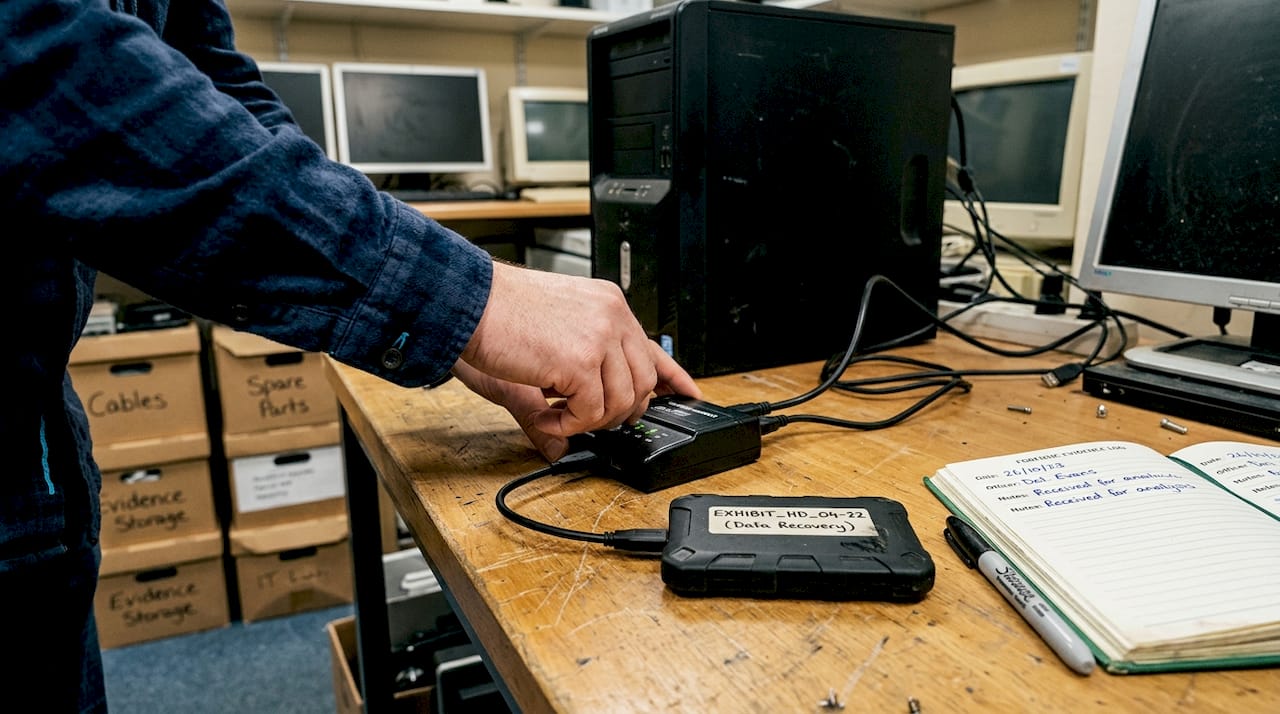
Forensic workstations provide the processing power needed for large-scale analysis. These systems feature multiple drive bays for simultaneous evidence processing, high-capacity RAM for in-memory analysis, and redundant storage for evidence copies. Portable forensic workstations enable on-site processing whilst maintaining laboratory capabilities. Specifications should include fast processors, 32GB+ RAM, and hardware RAID configurations.
Mobile device forensic hardware addresses the unique challenges of phone investigations. Faraday bags block wireless signals, preventing remote wipes and preserving evidence state. Specialised extraction hardware bypasses security features and accesses locked devices. JTAG and chip-off tools enable physical extraction when logical methods fail. These techniques require specialised training and carry risks of evidence damage.
Secure evidence transport options maintain chain of custody during physical transfer. Tamper-evident bags and containers provide visual indication of unauthorised access. Climate-controlled cases protect sensitive electronics during transport. GPS-tracked containers enable real-time location monitoring for high-value evidence.
Ensuring non-alteration during acquisition follows a systematic process:
- Photograph evidence in its discovered state before any handling
- Connect write-blocker between evidence storage and imaging system
- Verify write-blocker functionality using test procedures
- Create cryptographic hash of source media before imaging
- Perform forensic image acquisition using validated software
- Generate hash of acquired image and compare to source hash
- Document all actions, tools, and personnel in evidence log
- Store original evidence in secure, climate-controlled environment
Essential hardware components include:
- Hardware write-blockers for multiple interface types
- Forensic workstation with adequate processing capability
- Portable imaging devices for field acquisition
- Faraday bags and signal isolation equipment
- Secure storage containers with tamper evidence
- Backup power supplies for uninterrupted operations
- Cable and adapter collections for legacy devices
| Hardware type | Function | Critical feature | Investment priority |
|---|---|---|---|
| Write-blocker | Prevents modification | Interface coverage | Essential |
| Workstation | Analysis platform | Processing power | High |
| Mobile tools | Phone extraction | Device compatibility | Medium |
| Transport cases | Evidence security | Tamper evidence | Medium |
| Power backup | Continuous operation | Runtime capacity | Low |
Hardware investments should align with your investigation volume and device diversity. Start with essential write-blocking and basic workstation capabilities, then expand based on case requirements.
Comparing computer forensics tools for different investigative scenarios
Matching tools to investigation types maximises efficiency and ensures appropriate capability deployment. Different scenarios demand distinct technical approaches.
Corporate investigations typically involve employee misconduct, intellectual property theft, or policy violations. These cases require tools that handle email analysis, document forensics, and user activity reconstruction. EnCase and FTK suit corporate environments through their enterprise management features and detailed reporting. Speed matters less than thoroughness and documentation quality. Corporate investigators need tools that integrate with HR systems and produce reports suitable for internal disciplinary proceedings.
Law enforcement cases demand tools meeting strict evidentiary standards and supporting criminal prosecution. Selecting appropriate tools balances technical and legal factors across different case types. Police investigations often involve mobile devices, encrypted communications, and multi-device correlation. Cellebrite and Oxygen Forensics lead mobile extraction, whilst EnCase handles computer evidence. Law enforcement tools must generate reports satisfying disclosure requirements and withstand defence expert scrutiny.
Civil litigation forensics focuses on discovery, evidence preservation, and expert testimony support. These cases involve large data volumes requiring efficient processing and precise searching. Relativity and Nuix excel at eDiscovery with their scalable architectures. Civil cases prioritise cost management and proportionality, making tool efficiency crucial. Reports must satisfy court-ordered search terms and demonstrate reasonable search methodology.
Incident response investigations require rapid deployment and real-time analysis capabilities. Security teams need tools that capture volatile data, analyse malware, and reconstruct attack timelines. Volatility Framework and SIFT Workstation provide open-source incident response capabilities. Speed and automation take priority over exhaustive analysis. These tools integrate with SIEM platforms and threat intelligence feeds.
| Investigation type | Primary tools | Key requirement | Reporting focus |
|---|---|---|---|
| Corporate misconduct | EnCase, FTK | Thoroughness | Internal discipline |
| Criminal prosecution | Cellebrite, EnCase | Legal admissibility | Court evidence |
| Civil litigation | Relativity, Nuix | Volume handling | Discovery compliance |
| Incident response | Volatility, SIFT | Speed | Technical analysis |
| Fraud examination | ACL, IDEA | Data analytics | Financial patterns |
Budget considerations vary dramatically across contexts. Corporate teams might justify £50,000+ annual tool investments, whilst small practices require cost-effective solutions. Open-source tools like Autopsy and Sleuth Kit provide professional capabilities without licensing costs. However, commercial tools offer vendor support, regular updates, and established legal acceptance.
Tool combinations often outperform single-platform approaches. Use FTK Imager for acquisition, X-Ways for analysis, and specialised utilities for specific tasks like mobile extraction or email processing. This modular approach provides flexibility and enables cross-validation of findings.
Practical recommendations for selecting and deploying forensic tools
Successful forensic programmes combine appropriate tools with robust procedures and ongoing skill development. Implementation strategy matters as much as tool selection.
Establish clear protocols before deploying any forensic capability. Document your acquisition procedures, analysis workflows, and reporting standards. Create templates for evidence logs, chain of custody forms, and examination reports. Standard operating procedures ensure consistency across examiners and cases. Your protocols should reference specific tool versions and settings used for evidence processing.
Regular tool validation maintains credibility and identifies potential issues before they affect cases. Create reference data sets containing known files, deleted content, and various file systems. Process these test cases quarterly using your standard tools and procedures. Compare results against expected outcomes and document any discrepancies. Maintaining chain of custody and validation ensures findings withstand legal challenges.
Training investment pays dividends through improved efficiency and reduced errors. Vendor certifications demonstrate competency with specific platforms. General forensic certifications like EnCE or GCFA establish broader credibility. Attend conferences and workshops to learn emerging techniques and network with peers. Budget 40-80 hours annually per examiner for training and professional development.
Integrate forensic tools with case management systems to streamline workflows. Link evidence items to case files, track analysis progress, and generate status reports. Integration reduces administrative overhead and ensures documentation completeness. Cloud-based case management enables collaboration across distributed teams whilst maintaining security.
Budget planning should account for total cost of ownership beyond initial licensing. Include hardware refresh cycles, annual maintenance fees, training costs, and tool validation expenses. Plan for technology obsolescence by allocating funds for emerging capabilities like cloud forensics and IoT analysis. Small practices might spend £10,000-25,000 annually, whilst large teams require £100,000+ budgets.
Scalability considerations affect long-term tool viability. Cloud-based platforms offer elastic capacity but raise data sovereignty concerns. On-premises solutions provide control but require infrastructure investment. Hybrid approaches balance flexibility with security requirements. Evaluate whether tools support growing case volumes and team expansion.
Pro tip: Develop relationships with tool vendors and forensic communities. Vendor technical support resolves issues quickly, whilst peer networks provide practical guidance on challenging cases.
Implementation best practices include:
- Pilot new tools on closed cases before live deployment
- Maintain detailed tool validation documentation
- Create standard operating procedures for all forensic processes
- Implement peer review for significant findings
- Archive tool versions and validation records for historical cases
- Schedule regular training and skills assessment
- Monitor industry developments and emerging threats
- Participate in professional forensic organisations
Your forensic capability should evolve with technology and legal developments. Annual programme reviews identify gaps and improvement opportunities. Assess whether your tools and skills match current investigation demands.
Enhance your digital investigations with expert forensic services
Navigating the complex landscape of forensic tools and techniques becomes simpler with experienced guidance. Computer Forensics Lab provides comprehensive digital forensics services tailored to UK legal and security professionals. Our London-based team combines advanced forensic tools with deep investigative expertise across criminal, corporate, and civil matters.
We assist with evidence collection, data recovery, and analysis using industry-leading platforms and validated methodologies. Our expert witness services support litigation through detailed reports and court testimony. Whether you need mobile device extraction, email forensics, or complex data analysis, our specialists deliver results that withstand legal scrutiny. We understand the critical importance of preserving digital evidence integrity throughout investigations.
Our integrated approach ensures chain of custody essentials remain intact from initial seizure through final reporting. Contact us to discuss how our forensic capabilities can strengthen your investigations and provide the technical expertise your cases demand.
Frequently asked questions
What is the most important factor when selecting forensic tools?
Prioritise legal compliance with UK standards and evidence integrity preservation above all other factors. Tools must produce admissible evidence that withstands cross-examination. Technical capability means nothing if findings face exclusion due to methodology concerns. Verify that tools have documented validation and acceptance in UK courts.
Can these forensic tools be used for mobile device investigations?
Yes, specialised mobile forensics tools handle phones and tablets effectively. Platforms like Cellebrite and Oxygen Forensics support thousands of device models and extract data from various sources. However, mobile forensics requires specific training due to unique technical and legal challenges. Forensic data analysis techniques differ significantly between computers and mobile devices.
How can I maintain chain of custody during digital investigations?
Document every evidence handling step with detailed logs including dates, times, personnel, and actions performed. Use write-blockers during acquisition to prevent modification. Store evidence in secure, climate-controlled environments with access controls. Generate cryptographic hashes at multiple points to verify integrity. Follow chain of custody best practices consistently across all cases.
What training should forensic examiners undertake?
Pursue vendor-specific certifications for your primary tools combined with general forensic credentials like EnCE or GCFA. Attend regular workshops on emerging technologies and legal developments. Participate in practical exercises and peer review sessions. Budget 40-80 hours annually for professional development. Forensic compliance training ensures examiners understand both technical and legal requirements.
How much should organisations budget for forensic capabilities?
Small practices typically spend £10,000-25,000 annually covering basic tools, training, and hardware. Mid-sized teams require £50,000-100,000 for comprehensive capabilities. Large organisations with dedicated forensic units may invest £200,000+ including staff, advanced tools, and infrastructure. Consider total cost of ownership including maintenance, training, and validation expenses rather than just initial licensing costs.