
Investigating insider threats is not optional for any organisation that takes its legal obligations and operational continuity seriously. When an insider incident occurs, whether through malicious intent, negligence, or compromised credentials, a structured investigation limits financial loss, preserves evidence for regulatory reporting or litigation, and deters repeat behaviour. The NCSC and the ICO both expect organisations to understand the source and scope of incidents affecting personal data or national security interests. Without an investigation, you cannot contain the harm, attribute responsibility, or demonstrate compliance.
The core objectives of any insider threat investigation are:
- Contain the immediate risk and prevent further data loss or system damage
- Attribute the activity to a specific individual, system, or process
- Remediate the technical and procedural vulnerabilities that enabled the incident
- Learn from the incident to improve controls, policies, and awareness
Table of Contents
- What counts as an insider threat: types and examples
- Why organisations should investigate insider threats
- Common indicators, why detection is hard, and how to manage false positives
- How a typical insider threat investigation proceeds
- The multidisciplinary insider-threat team: roles and responsibilities
- How to prioritise incidents and when to escalate
- Measures that reduce the frequency and impact of insider incidents
- What professional digital forensics adds: evidence, admissibility and chain of custody
- Key takeaways
- The case for treating insider investigations as a board-level discipline
- When to contact Computerforensicslab and what to prepare first
- Further reading and authoritative UK sources
What counts as an insider threat: types and examples
CISA’s Insider Threat Mitigation Guide defines an insider as any person with authorised access to an organisation’s resources, including employees, contractors, business partners, and former staff whose access has not been fully revoked. The threat arises when that access is used, deliberately or inadvertently, to cause harm.
Three practical categories cover most cases:
Malicious insiders act with intent. A departing sales director who copies the entire client database to a personal cloud account before resigning is a clear example. Motivations include financial gain, grievance, espionage, or coercion by a third party.
Negligent insiders cause harm through carelessness rather than intent. A system administrator who misconfigures a cloud storage bucket, exposing sensitive records publicly, fits this category. Proofpoint’s research identifies negligent insiders as a major contributor to data loss, recommending threat modelling and targeted training as primary controls.
Compromised or third-party insiders arise when an external actor obtains valid credentials through phishing, social engineering, or collusion. A contractor whose laptop credentials are harvested by a criminal group, who then use those credentials to exfiltrate intellectual property, represents this type. The organisation’s systems record legitimate access throughout, making detection particularly difficult.
“Insider threats can cause harm through economic espionage, sabotage, workplace violence, fraud and other misuse of corporate resources. Insiders can also cause harm through simple negligence or carelessness.” — NITTF / DNI, Insider Threat Mitigation for US Critical Infrastructure
Why organisations should investigate insider threats
The business case for investigation rests on four categories of harm: financial loss, intellectual property theft, operational disruption, and reputational damage. Government best practice guides note that insider incidents have resulted in large financial and strategic losses and are consistently under-reported, meaning the true cost to organisations is higher than published figures suggest.
Statistic callout: Government best practice guidance confirms that insider incidents have produced losses reaching into the billions and remain among the most under-reported categories of organisational harm.
Beyond direct financial loss, the legal and regulatory drivers in the UK are specific and consequential:
- UK GDPR and the Data Protection Act 2018 require organisations to report personal data breaches to the ICO within 72 hours of becoming aware, where the breach is likely to result in risk to individuals. An investigation is the mechanism by which you establish whether that threshold is met.
- NCSC guidance on incident management expects organisations to be able to characterise an incident, identify affected systems, and take proportionate action. An undocumented insider incident leaves you unable to satisfy that expectation.
- Employment law in England and Wales requires that disciplinary action, including dismissal, follows a fair and evidence-based process. An investigation that produces documented, forensically sound evidence protects the organisation in any subsequent employment tribunal.
- Civil and criminal litigation depends on admissible evidence. Without a structured investigation, the evidence needed to pursue recovery of assets or to support a police referral may be lost or rendered inadmissible.
The secondary benefits are equally significant. Root-cause analysis from an investigation typically reveals the specific control failures that enabled the incident, whether a misconfigured access policy, an unmonitored privileged account, or a gap in offboarding procedures. Addressing those findings reduces the probability of recurrence. Security Magazine notes that many organisations rank insider threats low on their risk registers despite the fact that early behavioural signals often precede technical exfiltration. Organisations that investigate consistently report improved detection capability in subsequent incidents.
Common indicators, why detection is hard, and how to manage false positives
Detection is the first practical challenge. Authorised credentials and SaaS cloud use mean there is no perimeter breach to observe; the malicious or negligent action looks, at the network level, like normal work.

| Indicator category | Technical signals | Behavioural signals |
|---|---|---|
| Data movement | Large or unusual file transfers, bulk downloads, USB device use outside policy | Requests for access beyond job role, copying data before resignation |
| Access patterns | Logins outside normal hours, access to systems unrelated to role, repeated failed authentication | Unexplained interest in colleagues’ work or restricted areas |
| Endpoint activity | Installation of unapproved applications, use of personal cloud sync tools, disabling of endpoint controls | Reluctance to share screen, working in isolation on sensitive tasks |
| Financial and personal | Unexplained affluence, financial distress, undisclosed outside employment | Expressed grievances, recent disciplinary action, notice of resignation |
The DCSA Potential Risk Indicators guide is explicit: indicators are signals, not proof. A single anomalous file transfer may reflect a legitimate project. Financial stress is common and rarely connected to insider activity. The risk of acting on a single indicator is both a false positive and a potential breach of UK GDPR if monitoring activity is disproportionate.
The practical approach is contextual enrichment: correlate technical signals with behavioural observations, apply a structured triage, and escalate only when multiple independent indicators align. A focused triage model, starting with business impact and corroborating multiple indicator types, reduces investigator workload and improves detection precision compared with broad, undifferentiated monitoring.
Pro Tip: Never open a formal investigation on the basis of a single technical alert. Require at least two independent indicator categories, one technical and one behavioural or contextual, before escalating to a formal case. This protects both the organisation and the individual under UK data protection law.
How a typical insider threat investigation proceeds
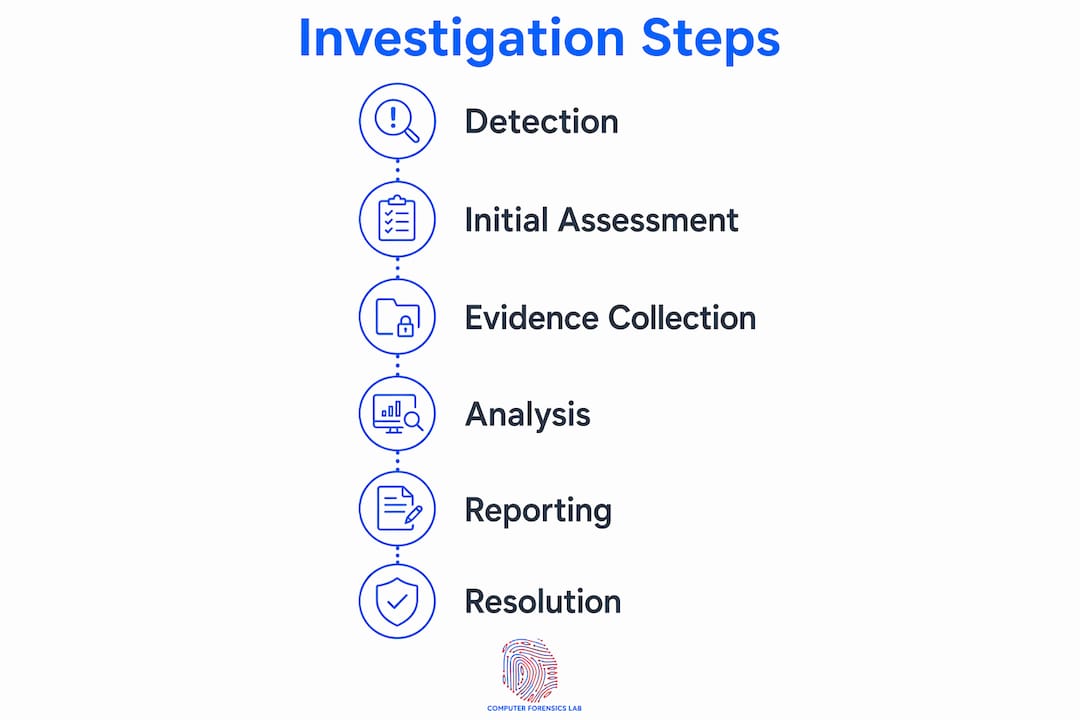
CISA frames insider threat mitigation around four core steps: define, detect and identify, assess, and manage. In practice, a UK investigation follows a more granular sequence.
Investigation steps
- Initial report and triage. A concern is raised, either through a technical alert, a manager report, or an HR referral. The triage team assesses severity, identifies the systems and data potentially affected, and decides whether to open a formal investigation or monitor.
- Evidence preservation. Before any device is touched or account suspended, preserve volatile data: active network connections, running processes, and system logs. Disk images should be taken using forensically sound acquisition methods. Suspending an account before imaging can destroy evidence.
- Technical analysis. Examine preserved images, log files, email records, and cloud activity. Reconstruct a timeline of events. Identify what data was accessed, copied, or transmitted, and to where.
- Interviews and contextual assessment. HR and legal counsel conduct structured interviews with the individual and relevant witnesses. Technical findings are contextualised against the individual’s role, access rights, and stated explanations.
- Action and closure. Depending on findings: disciplinary action, civil or criminal referral, regulatory notification, or closure with remediation. A formal investigation report is produced, documenting methodology, findings, and recommendations.
Timelines and cost drivers
Low-severity cases, such as a single misdirected email or a minor policy breach, can typically be resolved within one to two weeks. Medium-severity cases involving potential data exfiltration or IP theft usually require four to eight weeks, depending on data volume and the number of devices involved. High-severity cases, particularly those with cross-jurisdictional elements, active exfiltration, or potential criminal referral, may run for several months.
The primary cost drivers are data volume, the number of custodians, the need for specialist forensic equipment, and whether the evidence must meet the standard required for court proceedings. In-house teams can handle lower-severity cases where the evidentiary bar is limited to internal disciplinary proceedings. External forensic specialists become necessary when the case may proceed to litigation, regulatory scrutiny, or criminal prosecution, because forensic evidence is only admissible if chain of custody and forensically sound acquisition methods were used; delayed or ad hoc collection frequently weakens the evidential position.
Statistic callout: Government guidance confirms insider incidents are among the categories of organisational harm that are under-reported, meaning organisations that do not investigate are almost certainly underestimating their exposure.
UK legal checklist for investigators
- Confirm the legal basis for monitoring and data processing under UK GDPR before collecting evidence
- Check whether the investigation triggers a 72-hour ICO notification obligation
- Obtain legal sign-off before interviewing the subject
- Document chain of custody for every device and data source from the moment of preservation
- Assess whether the matter should be referred to the police or the National Crime Agency
The multidisciplinary insider-threat team: roles and responsibilities
CISA’s guidance is unambiguous: insider threat investigations work best when run by a multidisciplinary team that includes HR, legal counsel, and business leaders alongside security. A purely technical investigation misses context; a purely HR-led process misses evidence.

| Role | Primary responsibilities | Authority |
|---|---|---|
| Security / incident response | Evidence preservation, technical analysis, log review, timeline reconstruction | Initiates technical containment |
| HR | Contextual assessment, structured interviews, disciplinary process | Approves interview conduct |
| Legal counsel | UK GDPR compliance, employment law advice, litigation readiness | Approves regulatory notifications and external referrals |
| IT | System access management, account suspension timing, log retrieval | Executes technical instructions from security lead |
| Business owner | Identifies crown jewels, assesses operational impact, confirms data classification | Defines scope of harm |
| Information governance | Data protection impact assessment, ICO liaison | Owns regulatory notification decision |
| Executive sponsor | Resource allocation, external communications, board reporting | Authorises escalation to law enforcement |
Escalation to legal or law enforcement referral is triggered when: the investigation reveals evidence of criminal activity; the data involved includes personal data of third parties requiring ICO notification; the individual poses an ongoing safety risk; or the financial or reputational exposure exceeds the organisation’s internal resolution capacity.
For guidance on managing stakeholder communications throughout an investigation, Silverstone Investigations’ client management guidance offers practical framing that complements the forensic process.
The role of cyber incident response in legal cases is particularly relevant here: legal teams need to be involved from the outset, not brought in after the technical work is complete, because decisions made in the first hours of an investigation directly affect what evidence is usable in proceedings.
How to prioritise incidents and when to escalate
Not every indicator warrants a full investigation. Scarce investigative resources must be directed at cases where the potential harm is greatest and the evidence of intent or impact is strongest.
Triage criteria:
- Does the activity involve the organisation’s most sensitive assets (intellectual property, personal data, financial systems, critical infrastructure)?
- Are there indicators of deliberate intent rather than negligence (data staging, use of personal devices, counter-forensic activity such as file deletion)?
- What is the scale of potential data exposure: a single document or a bulk export?
- Is there evidence of exfiltration to an external destination, or is the activity contained within internal systems?
Red flags requiring immediate escalation:
- Active exfiltration in progress or evidence of data already leaving the organisation
- Any indication of a safety risk to individuals
- Cross-border data transfer involving personal data, triggering UK GDPR international transfer obligations
- Evidence of collusion with an external party, including a competitor or foreign entity
- The individual has already resigned or been dismissed and still has active access
Decision framework:
- Investigate now: multiple corroborating indicators, crown jewel data involved, evidence of intent or active exfiltration
- Monitor with enhanced logging: single indicator, no confirmed data movement, legitimate explanation plausible
- Close with remediation: indicator explained by context, no evidence of harm, control gap identified and addressed
Pro Tip: When an employee gives notice, run an immediate access audit and check for anomalous data movement in the 30 days prior to resignation. The period immediately before departure is the highest-risk window for deliberate data theft, and early detection preserves the evidence needed for any subsequent action.
Measures that reduce the frequency and impact of insider incidents
Prevention reduces the investigation workload over time. The most effective controls address both technical exposure and the human factors that precede incidents.
Technical controls:
- Least-privilege access: users should have access only to the data and systems their role requires, reviewed quarterly
- Data classification: label sensitive assets so that DLP (data loss prevention) tools can apply appropriate controls automatically
- User behaviour analytics (UBA): baseline normal activity per user and alert on statistically significant deviations
- Segmented access: separate crown jewel systems from general network access, requiring additional authentication
- Endpoint hygiene: disable USB ports by policy where not required, monitor personal cloud sync applications
- Managed offboarding: revoke all access on the day of departure, not days later
Organisational measures:
- Awareness campaigns that explain what constitutes a policy violation and why data protection matters
- A confidential reporting mechanism so colleagues can raise concerns without fear of retaliation
- Fair and consistent grievance handling, since unresolved grievances are a documented precursor to malicious insider activity
Implementation priority: start with crown jewels. Identify the five to ten data sets or systems whose compromise would cause the most harm, and apply the strongest controls there first. Quick wins include enforcing MFA on all privileged accounts and auditing stale access rights, both of which can be completed within days and materially reduce exposure.
Pro Tip: The insider misconduct investigation guide from Computerforensicslab covers the specific UK employment law requirements that must be met for disciplinary action to be defensible. Reviewing it before an incident occurs means your policies are already aligned when you need them.
What professional digital forensics adds: evidence, admissibility and chain of custody
The difference between an internal investigation and a professionally conducted forensic investigation is not just technical capability; it is the legal weight of the output. Forensic evidence is only admissible if chain of custody and forensically sound acquisition methods were used throughout. An internal IT team that copies files to a shared drive, or suspends an account before imaging the device, may inadvertently destroy the very evidence the organisation needs.
A professional digital forensics engagement delivers specific, documented outputs:
- Forensically sound disk images acquired using write-blocking hardware, with cryptographic hash verification to prove integrity
- Deleted data recovery from devices, cloud accounts, and communication platforms, recovering artefacts the subject believed were gone
- Timeline reconstruction mapping every relevant file access, transfer, and deletion to a precise timestamp
- Expert witness reports prepared to the standard required by UK courts, including Civil Procedure Rules Part 35 compliance where relevant
The digital forensics compliance guidance from Computerforensicslab sets out the specific standards that apply in UK legal contexts. Chain of custody documentation must begin at the moment of seizure and account for every person who has handled the evidence and every system it has passed through.
What to ask an external forensics provider before engaging:
- Do you use write-blocking hardware and cryptographic hashing for all acquisitions?
- Can you produce an expert witness report compliant with CPR Part 35?
- What is your experience with UK employment tribunal and High Court proceedings?
- How do you handle UK GDPR obligations during evidence collection?
- What is your typical turnaround for a case of this scope?
Early engagement matters. Computerforensicslab’s investigation guidance confirms that early forensic involvement preserves evidence and speeds admissible outcomes; organisations that call in specialists after an internal team has already handled devices frequently face a weaker evidential position.
Pro Tip: Do not suspend the subject’s account before a forensic image of their device and cloud accounts has been taken. Account suspension triggers automatic deletion processes in many platforms and can permanently destroy evidence of exfiltration routes.
Key takeaways
Investigating insider threats protects your organisation’s assets, satisfies UK regulatory obligations, and produces the evidence base needed for disciplinary action, litigation, or regulatory defence.
| Point | Details |
|---|---|
| Investigate every credible incident | Without investigation, you cannot contain harm, attribute responsibility, or demonstrate ICO compliance. |
| Use a multidisciplinary team | Security, HR, legal, and business owners must all be involved from the outset to preserve context and legal defensibility. |
| Preserve evidence before acting | Forensically sound acquisition before any account suspension or device handling is the single most critical step. |
| Prioritise crown jewels | Direct triage and investigative resources at the data and systems whose compromise causes the most harm. |
| Engage Computerforensicslab early | Early forensic engagement preserves admissible evidence and reduces the risk of procedural errors that weaken legal outcomes. |
The case for treating insider investigations as a board-level discipline
The conventional view in many organisations is that insider threats are an IT problem, escalated to HR when a name is attached. That framing consistently produces worse outcomes. By the time a case reaches the board, the evidence has often been mishandled, the regulatory clock has been running unnoticed, and the organisation’s legal position has been weakened by decisions made without legal counsel present.
The more defensible position is to treat insider threat investigation as a board-level governance discipline from the outset. This means having a documented response plan before an incident occurs, knowing which external specialists to call and when, and understanding that the 72-hour ICO notification window does not pause while internal teams decide whether something is serious enough to escalate.
The pitfall seen most often in practice is the instinct to resolve matters quietly and internally. That instinct is understandable but frequently counterproductive. An undocumented internal resolution that later surfaces in litigation, or a data breach that was never notified to the ICO, creates far greater exposure than a properly managed investigation would have. The organisations that handle these cases best are those that treat the investigation process with the same rigour they would apply to any other regulated activity.
When to contact Computerforensicslab and what to prepare first
Computerforensicslab provides digital forensic investigation services from its London base, working with organisations across the UK on insider threat cases that range from employee data theft to IP exfiltration and sabotage. The practical advantage of early engagement is straightforward: forensic specialists can preserve evidence correctly from the first moment, avoiding the procedural errors that weaken legal and regulatory outcomes.
Before making contact, prepare the following:
- A list of devices and accounts potentially involved, including personal devices if relevant
- Recent access logs or SIEM alerts that triggered the concern
- The individual’s role, access rights, and employment status
- Any HR facts relevant to the timeline (resignation date, disciplinary history, recent access requests)
- A clear statement of the scope: what data or systems are involved and what harm is suspected
All engagements are conducted under strict confidentiality obligations and in compliance with UK GDPR and the Data Protection Act 2018. Computerforensicslab’s digital forensics services cover evidence collection, data recovery, timeline reconstruction, and expert witness reporting, providing everything required to support disciplinary proceedings, regulatory notification, or litigation. Contact the team as early as possible in the process; the sooner forensic discipline is applied, the stronger the evidential position.
Further reading and authoritative UK sources
- NCSC Incident Management guidance — UK government guidance on responding to cyber incidents, including insider-related events
- ICO guidance on personal data breaches — notification obligations and thresholds under UK GDPR
- CISA Insider Threat Mitigation — operational frameworks for detection, assessment, and management
- NPSA Insider Risk Guidance — UK-specific guidance from the National Protective Security Authority
- NITTF Government Best Practices Guide — authoritative standards for insider threat programme design
- Computerforensicslab: how to investigate insider threats — practical UK-focused investigation guidance and forensic services
- Silverstone Investigations: investigative insights — complementary operational and investigative process guidance
This article provides general information for security professionals and organisational leaders. It does not constitute legal advice. Organisations should confirm their specific obligations with qualified legal counsel and consult the ICO and NCSC directly for current regulatory requirements.