TL;DR:
- Digital evidence must be handled according to UK forensic best practices to ensure its legal admissibility. These standards, rooted in ACPO principles and ISO/IEC 17025 accreditation, emphasize integrity, competence, and reproducibility throughout the investigation process. Proper compliance significantly reduces risks of evidence exclusion and strengthens case credibility in court proceedings.
Digital evidence does not speak for itself. Many legal professionals, compliance officers, and law enforcement teams assume that recovering data from a device is enough, but UK courts apply strict standards that can render even genuine evidence worthless if it has been handled incorrectly. Understanding why follow forensic best practices is not a procedural nicety but a legal necessity that directly determines whether your investigation succeeds or collapses. This guide explains the principles, the pitfalls, and the practical steps that protect your case from the first point of seizure to the final courtroom submission.
Table of Contents
- Understanding forensic best practices and their legal foundation
- How forensic best practices protect evidence integrity and admissibility
- The crucial role of ISO/IEC 17025 accreditation in forensic best practices
- Common misconceptions and pitfalls in forensic evidence handling
- Practical steps to ensure forensic best practices in your investigations
- Why forensic best practices often remain misunderstood and how to change that
- How Computer Forensics Lab supports your forensic best practice compliance
- Frequently asked questions
Understanding forensic best practices and their legal foundation
In the UK, digital forensics best practices are anchored to a well-established legal framework. The foundation is the ACPO (Association of Chief Police Officers) Good Practice Guide for Digital Evidence, and its four core principles apply to anyone handling digital evidence, not just police officers. These forensic compliance legal principles set the minimum standard for courts to treat evidence as credible.
The four ACPO principles are foundational for digital evidence integrity in UK courts:
- Principle 1: No action taken should change data held on a digital device that may subsequently be relied upon in court. This means forensic images must be created before any analysis begins.
- Principle 2: Access to original data must only be performed by a competent person, who can explain their actions and their relevance to the investigation. Competence here is formal, not assumed.
- Principle 3: An audit trail must be created and preserved, recording all processes applied to digital evidence. A third party must be able to examine those records and reach the same conclusions.
- Principle 4: The person leading the investigation bears overall responsibility for ensuring the above principles are followed throughout.
What makes Principle 2 particularly important for corporate clients and legal teams is that competence is not self-certified. An IT administrator who mirrors a drive using standard Windows tools is not a forensically competent operator under this framework. The legal considerations in digital forensics in the UK require that the person accessing evidence can articulate every step, tool, and decision in a format the court can scrutinise.
How forensic best practices protect evidence integrity and admissibility
The practical consequences of following, or failing to follow, these standards are significant. Courts do not simply ask whether evidence exists. They ask whether the evidence is reliable, and the mechanism for answering that question is reproducibility.
Reproducibility by an independent third party is the legal test for digital evidence, not just documentation. In practice, that means another qualified examiner must be able to review your audit trail, apply the same methods, and arrive at the same findings without ever touching the original device. If that is not possible, the evidence’s weight diminishes sharply.
Here are the most common failure points that undermine digital evidence in court:
- Broken chain of custody. If you cannot demonstrate who had access to a device and when, the opposing side will argue the data could have been altered.
- Unqualified operators. Evidence accessed or processed by someone without documented forensic competence will face credibility challenges during cross-examination.
- Missing or incomplete audit trails. Without a full log of processes, tools, and decisions, reproducibility is impossible and the court may exclude the evidence entirely.
- Use of unvalidated tools. Commercial or open-source software used without validation records undermines the reliability of the findings produced.
- Failure to image before analysis. Accessing original data directly risks altering metadata, timestamps, and file structures, often invisibly.
The consequences range from reduced evidential weight, where the judge instructs the jury to treat the evidence with caution, to outright exclusion. In corporate litigation, this can mean losing a claim worth millions. In criminal matters, it can mean a prosecution collapses entirely.
Pro Tip: Establish your chain of custody for digital evidence from the moment a device is identified, not from when forensic examination begins. Every gap in that record is a vulnerability a defence team will exploit.
The crucial role of ISO/IEC 17025 accreditation in forensic best practices
Beyond the ACPO framework, accredited forensic laboratories operate under ISO/IEC 17025, the international standard for testing and calibration laboratories. ISO/IEC 17025 accreditation ensures labs maintain technical competence, quality management, and process reliability in digital forensics, offering a layer of assurance that internal IT teams simply cannot replicate.
Key elements that ISO/IEC 17025 requires in a forensic context include:
- Personnel training and documented competency assessments for every examiner
- Validation records for all forensic tools and software, including version control
- Documented quality management processes, covering how non-conformances are identified and resolved
- Internal audits and management reviews to ensure continuous improvement
- Clear, detailed reporting standards that make findings accessible and defensible in court
The table below summarises the key requirements under each framework and how they relate to evidence admissibility:
| Requirement | ACPO principles | ISO/IEC 17025 |
|---|---|---|
| No alteration of original data | Principle 1 | Procedural controls and tool validation |
| Operator competence | Principle 2 | Documented training and assessment |
| Reproducible audit trail | Principle 3 | Quality management and process records |
| Overall responsibility | Principle 4 | Management review and accountability |
| Tool reliability | Implied by competence | Mandatory validation and calibration |

Accreditation does not make evidence bulletproof, but it shifts the burden significantly. When a forensic provider can demonstrate ISO/IEC 17025-aligned processes, the court has an independent quality benchmark to rely on. This is particularly relevant for digital forensic methods that involve advanced techniques such as deleted file recovery, mobile extraction, or cloud data acquisition, where tool reliability is routinely challenged.
Pro Tip: When instructing a forensic provider, ask specifically for their tool validation records and accreditation certificates. If they cannot produce both, that gap will likely surface during expert witness scrutiny, not before it. Knowing how to secure digital evidence begins with choosing the right partner.
Common misconceptions and pitfalls in forensic evidence handling
Even experienced legal teams carry assumptions about digital evidence that simply do not hold in court. The most persistent is that digital devices are self-authenticating. They are not.
Common failures include unverified screenshots, broken chain of custody, lack of competence, and over-reliance on the computer’s presumed accuracy. In practice, this plays out in several recognisable patterns:
- Screenshots treated as evidence. A screenshot shows what someone claims appeared on screen. Without metadata, hash verification, and a clear acquisition record, it proves nothing independently.
- IT staff conducting forensic analysis. A competent network engineer is not automatically a forensically competent examiner. The skill sets and legal requirements are distinct.
- Assuming timestamps are reliable. System clocks can be wrong, manipulated, or misinterpreted across time zones. Forensic examiners account for this; standard IT staff typically do not.
- No formal seizure record. Many organisations simply pick up a device and send it for analysis, with no written record of its condition, location, or who authorised the seizure.
- Witness competence overlooked. If a member of staff is likely to give evidence about digital activity, their competence and the process they followed will be scrutinised directly.
Pro Tip: For corporate investigations involving employee misconduct or IP theft, document your essential digital evidence handling procedures before an incident occurs. A policy written in the middle of a crisis will contain the gaps that matter most.
Practical steps to ensure forensic best practices in your investigations
Knowing the principles is one thing. Applying them under pressure, when an employee has just been suspended or a breach has just been discovered, requires preparation. Here is how to build that preparation into your process.
The person leading the investigation holds overall responsibility for adherence to forensic best practices and must ensure all participants understand and comply. That is not a delegable function. Leadership accountability is built into the framework by design.
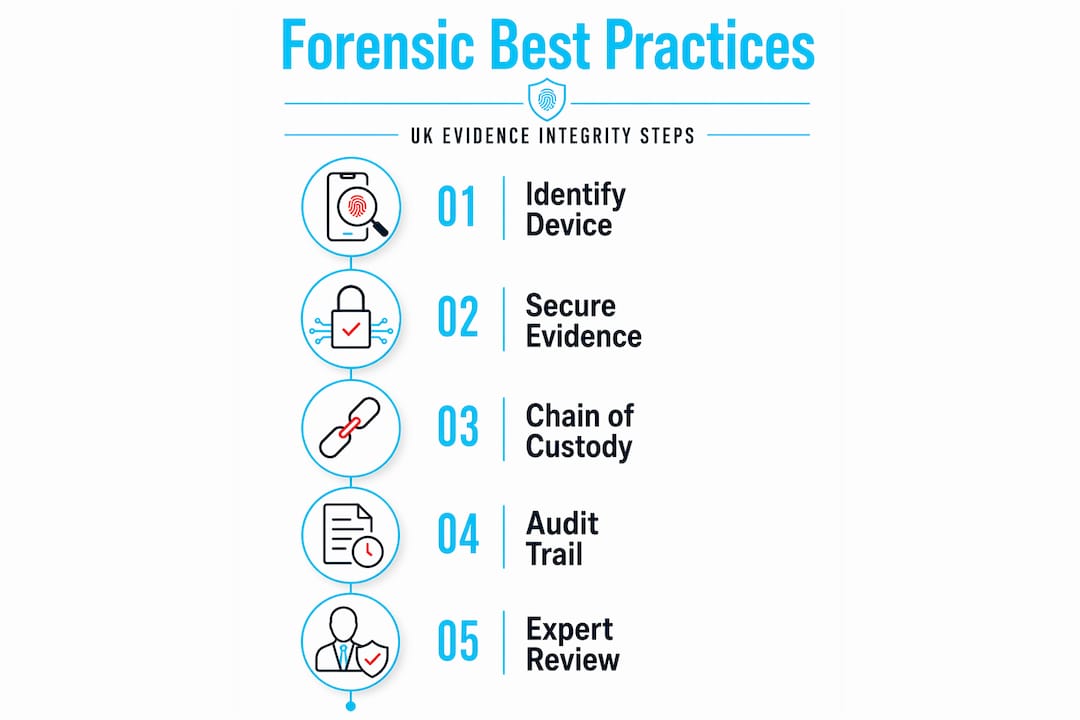
Step-by-step approach for maintaining forensic best practices:
- Appoint a named investigation lead before any device is touched. This person is accountable for compliance with all four ACPO principles throughout.
- Immediately isolate the device or data source. No logins, no remote wipes, no “quick checks.” Secure the environment first.
- Commission forensic imaging by a qualified examiner before any analysis takes place. Retain the original device separately.
- Log every action in real time, including who did what, which tools were used, and what the purpose of each step was.
- Instruct an accredited forensic provider for analysis, particularly if court proceedings are anticipated. Ensure they can provide expert witness support if required.
- Prepare for cross-examination. The role of the expert witness in digital forensics includes explaining every decision made during the investigation to a sceptical court. Your documentation must support that narrative.
Additionally, maintain these ongoing practices:
- Review and update your internal forensic handling policies annually
- Train relevant staff on what not to do when a device is flagged as potential evidence
- Maintain a list of accredited forensic providers you can instruct without delay
- Ensure your legal team understands what digital evidence collection requires before a matter reaches litigation
Why forensic best practices often remain misunderstood and how to change that
After working with legal teams, law enforcement agencies, and corporate clients across a range of investigations, one pattern appears consistently. The problem is rarely a lack of expertise. It is a lack of clarity about who owns the responsibility for forensic compliance.
Organisations often assume that forensic rigour is the examiner’s problem. The examiner takes the device, does their work, and delivers a report. What happens before the examiner arrives, the conversations, the access, the assumptions made by HR or IT, is treated as outside the forensic scope. It is not. The forensic compliance responsibility begins the moment a potential evidential source is identified, and it sits with the investigation lead, not the technical specialist.
There is also a cultural assumption, particularly in corporate settings, that internal processes are good enough because they have never been challenged. That is not evidence of compliance. It is evidence that you have not yet faced serious legal scrutiny. When you do, the absence of a proper audit trail, the use of an unvalidated tool, or a casual handoff between departments will surface immediately.
The fix is not complicated, but it does require commitment. Legal professionals who champion forensic rigour internally, who ask the right questions before a device is touched and who insist on accredited providers, create a measurable advantage in litigation. They reduce the risk of exclusion, reduce the cost of challenges, and reduce the likelihood that a strong factual case is lost to a procedural failure. In our experience, the cases that fail forensically almost never fail because the evidence was not there. They fail because no one treated its integrity as their personal responsibility from the start.
How Computer Forensics Lab supports your forensic best practice compliance
Computer Forensics Lab works with solicitors, barristers, law enforcement teams, and corporate compliance officers across the UK to deliver investigations that hold up to the strictest legal scrutiny. Our processes are aligned with ACPO principles and ISO/IEC 17025 quality standards, covering everything from initial evidence collection through to expert witness reporting. Every case includes a complete, reproducible audit trail and documented chain of custody so that nothing you present to a court can be credibly challenged on process grounds. Whether you need forensic data analysis for a dispute, support with a regulatory investigation, or urgent assistance following a data breach, our digital forensics services are structured to move quickly without compromising rigour. Contact us to discuss your matter in confidence.
Frequently asked questions
What are the four ACPO principles in digital forensics?
They are: no alteration of original data, access only by competent persons, creation of a reproducible audit trail, and overall responsibility held by the person leading the investigation. The four ACPO principles remain the foundational standard for digital evidence integrity in UK courts.
Why is reproducibility important in forensic investigations?
Reproducibility allows an independent expert to examine the audit trail and reach the same conclusions without accessing the original device, which is the practical proof that evidence has not been altered. Reproducibility is the legal test, not mere documentation, for digital evidence admissibility in UK proceedings.
What risks arise from not following forensic best practices?
Risks include evidence being given reduced weight, exclusion from court proceedings, increased legal costs, and case collapse. Consequences of breaches range from reduced evidential weight to complete exclusion and reputational damage for the organisations involved.
How does ISO/IEC 17025 accreditation benefit forensic investigations?
It ensures forensic laboratories maintain documented competence, use validated methods, and follow quality-controlled processes, all of which strengthen the reliability and court acceptance of findings. ISO/IEC 17025 accreditation demonstrates laboratory competence and reliable forensic practices to an internationally recognised standard.
Who is responsible for ensuring forensic best practices during an investigation?
The person leading the investigation, whether that is a compliance officer, solicitor, or head of legal, holds overall responsibility for ensuring all principles are followed. Overall responsibility for ensuring forensic principles are followed rests with the investigation lead, not the technical examiner.