
TL;DR:
- Encryption analysis uses forensic methods to recover or infer information from encrypted data and traffic.
- In the UK, traffic inference methods tend to be more productive than attempting direct cryptanalysis against modern algorithms.
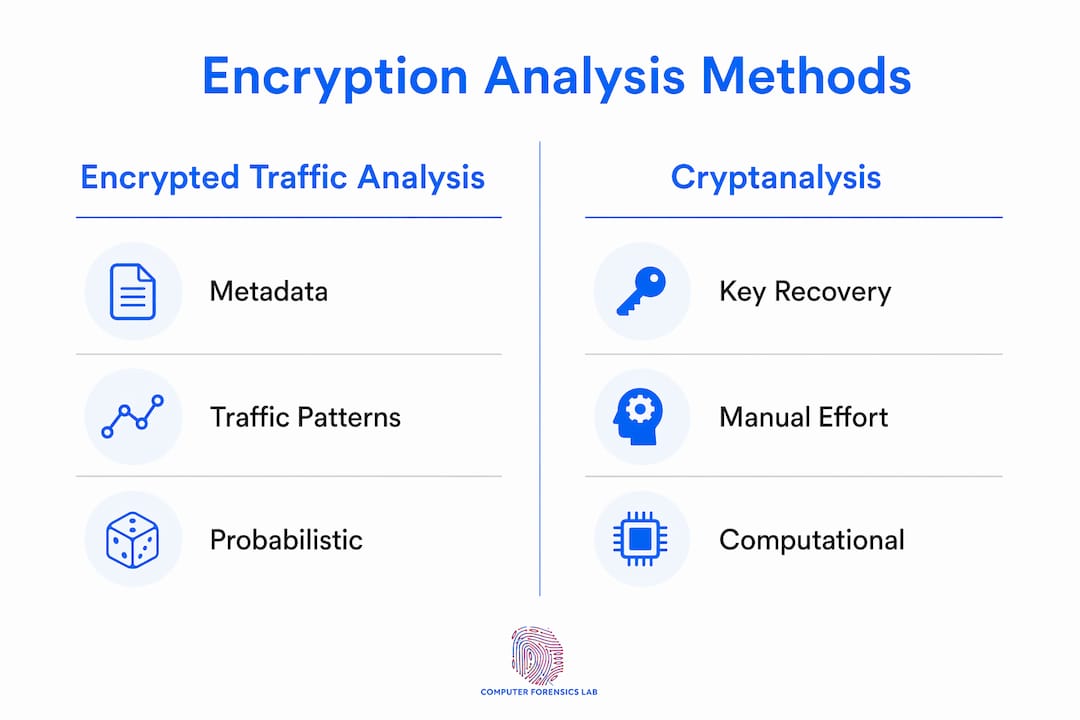
Encryption analysis is the set of forensic methods used to identify, classify, and, where feasible, recover or infer information from encrypted data or encrypted network traffic. For UK investigators and legal professionals, it divides into two principal methodologies: mathematical cryptanalysis, which attempts to break or partially recover keys through algorithmic means, and encrypted traffic analysis (ETA), which infers application type, user behaviour, and file activity from observable metadata without decrypting payloads. In practice, ETA is far more frequently productive in forensic casework. ENISA and the NCSC both publish guidance that shapes how these methods are applied in European and UK contexts; Computerforensicslab operates as a specialist practitioner within this framework, providing expert witness reports and court-ready analysis.
Encryption analysis is most likely to assist a UK investigation when:
- Key material is recoverable from memory, backups, or misconfigured key stores
- Metadata and traffic inference can establish user behaviour or application use without full decryption
- Lawful compelled disclosure under the Investigatory Powers Act is a viable route
- Deployment weaknesses (poor key management, insecure backups) offer a practical avenue
Table of Contents
- What is encryption analysis, and which methodology applies to your case?
- What forensic outcomes can you realistically expect?
- How does a UK forensic workflow proceed from authority to report?
- Which tools are used in UK encryption analysis practice?
- What UK legal and ethical constraints govern encryption analysis?
- How should you present encryption analysis findings in court?
- Key takeaways
- A practitioner’s perspective on what encryption analysis actually delivers
- When to commission a specialist lab for encryption analysis
- Primary references and further reading
What is encryption analysis, and which methodology applies to your case?
Forensic encryption analysis divides cleanly into two methodologies with very different practical profiles.
Mathematical cryptanalysis targets the algorithm or its implementation directly. According to OWASP’s cryptanalysis taxonomy, the goals range from a total break (full key recovery) through global deduction (finding an equivalent key), information deduction (recovering partial plaintext), to simply distinguishing ciphertext from random data. Attack models include ciphertext-only, known-plaintext, chosen-plaintext, and differential attacks, each requiring different data from the investigator. Side-channel and implementation attacks extend this further, targeting physical or operational weaknesses rather than the cipher’s mathematics. Against well-designed modern algorithms such as AES-256 or ChaCha20, a pure mathematical break is not a realistic forensic objective.
Encrypted traffic analysis takes a different route entirely. Rather than attacking the cipher, ETA extracts features from packet headers, TLS handshakes, timing patterns, and payload byte distributions to classify traffic, identify applications, and infer user activity. Machine-learning classifiers and fingerprint databases can map encrypted flows to specific web pages, file types, or video content without ever touching the key.
Practitioners should prioritise analysing how cryptography is deployed in the wild, since sociotechnical misconfigurations yield exploitable weaknesses far more reliably than attacking the underlying mathematics of modern ciphers.
Pro Tip: Before committing resources to any cryptanalytic attempt, map the deployment: examine key storage locations, backup configurations, and access controls. The weakness is almost always there, not in the algorithm.
What forensic outcomes can you realistically expect?
The possible results of encryption analysis, ordered from most to least achievable in modern casework, are:
- Total break / key recovery: Rare against correctly implemented modern ciphers, but achievable when keys are stored alongside ciphertext, cached in memory, or recoverable from backups.
- Global deduction: Finding a functionally equivalent key through implementation flaws or side-channel leakage; uncommon but documented in legacy systems.
- Information deduction: Recovering partial plaintext, query patterns, or metadata fragments. Leakage cryptanalysis of searchable encryption schemes, for example, can reconstruct query content from access patterns alone.
- Traffic labelling and application identification: ETA can infer application type and user behaviour from metadata even when payloads remain fully encrypted. This is the most consistently productive outcome in network-based investigations.
- Distinguishing ciphertext from random data: Confirms that encryption is present and may indicate the algorithm family, supporting case narrative even without decryption.
Timeline expectations matter for case planning. Metadata inference from captured traffic can yield results quickly. Password-cracking campaigns against recovered hashes may run for varying durations depending on hash type and available GPU resource. Full key recovery from memory artefacts, when possible, is typically resolved within a few days. Algorithmic cryptanalysis of a modern cipher is not a realistic timeline for any live investigation.
How does a UK forensic workflow proceed from authority to report?
A legally sound workflow must begin before any technical action is taken.
- Obtain lawful authority. Secure a PACE warrant, Investigatory Powers Act authorisation, or equivalent legal basis before capturing or analysing any data. Identify disclosure obligations and consult counsel on proportionality. Document the legal authority in the case file.
- Capture and image evidence. Create forensically sound images of storage media using write-blockers. Preserve chain of custody with hash manifests (SHA-256 or better) at acquisition. Separate key stores from ciphertext where possible to prevent contamination.
- Capture volatile artefacts. Acquire live RAM before powering down any device; memory may contain decryption keys, session tokens, or key caches. Record TPM state and note any device-specific behaviours that affect key recovery.
- Collect network traffic. Capture pcap files for ETA. Record TLS handshake data, JA3/JA3S fingerprints, and timing metadata. Tools such as Wireshark and Zeek are appropriate at this stage.
- Triage for key material and misconfigurations. Examine backup files, configuration directories, and cloud-hosted key stores. Key management failures — keys stored alongside data, insecure backups, poor separation of duties — are the most common forensic opportunity.
- Run targeted cracking only when justified. Apply Hashcat or John the Ripper to recovered password hashes where the evidential value justifies the resource cost. Log all commands, wordlists, and rule sets used.
- Perform ETA and metadata analysis. Use Zeek, Arkime, or Wireshark to extract traffic features and apply fingerprinting or ML classification. Document model versions and dataset provenance.
- Compile findings and prepare the report. Record all steps, tool versions, hash values, and conclusions with appropriate uncertainty language for probabilistic inferences.
Pro Tip: Capture volatile artefacts first, every time. RAM acquisition is time-critical and irreversible; a powered-down device may destroy the only available key material.
For cloud-hosted evidence, the challenges specific to cloud forensics introduce additional jurisdictional and access considerations that should be addressed at the authorisation stage.
Which tools are used in UK encryption analysis practice?
Core tools and their forensic roles
ETA and cryptanalytic work each draw on a distinct toolset. The table below maps the principal tools to their forensic purpose.

| Tool | Primary purpose | Typical use case | Evidence types | Labour profile |
|---|---|---|---|---|
| Wireshark | Packet capture and protocol dissection | TLS handshake inspection, traffic triage | pcap, TLS metadata | Low to medium |
| Zeek | Network traffic analysis and logging | Feature extraction, JA3 fingerprinting, flow logs | Logs, connection records | Medium |
| Arkime | Full-packet indexing and search | Long-term traffic retention, session reconstruction | pcap, indexed metadata | Medium to high |
| Hashcat | GPU-accelerated password cracking | Hash recovery from seized devices | Password hashes | High (GPU-intensive) |
| John the Ripper | Password and hash cracking | Offline cracking, format-wide hash support | Password hashes, key files | Medium to high |
| X-Ways Forensics | Disk and file system forensics | Encrypted volume identification, artefact recovery | Disk images, file systems | Medium |
| EnCase | Enterprise forensic acquisition | Court-ready imaging, case management | Disk images, reports | Medium |
| Cellebrite | Mobile device acquisition | Encrypted mobile data extraction, app artefacts | Mobile images, app data | Low to medium |
Additional techniques include:
- JA3/JA3S fingerprinting: Generates a hash of TLS ClientHello and ServerHello parameters, enabling identification of client software or malware families without decryption.
- Traffic fingerprinting databases: Map observed flow properties to known applications or file types, supporting file and website identification without payload access.
- Memory forensics: Volatility-based analysis of RAM captures to locate key material, session tokens, and decryption artefacts.
- Side-channel analysis: Targets timing, power, or cache behaviour in implementations rather than the cipher itself.
ETA outputs from ML classifiers are probabilistic. Curated, validated datasets are required, and results must be presented with explicit uncertainty bounds in any expert report.
Pro Tip: Log every tool version, command, wordlist, and configuration file used. Reproducibility is the single most scrutinised aspect of digital forensic evidence in UK proceedings.
The role of encryption in forensic evidence collection is explored in further detail in Computerforensicslab’s practical guide for investigators.
What UK legal and ethical constraints govern encryption analysis?
UK forensic practice operates within a layered legal framework that directly shapes what analysis is permissible and how results may be used.
- PACE (Police and Criminal Evidence Act 1984): Governs search and seizure; any evidence obtained outside a valid warrant or consent risks exclusion.
- Investigatory Powers Act 2016: Authorises interception and equipment interference under strict oversight; compelled disclosure of encryption keys or passwords under Part III carries its own procedural requirements and legal cautions.
- Data Protection Act 2018 / UK GDPR: Limits retention and processing of personal data captured during traffic analysis; proportionality and data minimisation apply even in criminal investigations.
- NCSC and ENISA guidance: Both bodies publish technical standards and risk frameworks that courts and opposing counsel may reference when assessing methodology.
ENISA warns that ETA can expose user behaviours from metadata alone, making proportionality assessments and privacy impact considerations legally significant, not merely ethical ones.
For admissibility, the following checklist applies:
- Written record of legal authority (warrant reference, IPA authorisation number)
- Hash manifests at acquisition and at each transfer point
- Unbroken chain-of-custody log with timestamps and custodian signatures
- ISO 17025 accreditation of the examining laboratory where expert evidence is intended for court
- Tool validation records and version logs
- Explicit uncertainty language for any probabilistic ETA inference
- Defence disclosure of methodology and raw data where required
Secure evidence storage throughout the process is addressed in Computerforensicslab’s guidance on why evidence storage integrity matters.
Pro Tip: Consult counsel before any intrusive measure, particularly compelled disclosure requests. Document the legal basis in writing before the technical work begins, not after.
This article provides general information for professional guidance purposes. Investigators and legal professionals should confirm the current legal position with qualified counsel for their specific case.
How should you present encryption analysis findings in court?
A well-structured expert report on encryption analysis typically contains the following sections, each of which judges and opposing counsel will examine closely:
- Executive summary: One to two paragraphs stating what was found, what was not found, and the evidential significance.
- Scope and limitations: What data was available, what was not examined, and why.
- Legal authority: Reference to the warrant or authorisation under which analysis was conducted.
- Methodology: Step-by-step description of each technique applied, with tool names, versions, and commands.
- Evidence log: Hash values, acquisition timestamps, and chain-of-custody entries.
- Findings: Factual statements of what the analysis produced, separated clearly from inference.
- Conclusions and evidential weight: Where probabilistic inference is involved (ETA classification, fingerprinting), state confidence levels and the basis for them explicitly.
In testimony, the most common challenge is overstating the certainty of ETA-derived inferences. A traffic classifier that identifies an application with high probability is not proof of use; it is a probabilistic indicator that requires corroboration. Be prepared to explain the model, its training data, and its known error rates in plain language. Demonstrating repeatability, by showing that another analyst following the same steps would reach the same result, is the most effective response to a challenge on methodology.
For further guidance on presenting digital evidence in criminal proceedings, Computerforensicslab’s resource for legal teams covers admissibility standards in detail.
Key takeaways
Encryption analysis in UK forensic practice is most productive when investigators prioritise key discovery, metadata inference, and deployment weaknesses rather than attempting mathematical breaks against modern ciphers.
| Point | Details |
|---|---|
| ETA over cryptanalysis | Encrypted traffic analysis is the most consistently productive forensic route in network-based UK investigations. |
| Key management is the weak point | Keys stored alongside data, in backups, or in memory are the primary recovery opportunity; prioritise these first. |
| Legal authority comes first | Obtain PACE or IPA authorisation and document it in writing before any technical analysis begins. |
| Probabilistic outputs need caveats | ETA and fingerprinting results are probabilistic; expert reports must state confidence levels and limitations explicitly. |
| Computerforensicslab | Provides ISO 17025-aligned, court-ready encryption analysis and expert witness reports for UK investigators and legal teams. |
A practitioner’s perspective on what encryption analysis actually delivers
The gap between what encryption analysis promises in theory and what it delivers in practice is wider than most legal teams expect, and narrower than most defendants hope.
The persistent misconception is that modern encryption is either impenetrable or breakable given enough computing power. Neither is accurate in a forensic context. AES-256 with a properly managed key is not going to yield to a brute-force campaign in any operationally relevant timeframe. What does yield, repeatedly, is the surrounding infrastructure: the key cached in RAM because the device was seized while running, the backup stored in a cloud bucket with default permissions, the password reused across a corporate VPN and a personal account. Cryptography deployed in the wild is rarely as secure as its algorithm; the implementation and operational context are where forensic opportunities consistently arise.
For legal teams, the practical implication is this: commission encryption analysis early, before devices are powered down and volatile artefacts are lost. Early evidence handling often determines whether key material is recoverable at all. A ransomware investigation handled by Computerforensicslab illustrates the pattern well: the encryption itself was unbroken, but key material recovered from a live memory image enabled partial plaintext recovery that proved decisive in establishing the attack timeline.
ETA is equally misunderstood. It does not decrypt traffic. What it does, reliably, is establish that a particular application was in use, that a file transfer of a certain size occurred, or that a connection was made to a known service, all from metadata alone. That is often enough to corroborate other evidence or to direct further investigation. The evidential weight is real, provided the methodology is documented and the probabilistic nature of the inference is stated plainly in the report.
When to commission a specialist lab for encryption analysis
Complex key recovery operations, long-running GPU cracking campaigns, and contested expert evidence in UK proceedings are the three clearest triggers for engaging a specialist forensic laboratory rather than attempting analysis in-house.
Computerforensicslab provides end-to-end digital forensic investigation services for legal professionals, law enforcement, and corporate clients across the United Kingdom, including encryption analysis, expert witness reporting, and chain-of-custody documentation aligned with ISO 17025 standards. Where encryption intersects with data recovery, the lab’s digital forensics data services cover the full scope of evidence acquisition and analysis. Contact Computerforensicslab directly to discuss a statement of work or to commission an initial assessment of your case.
Primary references and further reading
The following authoritative sources provide methodological, legal, and technical grounding for encryption analysis in UK and European forensic practice:
- ENISA — Encrypted Traffic Analysis: The primary European reference for ETA methodology, fingerprinting taxonomy, and privacy considerations. Use this for methodology justification and proportionality arguments.
- OWASP — Cryptanalysis: Defines the standard taxonomy of cryptanalytic goals and attack models. Use when scoping what is and is not achievable against a given cipher.
- Analysing Cryptography in the Wild (ePrint): Academic reflection on applied cryptanalysis of real-world deployments; directly relevant to the deployment-focused forensic approach.
- TechTarget — What is cryptanalysis?: Practitioner-oriented overview of attack models including ciphertext-only and known-plaintext; useful for briefing legal teams on data collection priorities.
- AWS Security Blog — Importance of encryption and key management: Explains key management failure modes that create forensic opportunities; relevant to cloud-hosted evidence scenarios.
- NCSC (National Cyber Security Centre) — ncsc.gov.uk: The UK’s primary authority for cryptographic standards and incident response guidance. Consult for current algorithm recommendations and legal context on encryption in UK systems.