
Data breaches often remain hidden for months before discovery. The average breach detection time globally is 287 days, a delay that dramatically amplifies damage to organizations. For legal professionals and corporate security officers in London, this statistic underscores why mastering incident response is critical. When cybercrime strikes, every hour counts for evidence preservation, legal compliance, and damage control. This article explains how to build strategic incident response processes that protect your organization legally and operationally.
Table of Contents
- Understanding Incident Response: Definition And Purpose
- Incident Response Process And Frameworks
- Legal And Forensic Considerations In Incident Response
- Common Misconceptions About Incident Response
- Importance Of Effective Incident Response
- Collaboration Between Legal And Security Teams
- Bridging Incident Response To Legal And Corporate Strategy
- Explore Professional Digital Forensics And Incident Response Services
- Frequently Asked Questions About Incident Response
Key Takeaways
| Point | Details |
|---|---|
| Incident response involves six structured phases from preparation through lessons learned. | |
| Early breach detection reduces costs by up to 50% through prompt containment and forensic action. | |
| Major frameworks like NIST, ISO/IEC 27035, and SANS provide tailored approaches for legal compliance and operational efficiency. | |
| Legal and security teams must collaborate closely to preserve evidence integrity and meet regulatory requirements. | |
| Professional forensic support ensures chain of custody maintenance and admissible digital evidence for litigation. |
Understanding Incident Response: Definition and Purpose
Incident response is a structured, systematic approach to managing cybercrime events and data breaches. It focuses on detecting, containing, and recovering from security incidents while preserving digital evidence for legal proceedings. The definition of incident response emphasizes coordinated action across technical, legal, and business functions.
The process follows six core phases that guide organizations from initial preparation through post-incident improvement. These phases create a repeatable framework that reduces chaos during crisis moments. Each phase serves specific legal and operational objectives that protect both evidence integrity and business continuity.
Timely response is essential because delays compound damage exponentially. UK breach data shows over 60% of firms experience delayed detection or poor response processes, directly increasing breach costs and legal exposure. When you act quickly, you preserve forensic evidence before attackers destroy it, contain damage before it spreads, and demonstrate due diligence for regulatory compliance.
The six phases form a continuous cycle:
- Preparation: Establishing policies, tools, and trained response teams before incidents occur
- Identification: Detecting and confirming security events through monitoring and analysis
- Containment: Isolating affected systems to prevent further damage or data loss
- Eradication: Removing threats completely from the environment
- Recovery: Restoring systems to normal operations with enhanced security
- Lessons Learned: Reviewing incidents to improve future response capabilities
Each phase requires legal awareness. Evidence collection must begin during identification, chain of custody protocols govern containment actions, and documentation throughout supports potential litigation. For legal professionals, this framework transforms reactive crisis management into strategic risk mitigation.
Incident Response Process and Frameworks
The six incident response phases provide granular guidance for practitioners. Understanding each phase helps you implement effective processes suited to your organization’s legal and security needs.
-
Preparation involves creating response plans, defining roles, deploying monitoring tools, and training teams. This phase establishes the foundation before incidents occur, including legal protocols for evidence handling.
-
Identification requires continuous monitoring to detect anomalies, analyze alerts, and confirm genuine security incidents versus false positives. Speed matters here because early detection dramatically reduces breach costs.
-
Containment splits into short-term actions (isolating infected systems) and long-term strategies (implementing patches, changing credentials). Legal considerations guide what evidence to preserve during containment.
-
Eradication removes malware, closes vulnerabilities, and eliminates attacker access points completely. Forensic analysis during this phase identifies root causes for legal documentation.
-
Recovery carefully restores systems while monitoring for signs of persistent threats. This phase balances operational urgency with evidence preservation requirements.
-
Lessons Learned documents what happened, what worked, and what needs improvement. This creates a defensible record for legal proceedings and compliance audits.
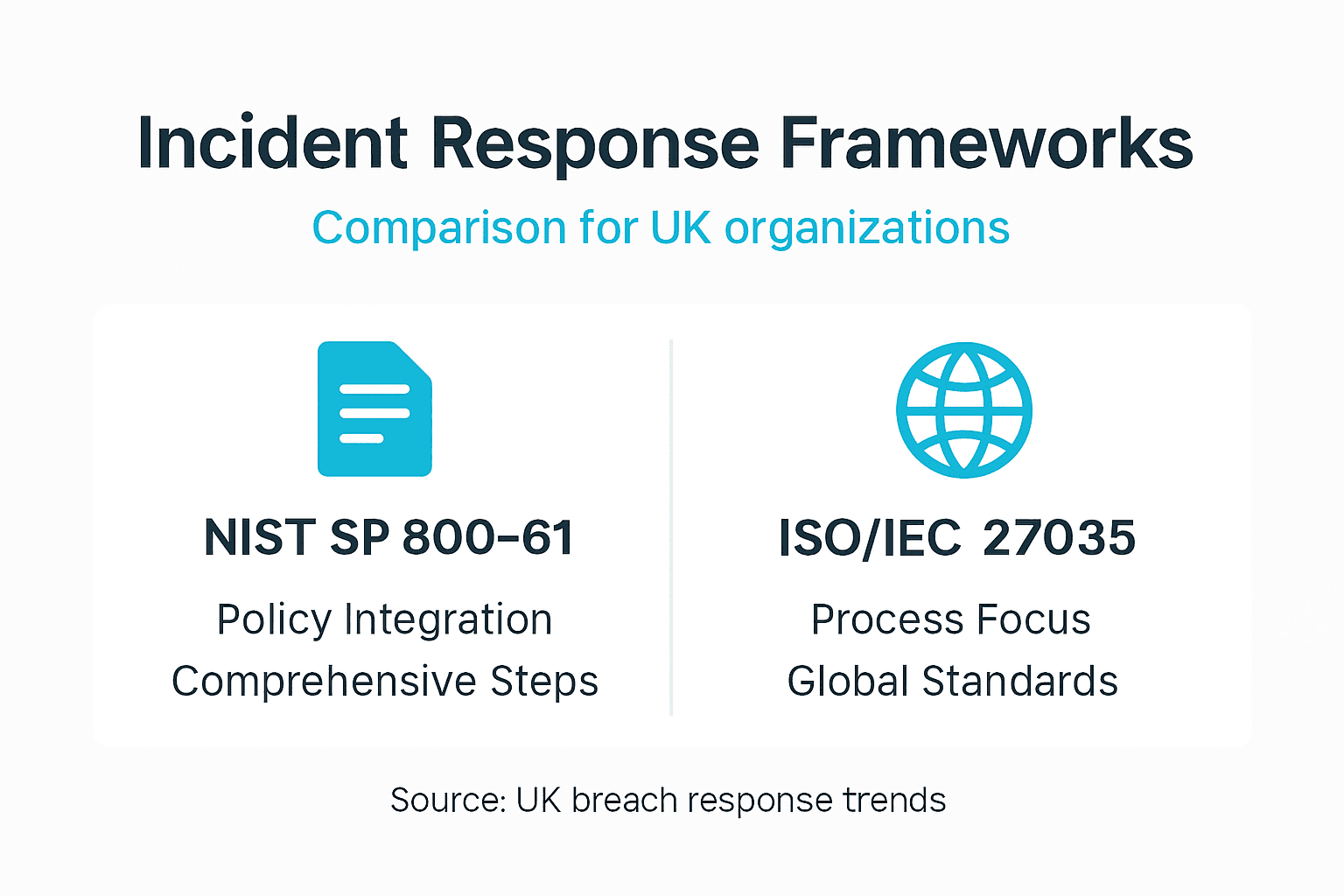
Major frameworks provide structured approaches to implementing these phases. The ISO/IEC 27035 standard and comparable frameworks differ in scope and emphasis, helping organizations choose the right fit.
| Framework | Primary Focus | Best For | Key Strength |
|---|---|---|---|
| NIST SP 800-61 | Comprehensive organizational policy | US-aligned enterprises, federal compliance | Detailed technical guidance and governance integration |
| ISO/IEC 27035 | International standards alignment | Multinational organizations, global compliance | Continuous improvement methodology and international recognition |
| SANS Incident Response | Tactical operational response | Security operations teams, rapid deployment | Practical checklists and field-tested procedures |
Framework selection depends on your organization’s priorities. NIST offers comprehensive policy integration suitable for complex legal environments. ISO/IEC 27035 provides international credibility valuable for cross-border operations. SANS delivers tactical tools for front-line responders needing immediate action guidance.
Pro Tip: Organizations often benefit from hybrid approaches. Use NIST for strategic planning and governance, ISO/IEC 27035 for compliance documentation, and SANS procedures for operational playbooks. This combination addresses legal requirements while enabling effective tactical response.
Your framework choice should reflect regulatory obligations, organizational complexity, and available resources. Legal teams should review framework selection to ensure alignment with evidence handling requirements and disclosure obligations specific to your jurisdiction.
Legal and Forensic Considerations in Incident Response
Integrating legal aspects of incident response with technical actions ensures evidence remains admissible and compliant. Digital evidence differs fundamentally from physical evidence, requiring specialized handling to maintain legal validity.
Chain of custody documentation tracks every person who accesses evidence, when they accessed it, and what actions they took. This unbroken record proves evidence integrity in court. One gap in documentation can render critical evidence inadmissible, potentially losing cases despite strong technical findings.
Digital evidence handling requires forensic techniques that preserve original data while enabling analysis. Key methods include:
- Forensic imaging: Creating bit-by-bit copies of storage media using write-blocking hardware to prevent contamination
- Timeline analysis: Reconstructing event sequences from system logs, file metadata, and network traffic to establish attacker actions
- Malware identification: Analyzing malicious code to determine capabilities, origins, and indicators of compromise
- Data recovery: Retrieving deleted or hidden files that attackers attempted to destroy
- Memory forensics: Capturing volatile system memory to identify active threats and encryption keys
Forensic experts bridge technical investigation and legal requirements. They provide expert witness testimony explaining technical findings to judges and juries. They prepare detailed reports documenting methodology, findings, and conclusions in formats courts accept. Their involvement ensures technical work translates into legally defensible evidence.
Pro Tip: Engage forensic and legal professionals immediately when you detect serious incidents. Early involvement prevents evidence spoliation and ensures proper documentation from the start. Retrofitting legal compliance after technical response often fails, leaving gaps attackers exploit to challenge evidence validity.
Regulatory requirements add complexity. GDPR mandates breach notification within 72 hours, requiring rapid legal assessment of notification obligations. Data Protection Act 2018 imposes specific evidence handling requirements. Industry regulations like PCI DSS create additional compliance obligations during response. Legal teams must understand these requirements to guide response priorities and timelines.
Common Misconceptions About Incident Response
Several persistent myths hinder effective incident response adoption. Addressing these misconceptions helps organizations build realistic, effective programs.
Misconception: Incident response is purely an IT security function. Reality: Effective response requires coordination across IT, legal, compliance, communications, and executive leadership. Legal teams play essential roles in evidence handling, regulatory notification, and litigation preparation. Security teams cannot make legal decisions about disclosure or evidence preservation alone.
Misconception: Incident response means technical containment and system recovery. Reality: Response encompasses preparation, evidence collection, legal compliance, stakeholder communication, and continuous improvement. Technical actions represent only part of a complete response.
Misconception: Small organizations don’t need formal incident response processes. Reality: Attackers target organizations of all sizes. Small firms often face disproportionate damage from breaches because they lack response capabilities. Formal processes scaled to organizational size protect even small teams.
Misconception: Incident response starts when you detect a breach. Reality: Preparation is the first phase because it enables all subsequent actions. Organizations without preparation plans, trained teams, and deployed tools cannot respond effectively when incidents occur.
Misconception: Outside forensic experts are only needed for major breaches. Reality: Professional forensic involvement ensures evidence admissibility and proper handling even for smaller incidents. The cost of expert engagement is minimal compared to losing legal cases due to compromised evidence.
These misconceptions often stem from viewing incident response as technical rather than organizational. When you understand response as a cross-functional discipline requiring legal, technical, and business expertise, you build more resilient capabilities. Legal professionals bring unique value by ensuring response actions support rather than undermine potential litigation.
Importance of Effective Incident Response
Data proves that structured incident response delivers measurable benefits. Organizations with mature response capabilities experience significantly lower breach costs, faster containment, and better legal outcomes.
UK breach detection data reveals that over 60% of breaches involve delayed detection or poor response processes. These delays directly increase costs through extended attacker dwell time, larger data loss, and greater system damage. Each day attackers remain undetected expands the scope of compromise.
The average time to identify a breach globally is 287 days, highlighting the need for efficient incident detection and response mechanisms.
This detection delay allows attackers to establish persistence, steal sensitive data gradually, and cover their tracks. By the time organizations discover breaches, damage is often severe and evidence is compromised.
Organizations that practice regular incident response drills reduce breach containment time by up to 50%. This improvement translates directly into lower costs, reduced data loss, and preserved evidence quality. Drills identify process gaps before real incidents occur, allowing teams to refine procedures in low-pressure environments.

| Metric | With Effective Response | Without Effective Response | Improvement |
|---|---|---|---|
| Average breach detection time | 143 days | 287 days | 50% faster |
| Mean containment time | 41 days | 82 days | 50% faster |
| Average breach cost | £2.8 million | £4.1 million | 32% lower |
| Regulatory penalty likelihood | 28% | 54% | 48% reduction |
Early forensic involvement improves legal success rates substantially. When forensic experts document evidence properly from incident start, prosecution and civil litigation success rates increase measurably. Conversely, delayed forensic engagement often means critical evidence is lost, contaminated, or legally challenged.
The financial case for investment is clear. Organizations spending on preparation, training, and tools recover these costs many times over through reduced breach impact. Legal professionals should view incident response capabilities as risk management investments that protect organizational value and enable successful litigation when needed.
Collaboration Between Legal and Security Teams
Effective incident response requires seamless collaboration between legal and security teams. Each team brings specialized expertise that complements the other during crisis response.
Security teams provide technical expertise in threat detection, forensic analysis, and system recovery. They understand attacker tactics, technical vulnerabilities, and remediation strategies. Legal teams contribute regulatory knowledge, evidence handling protocols, and litigation strategy. They ensure response actions comply with laws and preserve options for legal action.
Establishing formal collaboration protocols before incidents occur prevents confusion during crises. Key steps include:
- Define clear roles and responsibilities for each team during each incident response phase
- Create communication channels with predetermined escalation paths and contact information
- Establish decision-making authority for critical choices like system isolation, law enforcement notification, and public disclosure
- Document evidence handling procedures that satisfy both forensic integrity and legal admissibility requirements
- Schedule joint training sessions where teams practice coordinated response to realistic scenarios
- Develop shared terminology so technical and legal professionals understand each other during time-sensitive decisions
Joint response delivers multiple benefits. Evidence integrity improves when legal teams guide collection from the start. Regulatory compliance strengthens when security teams understand legal obligations. Response speed increases when predetermined protocols eliminate decision delays.
Pro Tip: Conduct quarterly tabletop exercises where legal and security teams jointly respond to simulated incidents. These exercises reveal process gaps, build working relationships, and create muscle memory for real crises. Include scenarios requiring difficult trade-offs between technical containment and evidence preservation to practice balancing competing priorities.
Successful collaboration requires mutual respect for each discipline’s expertise. Security professionals must recognize that legal considerations sometimes constrain technical responses. Legal professionals must understand that technical realities sometimes limit ideal legal outcomes. When teams approach incidents as partners rather than gatekeepers, response quality improves dramatically.
Bridging Incident Response to Legal and Corporate Strategy
Incident response capabilities extend beyond crisis management to support broader legal strategy and corporate governance. When you integrate response processes with organizational priorities, you create sustainable competitive advantages.
Aligning incident response with corporate governance means treating cybersecurity incidents as enterprise risks requiring board-level awareness. Risk committees should receive regular briefings on response capabilities, drill results, and lessons learned from incidents. This visibility ensures adequate investment and demonstrates due diligence to regulators and stakeholders.
Forensic findings from incidents provide valuable inputs for legal case planning and compliance reporting:
- Litigation strategy: Evidence collected during response directly supports civil claims, criminal prosecutions, and regulatory defenses
- Insurance claims: Detailed incident documentation substantiates cyber insurance claims and demonstrates policy compliance
- Regulatory reporting: Comprehensive response records satisfy disclosure obligations and demonstrate good faith efforts
- Contract enforcement: Forensic evidence of third-party breaches supports vendor liability claims and contract negotiations
The lessons learned phase creates opportunities for continuous improvement that strengthen legal posture. Each incident reveals vulnerabilities, process gaps, and training needs. Addressing these findings systematically reduces future risk and demonstrates commitment to security that courts and regulators value.
Legal professionals should view incident response as a strategic asset rather than a cost center. Organizations with mature response capabilities negotiate better insurance rates, defend regulatory investigations more effectively, and pursue legal remedies more successfully. Response investment pays dividends across multiple business dimensions.
Developing this strategic perspective requires ongoing dialogue between legal, security, and business leadership. Quarterly reviews of response metrics, capability assessments, and emerging threats keep everyone aligned. When legal professionals champion incident response investment, organizations build resilience that protects long-term value.
Explore Professional Digital Forensics and Incident Response Services
Building internal incident response capabilities takes time and specialized expertise. Professional digital forensics services provide immediate access to experienced investigators who handle evidence properly and support legal requirements. These experts conduct digital forensic investigations that uncover attacker actions, preserve admissible evidence, and document findings for court proceedings. When cybercrime strikes, following proven cybercrime investigation steps ensures comprehensive response that protects your legal position while enabling operational recovery. Expert support transforms incident response from reactive crisis management into strategic advantage.
Frequently Asked Questions About Incident Response
What is the typical timeframe for incident response phases?
Identification should occur within hours through monitoring systems. Containment typically takes one to three days for short-term isolation and one to two weeks for complete containment. Eradication and recovery often span two to four weeks depending on breach scope. Lessons learned reviews should complete within 30 days of incident closure.
How does legal involvement affect digital evidence admissibility?
Legal guidance ensures evidence collection follows chain of custody requirements and proper forensic procedures. Courts may exclude evidence obtained through improper methods, making legal oversight essential. Early legal involvement prevents procedural errors that compromise evidence value in litigation.
What are best practices for preserving chain of custody?
Document every person who accesses evidence, when access occurred, and what actions they took. Use forensic imaging tools with write-blocking to prevent data modification. Store evidence in secure locations with access logs. Maintain detailed contemporaneous notes explaining all evidence handling decisions and procedures followed.
How often should incident response drills be conducted?
Conduct full tabletop exercises quarterly with legal and security teams. Run technical response drills monthly for security operations staff. Review and update response plans semi-annually to reflect organizational changes, new threats, and lessons learned from drills and real incidents.
What distinguishes incident response from general IT security?
IT security focuses on prevention through controls, monitoring, and vulnerability management. Incident response assumes prevention sometimes fails and provides structured processes for detection, containment, investigation, and recovery. Response also emphasizes legal evidence preservation and regulatory compliance beyond technical remediation.