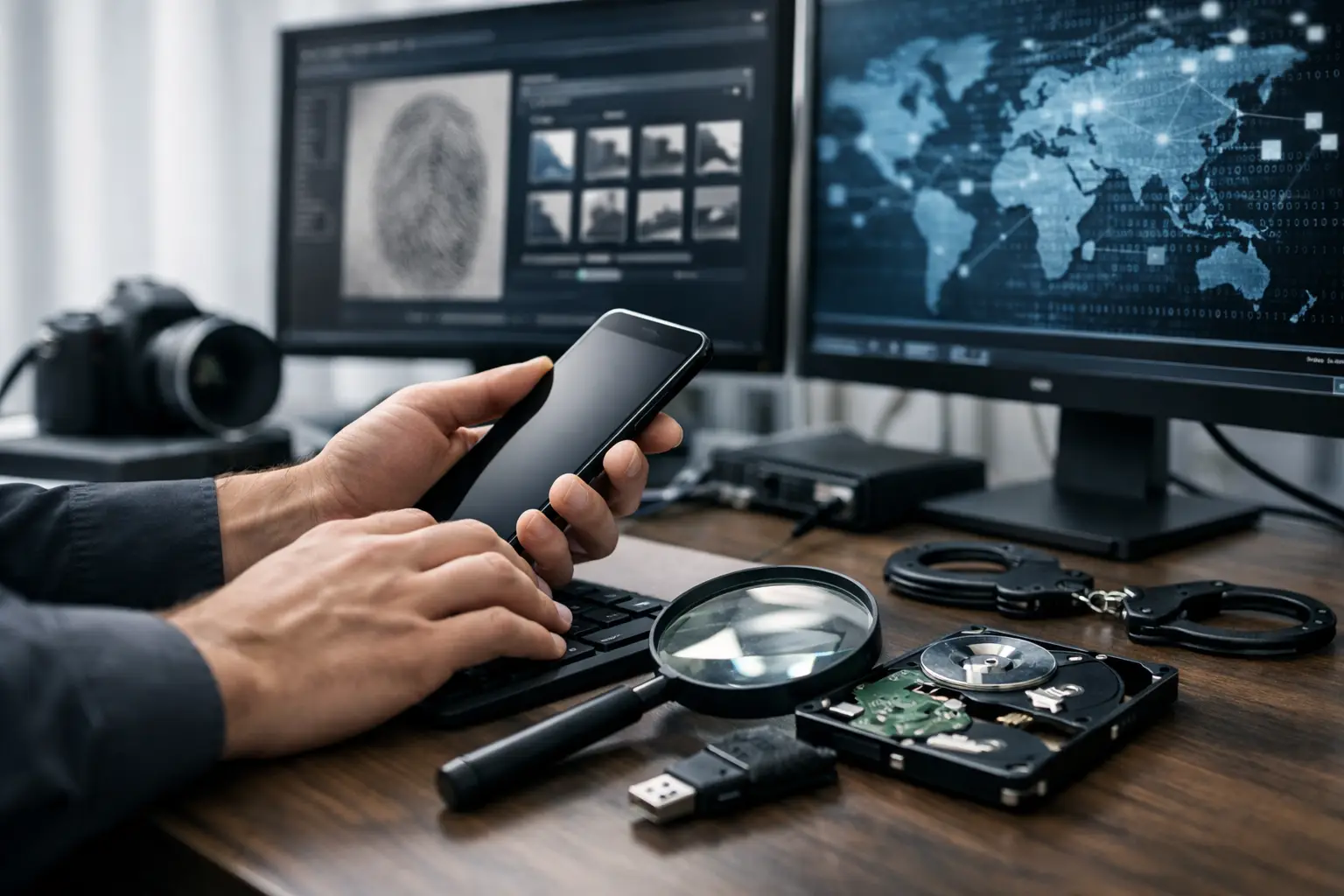
A case can turn on a single message, login record or deleted file. That is why understanding how digital evidence is analysed matters long before a report reaches court. If the device was handled badly, if metadata was altered, or if the findings cannot be explained clearly, the evidence may lose weight at the very point it is needed most.
Digital forensics is not the same as looking through a phone or running basic IT checks on a laptop. The work must be methodical, repeatable and defensible. For solicitors, businesses and private clients, the real issue is not simply whether something can be found. It is whether the evidence can be preserved, interpreted and presented in a way that will withstand scrutiny.
How digital evidence is analysed in forensic practice
In forensic practice, analysis starts well before any examiner opens a device. The first stage is preservation. A mobile phone, computer, tablet, server image or storage medium must be secured so that its contents are not changed unnecessarily. That includes recording who had access to the item, when it was received, its condition on receipt and the steps taken to prevent contamination.
This is where chain of custody becomes central. In legal and regulatory disputes, a gap in handling can create doubt. An examiner must be able to account for the exhibit from collection to reporting. If a device has passed through several hands without proper records, the problem is not merely administrative. It may affect credibility.
Once preserved, the examiner will usually create a forensic image or other forensically sound acquisition of the data. The purpose is straightforward. Analysis should, where possible, take place on a verified copy rather than the original exhibit. That protects evidential integrity and allows the examiner to demonstrate that the working data matches the source.
Verification is commonly carried out using hash values. In simple terms, a hash is a digital fingerprint. If the hash of the acquired data matches the expected value, that supports the position that the copy is unchanged. For legal professionals, this matters because it moves the discussion away from assumption and towards demonstrable process.
What happens after forensic acquisition
After acquisition, the analytical phase begins. This is the point at which raw data is turned into evidence, but the process is rarely linear. A competent examiner does not simply search for dramatic material. The task is to identify relevant artefacts, test competing explanations and place findings in context.
Different devices produce different forms of evidence. A mobile phone may reveal messages, call logs, app data, photographs, location history and internet usage. A computer may contain user documents, system logs, browser history, external device connections and evidence of file manipulation. Cloud-linked accounts may add another layer, particularly where data held on the handset differs from data available through associated services.
Deleted data can also form part of the picture, but recovery is never guaranteed. It depends on the device type, file system, operating system, usage after deletion, encryption and whether data has been overwritten. That is one reason experienced forensic examiners are careful with language. A missing item does not always mean it never existed, and a recovered fragment does not always tell the whole story.
Timeline analysis is often one of the most valuable parts of the work. Rather than viewing files in isolation, the examiner reconstructs activity across time. When was a user account accessed? When was a document created, opened, edited or transferred? Was a USB device connected shortly before sensitive files disappeared? Did internet history, messaging activity and location data align with the account being given?
This is where forensic analysis becomes especially useful in disputed matters. In an employment investigation, the issue may be whether confidential information was copied before resignation. In a criminal defence case, the question may be whether a device was used by the defendant at a material time. In matrimonial or civil litigation, the focus may be on communications, hidden assets, account access or movements evidenced by device data. The same discipline applies across all three: identify the artefacts, test their reliability and explain what they do and do not show.
Interpreting digital evidence without overstating it
One of the greatest risks in this field is overinterpretation. Digital artefacts can be powerful, but they are not self-explanatory. A timestamp may reflect creation, modification, syncing or system activity depending on the source. A message on a device may indicate user action, automated backup behaviour or partial app retention. A location point may place a device within an area, but not necessarily prove who was holding it.
Good forensic work is therefore cautious as well as thorough. The examiner must distinguish between fact, inference and possibility. That distinction matters in court. Judges and legal teams do not need technical theatre. They need reliable findings, clear reasoning and proper acknowledgement of limitations.
There are also situations where live analysis is necessary, particularly in cyber incident response. If a business has suffered unauthorised access, ransomware activity or suspected insider compromise, waiting too long may result in volatile data being lost. Even then, speed must not displace discipline. The examiner must record actions carefully, justify methods used and preserve the basis on which conclusions were reached.
How digital evidence is analysed for court use
For court purposes, the analysis is only as useful as the report that follows it. A forensic report should do more than list extracted data. It should identify the instructions received, the exhibits examined, the methods used, the relevant findings, and any limitations or assumptions. It should also be written in a way that a non-technical reader can follow without sacrificing accuracy.
This is where many non-specialist examinations fall short. It is possible to extract large volumes of data from a device and still fail to answer the actual evidential question. Courts are not assisted by data dumps. They are assisted by focused analysis that addresses the pleaded issues, preserves independence and remains capable of challenge.
An expert’s duty is not to the party paying the fee. It is to the court. That principle is fundamental. In practical terms, it means an examiner should not shape findings to fit a preferred narrative. If the data supports one interpretation only weakly, that should be said. If there are alternative explanations, they should be addressed.
Peer review also has real value. In higher-stakes matters, review by another qualified practitioner can help identify gaps, clarify wording and test whether the conclusions follow properly from the data. That does not make the report infallible, but it does strengthen confidence that the work has been carried out with appropriate rigour.
Common challenges in digital forensic analysis
Encryption is an obvious challenge, particularly on modern phones and secure messaging platforms. Some data may be available only with passcodes, lawful authority or supporting material from other sources. Equally, cloud dependence means relevant evidence may sit partly on the device and partly elsewhere. A narrow examination can therefore miss context.
Volume is another issue. Corporate investigations may involve multiple custodians, email sets, chat platforms, shared drives and endpoint devices. In those cases, the question is not just how to collect data, but how to reduce it intelligently without losing relevant material. That requires experience in both forensic triage and disclosure strategy.
Then there is the problem of prior handling. Clients often arrive after an internal IT team, family member or former adviser has already accessed the device. Sometimes that cannot be avoided. But once normal use resumes, opportunities for pristine recovery can narrow quickly. Early instruction usually gives the best prospect of preserving probative material.
For that reason, Computer Forensics Lab and similar specialist providers are often instructed at the point when evidential decisions need to be made, not after the opportunity has passed. In urgent matters, the timing of the first forensic step can shape the value of everything that follows.
Why the process matters as much as the result
When clients ask what can be found on a device, they are usually asking a larger question: can the truth be shown clearly enough to matter? The answer depends on more than technical capability. It depends on process, documentation, interpretation and the discipline to stay within what the evidence genuinely supports.
That is the real answer to how digital evidence is analysed. It is not a single software task or a quick extraction. It is a controlled forensic process designed to preserve integrity, examine data properly and present findings that stand up under pressure. When the stakes are high, that standard is not optional. It is the difference between information and evidence.
If you are dealing with disputed device activity, missing communications, suspected misconduct or a cyber incident, the safest step is often the earliest one: secure the evidence before someone unintentionally changes it.