
When presenting digital evidence in United Kingdom courts, even minor documentation gaps can jeopardise admissibility. For corporate lawyers in London, scrutinising every stage of chain of custody is vital to safeguard electronic data from tampering and unauthorised alterations. By understanding robust documentation protocols and the strengths of different tracking methods, you empower your team to maintain authenticity and meet the strict standards demanded by British legal proceedings.
Table of Contents
- Defining Chain Of Custody In Digital Forensics
- Key Stages And Documentation Protocols
- Legal Frameworks And Admissibility Standards
- Roles And Responsibilities In Evidence Handling
- Common Pitfalls And How To Avoid Them
Key Takeaways
| Point | Details |
|---|---|
| Importance of Chain of Custody | The chain of custody is essential for maintaining the integrity and admissibility of digital evidence throughout investigations. |
| Documentation Essentials | Rigorous documentation of evidence transfers, including date, personnel, and conditions, is critical to demonstrate authenticity. |
| Legal Admissibility Frameworks | Digital evidence must meet strict legal standards, such as the Daubert Standard and Federal Rules of Evidence, to be admissible in court. |
| Common Pitfalls | Incomplete documentation and inadequate access controls are frequent risks; implementing standardised templates and secure authentication measures can mitigate these issues. |
Defining chain of custody in digital forensics
In digital forensics, chain of custody is a systematic documentation process that tracks every interaction with digital evidence from initial collection through final analysis. Tracking digital evidence lifecycles involves meticulous recording of all individuals who handle, examine, or transfer electronic data throughout an investigation.
The chain of custody serves several critical purposes in legal and investigative contexts:
- Establishes a chronological record of evidence handling
- Prevents potential tampering or unauthorised modifications
- Ensures evidence admissibility in criminal and civil legal proceedings
- Validates the authenticity and integrity of digital materials
- Provides transparent documentation for forensic examinations
Digital evidence requires particularly rigorous tracking because electronic data can be easily altered without leaving visible traces. Contemporary chain of custody approaches typically encompass three primary methodological categories:
- Traditional paper trail documentation
- System-oriented tracking mechanisms
- Infrastructure-driven preservation protocols
Forensic professionals must document specific details for each evidence transfer, including:
Below is a comparison of common chain of custody documentation methods in digital forensics:
| Method | Strengths | Typical Limitations |
|---|---|---|
| Traditional paper trail | Legally recognised, easy auditing | Prone to loss or unauthorised access |
| System-oriented tracking | Automated logging, real-time updates | Security relies on system integrity |
| Infrastructure-driven preservation | Ensures controlled environment | High implementation cost and training |
- Date and time of transfer
- Identifying information of personnel involved
- Reason for evidence movement
- Precise location and storage conditions
- Signature or digital authentication
Pro tip: Always maintain a contemporaneous, unbroken documentation trail and implement multiple verification checkpoints to guarantee digital evidence integrity.
Key stages and documentation protocols
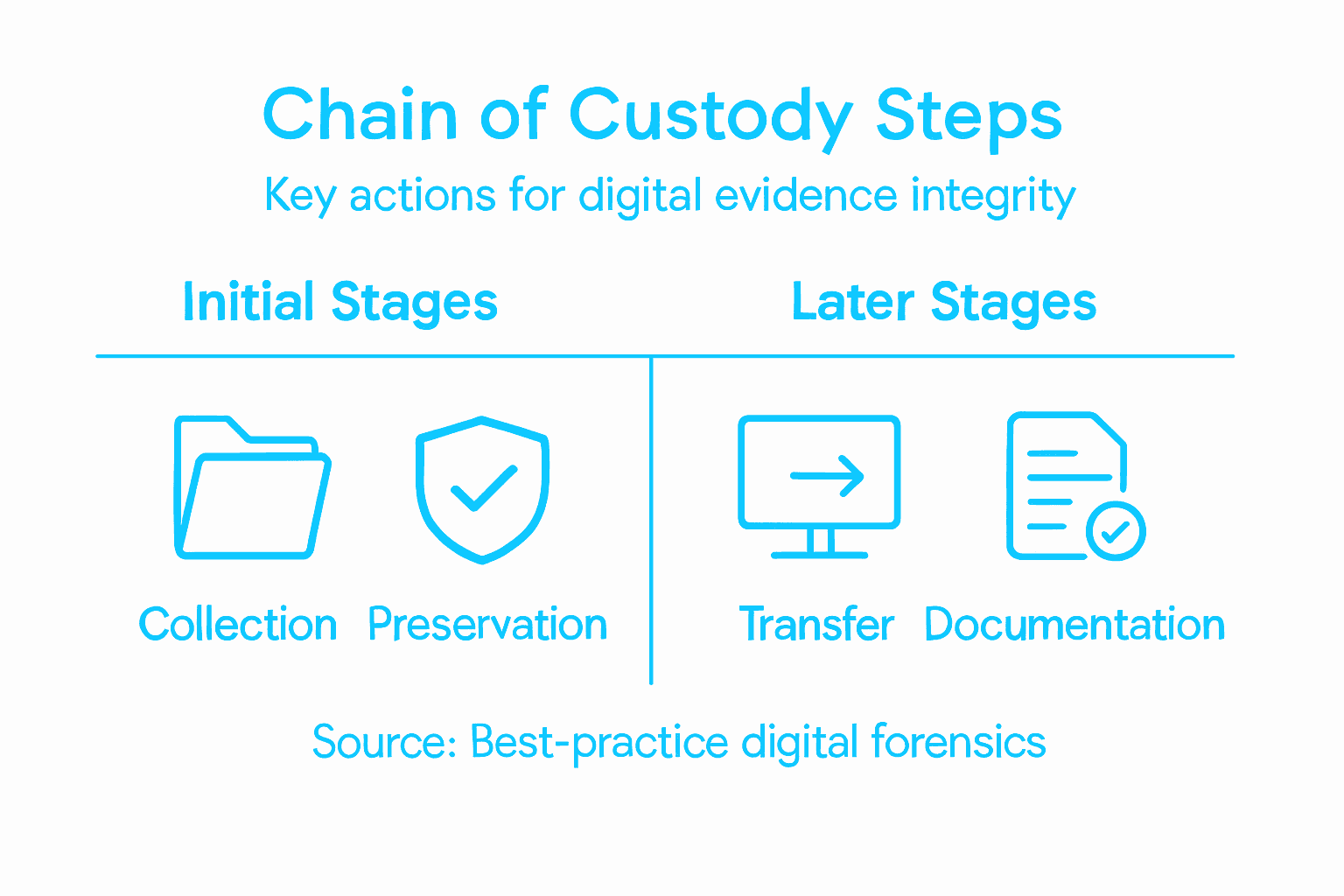
In digital forensics, chain of custody involves a systematic approach to documenting digital evidence handling through multiple critical stages. Each stage requires meticulous attention to detail and comprehensive documentation to maintain evidence integrity and legal admissibility.
The key stages of chain of custody documentation typically include:
- Collection: Identifying and securing digital evidence
- Preservation: Protecting evidence from potential contamination
- Transportation: Securely moving evidence between locations
- Storage: Maintaining evidence in controlled, restricted environments
- Analysis: Examining evidence using forensically sound methodologies
- Presentation: Preparing evidence for legal proceedings
Forensic documentation protocols require comprehensive tracking of every interaction with digital evidence. This necessitates recording specific details for each transfer:
- Exact date and time of evidence handling
- Complete identification of personnel involved
- Precise reason for evidence movement
- Detailed storage and transportation conditions
- Verification mechanisms and authentication signatures
Professional digital forensics teams implement rigorous strategies to prevent evidence tampering, including:
- Using tamper-evident packaging
- Maintaining controlled access logs
- Creating comprehensive audit trails
- Implementing strict documentation protocols
- Utilising forensically validated acquisition tools
Maintaining an unbroken, thoroughly documented chain of custody is paramount to ensuring digital evidence remains legally admissible and scientifically credible.
Pro tip: Develop a standardised, repeatable documentation template that captures all critical evidence handling details and can be consistently applied across different investigative scenarios.

Legal frameworks and admissibility standards
Digital forensic evidence must navigate complex legal admissibility standards to be considered acceptable in judicial proceedings. Courts demand rigorous scientific validation and methodological integrity to ensure the reliability of digital evidence collected during investigations.
The primary legal frameworks governing digital evidence admissibility include:
- Daubert Standard: Assessing scientific methodology and expert testimony
- Federal Rules of Evidence: Establishing relevance and reliability criteria
- Best Evidence Rule: Ensuring original or authenticated digital records are presented
- Frye Standard: Evaluating scientific techniques based on general acceptance
- Frcp Rule 26: Governing expert witness disclosure and evidence management
Chain of Custody requirements mandate comprehensive documentation demonstrating evidence authenticity and preventing potential manipulation. Key considerations for legal admissibility include:
- Demonstrating unbroken evidence tracking
- Proving forensic tool reliability
- Maintaining evidence in unaltered condition
- Documenting collection and analysis methodologies
- Providing transparent forensic examination procedures
Critical factors courts examine when assessing digital evidence include:
- Scientific validity of forensic techniques
- Qualifications of forensic professionals
- Comprehensive documentation
- Preservation of original evidence
- Reproducibility of forensic analysis
Digital evidence must withstand intense judicial scrutiny, requiring forensic professionals to maintain impeccable documentation and methodological precision.
Pro tip: Develop a comprehensive documentation template that anticipates potential legal challenges and provides comprehensive, transparent evidence tracking.
Roles and responsibilities in evidence handling
In digital forensics, evidence handling professionals play a critical role in maintaining the integrity and admissibility of digital evidence throughout investigative processes. Their responsibilities extend far beyond simple evidence collection, encompassing complex legal and technical requirements.
Key roles in digital forensics evidence handling include:
- Digital Forensic Investigators: Collecting and analysing electronic evidence
- Evidence Technicians: Documenting and preserving digital materials
- Legal Compliance Officers: Ensuring procedural and legal standards are met
- Forensic Data Analysts: Examining and interpreting complex digital information
- Chain of Custody Coordinators: Tracking evidence movement and documentation
Government digital forensics roles involve comprehensive responsibilities across multiple operational levels:
- Operational technicians managing evidence collection
- Mid-level forensic specialists conducting detailed analyses
- Senior strategists developing forensic investigation protocols
- Principal advisors providing expert legal and technical guidance
- Executive-level professionals defining organisational forensic strategies
Critical responsibilities for evidence handlers include:
- Maintaining secure evidence handling environments
- Documenting every access and transfer meticulously
- Preventing potential evidence contamination
- Using forensically validated technological tools
- Ensuring comprehensive audit trail maintenance
Effective digital evidence handling requires a systematic approach combining technical expertise, legal knowledge, and unwavering commitment to procedural integrity.
Pro tip: Develop a standardised, comprehensive training programme that continuously updates professionals on emerging digital forensics methodologies and legal requirements.
Common pitfalls and how to avoid them
Digital forensics professionals must be vigilant about maintaining evidence integrity through comprehensive documentation and strict procedural controls. Even minor oversights can potentially compromise the entire forensic investigation and render critical evidence inadmissible in legal proceedings.
Most frequent chain of custody pitfalls include:
- Incomplete documentation of evidence transfers
- Inadequate access control mechanisms
- Poor metadata preservation
- Insufficient forensic tool validation
- Lack of comprehensive audit trails
Common mistakes in digital evidence handling often stem from systemic vulnerabilities in investigative processes. Critical risks that can jeopardise evidence include:
- Uncontrolled device handling
- Improper digital evidence storage
- Inconsistent logging procedures
- Inadequate personnel training
- Weak authentication protocols
Strategies for mitigating these risks involve implementing robust preventative measures:
Here is a summary of frequent chain of custody pitfalls and recommended prevention strategies:
| Common Pitfall | Preventative Strategy | Underlying Risk Addressed |
|---|---|---|
| Incomplete documentation | Use standardised templates | Ensures full tracking and accountability |
| Weak access controls | Implement secure authentication | Reduces risk of unauthorised evidence use |
| Poor metadata management | Employ automated logging tools | Maintains critical context and audit trail |
| Insufficient tool validation | Regular tool validation and updates | Ensures evidential integrity |
| Gaps in personnel training | Schedule regular expert training | Keeps staff updated on best practices |
- Using write-blocking technologies
- Creating automated, timestamped logs
- Establishing strict access control protocols
- Conducting regular forensic methodology training
- Maintaining comprehensive documentation standards
Digital forensics demands meticulous attention to detail, where a single procedural misstep can invalidate months of investigative work.
Pro tip: Develop a standardised checklist for every evidence handling scenario that includes mandatory verification steps and ensures consistent, legally defensible documentation.
Strengthen Your Digital Evidence Integrity with Expert Chain of Custody Solutions
Maintaining an unbroken and meticulously documented chain of custody is crucial to safeguarding digital evidence from tampering and ensuring its admissibility in legal proceedings. If you recognise the challenge of tracking every interaction with evidence from collection to analysis, our specialised services at Computer Forensics Lab are designed precisely to address these critical needs. We bring advanced expertise in preventing contamination, implementing verified documentation protocols, and providing legally defensible forensic reports.
Discover how our Chain of Custody Tracking solutions can deliver rigorous, transparent evidence management tailored to your investigations. Whether you are a legal professional, law enforcement agent, or business concerned with cyber incidents, our team ensures your digital evidence remains protected with thorough audit trails and forensic precision. Take control of your digital forensics challenges today by visiting Computer Forensics Lab and explore resources like our insightful Infographics that demystify complex processes. Contact us now for comprehensive support that helps you meet stringent chain of custody standards and secure confident legal outcomes.
Frequently Asked Questions
What is chain of custody in digital forensics?
Chain of custody in digital forensics refers to the systematic process of documenting every interaction and transfer of digital evidence from its initial collection through analysis and presentation in court. This ensures the integrity and admissibility of the evidence.
Why is maintaining an unbroken chain of custody important?
Maintaining an unbroken chain of custody is crucial to prevent evidence tampering or unauthorised modifications. It also validates the authenticity of digital materials and ensures they are admissible in legal proceedings.
What are the key stages of documenting chain of custody?
The key stages of documenting chain of custody in digital forensics include collection, preservation, transportation, storage, analysis, and presentation of evidence, each requiring meticulous attention to detail.
What are common pitfalls in managing digital evidence?
Common pitfalls include incomplete documentation, inadequate access control, poor metadata preservation, insufficient forensic tool validation, and lack of comprehensive audit trails. Implementing robust procedures can mitigate these risks.