IT forensics, also called digital forensics, is the systematic preservation, acquisition, analysis and reporting of electronic data so it can be used as evidence. Its primary objectives are to recover facts accurately, maintain evidential integrity and present findings in a form that withstands scrutiny. Legal teams, law enforcement and corporate investigators rely on it to produce court admissible evidence, establish the root cause of a data breach and support e-discovery obligations.
TL;DR:
- Digital evidence must maintain an unbroken chain of custody from seizure to final report to preserve its admissibility in court.
- Hashing and cryptographic checks at acquisition and analysis ensure the integrity of digital images and prevent accidental modifications.
- Investigation phases must follow strict procedures, starting with imaging and documentation, as flawed acquisition cannot be fixed later.
- Mobile, cloud, and IoT forensics often require specialized tools and experience beyond in-house capabilities due to encryption and jurisdictional complexities.
- Applying forensic principles consistently across legal, corporate, and private cases helps ensure findings are defensible and reliable.
Table of Contents
- What digital forensics covers and why it matters
- Core principles: chain of custody, hashing and order of volatility
- Branches of digital forensics and where they apply
- How an investigation runs: acquisition, examination, analysis and reporting
- Tools and techniques examiners rely on in casework
- Building a career: skills, training and certification
- What digital evidence can and cannot prove
- How a professional lab applies these principles
- What learners often get wrong early on
- Getting professional support when a case demands it
- FAQ
- Sources
What digital forensics covers and why it matters
Digital forensics sits under several overlapping labels, including computer forensics and Digital Forensics and Incident Response (DFIR). Despite the different names, the underlying discipline is the same: extracting, preserving and interpreting electronic data in ways that satisfy legal and technical scrutiny. The field supports criminal investigations, civil litigation and e-discovery, and corporate incident response following a security event. Legal professionals frequently depend on forensic findings to substantiate claims or defences in court, while businesses use the same methods internally to understand how an intrusion occurred.
Typical outcomes include:
- Evidence packages suitable for criminal or civil proceedings.
- A documented root cause explaining how a breach happened and what was accessed.
- Structured data sets for e-discovery deliverables in litigation.
- Attribution findings linking an incident to a device, account or individual.
The common thread across every use case is defensibility. Findings are only as useful as the process that produced them, which is why the next section covers the principles that keep evidence admissible.
Core principles: chain of custody, hashing and order of volatility
Every credible investigation rests on a documented chain of custody, a continuous record of who handled a piece of evidence, what they did with it, when, where and why. Guidance from the NIST Evidence Management Steering Committee treats an unbroken chain of custody as integral to preserving evidentiary value, and gaps in that record are often enough to undermine an otherwise sound examination. Our own guide to preserving chain of custody sets out the practical steps examiners follow from seizure to disposal.
Hashing provides the second safeguard. Cryptographic hash values, calculated at the point of acquisition and checked again at analysis, confirm that a forensic image has not changed. Storing those hash records separately from the image itself is a simple precaution that prevents accidental modification of the integrity record.
Volatility governs the order of collection on a live system:
- Capture RAM and running processes first, since they disappear on shutdown.
- Collect network connections and logs before they rotate or overwrite.
- Image storage media last, once volatile evidence is secured.
Pro Tip: Document every acquisition step in real time rather than reconstructing it afterwards; a contemporaneous log is far harder to challenge than a reconstructed one.
Forensic readiness, supported by documented standard operating procedures, turns these principles into repeatable practice rather than one-off judgement calls.
Branches of digital forensics and where they apply
Digital forensics divides into several branches, each suited to a different class of evidence and each carrying its own technical and legal quirks.
- Computer forensics examines desktops, laptops and servers, recovering files, registry data and system logs.
- Mobile forensics deals with smartphones and tablets, where encryption, proprietary file systems and app sandboxing complicate extraction.
- Network forensics reconstructs activity from traffic captures, firewall logs and intrusion detection records, often time-sensitive given log rotation policies.
- Cloud forensics depends on provider cooperation and jurisdictional rules, since data may sit across multiple regions and the examiner rarely has direct physical access.
- IoT forensics covers connected devices such as cameras and sensors, which often store limited local data and rely on companion apps or cloud logs.
Mobile and cloud cases in particular tend to exceed the scope of in-house IT teams, since provider processes and device-level encryption usually require specialist tools and experience to navigate reliably.
How an investigation runs: acquisition, examination, analysis and reporting
A forensic investigation moves through four distinct phases, each producing its own deliverables and decisions.
- Acquisition. Examiners create a forensic image, a sector-level duplicate of the original media, using write blockers to prevent any change to the source. The Wikipedia summary of the digital forensic process notes that this imaging step, paired with full documentation of hardware, software and timestamps, is what allows the original device to remain untouched while work continues on a copy. Our own explanation of evidence acquisition sets out how this stage is recorded in practice.
- Examination. This phase involves parsing the file system, carving deleted files from unallocated space, extracting metadata and building a timeline of activity. Registry analysis, keyword searches and email extraction are common tasks at this stage.
- Analysis. Findings from multiple sources, device artefacts, network logs, cloud records, are correlated to build a coherent narrative. This is where an examiner’s judgement matters most, since the same raw data can support different interpretations depending on the questions asked.
- Reporting and testimony. The final report needs to be concise, reproducible and written so that another examiner could follow the same steps and reach the same conclusions. When a case proceeds to court, the examiner may be called to explain methodology and defend conclusions under cross-examination, which is why clarity in the original report matters as much as the finding itself.
Each phase depends on the one before it. A flawed acquisition cannot be fixed at the reporting stage, which is why so much of forensic training focuses on getting the first step right.
Tools and techniques examiners rely on in casework
Casework draws on a consistent toolkit, even though the specific product varies by lab and case type.
- Imaging tools and write blockers create a bit-for-bit copy of storage media while physically or logically preventing writes to the source.
- Physical versus logical acquisition determines whether an examiner captures the entire disk, including unallocated space, or only the active file system, a choice that affects how much deleted material can be recovered.
- File carving recovers deleted files from unallocated space by matching file signatures, independent of file system metadata.
- Registry and artefact parsing reconstructs user activity, installed software and connected devices from operating system records.
- RAM captures preserve volatile memory for malware analysis and to recover encryption keys or running process data otherwise lost on shutdown.
- Network log analysis reconstructs connections, data transfers and potential exfiltration from firewall and server logs.
Automated parsing errors and version differences between tools are a recurring source of discrepancy in casework, which is why NIST’s review of the scientific foundations of digital forensics recommends cross-tool corroboration and transparent documentation of method choices for any finding that carries significant weight in a case. Two examiners using different search strategies can legitimately surface different subsets of relevant data, so the method itself needs to be recorded alongside the result.
Building a career: skills, training and certification
Most practitioners enter the field through a computer science, cybersecurity or digital forensics degree, though vocational and in-service routes from policing or IT support are equally common. Hands-on practice with real case data, under proper legal authorisation, matters more than any single qualification.
- Certifications demonstrate competence but are often tool-specific rather than a measure of broad forensic judgement.
- The SWGDE training guidelines recommend combining structured education, supervised hands-on training and ongoing continuing education rather than relying on certification alone.
- Typical roles include digital forensic examiner, incident responder and e-discovery analyst, often within a forensic investigation team.
- Day-to-day responsibilities range from evidence acquisition and report writing to giving testimony and liaising with legal counsel.
- SANS training resources are widely used alongside vendor-specific courses to build and refresh practical skills.
What digital evidence can and cannot prove
Digital forensic findings carry real evidential weight, but they are not infallible, and professional guidance is explicit about the boundaries.
Digital investigation techniques are grounded in established computer science principles, yet they have limits: different search strategies can yield different subsets of relevant information, and tools and methods require ongoing community testing and validation.
This is the conclusion of NIST’s scientific foundation review, and it carries a practical implication: the examiner’s methodology, not just the output of a tool, is what a court or opposing counsel will probe. Standards from bodies such as SWGDE and NIST exist precisely to narrow that risk, by setting out documented procedures, validated tools and consistent reporting formats that reduce the chance of a finding being successfully challenged on process grounds rather than substance.
How a professional lab applies these principles
Instructing a specialist lab becomes the sensible option once a case involves complex recovery, contested evidence or the prospect of expert testimony. We apply the principles covered above as a matter of routine casework.
- We maintain documented chain of custody records across engagements, from initial instruction to final report.
- Our specialist computer forensics services cover mobile, cloud and network examinations alongside traditional computer forensics.
- We prepare expert witness reports designed to withstand scrutiny.
- Our work spans legal, corporate and private instructions, including investigations related to cybercrime, data theft and breaches.
When a matter is heading towards litigation, or when the data involved sits across mobile devices and cloud accounts, instructing a lab early tends to preserve more usable evidence than waiting.
What learners often get wrong early on
The most common mistake beginners make is jumping straight into tools without first understanding chain of custody and documentation discipline. Learn the principles before the software, and never practise acquisition techniques on a real device you do not have clear legal authority to examine. Continuing education is not optional in this field; methods, encryption and operating systems all move faster than any single certification covers.
— Computer
Getting professional support when a case demands it
DIY troubleshooting has its place, but once a matter involves potential litigation, a serious data breach or evidence that needs to withstand cross-examination, the calculus changes. We offer digital forensics investigations, mobile phone forensics, and expert witness provision for exactly these situations, drawing on documented chain of custody procedures and validated tools rather than ad hoc recovery attempts.
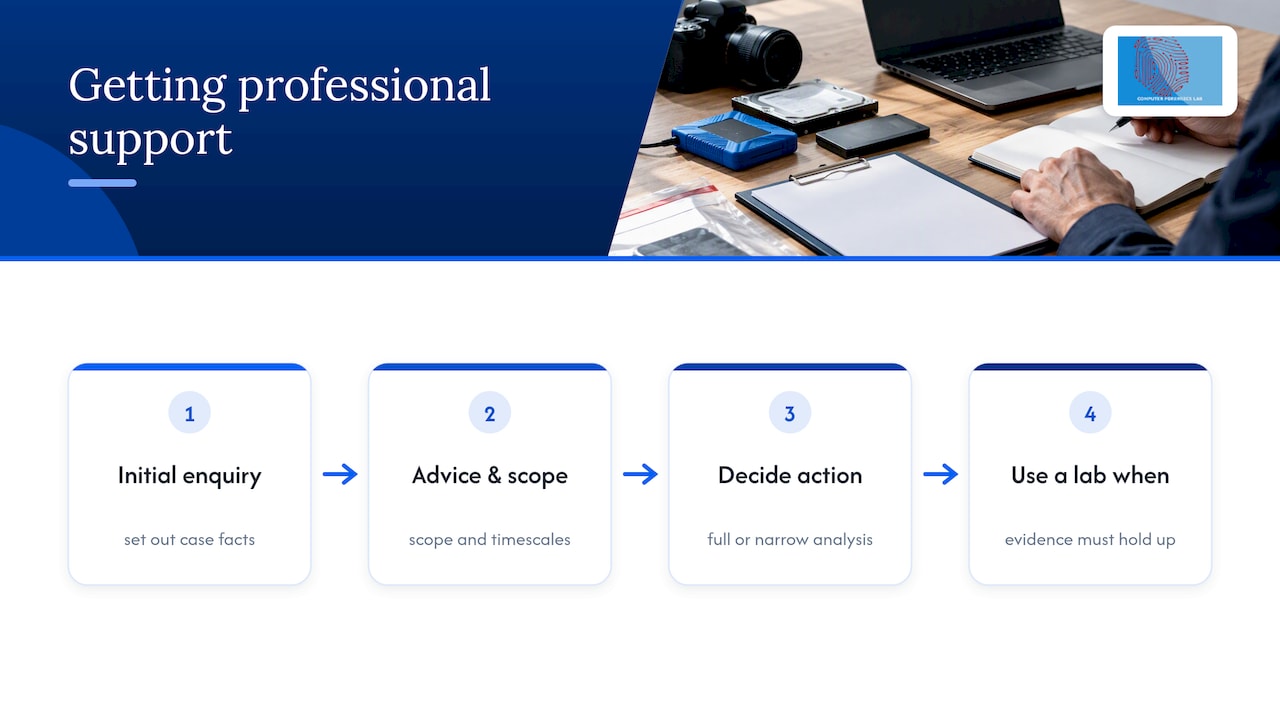
Getting in touch is straightforward: an initial enquiry sets out the facts of your matter, and we advise on scope, likely timescales and whether the case calls for a full investigation or a narrower piece of analysis. Where a matter touches employment disputes, intellectual property theft or suspected fraud, our specialist computer forensics services page sets out the relevant options in more detail. Choosing a lab over an in-house attempt matters most when the evidence needs to hold up outside your own organisation, in court, before a regulator or in a formal dispute.
FAQ
Is cyber forensics a good career?
Demand for information security and forensic roles remains strong, and the Bureau of Labor Statistics describes consistent demand for related information security roles requiring a computer science background and relevant certification. The field suits people who enjoy methodical analysis, documentation and occasional courtroom or legal involvement.
What qualifications do you need to be a digital forensic examiner?
Most examiners hold a degree in computer science, cybersecurity or digital forensics, though vocational routes through policing or IT support are also common. Certifications add credibility but, per SWGDE training guidance, structured education combined with supervised hands-on practice matters more than any single qualification.
How difficult is computer forensics?
The technical skills are learnable, but the discipline required for documentation, chain of custody and methodical reporting is what separates competent examiners from the rest. Difficulty tends to rise with case complexity, particularly with encrypted mobile devices or multi-jurisdiction cloud evidence.
Does computer forensics pay well?
Pay varies by employer, region and specialism, and no single figure applies across law enforcement, corporate and private practice roles. Related information security roles generally command competitive salaries reflecting their technical demands, according to the Bureau of Labor Statistics occupational overview.
What is chain of custody and why does it matter?
Chain of custody is the documented record of who handled a piece of evidence, when, where and why, from the moment it is collected to its final disposition. An unbroken chain, as described in NIST’s evidence management guidance, is integral to preserving the evidential value of digital material in any proceeding.
Sources
- Digital forensic process — Wikipedia
- Evidence management steering committee report — NIST SP 1500‑33A
- Guidelines & recommendations for training in digital & multimedia evidence — SWGDE