Computer forensics applies scientific methods to preserve, recover and analyse digital evidence so findings remain repeatable and legally defensible. A properly conducted investigation produces a verified forensic image, a documented hash value proving that image has not been altered, and a report that can withstand cross-examination Students, incident responders and legal professionals all rely on the same disciplined sequence to get there.
TL;DR:
- Proper acquisition and verification of a forensic image with hash values are critical to maintain evidential integrity and prevent alteration.
- Forensic investigation involves five phases: preservation, acquisition, examination, analysis, and reporting, all of which must be executed on verified copies only.
- Combining memory analysis, log review, and network traffic examination enhances evidence completeness, especially against fileless malware and encrypted data.
- Lab environments must be isolated, validated, and thoroughly documented to ensure evidence remains legally defensible during court proceedings.
- Cases involving complex malware, cross-device data, or legal disputes should involve specialized forensic labs from the outset to meet courtroom standards.
Table of Contents
- What is computer forensics and where does it sit among related disciplines?
- The five phases of a defensible digital investigation
- Forensic tools and techniques every investigator should understand
- Building a lab that produces evidence courts can trust
- A workflow checklist and the mistakes that undo good evidence
- Legal considerations, privacy and admissibility
- Public law enforcement versus private and corporate investigations
- Handling IoT, social media and cloud evidence
- Where incident response meets forensic investigation
- Certifications and training pathways for forensic investigators
- Reporting standards and presenting findings in court
- When a case genuinely needs a specialist forensic lab
- Instruct a forensic team that documents every step
- Sources
What is computer forensics and where does it sit among related disciplines?
Computer forensics is the practice of identifying, preserving, extracting, and interpreting digital data so it can serve as evidence in civil, criminal or administrative proceedings. The primary goal is not simply to find information. It is to find it in a way that a court, tribunal, or opposing expert cannot credibly challenge. Every step, from the moment a device is seized to the final report, has to survive scrutiny of both technical accuracy and legal procedure.
The discipline is often confused with adjacent fields, and the distinctions matter more than most newcomers expect.
- Data recovery focuses on restoring lost or damaged files with no evidentiary requirement; a technician recovering wedding photos from a corrupted drive is not concerned with chain of custody.
- Network forensics examines traffic and infrastructure logs across a network, often in real time, to trace an intrusion path or exfiltration event.
- Digital forensics and incident response (DFIR) merges forensic technique with active threat containment, usually inside a live security incident rather than after the fact.
- Computer forensics, narrowly defined, concentrates on individual devices, storage media, and their artefacts, examined under conditions that preserve evidential integrity throughout.
These fields overlap constantly in practice. An investigator responding to a ransomware attack might pull network logs, capture volatile memory, and image a compromised laptop within the same engagement, moving fluidly between DFIR and classical computer forensics as the case demands.
The reference textbook Guide to Computer Forensics and Investigations frames the field around recovering and analysing digital information for civil, criminal, or administrative cases, and draws a sharp line between public law enforcement investigations and private or corporate ones, a distinction that shapes almost every procedural decision that follows. Authority for method and conduct comes from several sources. SWGDE’s best-practice guidance sets out how examinations should be scoped, validated, and documented. RFC 3227, “Guidelines for Evidence Collection and Archiving,” remains the foundational internet-standards document on preserving volatile evidence, and NIST publishes complementary guidance on tool testing and forensic methodology.
Understanding these boundaries matters because forensic method has limits. A forensic examiner can prove that a file existed on a device at a given time with a matching hash value; they cannot always prove who typed it, and attribution frequently requires corroborating evidence from outside the digital estate entirely. Recognising what forensic analysis can and cannot establish is itself a professional skill, and it is one insurers, courts, and opposing counsel test relentlessly.
The five phases of a defensible digital investigation
Every credible investigation follows a broadly consistent structure: preservation, acquisition, examination, analysis, and reporting. Skipping or compressing any of these phases is the single most common way evidence loses its value.
- Preservation begins the moment a device or system is identified as relevant. The guiding principle here is the order of volatility: collect the most fragile evidence first. RAM contents, active network connections, and running processes vanish the instant power is lost, so they take priority over static disk data. Disk images, logs, and archived files, being comparatively stable, follow. This sequencing is not a preference; it reflects the physical reality that some evidence has a shelf life measured in minutes.
- Acquisition is where the investigator decides between live collection and offline imaging. Live collection, capturing RAM and network state while a system runs, is necessary when volatile evidence would otherwise be lost, but it inherently alters system state to some degree and needs careful justification. Offline imaging, performed after safely powering down or through a write-blocker, produces a bit-for-bit copy of the target media. Every acquired image must be verified against a cryptographic hash (commonly SHA-256) taken before and after transfer, since hash verification is the only reliable proof that an image matches its source exactly
- Examination involves extracting artefacts from the verified image: file system metadata, deleted file remnants sitting in slack space, registry entries, browser history, and application logs. This stage is deliberately mechanical and repeatable, distinct from the interpretive work that follows.
- Analysis is where extracted artefacts become a narrative. Investigators build timelines correlating file creation, modification and access timestamps against login events, network activity, and application usage, then weigh each artefact’s probative value: does this fact actually support the conclusion being drawn, or merely correlate with it?
- Reporting translates technical findings into a document a non-technical audience, a judge, jury, HR director, or opposing solicitor can follow without a computing background. Testifying preparation starts here too; an examiner who cannot explain a hash function in plain language during cross-examination undermines an otherwise flawless technical process.
The through-line across all five phases is that nothing happens on the original evidence. Every examination, from the first artefact extraction onward, takes place on a verified copy, never the source device.
Forensic tools and techniques every investigator should understand
A forensic image is not a simple file copy. It is a bit-for-bit reproduction of a storage device, capturing deleted files still sitting in unallocated space and fragments left in slack space that a standard copy operation would never touch. That completeness is precisely why forensic imaging remains the standard acquisition method rather than simply dragging files onto a new drive.
Memory forensics has become indispensable as attackers increasingly favour fileless malware that lives entirely in RAM and leaves no disk footprint. Capturing and analysing volatile memory can recover running processes, cached credentials, and injected shellcode invisible to any disk-based scan. Volatility 3 is a widely referenced open-source tool for this kind of RAM analysis, and no serious investigation into a suspected intrusion should skip this step purely because the affected machine has already been shut down.

Log and event analysis fills in the gaps between memory and disk evidence. Windows Event Logs and Unix-style syslogs record authentication attempts, service starts, and configuration changes with timestamps that, once correlated against other artefacts, let an investigator reconstruct a plausible sequence of events minute by minute.
Network evidence adds another dimension entirely:
- Packet capture analysis, typically performed with Wireshark, can reveal command-and-control traffic, data exfiltration volumes, and protocol anomalies that disk artefacts alone would never surface.
- Mobile evidence collection faces particular obstacles: device encryption, cloud synchronisation that spreads data across jurisdictions, and manufacturer-specific file systems that standard tools parse imperfectly at best.
- Cloud evidence often exists only as provider-held logs and API-accessible records, meaning acquisition depends on service agreements and legal process rather than physical access to hardware.
Pro Tip: Never trust an automated parser’s output as the final word on a proprietary file format. Practitioner guidance consistently stresses that manual review remains necessary for embedded artefacts and non-standard structures that automated tools frequently misread or skip entirely.
Investigators who work across Windows, macOS, Linux, and Android environments consistently produce stronger results than those confined to a single platform, since multi-platform proficiency is repeatedly emphasised in academic forensic training as a baseline requirement rather than a specialism.
Building a lab that produces evidence courts can trust
Evidential value is not created at the point of analysis. It is protected, or destroyed, by the conditions surrounding that analysis, which is why lab setup and quality assurance deserve as much attention as the technical work itself.
A dedicated examination environment should be physically isolated from production networks, with write-blocked access to original media and no route by which an examination workstation could inadvertently alter source evidence. Storage for both original media and working images needs environmental controls and restricted access logging, because a chain of custody that cannot account for who accessed evidence, and when, is a chain of custody a defence solicitor will attack first.
Several procedural disciplines separate a defensible lab from an amateur one:
- Validate every forensic tool against known test data before relying on it in a live case, and keep a version-control record of which tool build produced which result.
- Archive forensic tool logs alongside case files, not separately, so the exact software configuration used can be reconstructed months or years later.
- Record chain of custody entries for every item: description, collector identity, collection date and time, verification hash, storage location, and every subsequent transfer.
- Take contemporaneous notes during examination rather than reconstructing methodology from memory afterwards.
- Sanitise all imaging equipment between cases to eliminate any risk of cross-contamination between unrelated matters.
SWGDE’s best-practice framework requires examinations to run on forensically acquired copies with documented tool validation, chain of custody, and a clearly defined scope for each exam, and that scope discipline extends to minimisation: examiners should only extract data consistent with the legal authority and permissions the requestor has actually granted, not everything the drive happens to contain.
Statistic Callout: Chain of custody documentation should capture defined fields such as item description, collector identity, collection date and time, verification hash value, storage location, and transfer log. Missing any one of these gives opposing counsel a straightforward line of attack.
A workflow checklist and the mistakes that undo good evidence
A structured checklist keeps an investigation moving in the right order under pressure, when it is easy to skip a step that seems obvious in hindsight but proves costly later.
- Confirm legal authority and defined scope before touching any device.
- Photograph the scene and device state, including screen contents, before any interaction.
- Capture volatile memory and network state first, following the order of volatility.
- Create a forensic image of storage media and verify it against a hash value immediately.
- Log every item collected with a complete chain of custody entry.
- Perform examination exclusively on the verified copy, never the original.
- Build a timeline correlating artefacts from disk, memory, and logs.
- Draft the report in plain language, then have it reviewed for both technical accuracy and clarity.
- Archive the case file, including tool logs and validation records, for future reference.
Four mistakes account for most weakened evidence, and all of them are avoidable. Working directly on original media instead of a verified image is the most damaging, since it can permanently alter timestamps and metadata. Ignoring the order of volatility, imaging a disk while leaving RAM uncaptured, loses evidence that can never be recovered once power is cut. Poor or retrospective documentation gives an opposing expert grounds to question whether the process was followed at all, even when it was. And relying on an unvalidated tool version, without a record of which build produced which output, can undermine an otherwise sound technical result.
Pro Tip: Keep a one-page evidence log template pinned inside your kit: item description, hash value, timestamp, and collector name. Filling it in on the spot takes thirty seconds and closes off one of the most common cross-examination angles.
When encryption, cross-jurisdiction cloud data, or suspected anti-forensic techniques appear, that is the point to escalate to a specialist lab rather than pushing an internal IT team past its depth. Computerforensicslab’s step-by-step evidence collection guide sets out templates that map directly onto this kind of checklist for teams building their own internal procedures.
Legal considerations, privacy and admissibility
Admissibility rests on proving that evidence was collected lawfully, handled without contamination, and remains an accurate representation of its source. Courts scrutinise both the legal authority behind a seizure and the technical soundness of every step that followed, and a failure in either area can see evidence excluded regardless of how compelling it looks on paper.
Privacy law adds a layer of constraint that varies significantly by jurisdiction and context. Law enforcement typically operates under warrant requirements and statutory search powers, while corporate investigations depend on internal policy, employment contracts, and any warning banners that put employees on notice that monitoring may occur. Reviewing legal authority and defining scope before collection begins is not a bureaucratic formality; SWGDE’s guidance treats this scoping step as a precondition for a lawful, minimised examination, not an optional add-on.
Documentation practices developed for forensic work translate directly into other evidence-heavy legal contexts. Personal injury claims, for instance, depend on the same principle that evidence loses value the moment its handling becomes questionable, a point explored in Scotland Claims Injury Lawyers’ guidance on documenting accident evidence.
Cross-border cases raise further complications: data held by a cloud provider in one country, accessed by an investigator in another, on behalf of a client in a third, can trigger conflicting data protection obligations that need legal input before any collection attempt begins.
Public law enforcement versus private and corporate investigations
The two investigation types share technical method but diverge sharply in authority, scope, and constraint. The distinction is foundational enough that standard forensic training draws a hard line between them rather than treating it as a footnote.
Law enforcement investigations operate under statutory search and seizure powers, typically requiring a warrant grounded in probable cause, with strict procedural rules governing what can be seized and how it must be handled to remain admissible in criminal proceedings. The requesting authority is the state, and the stakes, potential imprisonment, mean courts apply the highest level of scrutiny to every procedural step.
Private and corporate investigations instead operate under internal policy, employment agreements, and the authority of whoever within the organisation is entitled to request an examination, whether that is legal counsel, HR, or a company director. Warning banners and acceptable-use policies that put employees on notice about monitoring often substitute for the statutory authority that governs police work. This does not lower the technical bar. It changes where authority comes from and who can validly request the work in the first place.
Confidentiality obligations also differ. A private examiner frequently works under legal privilege arranged through instructing solicitors, while a law enforcement examiner’s findings are subject to disclosure rules specific to criminal procedure. Both paths, correctly followed, can produce evidence robust enough for court. Computerforensicslab’s overview of forensic services in civil and criminal law sets out how that distinction plays out for readers weighing which route applies to their situation.
Handling IoT, social media and cloud evidence
Emerging platforms have expanded the evidence surface far beyond the traditional laptop-and-phone model, and each brings its own collection problem.
IoT devices, smart speakers, doorbell cameras, vehicle telematics units, often store only limited local data and rely on manufacturer cloud services for the bulk of their history, meaning acquisition frequently depends on legal process directed at the manufacturer rather than physical extraction from the device itself. Firmware variety across manufacturers also means no single tool covers the field, and investigators often need device-specific research before attempting extraction.
Social media evidence presents a different challenge: content can be edited or deleted by the platform, the account holder, or a third party, and screenshots alone rarely satisfy admissibility requirements without accompanying metadata, timestamps, and, ideally, a preservation request sent directly to the platform.
Cloud computing evidence, spanning storage, email, and collaboration platforms, usually exists only as provider-held logs and API-accessible records rather than anything recoverable from a physical device. This means acquisition depends heavily on service agreements, jurisdictional cooperation, and formal legal requests, and investigators need to understand a provider’s retention policy before assuming evidence will still exist by the time authorisation comes through. Computerforensicslab’s guide to digital evidence in cyber security covers how these evidence types differ in retention and collection method for readers building a broader evidential picture.
Where incident response meets forensic investigation
Incident response and computer forensics pursue related but distinct objectives, and confusing them mid-crisis wastes time that volatile evidence cannot afford. Incident response prioritises containment: stopping the bleeding, isolating affected systems, and restoring operations as quickly as safely possible. Forensic investigation prioritises evidence integrity, which can occasionally pull in the opposite direction from a responder’s instinct to wipe and rebuild a compromised system immediately.
Coordination works best when forensic capture happens before containment actions destroy volatile evidence. A responder who images a compromised server or captures its RAM before taking it offline preserves options that a same-day wipe-and-rebuild permanently forecloses. Time-critical actions like memory capture and network log preservation often determine whether an investigation can later reconstruct what an attacker actually did, which is exactly why forensic readiness needs to be planned into incident response procedure in advance, not improvised once a breach is already underway.
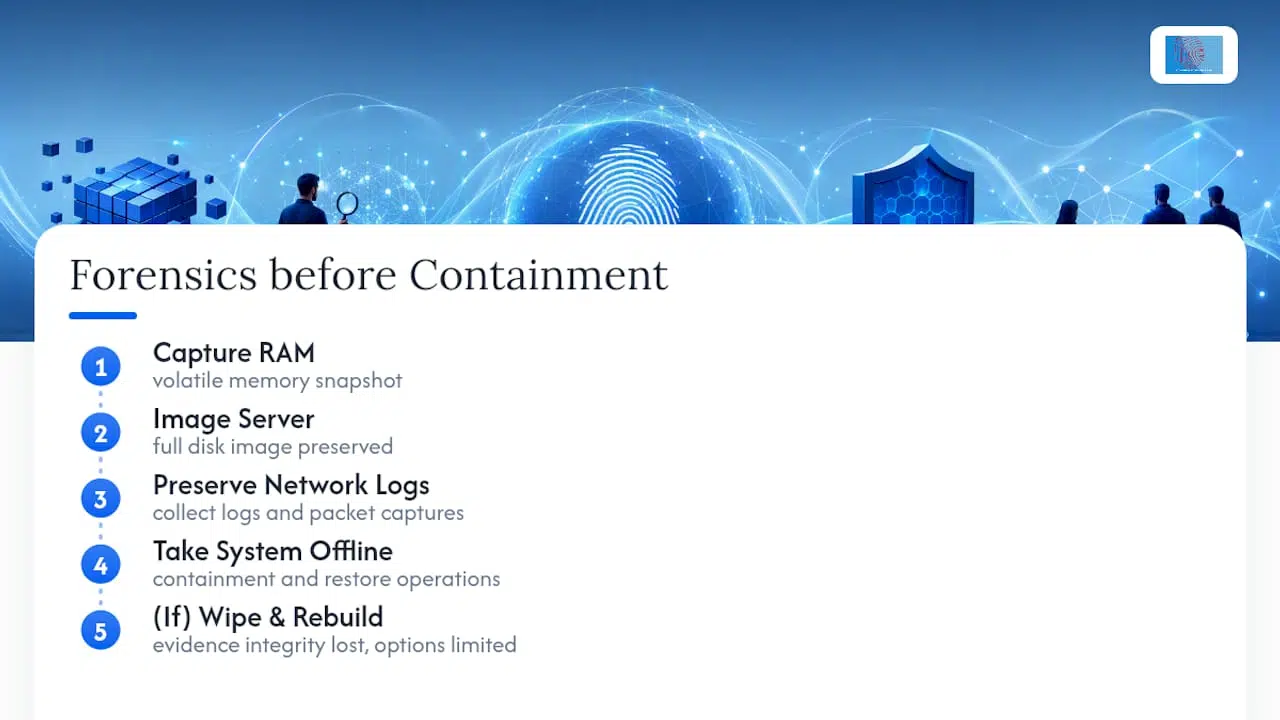
Organisations that build this coordination into their incident response plan, deciding in advance which systems trigger forensic capture and who is authorised to request it, consistently produce better post-incident evidence than those treating forensics as an afterthought bolted on once the immediate crisis has passed.
Certifications and training pathways for forensic investigators
Formal credentials signal a baseline of validated competence to courts, employers, and instructing solicitors alike, and several established pathways dominate the field. The Certified Forensic Computer Examiner (CFCE), the GIAC Certified Forensic Examiner (GCFE), and EnCase Certified Examiner (EnCE) each test practical examination skill against structured scenarios rather than pure theory. Vendor-neutral options like the Certified Computer Examiner (CCE) sit alongside vendor-specific tracks tied to particular forensic suites.
Academic routes matter too. University-level courses built around textbooks like Guide to Computer Forensics and Investigations provide the conceptual grounding, legal context, and multi-platform exposure that certification exams then test against, and current editions of that text explicitly build in coverage across Windows, macOS, Linux, and Android environments as a deliberate response to how fragmented the device landscape has become.
Continuing education carries real weight in a field where tools and attacker techniques shift constantly. A certification earned five years ago against a static exam says little about current competence unless it is backed by ongoing practical work, tool retraining, and exposure to genuinely current case types, mobile encryption schemes, cloud acquisition methods, and fileless malware among them.
Reporting standards and presenting findings in court
A forensic report has to satisfy two very different audiences at once: a technical peer capable of replicating the methodology, and a judge or jury with no computing background whatsoever. Meeting both without compromising either is the hardest writing task in the field.
Strong reports open with a plain-language summary of findings before any technical detail appears, then move into methodology, detailed findings, and supporting exhibits in that order. Every claim needs to trace back to a specific artefact, hash value, or timestamp, so opposing counsel cannot characterise a conclusion as speculation. Chain of custody documentation belongs in the report itself, not filed separately, since a reader should be able to verify evidential continuity without cross-referencing another document.
Testifying preparation starts well before any court date. An examiner needs to explain technical concepts, hash functions, timeline construction, the meaning of slack space, in language a lay juror can follow under cross-examination pressure, without either dumbing the science down inaccurately or drowning the room in jargon. Computerforensicslab’s guide to forensic evidence in legal disputes covers how expert reports translate into courtroom testimony for readers preparing to instruct or act as an expert witness themselves.
When a case genuinely needs a specialist forensic lab
Some cases are built for in-house handling. Others are not, and recognising the difference early saves both evidence and money.
Complex malware analysis, multi-device correlation across a dozen employee laptops in a data-theft investigation, or any matter heading toward litigation, all sit firmly beyond what internal IT teams can safely handle. The reason is not competence; it is that internal teams rarely have the chain-of-custody discipline, tool validation records, or courtroom-ready reporting experience that litigation demands, and a single procedural gap can undo months of otherwise sound technical work.
A specialist lab supplies what in-house resources typically cannot: formal expert witness reports written for judicial scrutiny, strict chain-of-custody handling from first contact through to trial, and advanced analysis techniques, memory forensics, malware reverse engineering, cross-device timeline correlation, that demand both specialist tooling and courtroom experience.
The clearest warning sign that a case has outgrown internal handling is uncertainty about whether current evidence-handling practice would survive cross-examination. If nobody on the team can confidently answer that question, the case has already reached the point where specialist involvement should have started, not the point where it might eventually become necessary.
— Computer
Instruct a forensic team that documents every step
Reading a guide like this one builds genuine understanding of how forensic investigation works, but understanding a process and executing it under evidential pressure, with a case’s outcome depending on it, are different skills entirely. A professional digital forensics provider applies the phase-by-phase discipline covered throughout this guide, forensic imaging, verified hash values, documented chain of custody, and courtroom-ready reporting, to real investigations for legal professionals, corporate clients, and private individuals.
Cases that involve cross-device correlation, suspected malware, contested digital evidence, or anything likely to end up in front of a judge benefit from specialist involvement from the outset rather than after an internal attempt has already compromised the evidence. Computerforensicslab’s digital forensic investigation services cover exactly this kind of engagement, from initial scoping through to expert witness reporting, and the broader digital forensics services overview sets out the full range of data recovery, analysis, and consultancy work available to solicitors, businesses, and private clients alike.
Sources
- Best Practices for Computer Forensic Examinations – SWGDE
- Guide to Computer Forensics and Investigations (extracts)
- Digital Forensics Tutorial: Evidence Collection and Analysis Guide (2026)