The quickest realistic route into digital forensics careers runs through one of two doors: a computer science or cybersecurity degree paired with hands-on lab practice, or existing IT, security, or law enforcement experience combined with a targeted certification and a working portfolio. Either path typically takes one to three years to reach entry-level competence, and both hinge on the same proof point employers actually check: can you produce reproducible, court-ready evidence?
TL;DR:
- Entry-level digital forensics roles typically take one to three years to reach competence, focusing on reproducible, court-ready evidence production.
- Employers value hands-on experience with tools like EnCase, FTK, or open-source alternatives, along with certifications aligned to their specific toolset.
- Building a portfolio through home labs, practical courses, and volunteering can often outweigh exam certificates in securing a job.
- Advancing in this field usually requires between three and seven years, with demand particularly strong in cloud forensics, memory analysis, and malware reverse-engineering.
- Networking through community involvement, conferences, and contributing to open-source projects significantly boosts chances of career progression.
Table of Contents
- What are the main forensics career paths and job titles?
- What skills and certifications do employers actually expect?
- How long does it take to build a forensics career, and what does it pay?
- How do you get hands-on forensic experience before landing a job?
- Where do forensic professionals actually work?
- How do you move into DFIR from IT, SOC work, or policing?
- What are the biggest challenges and ethical pitfalls in forensics careers?
- Which professional bodies and networks matter for career growth?
- How are new technologies changing forensics careers?
- What actually impresses hiring managers in this field?
- Where to find practical guides and professional support
- Sources
What are the main forensics career paths and job titles?
Digital forensics careers split broadly into two tracks: the technical bench and the investigative or courtroom-facing role. Some professionals move fluidly between both as they progress; others specialise deliberately.
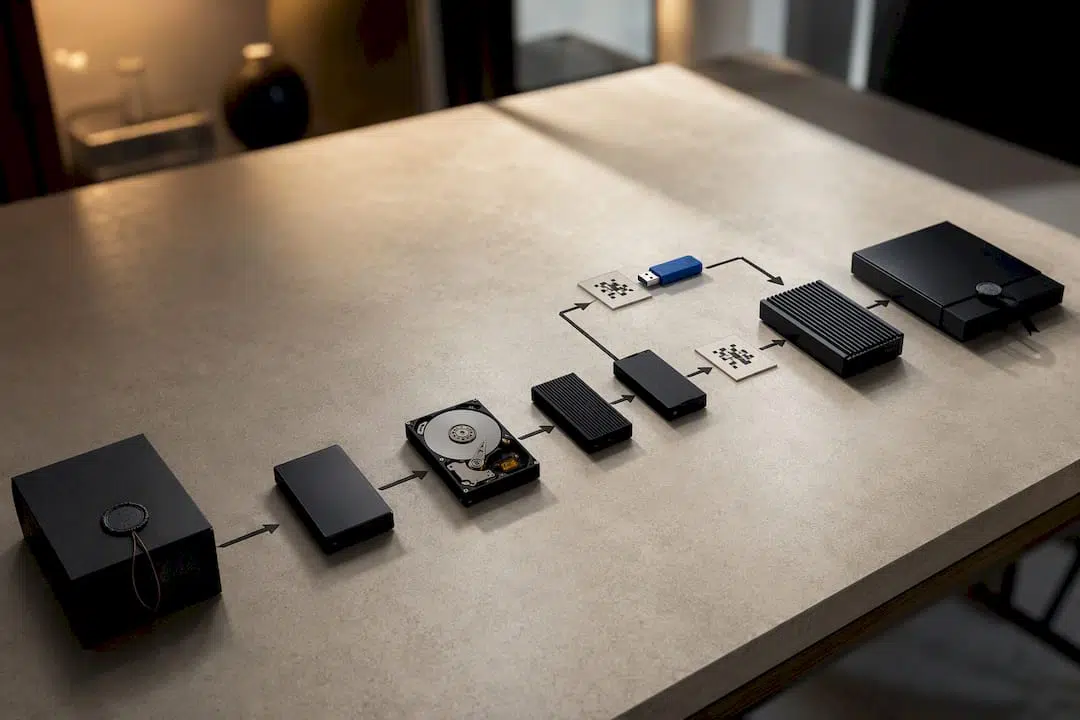
On the technical side, a forensic technician typically handles initial triage and imaging, often creating a forensically sound copy of a hard drive before an analyst begins deeper work. A digital forensic analyst or examiner takes that image and reconstructs what happened, building a timeline of file access, deletion, or network activity. Incident responders work faster and messier, often live inside a breached network, isolating malware while preserving evidence for later analysis. Mobile forensics specialists dig into phones and tablets, extracting deleted messages or app data that standard tools miss. Malware analysts reverse-engineer malicious code to understand its behaviour and origin.
On the investigative and legal side, e-discovery specialists manage the collection and review of electronic documents for litigation, while forensic consultants advise legal teams and sometimes prepare expert witness reports for court. A lab manager oversees casework quality, staffing, and compliance across a whole team.
Typical tasks vary sharply by role:
- A technician creates a forensic image and logs hash values for chain of custody.
- An analyst reconstructs a login timeline from registry and log artefacts.
- A consultant prepares an expert witness report explaining findings in plain language for a jury.
What skills and certifications do employers actually expect?
Employers look for a working grasp of operating system internals, networking fundamentals, file systems, and enough scripting (Python or PowerShell, usually) to automate repetitive analysis. Evidence handling and reproducible note taking matter just as much as technical chops. SWGDE’s core competencies frame the discipline around five stages: preparation, collection and acquisition, examination, analysis, and presentation or testimony, and most job descriptions map back to that structure whether they cite it directly or not.
Certifications form a rough ladder rather than a checklist to collect indiscriminately:
- CompTIA Security+ functions as a baseline, signalling foundational security knowledge to recruiters screening entry-level candidates.
- EnCE or CCE suit mid-career roles where the employer’s tooling centres on EnCase or similar commercial platforms.
- CHFI appeals to employers wanting a broad forensic investigation credential, particularly in corporate or government settings.
- GCFA or GCFE from SANS carry weight for advanced roles, especially where a team has trained on SANS methodology already.
Matching the certification to the employer’s actual tools pays off more than accumulating credentials for their own sake, since a firm running EnCase has little use for a candidate whose only proof is a generic exam. The NICE workforce framework and SWGDE competencies are the two references hiring managers most often use to benchmark candidates against a role’s real requirements.
Beyond the technical and legal skill set, courtroom basics matter more than most newcomers expect: knowing how to explain a finding without jargon, defend a methodology under cross-examination, and collaborate cleanly with solicitors on report language.
Pro Tip: Before sitting any exam, look at three job adverts for the role you actually want and note which tool names appear repeatedly. That tells you which certification will open doors, rather than which one merely looks impressive on paper.
How long does it take to build a forensics career, and what does it pay?
Progression in digital forensics tends to follow a fairly predictable arc. SANS Institute research places entry-level competence at one to three years, intermediate skill at three to seven years, and senior leadership positions at seven to fifteen years or beyond.
Career paths in DFIR commonly move from analyst to senior analyst, then to consultant or team lead, and eventually to lab manager or a security leadership role such as CISO.
Pay varies substantially by geography, sector, and specialism, so treat any figure as a band rather than a promise. Salary and demand data suggests solid, resilient demand for DFIR roles generally, with particularly strong upside for specialists in cloud forensics, memory analysis, and malware reverse-engineering. A government or law enforcement post often trades a lower ceiling for stability and pension benefits; a consultancy role usually pays more but demands billable hours and travel; an in-house corporate position sits somewhere between the two, with steadier hours but less variety of casework.
How do you get hands-on forensic experience before landing a job?
Employers rarely hire on theory alone, so the practical work you can point to matters more than the exam certificates in your file. Build it in this order:
- Set up a home lab. A spare laptop, a virtual machine, and a disk image you’re legally permitted to analyse are enough to start practising acquisition and examination workflows.
- Complete hands-on courses. SANS training and vendor-specific labs teach the exact workflows employers expect, and SANS guidance treats curiosity and consistent lab practice as more predictive of long-term success than formal background alone.
- Enter CTFs and NetWars-style exercises. These competitive challenges force you to solve realistic forensic puzzles under time pressure, which sharpens exactly the skills a live case demands.
- Publish reproducible case notes. Write up a home-lab investigation the way you would for a real client, showing your methodology clearly enough that another examiner could repeat it.
- Seek internships or pro bono work. Local legal clinics or student-run investigative projects sometimes need help and offer genuine, low-stakes casework experience.
When building your portfolio, anonymise everything and write sample reports with a proper chain-of-custody structure, because that discipline is exactly what a hiring panel wants to see demonstrated, not just described.
Practise on the tools your target employer actually uses. EnCase and FTK dominate many commercial and government labs, while open-source alternatives like Autopsy let you build the same muscle memory for free before you ever sit a paid course.
Pro Tip: Keep a running log of every artefact you find and how you found it, even in practice exercises. That habit, formed early, is what separates a competent examiner from one whose findings survive cross-examination.
Where do forensic professionals actually work?
Job adverts cluster around five sectors, and each rewards a different mix of skills:
- Law enforcement and government value stability and formal process, but expect slower promotion and heavier procedural constraints.
- Consultancies and specialist DFIR firms pay well for courtroom-ready reporting and variety, at the cost of unpredictable hours.
- Corporate security and incident response teams prioritise speed and containment over legal polish, since most cases never reach court.
- Legal and e-discovery providers want meticulous document handling and defensible review processes above all else.
- Financial services and defence sectors demand vetting, clearance, and often deep specialism in a narrow toolset.
Watch job adverts for concrete signals: named tools (EnCase, FTK, Cellebrite), explicit chain-of-custody experience, or a requirement for prior court testimony. Those phrases tell you exactly what the employer has actually needed before, not just what sounds good in a listing.
How do you move into DFIR from IT, SOC work, or policing?
Each feeder background needs a slightly different bridge into forensics careers.
From IT, the gap is usually evidence handling and scripting. Build examples from real incident triage you’ve already done, even informally, and learn proper imaging procedure so your existing troubleshooting instinct becomes forensically sound.
From SOC or incident response, you already understand detection; the leap is deep-dive analysis. Learn formal acquisition methods and timeline reconstruction so your alert-driven mindset extends into full investigative work.
From policing or military service, your investigative instincts transfer directly, but you need formal tool training and report-writing discipline that matches civilian forensic standards. A career guide for cyber crime investigators is worth reading if this is your starting point, since it maps investigative habits onto the specific documentation style DFIR work demands.
What are the biggest challenges and ethical pitfalls in forensics careers?
Digital evidence work carries pressures that rarely show up in a job advert. Caseloads can be relentless, particularly in law enforcement units chronically short-staffed against a growing volume of digital devices per investigation. Burnout is common among examiners who repeatedly review distressing material, and few organisations talk openly about that toll during recruitment.
Ethically, the core tension is objectivity under pressure. An examiner working for a defence solicitor or a prosecuting authority must reach the same conclusion regardless of who is paying the invoice, and that discipline is harder to maintain than it sounds when a client wants a particular answer. Evidence integrity is non-negotiable: a single broken hash value or an undocumented step in the acquisition process can render months of work inadmissible.
Scope creep is a quieter risk. Warrants and instructions define exactly what an examiner may access, and straying beyond that boundary, even accidentally, can taint an entire case. Confidentiality obligations run in parallel, since forensic examiners routinely see intimate personal data, corporate secrets, or evidence of serious crime, and the professional standard is silence outside the formally reported findings.
Finally, testifying under cross-examination tests more than technical knowledge. A methodology that seemed solid in the lab has to survive a barrister actively looking for cracks in it, which is precisely why reproducible, well-documented work matters more than clever one-off techniques.
Which professional bodies and networks matter for career growth?
Formal frameworks do more than set standards; they shape what a hiring manager expects from your CV. SWGDE’s competency guidance and the NICE cyber defence forensics analyst pathway are the two most commonly referenced frameworks in job descriptions, even when employers don’t cite them by name.
Beyond formal standards, community matters more in this field than most newcomers expect. SANS training and its associated community offer mentorship, forums, and CTF events that connect newcomers with practising examiners willing to answer questions and, occasionally, point towards open roles. Local chapters of broader security groups, alongside forensics-specific mailing lists and conference tracks, function as informal recruitment channels long before a vacancy is ever advertised publicly.
Networking in this field tends to work best around shared problems rather than small talk. Presenting a writeup at a local meetup, contributing to an open-source forensic tool, or simply being active and helpful in CTF communities builds a reputation that outlasts any single job application. Many senior examiners describe their first proper role coming through a personal introduction made at exactly this kind of informal gathering, not a job board.
How are new technologies changing forensics careers?
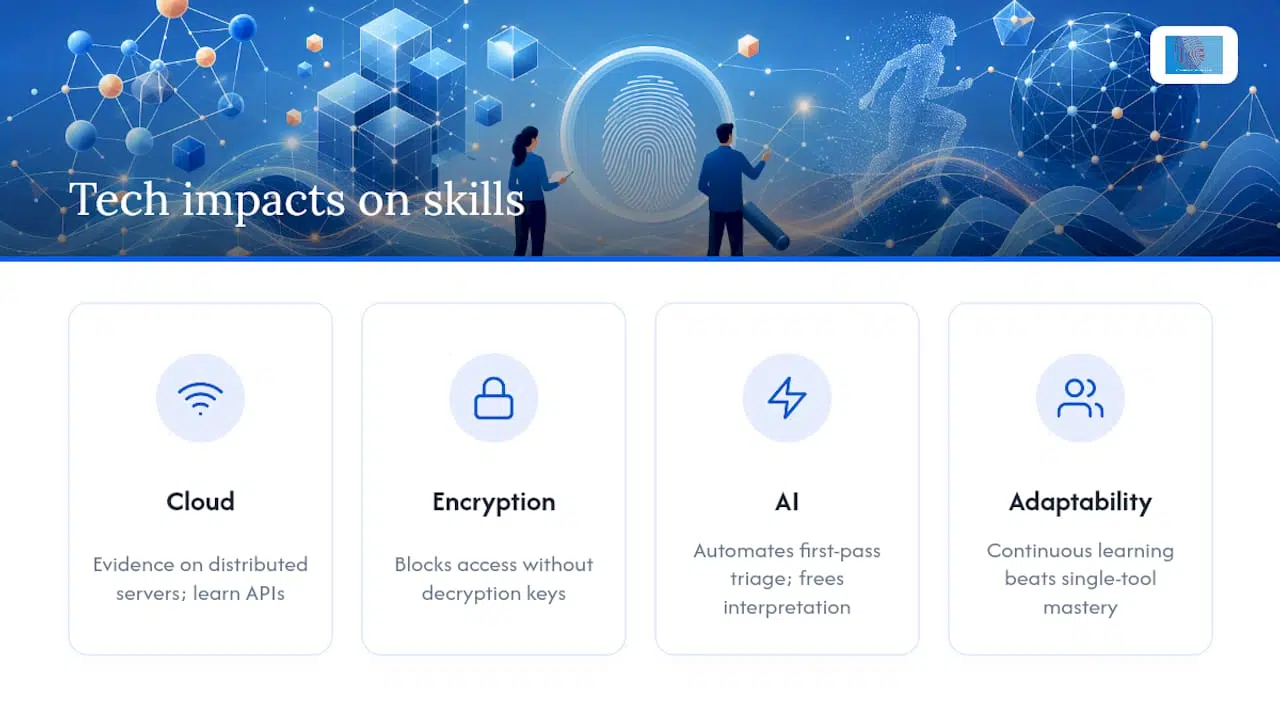
Cloud storage has already reshaped the discipline: evidence increasingly lives across distributed servers rather than a single seized hard drive, forcing examiners to master API-based acquisition and provider-specific legal processes instead of relying purely on physical imaging. Encryption, likewise, keeps raising the technical bar, and an examiner who cannot navigate full-disk encryption or encrypted messaging apps is increasingly locked out of entire categories of casework.
Artificial intelligence is starting to change the daily workload too, mostly by automating the tedious first pass through enormous data volumes, flagging anomalies in network logs or triaging thousands of files faster than a human ever could. That doesn’t replace the examiner’s judgment; it shifts their time towards interpretation and reporting rather than manual sifting. Mobile device complexity is climbing in parallel, with newer encryption schemes and app-specific data stores demanding constant retraining just to stay current.
None of this makes the fundamentals obsolete. If anything, it raises the value of examiners who can adapt their evidence-handling discipline to whatever new data source appears next, rather than those who mastered one tool and stopped learning.
What actually impresses hiring managers in this field?
Hiring managers in this field respond to demonstrated process, not credentials alone. Anonymised case notes that show a clean chain of custody, a clear examination log, and a reproducible artefact tell a stronger story than a certificate wall. Work in areas like expert witness reporting, mobile examinations, and cloud data recovery consistently separates candidates who can merely operate a tool from those who can explain their findings under scrutiny. Pairing independent study with a mentored internship remains the most honest shortcut available.
— Computer
Where to find practical guides and professional support
Independent study, CTFs, and community mentorship remain genuinely valid ways into this field, and nothing here should discourage that route. But if you want feedback on a portfolio, a clearer view of what real casework involves, or professional support while you build your own skills, Professional digital forensics services offer a practical next step that a self-study guide alone cannot: direct exposure to how properly documented, court-ready casework actually looks. The digital forensics services page outlines the range of investigative work handled day to day, from mobile examinations to cloud data recovery, and the guide on what cyber crime investigators do is a useful read for anyone still mapping out which role fits them best. If you’re weighing up a transition or want informal advice on where your existing background fits, get in touch to ask a question, no commitment required.
Sources
- Digital Forensics Salary, Skills, and Career Path | SANS Institute
- SWGDE core competencies for digital forensics
- Research