
TL;DR:
- Online investigations involve legally collecting and analyzing digital information from public sources for credible evidence. They require a structured approach, human verification, and strict legal compliance to produce admissible results in court.
An online investigation is the systematic process of legally collecting, analysing, and preserving digital information from public and authorised sources to produce credible intelligence for legal, corporate, or personal use. The discipline sits at the intersection of Open Source Intelligence (OSINT), digital forensics, and traditional investigative method. Professional firms combine over 100 years of team experience and more than 100 sworn testimony cases, which signals how seriously courts now treat digitally sourced evidence. Whether you are a solicitor building a fraud case, a corporate investigator tracing data theft, or a private individual verifying someone’s identity, the same core principles apply: lawful collection, rigorous verification, and defensible preservation.
What does an online investigation actually involve?
An online investigation is not simply searching Google. It is a structured process that combines OSINT techniques with traditional field expertise to produce findings that hold up under legal scrutiny. Digital investigations are foundational to serious cases, not supplementary, and they require integration with meticulous human verification at every stage.

The scope is broad. A single case may require analysing social media profiles, tracing email addresses, mapping digital footprints across platforms, recovering deleted content, and correlating accounts to a real identity. Each of these tasks calls for a different method and, often, a different tool. Computerforensicslab handles all of these layers as part of its digital forensic investigation services, covering everything from mobile device analysis to cloud data examination.
The term OSINT refers specifically to intelligence gathered from publicly available sources without any unauthorised access. That distinction matters enormously in court. Evidence gathered through hacking or bypassing authentication is inadmissible and exposes the investigator to criminal liability.
Essential tools for conducting online investigations
Modern OSINT toolkits are vast. OSINT Navigator aggregates over 7,500 curated tools, covering everything from username lookups to geolocation analysis. That scale means investigators must choose deliberately rather than exhaustively.
Tools fall into four practical categories:
- Data collection: Platforms that pull publicly available records, social media posts, domain registration data, and company filings.
- Verification: Services that cross-reference identifiers such as email addresses, phone numbers, and usernames across multiple databases.
- Archiving: Tools that capture and timestamp web pages, screenshots, and metadata to create a defensible record.
- Mapping: Utilities that visualise connections between accounts, entities, and locations.
For initial triage, browser-based tools like ghunt.sh support rapid lookups without installation. They suit early-stage verification when speed matters more than depth. Legal-grade work, however, requires command-line interface (CLI) tools that offer full logging, credential control, and audit trails. CLI frameworks such as osint-investigator can perform over 120 probes against a single email, cross-checking it against breach databases, social platforms, and registration records simultaneously. That depth is what separates a preliminary search from a court-ready investigation.
| Tool category | Primary purpose | Suitable for legal use |
|---|---|---|
| Browser-based lookup tools | Quick triage and initial verification | Preliminary only |
| CLI frameworks | Deep multi-source probing with logging | Yes, with documentation |
| Archiving utilities | Timestamped page capture and metadata | Yes |
| Mapping and link analysis | Visualising entity relationships | Yes, as supporting evidence |
Pro Tip: Before selecting any tool, confirm it collects data only from public sources and produces an auditable log. A tool that cannot show what it accessed, when, and how will undermine your evidence in court.
Pre-investigation preparation: legal compliance and planning
Legal compliance is not a box to tick at the end. It is the foundation of every stage. Investigators must strictly distinguish lawful public-source OSINT from illegal hacking or unauthorised access, because illegal collection voids evidence and exposes practitioners to prosecution.
Before any data collection begins, work through this checklist:
- Define the investigation’s specific objectives in writing. Vague goals produce unfocused evidence.
- Identify the jurisdictions involved. UK investigations fall under the Data Protection Act 2018 and the UK GDPR. Cross-border cases may also engage EU or US privacy law.
- Confirm that every data source you plan to use is publicly accessible without authentication.
- Document your authorisation to conduct the investigation, whether that is a client instruction letter, a court order, or a corporate mandate.
- Plan your chain-of-custody process before you collect a single piece of data. Decide who will handle evidence, how it will be stored, and how access will be logged.
- Engage legal counsel early if the case involves sensitive personal data, minors, or potential criminal proceedings.
Pro Tip: The most common compliance mistake is collecting data first and asking legal questions later. Reverse that order. A five-minute legal check before collection prevents weeks of inadmissibility arguments afterwards.
How to execute an online investigation step by step
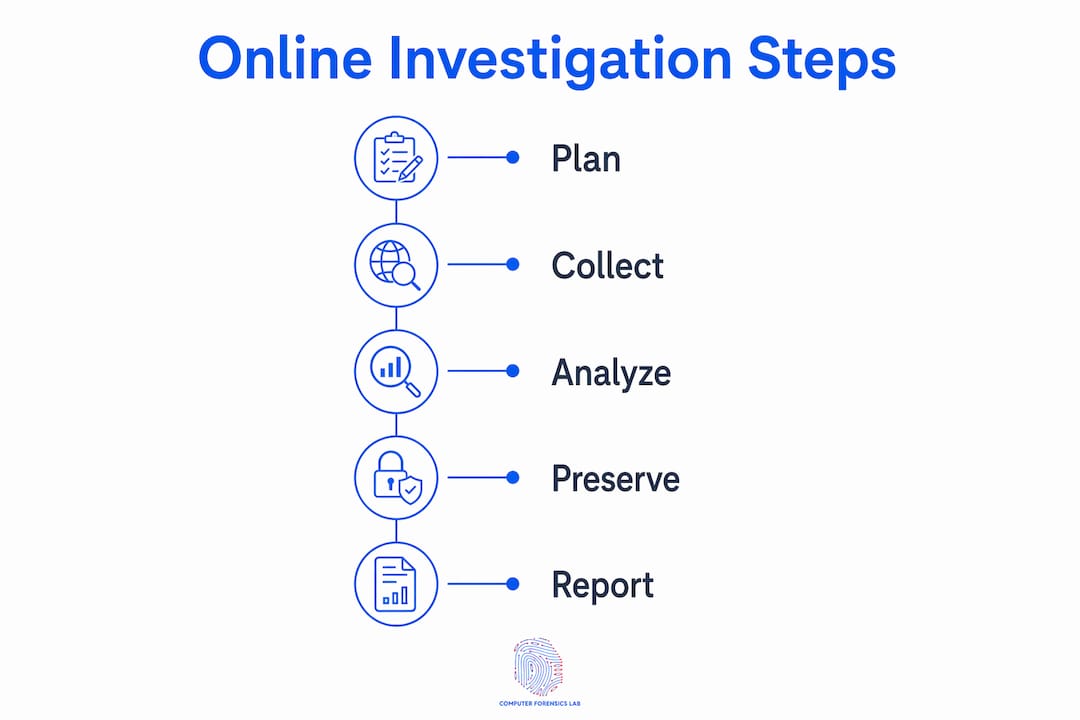
A structured execution process separates professional results from amateur searches. Follow these steps in order.
- Choose your starting identifiers. An email address, username, phone number, or company registration number gives you an anchor point. Every subsequent step builds outward from that anchor.
- Run initial lookups across multiple sources. Cross-reference the identifier against social platforms, domain records, breach databases, and public registries. Never rely on a single source.
- Validate each finding independently. Automated OSINT must be validated by human analysis before it carries evidential weight. A tool that returns a result does not mean the result is accurate.
- Detect deceptive activity. Look for inconsistencies in profile creation dates, writing style, profile images (reverse image search is standard practice), and account activity patterns. Fake profiles often show sudden bursts of activity followed by long silences.
- Map the digital footprint. Correlate accounts, email addresses, and usernames to build a picture of the subject’s online presence. Link analysis tools help visualise these connections.
- Archive everything with timestamps. Capture screenshots, save page source files, and record metadata. Web content disappears. Archived copies with verified timestamps are your insurance.
- Handle anti-scraping barriers professionally. Many people-finder sites deploy anti-scraping protections. Headless browsers like Playwright allow investigators to navigate these barriers and log blocked requests rather than silently returning incomplete data.
- Document continuously. Every action, every tool used, every source accessed, and every finding must be logged with a timestamp and the investigator’s name.
Pro Tip: Keep a running investigation log in a write-once format, such as a signed PDF journal or a version-controlled document. Courts scrutinise the gap between when evidence was collected and when it was first documented. Contemporaneous records close that gap.
Preserving digital evidence and ensuring legal admissibility
Evidence preservation is where investigations succeed or fail in court. Chain-of-custody documentation underpins evidence admissibility, and every step must be recorded: what was preserved, when, how, and by whom. Any gap in that record invites a challenge.
Hashing is the technical cornerstone of preservation. When you collect a file or capture a web page, you generate a cryptographic hash (typically SHA-256) of the original. If the hash matches when the file is examined later, the data has not been altered. That proof of integrity is what defensible preservation methods are built upon, and specialist firms with decades of experience in complex digital fraud cases treat it as non-negotiable.
Different data types require different handling. Social media content must be captured with its metadata intact, including post timestamps, geolocation tags, and account identifiers. Cloud data requires documented access logs showing that collection was authorised. Collaboration platform data, such as messages from Teams or Slack, needs to be exported in a format that preserves threading and timestamps.
Computerforensicslab follows evidence preservation best practices that satisfy UK legal standards, including maintaining a full chain of custody and producing expert witness reports that withstand cross-examination. For investigators handling their own cases, a digital evidence preservation checklist is the most practical starting point.
Pro Tip: Preserve evidence as early as possible. Social media posts, cloud files, and website content can be deleted within hours of a dispute arising. Delayed preservation is the single most common reason strong cases lose their evidential foundation.
Common challenges and how to overcome them
Online investigations encounter predictable obstacles. Knowing them in advance lets you plan around them rather than react to them.
- Anti-scraping protections block automated tools on many people-finder and social media sites. Use headless browser automation to detect blocking and log the attempt rather than accepting a silent failure as a complete result.
- Incomplete or stale data is common when subjects have deleted accounts or changed identifiers. Cross-reference multiple sources and check archived versions of pages using services like the Wayback Machine.
- Over-reliance on automated outputs produces errors. Tools aggregate data; they do not verify it. Every significant finding needs a human to confirm it through an independent source before it enters a report.
- Jurisdictional complexity catches investigators off guard. A subject based in Germany, investigated from the UK, with data stored in the US creates three overlapping legal frameworks. Map the jurisdictions before you collect anything.
- Generic findings without follow-through leave cases unresolved. Investigations must connect findings directly to response teams or recommended actions. A report that identifies a problem but offers no path forward has limited value to a legal team or a client.
- Deleted or time-sensitive content demands urgency. The moment an investigation begins, preservation of relevant content should begin simultaneously. Waiting until the analysis phase is complete often means key evidence has already gone.
The most dangerous habit in digital investigations is trusting a tool’s output without questioning it. Tools are fast. They are not infallible. Critical thinking applied to every result is what separates admissible evidence from a collection of interesting but useless data points.
Key takeaways
Effective online investigations depend on combining lawful OSINT methods, verified data collection, and defensible evidence preservation from the very first step.
| Point | Details |
|---|---|
| Legal compliance comes first | Distinguish lawful public-source OSINT from unauthorised access before collecting any data. |
| Use tools by category and purpose | Match browser-based tools to triage and CLI frameworks to legal-grade, logged investigations. |
| Validate every automated finding | Human analysis must confirm each result before it enters a report or legal submission. |
| Preserve evidence immediately | Hash and archive data at the point of collection; delayed preservation risks deletion or tampering. |
| Document every action | A contemporaneous investigation log with timestamps is the foundation of chain-of-custody integrity. |
Why methodology matters more than tools
After years of working on digital investigations, the pattern I see most often is investigators who invest heavily in tools and lightly in process. They acquire access to powerful OSINT platforms, run comprehensive probes, and produce detailed reports. Then the case collapses because the chain of custody was an afterthought, or because a key finding was never independently verified.
The tools are not the hard part. OSINT Navigator’s catalogue of 7,500+ tools means access is rarely the limiting factor. The hard part is discipline: logging every action, questioning every automated result, and preserving evidence before the subject has a chance to delete it. I have seen cases where a single unverified data point, accepted at face value from a CLI output, was the thread that unravelled an otherwise solid investigation under cross-examination.
The other thing I would stress is the value of combining digital methods with traditional field investigation. OSINT tells you what someone’s digital presence looks like. It does not always tell you whether that presence is genuine. Field verification, witness accounts, and physical records still close gaps that no browser tool or CLI framework can. The best investigators treat digital and traditional methods as complementary, not competing.
Continuous learning is not optional in this field. Privacy regulations change, platforms alter their data structures, and anti-scraping measures evolve constantly. What worked reliably in 2024 may return incomplete results in 2026. Staying current with OSINT communities, legal updates, and tool documentation is part of the job, not a bonus activity.
— Computer
Professional digital forensics support for complex investigations
When an investigation involves litigation, criminal proceedings, or significant corporate risk, professional support is not a luxury. Computerforensicslab provides expert digital forensics services covering digital footprint analysis, data preservation, mobile and cloud examination, and court-ready expert witness reports. Every engagement maintains a full chain of custody and meets UK legal standards for evidence admissibility. For cases involving cybercrime, employee misconduct, or intellectual property theft, Computerforensicslab’s team brings the forensic rigour that self-conducted investigations cannot replicate. If your case requires forensic investigation support or you need guidance on where professional involvement adds the most value, Computerforensicslab is the right starting point.
FAQ
What is OSINT and how does it relate to online investigation?
OSINT stands for Open Source Intelligence and refers to information gathered from publicly available sources without unauthorised access. It forms the primary method used in most online investigations, covering social media, domain records, public registries, and breach databases.
Is it legal to conduct an online investigation on someone?
Collecting publicly available information is lawful, but accessing private accounts, bypassing authentication, or intercepting communications is illegal and voids any evidence gathered. Always confirm that every source is publicly accessible before collection begins.
How do I preserve digital evidence for use in court?
Generate a cryptographic hash of each file at the point of collection, document who collected it, when, and how, and maintain an unbroken chain of custody throughout. Computerforensicslab’s evidence preservation guidance covers the full process for UK legal standards.
Can automated tools alone produce court-admissible evidence?
Automated tools cannot produce admissible evidence on their own. Human analysis must validate every automated finding before it enters a legal submission, as courts require evidence of human judgement and verification, not just tool output.
When should I engage a professional digital forensics firm?
Engage a professional firm when the case involves litigation, criminal proceedings, significant financial value, or data types that require specialist extraction such as deleted files, encrypted drives, or cloud platform data.