
TL;DR:
- Digital forensics involves a structured, sequential process of handling digital evidence that ensures legal credibility.
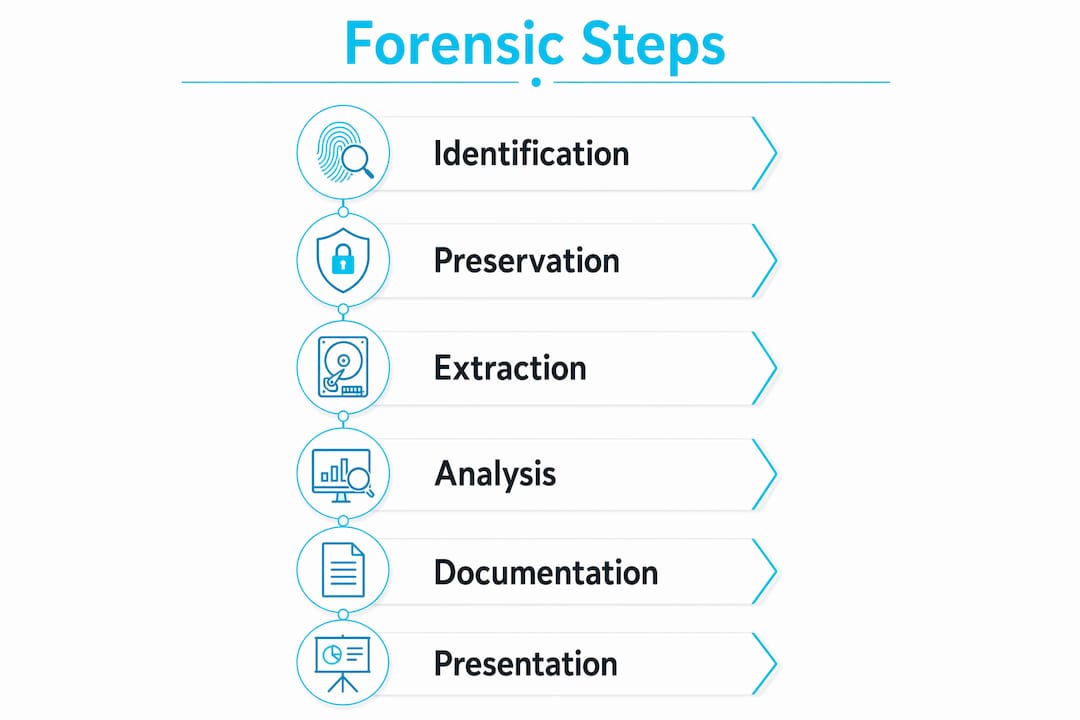
- Key phases include identification, preservation, extraction, analysis, documentation, and presentation, each building on the previous step.
Digital forensics is defined as the structured process of identifying, preserving, extracting, analysing, documenting, and presenting digital evidence in a manner that withstands legal scrutiny. The forensic workflow phases form a chain where each link directly affects the admissibility and credibility of evidence in court. Tools such as FTK Imager, XRY Pro, XAMN, and KAPE now define the professional standard across law enforcement and corporate investigations. In 2026, RAM capture has become a baseline requirement for high-stakes cases, and cryptographic hash verification is non-negotiable from the moment of acquisition. This guide covers every phase in sequence, with the precision that legal professionals, investigators, and cybersecurity teams require.
What are the steps of digital forensics?
The steps of digital forensics follow a strict sequence: identification, preservation, extraction, analysis, documentation, and presentation. Skipping or compressing any phase introduces risk of evidence contamination, legal challenge, or outright exclusion from proceedings. Each phase builds directly on the integrity of the previous one, which is why the computer forensics workflow must be treated as a single, unbroken chain rather than a checklist of independent tasks.
Identification defines the scope of the investigation. Preservation locks the evidence state before any extraction begins. Extraction retrieves data using methods appropriate to the device and case type. Analysis transforms raw data into a coherent evidentiary narrative. Documentation records every action, tool, and decision in real time. Presentation translates technical findings into language that judges, juries, and regulators can act upon.
Understanding this sequence is not merely academic. A defence barrister who identifies a gap between the extraction and documentation phases can challenge the entire chain of custody, potentially rendering months of investigative work inadmissible.
How to identify and isolate digital evidence effectively
Identification is the phase where investigators define what evidence exists, where it resides, and how it must be handled. Sources include endpoints, mobile devices, cloud storage, network logs, physical media, and IoT devices. Missing a single source at this stage can create evidentiary gaps that are impossible to close later.
The most consequential decision in this phase is how to isolate a live device. Immediate network isolation without powering off preserves volatile memory and active attack evidence that would be permanently lost on shutdown. Faraday bags prevent remote wipe commands from reaching mobile devices. Powering off a device before capturing RAM discards injected processes, decryption keys, and command history that exist only in live memory.
Key actions during the identification phase:
- Map all potential data sources before touching any device
- Place mobile devices in Faraday bags immediately upon seizure
- Isolate compromised hosts from the network without shutting them down
- Photograph the physical environment and device states before any interaction
- Note running processes, open applications, and network connections on live systems
Hidden devices present a genuine challenge. USB drives concealed in furniture, cloud accounts accessed from personal devices, and encrypted partitions on corporate hardware are all common in corporate misconduct and cybercrime cases. A thorough identification phase accounts for these possibilities by reviewing network access logs and account activity before physical seizure begins.
Pro Tip: Record the device’s screen state, battery level, and any visible notifications immediately upon discovery. This contemporaneous record can become critical evidence if the device’s condition is later disputed in court.
Best practices for preserving digital evidence without alteration
Preservation is the phase most frequently challenged in legal proceedings, because any alteration to original media after seizure is grounds for exclusion. The rule is absolute: working on original media compromises evidentiary reliability and risks exclusion in legal proceedings. Every forensic examination must be conducted on a verified forensic copy.
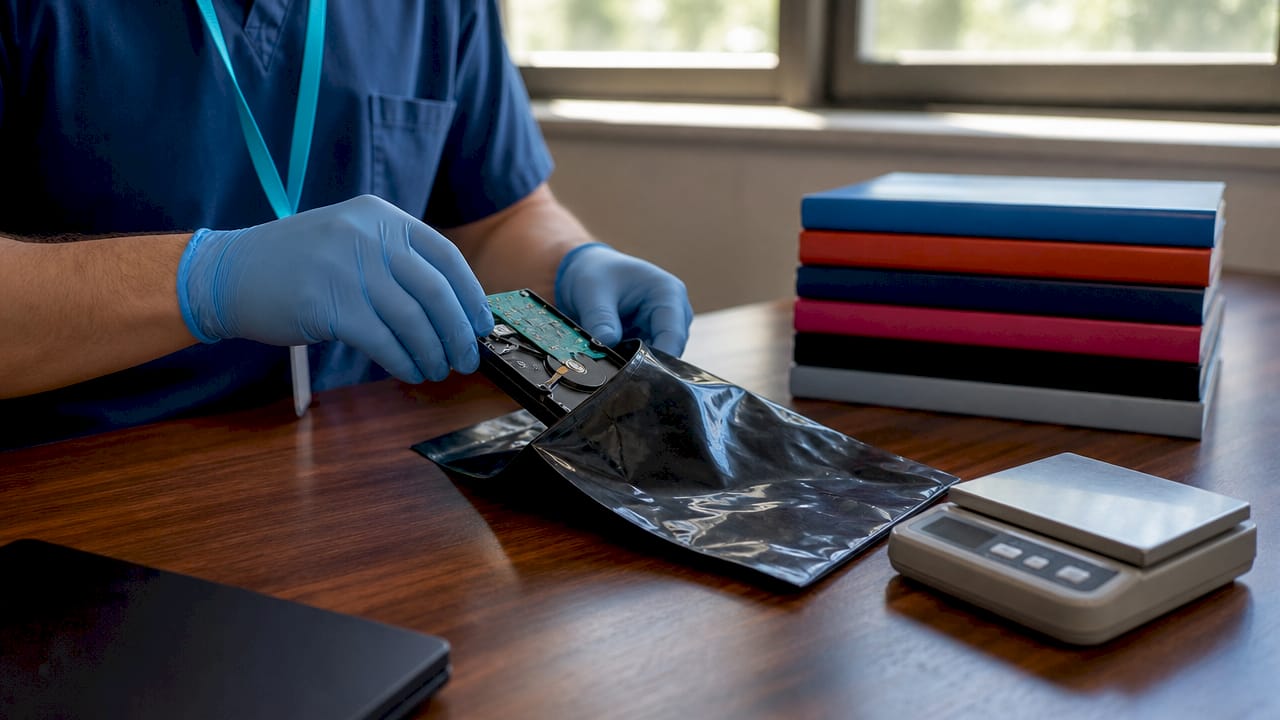
Hardware write blockers are the standard tool for disk acquisition. They allow data to be read from a drive without permitting any write operations, ensuring the original remains unmodified. For mobile devices, tools like XRY Pro maintain detailed audit logs of every extraction action, providing a verifiable record that supports chain-of-custody documentation.
Core preservation requirements:
- Use hardware write blockers for all disk-based acquisitions
- Generate and record cryptographic hashes (MD5 or SHA-256) immediately after acquisition
- Store original media in tamper-evident packaging with signed seals
- Work exclusively on forensic copies for all examination and analysis
- Maintain a detailed chain of custody log with timestamps, personnel names, and actions taken
Cryptographic hashes such as MD5 or SHA-256 must be recorded immediately after acquisition to verify integrity and maintain legal admissibility. A hash mismatch at any later point proves the evidence has been altered, which is why hashing is performed both at acquisition and again before analysis begins.
Pro Tip: Conduct forensic readiness drills at least twice a year. Readiness drills improve permissions, log retention policies, and process reliability before a real incident exposes gaps under pressure.
Extraction techniques: from logical to RAM capture in modern forensics
Extraction is where the technical complexity of a forensic investigation becomes most apparent. Four distinct methods exist, each suited to different circumstances, and choosing the wrong one can mean critical evidence is never recovered.
| Extraction method | What it captures | Pros | Cons | Ideal use case |
|---|---|---|---|---|
| Logical | Files, folders, databases visible to the OS | Fast, low risk of alteration | Misses deleted files, hidden partitions | Initial triage, cloud data |
| File system (FFS) | Full file system including deleted file entries | Recovers deleted data | Slower than logical | Standard criminal investigations |
| Physical | Bit-for-bit copy of entire storage media | Most complete; recovers all data | Time-intensive; requires write blocker | High-stakes litigation, serious crime |
| RAM capture | Live memory: processes, keys, sessions | Captures volatile data unavailable elsewhere | Must be performed before shutdown | Malware analysis, encryption bypass |
RAM extraction is now the 2026 standard for high-stakes investigations because it captures decryption keys and live session data that disappear permanently when a device is powered down. Tools such as XRY Pro and WinPmem are purpose-built for this task. The Order of Volatility dictates that RAM must be captured first, followed by disk and other persistent media, to prevent permanent evidence loss.
Encryption presents the most significant barrier to physical and file system extraction. Full-disk encryption on modern devices, combined with secure enclave architectures, means that physical acquisition without the correct credentials yields unreadable data. RAM capture sidesteps this problem by recovering keys from live memory before the device is locked or shut down.
Targeted artifact extraction using KAPE dramatically reduces triage time by pulling specific files such as registry hives and event logs rather than imaging entire disks. This approach reduces investigation time from days to hours when the scope of relevant data is well-defined.
Pro Tip: Always document which extraction method was chosen and why. A court may require justification for why a physical image was not taken, particularly in cases where the defence argues that relevant data was overlooked.
How forensic analysis transforms raw data into actionable evidence
Analysis is the phase where raw extracted data becomes a coherent account of events. The process involves parsing application databases, carving deleted files, reconstructing timelines, and correlating artefacts across multiple data sources to build the evidentiary narrative.
Parsing application databases is often where the most significant evidence resides. WhatsApp and Telegram store message histories, group memberships, and media in SQLite databases that survive deletion from the visible interface. Forensic tools such as XAMN parse these databases directly, recovering message threads, timestamps, and contact identifiers that are invisible to standard device browsing.
Key analysis processes and their outputs:
- File carving: Recovers deleted files by identifying file headers and footers in unallocated disk space, independent of file system records
- Metadata examination: Extracts creation, modification, and access timestamps from documents and images, often revealing discrepancies between claimed and actual file histories
- Timeline reconstruction: Correlates events across system logs, application records, and network data to establish a precise sequence of actions
- Link analysis: Maps relationships between accounts, devices, and communications to identify co-conspirators or data exfiltration pathways
- Hash verification: Cross-checks recovered files against known malware databases or previously hashed evidence to confirm authenticity
XAMN and KAPE together cover the two dominant analysis workflows: XAMN for mobile and communication data, KAPE for targeted Windows artefact collection. Using both in parallel on a single case reduces the risk of missing evidence that falls outside either tool’s primary scope.
Validation is not optional. Every significant finding must be verified by re-running the analysis on the forensic copy and confirming that hash values match the acquisition baseline. A finding that cannot be reproduced independently will not survive cross-examination. For cases involving forensic data analysis at scale, structured workflows that document each analytical step are the difference between a defensible report and a challenged one.
Documentation and presentation: making forensic findings legally defensible
Documentation and presentation are, in practice, the most critical phases for legal outcomes. A technically flawless investigation that produces poorly documented findings will fail in court. Technical findings must be presented in understandable language, backed by traceable evidence references that any competent barrister can follow.
Real-time documentation is the standard. Every tool used, every command executed, and every hash recorded must be logged at the moment of action, not reconstructed from memory afterwards. Immutable case logs, maintained in structured formats such as Git repositories, ensure that the investigation record is reproducible and verifiable months after the event. This matters acutely when cases reach trial a year or more after the initial investigation.
A complete forensic report contains the following components:
- Executive summary: A non-technical overview of findings, conclusions, and their significance to the case
- Methodology section: A precise account of tools used, extraction methods applied, and the rationale for each decision
- Evidence log: A timestamped record of every item examined, with hash values and chain-of-custody entries
- Findings section: Detailed technical findings with direct references to the evidence items that support each conclusion
- Appendices: Raw data outputs, tool version records, and any peer review or independent validation results
Translating technical findings for non-technical audiences is a skill that many forensic practitioners underestimate. A judge does not need to understand SQLite database structure. They need to understand that a message was sent from a specific device at a specific time, and that the evidence proving this cannot have been fabricated or altered. Clear documentation that translates complex technical findings into understandable narratives is the defining factor in courtroom success.
Independent peer review of the report before submission strengthens its credibility significantly. A second qualified examiner who reaches the same conclusions from the same evidence removes the possibility of a successful challenge based on examiner bias or error.
Pro Tip: Use AI-assisted legal tools to review draft forensic reports for clarity and logical consistency before submission. These tools identify ambiguous language that could be exploited during cross-examination.
Key takeaways
A defensible digital forensics investigation depends on executing each phase in strict sequence, with real-time documentation and cryptographic verification at every stage.
| Point | Details |
|---|---|
| Sequence is non-negotiable | Each phase from identification to presentation builds on the previous; skipping any step risks evidence exclusion. |
| RAM capture is now standard | Volatile memory must be acquired before any other extraction in high-stakes cases to preserve decryption keys and live session data. |
| Work only on forensic copies | Examining original media directly compromises admissibility; always use verified copies with matching hash values. |
| Documentation drives court outcomes | Real-time, immutable logs and clear non-technical narratives determine whether findings survive legal challenge. |
| Readiness drills prevent failure | Practising the forensic workflow before an incident occurs identifies gaps in permissions, log retention, and process reliability. |
Why process discipline matters more than the tools you use
After working with legal teams, law enforcement, and corporate clients across a wide range of digital investigations, the pattern that stands out most clearly is this: cases are won or lost on process, not on which software was used. Investigators who rely on expensive platforms but document inconsistently produce reports that collapse under cross-examination. Investigators who follow a repeatable, well-documented workflow produce findings that hold up even when the opposing barrister is determined to find fault.
The most common failure point is the gap between extraction and documentation. An examiner recovers critical evidence, moves immediately into analysis, and reconstructs the documentation later from memory. That reconstruction, however accurate, is not contemporaneous. A skilled defence counsel will exploit that gap.
Encryption and volatile data loss are the two challenges that catch even experienced teams unprepared. The instinct to power down a device before imaging it is understandable but wrong. Losing RAM content means losing the only evidence that a particular process was running, a particular key was loaded, or a particular session was active. Computerforensicslab has seen cases where this single error eliminated the possibility of proving malware execution.
The other underestimated factor is multidisciplinary collaboration. Legal professionals, forensic examiners, and IT security teams each see a different dimension of the same investigation. When they work in silos, findings are incomplete. When they work together from the identification phase onwards, the investigation is more thorough, the documentation is more coherent, and the courtroom presentation is more persuasive. Digital forensics compliance is not a forensic team’s problem alone. It is a shared responsibility across every discipline involved in the case.
— Computerforensicslab
How Computerforensicslab supports your forensic investigation
Computerforensicslab provides end-to-end digital forensic investigations for legal professionals, law enforcement, and corporate clients across the UK. Every engagement follows the structured workflow described in this guide, with real-time documentation, cryptographic verification, and chain-of-custody records maintained throughout. Reports are prepared to expert witness standard, with clear non-technical narratives suitable for court submission and regulatory review. Whether your case involves mobile device extraction, cloud data recovery, malware analysis, or employee misconduct, Computerforensicslab applies the latest techniques to produce findings that withstand legal scrutiny. Explore the step-by-step evidence collection service to understand how each phase is handled in practice.
FAQ
What are the main steps of digital forensics?
The six core steps are identification, preservation, extraction, analysis, documentation, and presentation. Each phase must be completed in sequence to maintain evidence integrity and legal admissibility.
Why is RAM capture important in modern forensic investigations?
RAM holds volatile data including decryption keys, active sessions, and running processes that are permanently lost when a device is powered down. Capturing RAM before any other extraction is now the standard practice for high-stakes investigations in 2026.
What is the purpose of cryptographic hashing in digital forensics?
Cryptographic hashes such as MD5 or SHA-256 create a verifiable fingerprint of evidence at the moment of acquisition. Any subsequent alteration to the data produces a different hash value, proving tampering and protecting chain-of-custody integrity.
How does chain of custody affect evidence admissibility?
Chain of custody is the documented record of every person who handled evidence, every action taken, and every location where it was stored. Gaps or inconsistencies in this record give defence counsel grounds to challenge admissibility in court.
What is the difference between logical and physical extraction?
Logical extraction retrieves files and data visible to the operating system, while physical extraction produces a bit-for-bit copy of the entire storage media including deleted files and unallocated space. Physical extraction is more complete but requires more time and a hardware write blocker to avoid altering the original.