
TL;DR:
- Deleted data often remains recoverable long after deletion due to how operating systems handle file removal. Proper forensic techniques, validated tools, and prompt action are essential for admissible evidence recovery. Understanding the technical nuances and limitations is crucial for legal professionals involved in digital investigations.
When a device is wiped, most people assume the data vanishes permanently. In reality, that assumption has cost countless legal cases their strongest evidence. Deleted data frequently persists on storage media long after the act of deletion, and understanding exactly when, how, and to what degree it can be retrieved is fundamental knowledge for any legal professional or organisation navigating cybercrime investigations, data breach litigation, or employee misconduct disputes in the UK.
Table of Contents
- Understanding deleted data recovery
- Data recovery tools and their effectiveness
- Limits and challenges of deleted data recovery
- Applying deleted data recovery in legal investigations
- Why deleted data recovery is misunderstood in legal circles
- Expert forensic support for deleted data recovery
- Frequently asked questions
Key Takeaways
| Point | Details |
|---|---|
| Deleted data is recoverable | Most deleted data can be retrieved unless it has been overwritten, encrypted, or securely erased. |
| Recovery tool effectiveness varies | Top tools offer up to 98.7% recovery rates for certain formats, but context and file type are critical. |
| Legal process requires caution | Chain of custody and correct recovery protocol are essential for evidence admissibility in UK courts. |
| Timing is vital | Quick initiation after deletion maximises data recovery viability and reliability. |
| Expert support maximises reliability | Professional digital forensics teams provide essential guidance and reduce risks for legal cases. |
Understanding deleted data recovery
The term “deleted” is one of the most misleading words in digital forensics. When a user deletes a file, the operating system does not immediately erase the underlying data. Instead, it marks the space occupied by that file as available for reuse. The actual content remains intact on the storage medium until new data physically overwrites it. This technical distinction is the cornerstone of forensic recovery work.
For legal professionals, the practical implication is significant. Evidence you believe is gone may be fully recoverable, provided the device is secured quickly and handled correctly. Key sources for deleted data in investigations include:
- Unallocated space: The area of a drive marked as free but still containing remnant data from deleted files
- File system logs and journals: Many operating systems maintain logs of file activity that record traces even after deletion
- Backup repositories: Cloud syncs, shadow copies, and local backups often retain deleted files automatically
- Swap files and temporary caches: The operating system routinely writes data to temporary locations that persist beyond a session
- Email server logs: Even deleted emails frequently leave metadata traces on mail servers
The data recovery guide published by Computer Forensics Lab provides a thorough primer on how these sources are accessed legally and methodically. Recovery success is not guaranteed in every scenario. Benchmarks show 70-90% success for non-overwritten data in cybercrime and breach investigations, but success drops to precisely zero after TRIM commands on solid-state drives (SSDs) or after full-disk encryption has been applied without key access. TRIM is a command that SSDs use to proactively erase deleted blocks, which dramatically accelerates write performance but permanently destroys forensic potential.
The legal relevance of evidential value depends entirely on how data was recovered, from which source, and under what chain of custody. Following best practice forensics protocols ensures that recovered data is not only genuine but defensible in court.
Pro Tip: The moment you suspect a device contains relevant evidence, instruct your IT team or forensic examiner to take it offline immediately. Every write operation to an active device risks overwriting the very data you need.
Data recovery tools and their effectiveness
Having established what deleted data is and its legal relevance, let us examine which tools deliver the best recovery outcomes and why these details matter for evidence.
Not all forensic tools are equal. Different tools are optimised for different file types, storage media, and operating systems. For legal investigations, choosing the wrong tool does not just mean lower recovery rates; it can mean inadmissible evidence if the tool’s methodology cannot withstand expert scrutiny.
| Tool | Recovery benchmark | Best use case | Admissibility considerations |
|---|---|---|---|
| PhotoRec | 98.7% (JPEG/PDF) | Media and document recovery | Open-source; methodology is transparent and peer-reviewed |
| Bulk Extractor | 90% deleted files | Large-scale data carving | Widely used in law enforcement; strong documentation |
| Puran File Recovery | 88.89% (USB drives) | Removable media recovery | Less common in courts; requires expert validation |
| EnCase | Industry standard | Full forensic investigations | Gold standard for UK court proceedings |
| Autopsy | High for structured data | Open-source investigations | Acceptable when properly validated |
Empirical benchmarks show striking variation across tools: PhotoRec achieves 98.7% recovery for JPEG and PDF files, Bulk Extractor recovers approximately 90% of deleted files in carving operations, Puran File Recovery demonstrates 88.89% success on USB drives, and the landmark Enron investigation demonstrated that 85% of deleted emails were ultimately recovered through forensic examination. These figures matter enormously when you are building a legal argument around digital evidence, because opposing counsel will scrutinise the methodology.
Key considerations when selecting a tool for legal investigations include:
- Validation status: Has the tool been tested and validated by an independent body such as the National Institute of Standards and Technology (NIST)?
- Audit trail: Does the tool produce a complete, reproducible log of every action taken during recovery?
- File type specificity: No single tool excels across all file types; experienced forensic examiners often use multiple tools in combination
- Chain of custody compatibility: The tool must support write-blocking and work-image protocols so the original evidence is never altered
For a practical breakdown of which approaches suit which investigation type, the article on top data recovery techniques for legal investigations is worth reviewing before instructing a forensic expert.
Key figure: The Enron scandal recovery of 85% of deleted emails remains one of the most cited demonstrations of what forensic data recovery can achieve in high-stakes legal proceedings. It fundamentally shifted how courts and legal teams perceive digital evidence.
Limits and challenges of deleted data recovery
With tool effectiveness understood, it is essential to recognise the boundaries and the technical and legal complications that can undermine evidence recovery entirely.
Recovery is never a certainty, and legal teams that proceed as if it is often damage their own cases. The following numbered checklist represents the most common points of failure that we see in investigations referred to us after other attempts have gone wrong:
- Delayed action: Every second a device remains active after deletion is a risk. Modern operating systems write constantly to storage media. Waiting even 24 hours before securing a device can result in critical data being overwritten.
- Improper imaging: Forensic examiners must create a bit-for-bit image of the original drive using write-blocking hardware before any analysis begins. Working directly on the original device is professionally indefensible.
- TRIM-enabled SSDs: Recovery success drops to 0% on solid-state drives where TRIM has been active, because the drive proactively erases deleted blocks. This is a fundamental difference from traditional hard disk drives (HDDs) and catches many investigators by surprise.
- Full-disk encryption: If the device uses encryption such as BitLocker or FileVault and the key is unavailable, recovery of meaningful content is effectively impossible with current technology.
- Secure deletion tools: Applications like DBAN or Eraser are designed specifically to defeat forensic recovery. If a suspect used such a tool, this itself can be legally significant and should be documented.
- Contamination of the original device: Allowing IT staff or the device owner to continue using a suspect device before forensic imaging is one of the most damaging mistakes a legal team can make.
The evidence preserved case studies on our site illustrate how prompt, proper action has changed litigation outcomes. Conversely, the recovery workflow guidance demonstrates the precise steps required to protect evidence integrity from instruction through to court.
For organisations subject to document retention obligations, document retention compliance requirements also intersect directly with forensic readiness. A business that has proactively retained data in accordance with legal obligations is already in a far stronger position when litigation arises.
Pro Tip: Always instruct that suspect devices be placed in a Faraday bag (a shielded pouch that blocks wireless signals) immediately. Mobile devices that remain connected to a network can have data remotely wiped, which is a tactic increasingly used in cases involving corporate misconduct.
Applying deleted data recovery in legal investigations
Now that the limitations are clear, let us focus on how to practically apply deleted data recovery in live legal investigations with specific best practices and workflows.
The most effective forensic recoveries follow a disciplined, sequenced process. Improvising at any stage introduces risk of contamination, legal challenge, or simply missed evidence. Below is how a structured workflow should look in practice.

| Stage | Action | Who is responsible | Key output |
|---|---|---|---|
| 1. Identification | Identify all devices holding potential evidence | Legal team and IT | Device register |
| 2. Preservation | Secure devices; use Faraday bags for mobile | Forensic examiner | Tamper-evident packaging |
| 3. Imaging | Create forensic bit-for-bit image with write-blocker | Forensic examiner | Verified disk image with hash values |
| 4. Analysis | Apply recovery tools to image, not original | Forensic examiner | Recovered file set |
| 5. Documentation | Log all actions with timestamps and tool details | Forensic examiner | Chain of custody record |
| 6. Reporting | Prepare expert witness report for court | Forensic examiner | Admissible evidence report |
Practical examples where this workflow has been decisive include:
- Deleted emails in employment disputes: Benchmarked recovery of 85% of deleted emails, as demonstrated in the Enron case, shows that even deliberate email deletion rarely achieves total erasure. In UK employment tribunal cases, recovered correspondence has proven essential in both unfair dismissal and whistleblowing claims.
- USB drive analysis: Removable media frequently carries deleted files long after use. USB drives submitted in intellectual property theft cases regularly yield recoverable file remnants that reveal what was copied and when.
- Log file reconstruction: System event logs, even partially overwritten, can establish timelines of access, deletion, and data transfer that are invaluable in breach investigations.
Best practices for maintaining evidence integrity throughout the process include always hashing images at the point of acquisition (MD5 and SHA-256 are standard), maintaining a continuous chain of custody log, ensuring no analysis is ever carried out on the original media, and documenting the state of the device at the point of receipt.
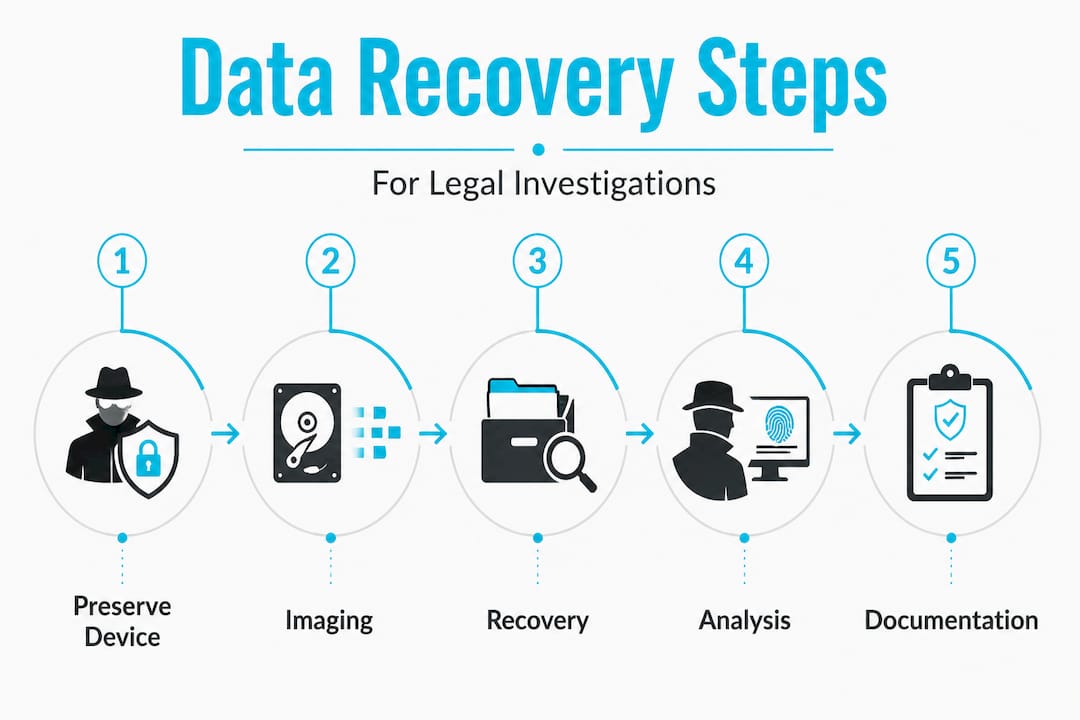
The guide on how to recover deleted data in legal investigations and the detailed forensic data recovery steps resource both provide step-by-step procedural guidance that legal teams can use to brief clients and align expectations before engaging forensic support.
Why deleted data recovery is misunderstood in legal circles
After examining the practicalities, it is important to discuss why deleted data recovery is so frequently misunderstood, even by experienced legal professionals who handle digital evidence regularly.
The most damaging misconception is the binary one: data is either there or it is not. Courts sometimes hear arguments that treat deletion as a definitive act, when in reality it is closer to removing a book from a library catalogue while leaving the book on the shelf. The catalogue entry is gone; the book remains until someone actively disposes of it.
This oversimplification leads to two opposite errors. Some legal teams prematurely concede that evidence is unrecoverable and fail to pursue forensic examination at all. Others overclaim, asserting that any deleted file can be retrieved regardless of the technical circumstances, which collapses the moment opposing forensic experts challenge the methodology.
Technology evolves faster than legal perception. SSDs are now standard in most laptops and mobile devices, yet many legal professionals still operate with expectations formed in an era of traditional hard drives where TRIM was irrelevant. The forensic landscape in 2026 requires practitioners to understand that recovery odds vary dramatically by storage type, operating system, and elapsed time since deletion.
The counter-intuitive lesson from years of casework is that context matters more than the recovery rate. A 70% recovery rate sounds strong, but if the 30% that was not recovered happens to be the specific file or date range most relevant to the case, the headline benchmark means very little. Equally, a partial recovery that yields only metadata, such as filename, creation date, and file size, without content, can still be decisive in establishing that a document existed and was deliberately destroyed.
For legal professionals committed to stronger digital evidence strategies, the recovery best practices resource outlines the current standard of care that courts expect from forensic recovery work.
The uncomfortable reality is this: the legal system increasingly depends on digital evidence, but the gap between what is technically possible and what legal teams understand about that technology remains wide. Closing that gap is not optional. It is a professional obligation.
Expert forensic support for deleted data recovery
With the right perspective and practical knowledge, expert support can make all the difference in complex legal investigations. Computer Forensics Lab provides specialist digital forensic investigations across the full range of UK legal matters, including cybercrime, data breaches, intellectual property theft, and employment disputes. Our team produces court-ready expert witness reports, maintains rigorous chain of custody procedures, and applies validated forensic tools to maximise legitimate recovery rates. Whether you are a solicitor building a litigation strategy or an in-house legal team responding to a breach, our digital forensics services are designed to support you from initial device seizure through to expert testimony, giving your case the strongest possible evidentiary foundation.
Frequently asked questions
Can deleted data always be recovered?
Recovery is possible 70-90% of the time for non-overwritten data, but once TRIM commands have run on an SSD or encryption has been applied without a key, recovery drops to zero.
What is the most reliable tool for recovering deleted data?
PhotoRec achieves 98.7% recovery for JPEG and PDF files, making it highly effective, though the optimal tool always depends on the specific file types and storage media involved.
Is recovered deleted data admissible in UK courts?
Yes, recovered data is admissible provided the forensic examiner followed accepted recovery protocols, maintained a documented chain of custody, and used validated tools that can withstand expert scrutiny.
What are the main legal risks when attempting deleted data recovery?
The primary risks are evidence contamination from improper device handling, inadmissibility from using unvalidated tools, and loss of evidence through delayed action that allows overwriting to occur before imaging takes place.
How fast must deleted data recovery begin to maximise success?
Recovery should begin immediately after the device is secured, because every write operation risks overwriting deleted data that has not yet been physically erased, reducing the probability of successful retrieval with every passing hour.