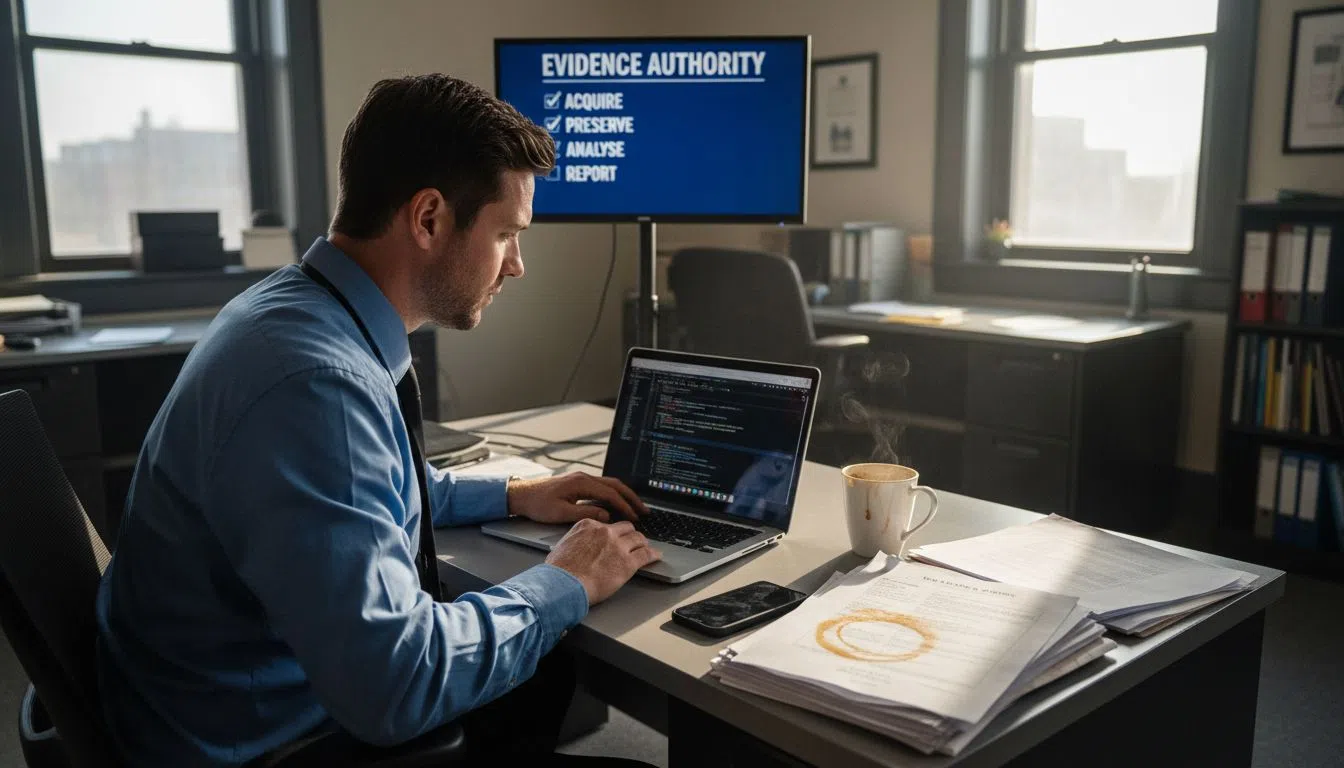
When building a cybercrime case in London, one misstep during evidence collection could mean vital digital proof is lost or rendered inadmissible. For legal professionals and criminal lawyers, mastering the precise stages of digital forensic investigation is crucial to secure convictions and maintain professional credibility. This guide breaks down each step, from establishing proper legal authority to verifying evidence reliability, using internationally recognised standards and forensically sound procedures to protect both data integrity and your legal standing.
Table of Contents
- Step 1: Establish Legal Authority And Define Scope
- Step 2: Prepare And Secure Digital Environments
- Step 3: Identify And Isolate Relevant Devices
- Step 4: Collect Data While Preserving Integrity
- Step 5: Document Chain Of Custody Throughout
- Step 6: Verify Evidence Completeness And Reliability
Quick Summary
| Key Point | Explanation |
|---|---|
| 1. Establish Legal Authority | Secure proper legal documentation before collecting evidence to ensure admissibility in court. |
| 2. Prepare Forensic Environment | Set up a controlled workspace to prevent evidence contamination and maintain integrity during analysis. |
| 3. Document Chain of Custody | Maintain detailed records of evidence handling to ensure credibility and traceability throughout the investigation. |
| 4. Verify Evidence Integrity | Validate the authenticity and completeness of digital evidence through hash comparison and metadata analysis. |
Step 1: Establish legal authority and define scope
In digital forensic investigations, establishing legal authority is the crucial first step that determines the entire trajectory of your evidence collection. Before touching any digital device or accessing potential electronic evidence, you must ensure you have the proper legal permissions and clearly defined investigative boundaries.
To establish legal authority, you’ll need to secure the appropriate legal documentation, which typically involves one of three primary mechanisms:
Here is a comparison of digital evidence legal authority types and their primary characteristics:
| Legal Mechanism | Typical Use Case | Strength of Authority |
|---|---|---|
| Warrant | Police or court investigations | Highest legal standard |
| Consent | Voluntary by owner or custodian | Situational, can be withdrawn |
| Corporate Policy | Internal organisational matters | Limited to policy boundaries |
- Warrant: A court-issued document explicitly authorising digital evidence seizure
- Consent: Written permission from the device or data owner
- Corporate policy: Organisational guidelines permitting internal investigations
Defining the investigative scope requires meticulous planning. Forensic professionals must precisely outline:
- Specific devices to be examined
- Data types being investigated
- Temporal range of the investigation
- Precise technological boundaries
Critically, your investigative scope must be narrow enough to respect privacy laws, yet comprehensive enough to capture relevant evidence.
Documenting these parameters protects the integrity of your investigation and ensures any collected evidence remains legally admissible in potential court proceedings.
Investigator’s Tip: Always consult legal counsel before commencing your digital investigation to confirm all procedural requirements are comprehensively met.
Step 2: Prepare and secure digital environments
Preparing and securing digital environments is a critical foundation for successful digital forensic investigations. Your goal is to create a controlled, isolated workspace that prevents contamination, preserves evidence integrity, and minimises the risk of data alteration during examination.
To establish a robust forensic workspace, you’ll need to implement several key protective measures:
- Dedicated forensic workstation: A specialised computer isolated from network connections
- Write blockers: Hardware that prevents any modifications to original evidence
- Forensically sterile storage media: Verified drives with no pre-existing data
- Comprehensive antivirus and monitoring tools: To detect potential system interactions
The process involves creating a forensically sound environment through precise steps:
- Set up an air-gapped forensic workstation
- Install forensic analysis software
- Verify all equipment’s forensic readiness
- Document initial system configuration
A single unintended system interaction can compromise your entire digital investigation.
Effective environment preparation goes beyond technical setup. Secure digital evidence preservation requires meticulous attention to detail and a systematic approach to maintaining forensic integrity.

Investigator’s Tip: Always maintain a comprehensive audit trail of every action taken in your forensic environment to ensure complete transparency and potential courtroom defensibility.
The following table summarises major risks and corresponding safeguards in digital forensic environments:
| Risk Factor | Example Scenario | Key Safeguard |
|---|---|---|
| Data Contamination | Accidental file modification | Use write blockers |
| Introduction of Malware | Infected evidence device | Deploy comprehensive antivirus |
| Loss of Audit Trail | Actions not recorded | Maintain detailed activity logs |
| Unauthorised Data Access | Shared workspace exposure | Isolate with dedicated systems |
Step 3: Identify and isolate relevant devices
Identifying and isolating relevant digital devices is a critical phase of forensic investigation that requires systematic precision and meticulous attention to detail. Your primary objective is to locate, document, and secure all potential sources of electronic evidence without compromising their integrity or potential evidentiary value.
To successfully navigate this crucial stage, you’ll need to implement several strategic identification methods:
- Visual device mapping: Catalogue all electronic devices present at the investigation site
- Network connection tracing: Identify interconnected digital systems
- Preliminary device classification: Sort devices by potential evidentiary significance
- Physical and logical segregation: Prevent cross-contamination between devices
The comprehensive device identification process involves the following key steps:
- Conduct initial site survey
- Create detailed device inventory
- Document device interconnections
- Implement secure isolation protocols
- Prepare devices for forensic imaging
Careful device identification prevents critical evidence from being overlooked or accidentally destroyed.
Preserve digital evidence requires a methodical approach that balances technical expertise with legal precision. Each device must be handled as a potential treasure trove of critical investigative information.
Investigator’s Tip: Always photograph device locations and connections before disconnection to maintain a comprehensive visual record of the original configuration.
Step 4: Collect data while preserving integrity
Collecting digital evidence requires an intricate balance between comprehensive data acquisition and maintaining absolute forensic integrity. Your primary goal is to extract critical information without altering a single byte of the original digital artefacts, ensuring the evidence remains legally admissible and scientifically reliable.
To achieve this delicate process, you’ll need to implement several critical preservation strategies:
- Forensic imaging: Create bit-by-bit exact copies of original media
- Hash verification: Generate cryptographic checksums to validate data integrity
- Write blocking: Prevent any modifications during data extraction
- Metadata preservation: Capture all system and file metadata
The systematic data collection process involves precise technical steps:
- Select appropriate forensic imaging tools
- Configure write blockers
- Generate cryptographic hash values
- Perform comprehensive data extraction
- Validate extracted data against original
One altered bit can invalidate an entire digital forensic investigation.
Secure digital evidence preservation demands meticulous attention to technical and legal requirements. Every action must be documented, repeatable, and defensible in potential legal proceedings.
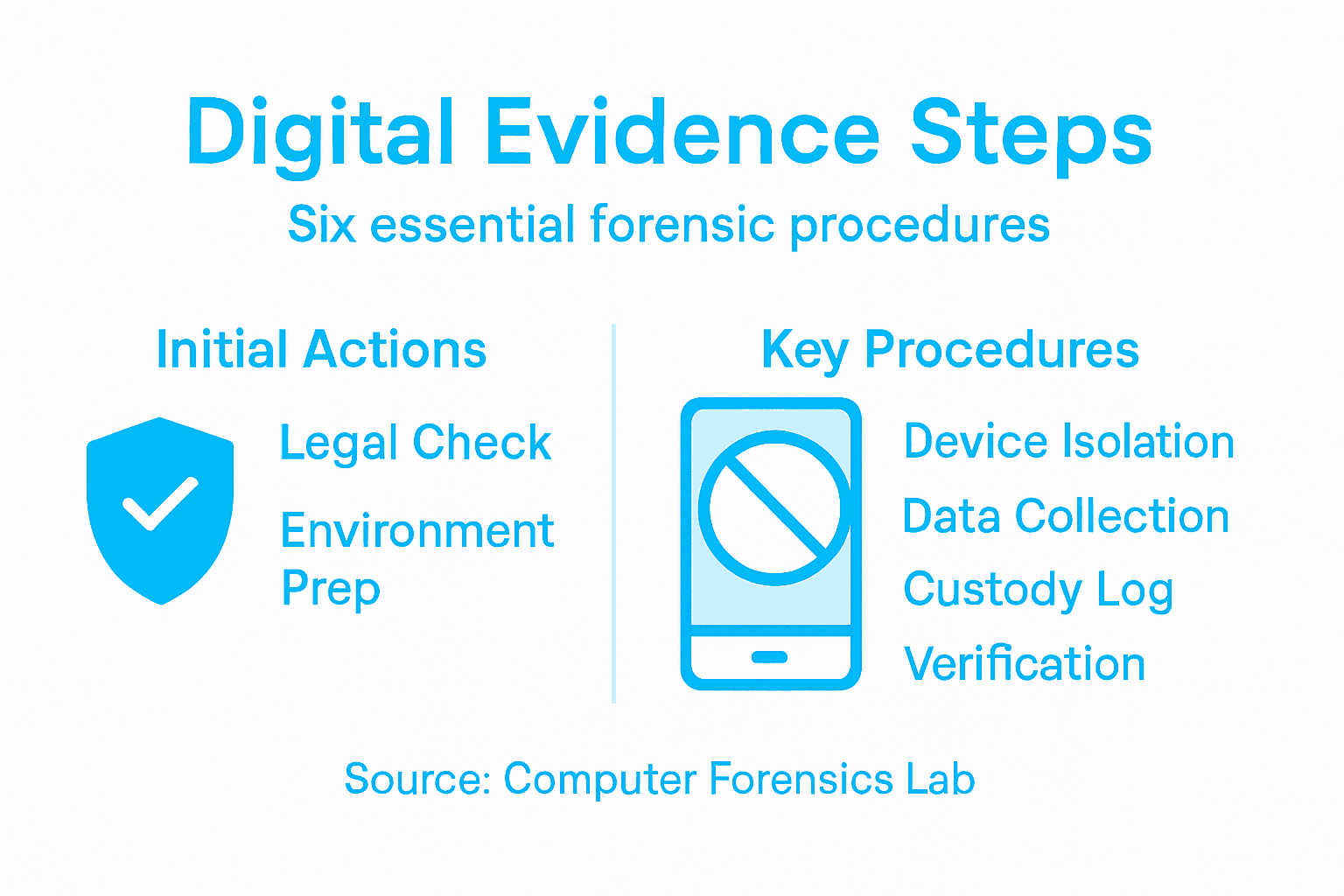
Investigator’s Tip: Always maintain multiple verified forensic copies and document every single action during the evidence collection process to ensure complete transparency.
Step 5: Document chain of custody throughout
Documenting the chain of custody is a critical forensic procedure that provides legal and scientific credibility to your digital evidence collection. Your goal is to create an unbroken, transparent record that tracks every single interaction with digital artefacts from initial discovery through final analysis.
To maintain rigorous evidence tracking protocols, you’ll need to systematically document the following key elements:
- Evidence identification: Unique reference numbers for each digital item
- Handling log: Comprehensive record of who accessed the evidence
- Time and date stamps: Precise chronological documentation
- Transfer records: Detailed logs of evidence movement between investigators
The comprehensive chain of custody documentation involves these critical steps:
- Create initial evidence inventory
- Record detailed handling information
- Generate continuous access logs
- Maintain secure evidence tracking
- Prepare detailed transfer documentation
A single undocumented interaction can potentially invalidate critical digital evidence in legal proceedings.
Chain of custody procedures require meticulous attention to detail, ensuring every forensic professional can reconstruct the exact journey of each piece of digital evidence.
Investigator’s Tip: Use standardised forensic documentation templates and digital tracking systems to minimise human error and create consistent, legally defensible evidence records.
Step 6: Verify evidence completeness and reliability
Verifying the completeness and reliability of digital evidence is a critical forensic process that ensures the integrity and admissibility of your investigative findings. Your goal is to systematically validate every piece of collected digital information, confirming its authenticity, accuracy, and comprehensive coverage.
To establish robust evidence validation, you’ll need to implement multiple verification strategies:
- Hash value comparison: Confirm data integrity through cryptographic checksums
- Metadata analysis: Examine file timestamps, creation details, and system logs
- Cross-referencing: Validate evidence against multiple independent sources
- Forensic tool validation: Use verified forensic software for analysis
The comprehensive evidence verification process involves these essential steps:
- Generate forensic hash values for all evidence
- Compare hash values against original media
- Perform comprehensive metadata examination
- Cross-validate digital artefacts
- Document verification methodologies
Even a minor discrepancy can potentially compromise the entire forensic investigation.
Digital evidence impact requires meticulous validation to ensure legal and scientific credibility in investigative proceedings.
Investigator’s Tip: Always maintain multiple independent verification methods and document each validation step to create a transparent, defensible forensic record.
Ensure Flawless Evidence Collection with Expert Digital Forensics Support
Navigating the complex process of digital evidence collection requires thorough understanding of legal authority, forensic integrity, and meticulous device handling. The challenges of preserving data authenticity and maintaining an unbroken chain of custody can create uncertainty during investigations. By working with specialists experienced in securing, imaging, and verifying digital evidence, you can confidently overcome these hurdles while protecting your case’s integrity.
At Computer Forensics Lab, we offer comprehensive Digital Forensic Investigation services tailored to support your need for precise, legally compliant evidence handling. Our expertise extends through every phase of investigation including Electronic Evidence preservation and maintaining ongoing Digital Evidence Preservation protocols. Don’t let a minor oversight jeopardise your investigation. Visit https://computerforensicslab.co.uk today to connect with trusted professionals who ensure your digital investigations stand up to scrutiny and deliver reliable outcomes.
Frequently Asked Questions
What legal authority is needed for digital evidence collection?
To collect digital evidence, you need to establish legal authority through a warrant, consent, or corporate policy. Ensure you obtain the appropriate legal documentation that aligns with your investigative scope before proceeding with any evidence collection.
How can I prepare a secure digital forensic environment?
To prepare a secure digital forensic environment, set up a dedicated forensic workstation, use write blockers, and employ forensically sterile storage media. Create a controlled workspace to prevent data contamination and ensure the integrity of the evidence collected during your investigation.
What steps should I take to identify relevant digital devices?
Begin by conducting an initial site survey to visually map out all electronic devices present. Classify each device based on its potential evidentiary significance, and ensure you implement protocols for physical and logical segregation to prevent cross-contamination.
How do I collect digital data while preserving its integrity?
To collect data without altering the original evidence, perform forensic imaging to create exact copies and use write blockers to prevent modifications. Always verify the integrity of the extracted data with cryptographic hash values to ensure it remains admissible in court.
Why is documenting the chain of custody important in digital forensics?
Documenting the chain of custody is essential to track every interaction with the digital evidence, ensuring transparency and legal credibility. Maintain thorough records of evidence identification, handling logs, and transfer details to guard against any claims of evidence tampering.
How can I verify the completeness and reliability of the evidence collected?
To verify the completeness and reliability of the evidence, generate hash values for all collected data and compare them against the original media. Additionally, examine the metadata and cross-reference the evidence against independent sources to ensure its authenticity and comprehensiveness.
Recommended
- Step by Step Digital Evidence Collection Guide
- Role of Digital Evidence – Impact on Modern Investigations
- Essential Digital Evidence Preservation Methods for 2025
- What Is E-Discovery? Complete Overview and Process
- Day 231: Cracking the Case: How Forensic, Witness, and Digital Evidence Shape Criminal Trials » Tamou Law Group