
TL;DR:
- Evidence integrity ensures that evidence remains authentic, unaltered, and traceable from collection to court presentation. Maintaining an unbroken chain of custody, using cryptographic hashes, and applying lifecycle controls are vital to prevent evidence exclusion and uphold legal standards. Failure to do so can result in case dismissal, overturned convictions, regulatory penalties, and professional liability.
Evidence integrity is defined as the assurance that evidence remains authentic, unaltered, and reliably traceable from the moment of collection through to its presentation in court. Every legal professional, law enforcement officer, and corporate compliance team must understand why preserve evidence integrity is not a procedural formality but the foundation of admissible, credible evidence. Without it, even the most compelling case collapses. The chain of custody, cryptographic hashing, and the Federal Rules of Evidence all exist precisely because courts demand proof that evidence has not been compromised at any stage.
What is evidence integrity and why does it matter?
Evidence integrity refers to three inseparable qualities: authenticity, unaltered condition, and accountable handling. Authenticity confirms that the evidence is what it purports to be. Unaltered condition means no data, physical state, or metadata has changed since collection. Accountable handling means every person who touched the evidence is documented, with timestamps and reasons recorded.
Courts apply strict admissibility standards rooted in these qualities. Under frameworks such as the Federal Rules of Evidence and the UK’s Police and Criminal Evidence Act 1984, judges assess whether evidence meets a threshold of trustworthiness before it reaches the jury. Evidence that cannot demonstrate an unbroken, documented history is routinely excluded.
The consequences of losing integrity are severe and concrete:
- A digital file with altered metadata becomes inadmissible, even if its content is genuine.
- Physical evidence stored without proper sealing or labelling can be challenged as contaminated.
- Corporate investigation findings without verified access logs may be dismissed entirely in employment tribunals.
- Evidence in wrongful death cases faces the same scrutiny, where a single gap in handling can undermine an entire claim.
The importance of evidence integrity extends beyond individual cases. Systemic failures erode public trust in the justice system and expose organisations to regulatory penalties. Getting this right from the outset is not optional.
How does chain of custody preserve evidence integrity?
The chain of custody is the documented trail that records every person, transfer, and location associated with a piece of evidence from first collection to final presentation. Courts rely on this trail to determine whether evidence is trustworthy and admissible. A break anywhere in that trail creates a vulnerability that opposing counsel will exploit.
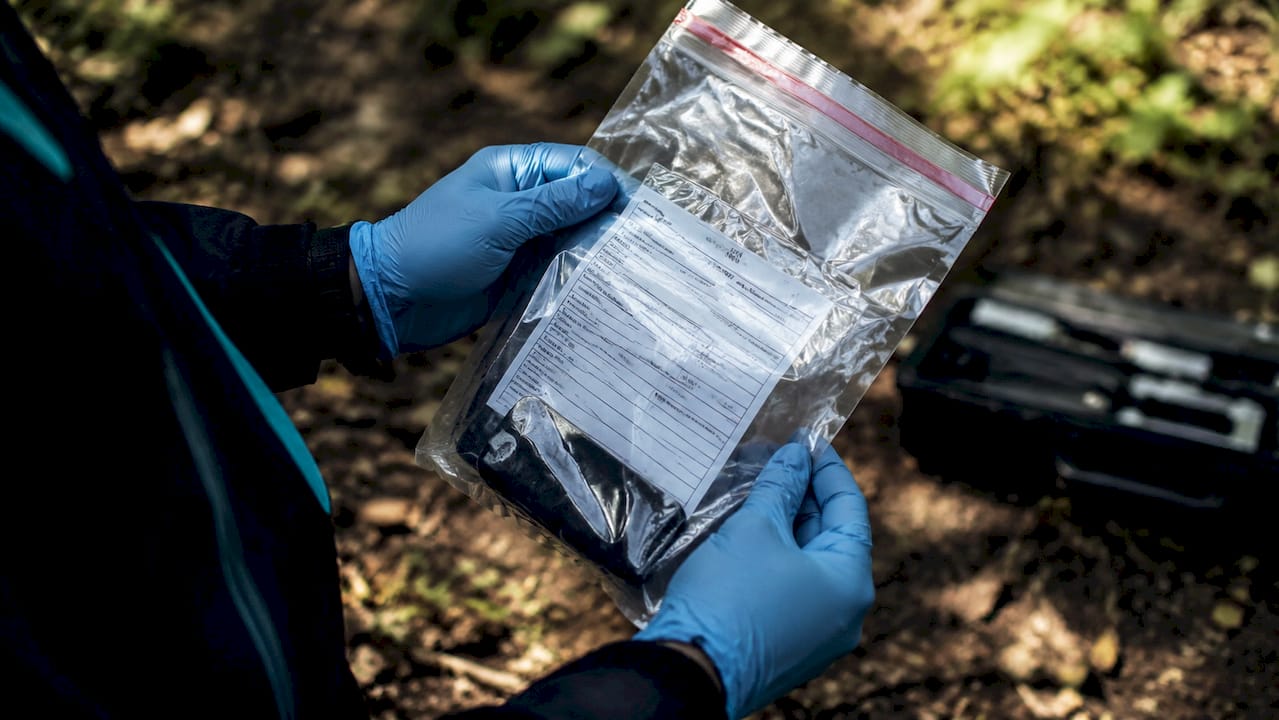
Understanding the difference between a weak link and a missing link matters enormously in practice. A weak link is a documented transfer with incomplete detail, such as a handover logged without a time or reason. A missing link is an undocumented gap, where evidence changed hands with no record at all. Missing links are almost always fatal to admissibility. Weak links can sometimes be rehabilitated with supplementary testimony, but they invite challenge and delay.
Maintaining a sound chain of custody requires the following steps:
- Assign a unique identifier to each item of evidence at the point of collection, before any analysis begins.
- Record every transfer with the name of the receiving custodian, the date, the time, and the purpose of the transfer.
- Log every access event, including instances where evidence is reviewed but not moved, since unlogged routine actions can undermine admissibility even when no tampering occurred.
- Restrict physical and digital access to authorised personnel only, using locked storage for physical items and role-based access controls for digital evidence.
- Verify integrity at each handover using cryptographic hash values for digital evidence, confirming the file has not changed between transfers.
Pro Tip: The most common documentation gap is not deliberate tampering but routine, unlogged actions such as copying a file to a working drive or moving physical evidence for photography. Build a workflow that logs every action automatically, and treat any undocumented step as a potential exclusion risk.
Why is evidence integrity compromised and how can you prevent it?
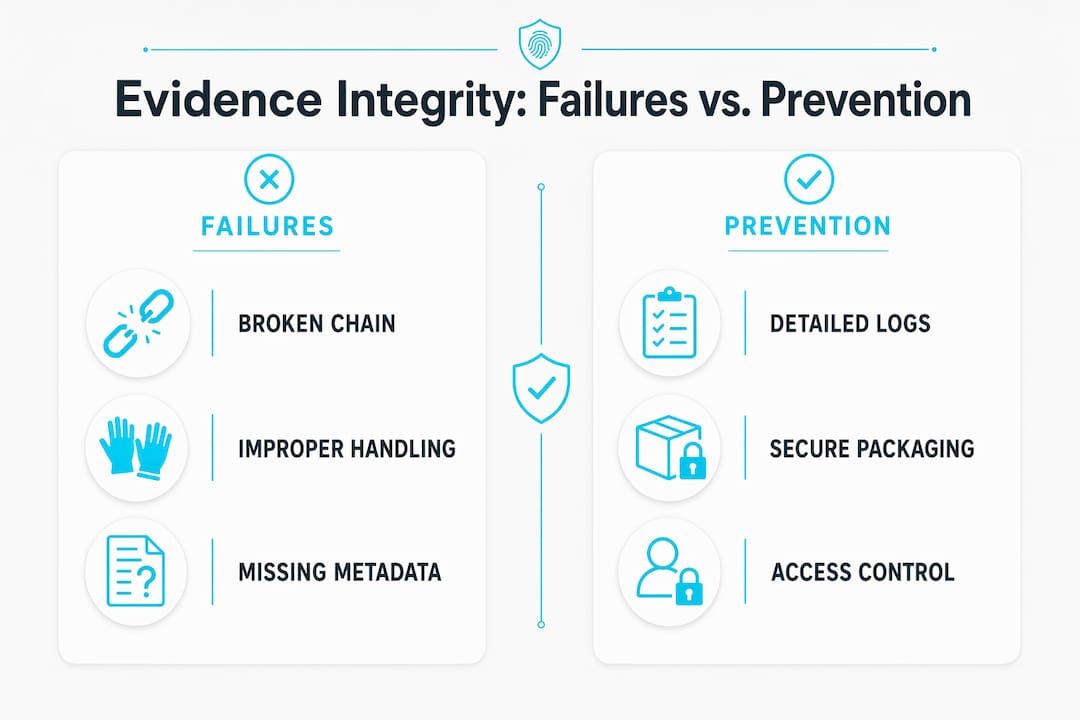
Seven recurring failure points cause digital evidence to be rejected in court, including broken chain of custody, improper collection methods, missing metadata, and inadequate access controls. Each failure is preventable with the right protocols in place.
Digital evidence is particularly vulnerable because it can be altered without visible trace. A physical exhibit shows signs of tampering through damage or contamination. A digital file can be modified, copied, or accessed without leaving any obvious mark unless forensic controls are applied from the start.
The table below contrasts the most common integrity failures with their corresponding prevention measures:
| Integrity Failure | Prevention Measure |
|---|---|
| Broken chain of custody | Log every transfer and access event with timestamps and custodian names |
| Improper collection methods | Use write-blockers and forensic imaging tools during acquisition |
| Missing or altered metadata | Preserve original metadata at acquisition; verify with cryptographic hashes |
| Inadequate access controls | Apply role-based permissions and audit logs for all evidence systems |
| Unsecured storage | Use tamper-evident packaging for physical items and encrypted storage for digital files |
| Lack of integrity verification | Generate and record SHA-256 or MD5 hash values at acquisition and at each transfer |
Physical evidence faces different but equally serious risks. Contamination, improper packaging, and environmental exposure can all compromise integrity. Cross-contamination between exhibits is a persistent problem in complex investigations involving multiple scenes or suspects.
Only 5.7% of organisations maintain full visibility into service accounts and identity events. That figure illustrates how poorly most corporate environments are equipped to produce reliable digital evidence when investigations arise. Compliance teams that wait until an incident occurs to think about evidence controls will almost certainly face integrity challenges.
How to maintain evidence integrity throughout the evidence lifecycle
Preserving integrity is not a single action at the point of collection. Evidence integrity requires ongoing proactive validation, not simply static storage. Every stage of the evidence lifecycle demands specific controls.
The key stages and their requirements are:
- Acquisition: Use forensically sound tools that create verified copies without altering the original. Generate cryptographic hash values immediately. Document the collection environment, the device state, and the personnel present.
- Storage: Store digital evidence in encrypted, access-controlled repositories. Physical evidence requires tamper-evident packaging, climate-controlled conditions where relevant, and a secure, logged storage facility.
- Analysis: Work exclusively on forensic copies, never originals. Log every analytical action, including software used, queries run, and findings recorded. Courts first examine chain of custody and hash values before evaluating content.
- Transfer: Verify hash values before and after every transfer. Record the transfer in the chain of custody log immediately, not retrospectively.
- Presentation: Prepare a clear, auditable record of the evidence lifecycle to accompany expert witness reports. Any gap between acquisition and presentation will be scrutinised.
Training is a non-negotiable component of this process. Personnel who handle evidence without understanding the legal implications of their actions are the single greatest source of unintentional integrity failures. Compliance with frameworks such as the Federal Rules of Evidence in US-linked matters, the eIDAS regulation for electronic evidence in EU contexts, and the UK’s own ACPO Good Practice Guide for Digital Evidence sets the minimum standard.
Pro Tip: Build your documentation workflow around the assumption that every action will be challenged in court. Use automated logging tools that record file access events, hash verifications, and transfer confirmations without relying on manual entry. Manual logs are the most common source of gaps.
Computerforensicslab recommends embedding evidence preservation methods into standard operating procedures rather than treating them as case-specific tasks. Organisations that treat preservation as routine rather than exceptional produce far more defensible evidence records.
What are the legal consequences of failing to preserve evidence integrity?
Failing to preserve evidence integrity produces consequences that extend well beyond losing a single case. Judges exclude evidence lacking an unbroken chain of custody, and that exclusion can be decisive. Historically, thousands of convictions have been overturned because evidence integrity could not be demonstrated to the required standard.
“Evidence handling is not bureaucratic box-ticking. Missing links in the chain of custody almost certainly render evidence inadmissible, regardless of how compelling its content may be.”
For corporate compliance teams, the stakes are equally high. A data breach investigation that cannot produce verified, integrity-assured evidence may fail to satisfy regulatory bodies such as the Information Commissioner’s Office, exposing the organisation to fines and reputational damage. Employment disputes where digital evidence lacks proper access logs frequently result in findings against the employer, even when the underlying conduct was genuine.
Preservation failures expose legal practitioners to professional liability. Solicitors and barristers who advise clients without ensuring evidence is properly preserved risk negligence claims if that failure costs the case. The liability risk is not theoretical; it is a documented consequence of inadequate evidence management.
Early preservation is the most effective safeguard. Evidence collected and verified at the earliest possible stage is far more defensible than evidence preserved retrospectively. The principle of “provenance by design,” where validation workflows are embedded early rather than justified after the fact, is the standard that courts and regulators increasingly expect.
Key takeaways
Preserving evidence integrity requires documented chain of custody, cryptographic verification, and proactive lifecycle controls applied from the moment of collection.
| Point | Details |
|---|---|
| Define integrity from the outset | Evidence must be authentic, unaltered, and fully accountable to meet admissibility standards. |
| Chain of custody is non-negotiable | Every transfer, access event, and custodian must be logged without gaps to prevent exclusion. |
| Digital evidence needs cryptographic proof | Generate and verify SHA-256 or MD5 hash values at acquisition and at every transfer point. |
| Prevention beats retrospective justification | Embed preservation protocols into standard workflows rather than constructing records after the fact. |
| Failures carry serious consequences | Compromised integrity risks case dismissal, overturned convictions, and professional liability. |
The underrated threat is documentation, not tampering
After years of working on digital forensic investigations, the pattern I see most often is not deliberate evidence tampering. It is the slow erosion of admissibility through routine, unlogged actions that nobody thought to record at the time.
A file copied to a working drive without a hash verification. A device handed between officers without a written transfer record. A corporate email archive exported by an IT administrator who was never formally designated as a custodian. None of these actions are malicious. All of them create exploitable gaps that opposing counsel will find.
The conventional wisdom treats evidence integrity as a technical problem solved by the right forensic tools. The reality is that it is primarily an organisational and cultural problem. Tools like write-blockers and hash verification software are only as reliable as the people using them and the workflows surrounding them. Organisations that invest in training and embed preservation into their operational DNA produce evidence that holds up. Those that treat it as a specialist task for the forensics team alone consistently produce records with gaps.
My recommendation is direct: treat every undocumented action as a potential exclusion event. Build that assumption into your training, your procedures, and your audit reviews. The chain of custody is only as strong as its weakest undocumented moment.
— Computerforensicslab
How Computerforensicslab supports evidence integrity
Computerforensicslab provides professional digital forensics services to legal professionals, law enforcement agencies, and corporate compliance teams across the UK. Every investigation is conducted with full chain of custody documentation, cryptographic hash verification, and court-ready expert witness reporting. Whether you are managing a corporate data breach, a criminal investigation, or a civil dispute, Computerforensicslab applies forensically sound methods that meet the admissibility standards required by UK courts. The team’s experience spans computing devices, mobile phones, cloud data, and social media evidence. Contact Computerforensicslab to discuss how its forensic investigation services can protect the integrity of your evidence from acquisition through to presentation.
FAQ
What is evidence integrity in legal terms?
Evidence integrity is the assurance that evidence is authentic, unaltered, and fully accountable from collection to court presentation. It is the foundational requirement for admissibility under frameworks such as the Federal Rules of Evidence and the UK’s Police and Criminal Evidence Act 1984.
Why does chain of custody matter for evidence integrity?
The chain of custody documents every person, transfer, and location associated with evidence. Courts rely on this trail to confirm trustworthiness, and a single undocumented gap can result in evidence being excluded regardless of its content.
What are the most common causes of evidence integrity failure?
Broken chain of custody, improper collection methods, missing metadata, and inadequate access controls are the primary causes. Routine unlogged actions, such as copying a file without recording it, are the most frequent source of exploitable gaps.
How do cryptographic hashes protect digital evidence?
A cryptographic hash value, such as SHA-256 or MD5, generates a unique fingerprint of a digital file at the point of acquisition. Any subsequent alteration to the file produces a different hash, providing verifiable proof that the evidence has not been modified.
What are the consequences of failing to preserve evidence integrity?
Consequences include evidence exclusion, case dismissal, overturned convictions, regulatory penalties, and professional liability for legal practitioners. Early and proactive preservation is the most reliable way to avoid these outcomes.