
Managing digital evidence in complex London criminal cases can feel overwhelming as technology outpaces traditional investigative skills. Law firms now face strict requirements for maintaining forensic integrity and presenting reliable data in court, with digital footprints playing a pivotal role across investigations. This overview highlights the benefits of outsourced digital forensics, focusing on access to certified specialists, advanced technology, and the ability to confidently meet UK legal standards while reducing operational risks and costs.
Table of Contents
- Defining Digital Forensics And Key Concepts
- Primary Types And Specialist Techniques Explained
- Legal Evidence Requirements And Uk Court Standards
- Benefits Of Outsourcing For Legal Professionals
- Risks, Costs, And Common Pitfalls In-House Analysis
Key Takeaways
| Point | Details |
|---|---|
| Digital Forensics Definition | Digital forensics involves systematic investigation of digital evidence, focusing on evidence integrity and legal standards. |
| Specialist Techniques | Key techniques include Disk Imaging, Network Forensics, and Mobile Device Forensics, each serving distinct investigative purposes. |
| Legal Standards in the UK | Digital evidence must adhere to strict legal standards, including chain of custody and forensic integrity, to be admissible in court. |
| Advantages of Outsourcing | Outsourcing digital forensics offers access to specialised expertise, advanced technology, and cost efficiency for legal professionals. |
Defining Digital Forensics and Key Concepts
Digital forensics represents a sophisticated scientific methodology for investigating digital evidence across multiple technological platforms. Scientific processes of digital evidence acquisition involve systematically searching operating systems, mobile devices, and cloud repositories to uncover critical information while maintaining legal standards.
At its core, digital forensics encompasses several essential components:
- Identification of potential digital evidence sources
- Preservation of data integrity and chain of custody
- Collection of electronic artifacts
- Examination of digital materials
- Analysis of recovered information
- Presentation of forensic findings for legal proceedings
Professionals in this field require specialised skills across multiple domains. Digital forensic investigation techniques demand expertise in network systems, database structures, mobile technologies, and cloud computing environments. Certified forensic analysts must navigate complex technological landscapes while maintaining rigorous legal and ethical standards.
Pro-Tip: When selecting a digital forensics expert, prioritise professionals with cross-platform certifications and demonstrable experience in multiple technological domains.
Primary Types and Specialist Techniques Explained
Digital forensics encompasses a diverse range of sophisticated investigative techniques designed to extract and analyse electronic evidence. Sophisticated digital forensic methods provide critical insights across multiple technological platforms, enabling investigators to uncover crucial information in criminal and civil proceedings.
The primary specialist techniques in digital forensics include:
- Disk Imaging: Creating exact replicas of digital storage devices
- File Carving: Recovering deleted or fragmented files
- Network Forensics: Analysing network traffic and communication logs
- Memory Analysis: Examining volatile computer memory for active processes
- Mobile Device Forensics: Extracting data from smartphones and tablets
- Cloud Storage Forensics: Investigating digital evidence stored in cloud environments
National forensic technology standards highlight the complexity of these techniques, emphasising the need for continual adaptation and professional expertise. Forensic specialists must navigate challenges such as advanced encryption, anti-forensic techniques, and rapidly evolving technological landscapes.
The following table summarises how different forensic techniques contribute to investigation objectives:
| Technique | Investigation Focus | Typical Outcome |
|---|---|---|
| Disk Imaging | Preserve full device copy | Enables repeatable analysis |
| Network Forensics | Track data transfer and sessions | Reconstructs digital activity |
| Memory Analysis | Identify volatile system processes | Reveals real-time evidence |
| Mobile Device Forensics | Extract handset communications | Recovers deleted messages |
| Cloud Storage Forensics | Assess remote evidence locations | Traces concealed data |
Pro-Tip: Always ensure your digital forensics expert maintains current certifications and demonstrates proficiency across multiple investigative platforms.
Legal Evidence Requirements and UK Court Standards
Digital evidence in the United Kingdom demands rigorous standards to ensure its admissibility and reliability in legal proceedings. European digital evidence standards highlight the complex challenges of incorporating electronic information into criminal investigations, emphasising the need for precise forensic protocols.
The critical requirements for legal digital evidence in UK courts include:
- Chain of Custody: Documenting every stage of evidence handling
- Forensic Integrity: Ensuring no alterations to original digital materials
- Comprehensive Documentation: Detailed logs of evidence collection processes
- Verifiable Acquisition Methods: Transparent forensic extraction techniques
- Expert Witness Testimony: Qualified professional explanations of digital findings
- Compliance with ISO Standards: Adherence to international forensic guidelines
International forensic investigation protocols mandate strict preservation techniques, with the UK National Police Chiefs Council emphasising that no investigative action should compromise the original digital data. Forensic specialists must meticulously follow identification, collection, acquisition, and preservation phases to maintain evidence credibility.

Pro-Tip: Engage digital forensics experts who can provide comprehensive documentation and demonstrate a clear, unbroken chain of evidence custody.
Benefits of Outsourcing for Legal Professionals
Legal professionals face increasingly complex digital evidence challenges that demand sophisticated technological expertise. Digital forensics outsourcing strategies offer a strategic solution to navigate these intricate investigative requirements, providing access to specialised skills and advanced technological resources.
The primary advantages of outsourcing digital forensics include:
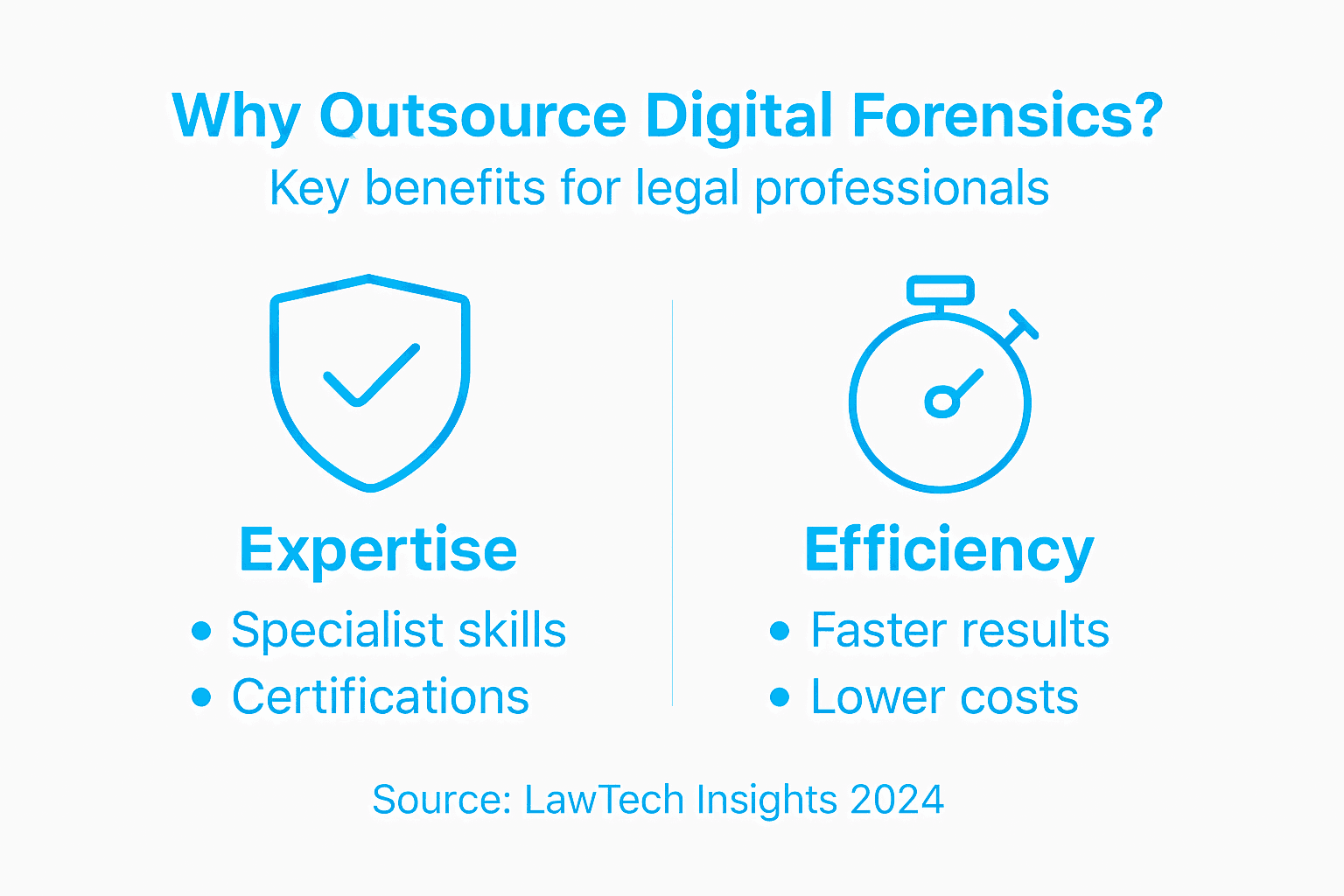
- Specialised Expertise: Access to certified forensic professionals
- Advanced Technology: Cutting-edge forensic analysis tools and techniques
- Cost Efficiency: Reduced infrastructure and training expenses
- Scalable Resources: Flexible investigative capacity on-demand
- Legal Compliance: Guaranteed adherence to forensic standards
- Time-Critical Response: Rapid evidence collection and analysis
Outsourcing transforms digital forensics from a potential operational burden into a strategic asset. By leveraging external experts, legal teams can focus on core litigation strategies while ensuring comprehensive, technologically robust evidence collection. The approach minimises internal resource strain and maximises investigative effectiveness, particularly in complex cases requiring nuanced digital investigation techniques.
Pro-Tip: Select digital forensics partners who demonstrate proven expertise, maintain current certifications, and can provide transparent, court-admissible investigation methodologies.
The table below compares the outcomes of in-house versus outsourced digital forensic investigations for legal professionals:
| Aspect | In-House Analysis | Outsourced Expertise |
|---|---|---|
| Response Speed | Potential delays due to limited staff | Rapid action with specialist teams |
| Cost Predictability | High, unpredictable investment required | Scalable, more controllable costs |
| Technical Breadth | Dependent on internal resources | Access to wide-ranging technologies |
| Legal Compliance Risk | Vulnerable to protocol errors | High reliability and court adherence |
Risks, Costs, and Common Pitfalls in In-House Analysis
In-house digital forensics presents substantial challenges that can compromise legal investigations and evidence reliability. Digital forensic analysis challenges reveal complex obstacles organisations encounter when attempting to manage digital investigations internally, highlighting significant risks to evidential integrity.
The primary risks and costly pitfalls include:
- Technological Obsolescence: Rapid technological changes outpacing internal capabilities
- High Training Costs: Continuous investment in specialist skill development
- Equipment Expenses: Significant financial investment in forensic tools
- Inconsistent Practices: Lack of standardised investigation methodologies
- Limited Technical Expertise: Insufficient specialist knowledge
- Data Preservation Challenges: Potential evidence contamination risks
Forensic qualification limitations demonstrate that internal teams often struggle with encryption challenges, anti-forensic techniques, and maintaining rigorous legal standards. These complexities create substantial vulnerabilities that can critically undermine the admissibility and credibility of digital evidence in legal proceedings.
Pro-Tip: Conduct a comprehensive cost-benefit analysis comparing internal forensic capabilities against specialised external expertise before committing to in-house digital investigations.
Secure Legal Success with Expert Digital Forensics Outsourcing
Navigating the complexities of digital evidence demands specialised skills and adherence to stringent legal standards. This article highlights the critical challenges legal professionals face including maintaining chain of custody, preserving forensic integrity, and employing advanced investigative techniques. Outsourcing digital forensics is not merely a convenience but a strategic necessity to overcome technological obsolescence, costly training, and equipment expenses while ensuring reliable and court-admissible outcomes.
At Computer Forensics Lab, we understand these pressures and provide comprehensive Digital Forensics Services tailored to support your legal needs. Our London-based team delivers expert witness reports, rigorous evidence preservation compliant with UK court standards, and advanced investigation methods that fully align with industry best practices. By choosing us, you gain access to scalable, certified professionals who prioritise integrity and speed in digital investigations.
Are you ready to enhance your case success with dependable digital evidence expertise? Discover how our Digital Evidence Preservation solutions and cutting-edge forensic techniques can transform your legal strategy. Visit Computer Forensics Lab now and take the first step towards securing the digital proof that matters.
Frequently Asked Questions
What are the benefits of outsourcing digital forensics?
Outsourcing digital forensics provides access to specialised expertise, advanced technology, cost efficiency, scalable resources, legal compliance, and time-critical response capabilities, allowing legal professionals to focus on core litigation processes.
How does outsourcing digital forensics improve response times in legal investigations?
Outsourced teams of specialists can act rapidly to collect and analyse digital evidence, significantly reducing the time taken compared to in-house analyses that may face limitations due to staff resources.
What risks are associated with in-house digital forensics?
In-house digital forensics may lead to risks such as technological obsolescence, high training costs, inconsistent practices, and limited technical expertise, all of which can undermine the reliability of evidence in legal proceedings.
How can legal professionals ensure compliance with forensic standards when outsourcing?
Legal professionals can ensure compliance by selecting outsourcing partners who demonstrate proven expertise, maintain current certifications, and can provide transparent methodologies that adhere to recognised forensic standards.