
TL;DR:
- Forensic password cracking involves lawfully recovering passwords from digital evidence while maintaining data integrity for court use.
- Examiners prioritize non-invasive methods like memory extraction and credential harvesting before using targeted, rule-based, or brute-force attacks.
- Recent advances in machine learning, such as MDBSCAN clustering, have improved success rates and reduced computational costs in 2026.
Password cracking in forensics is the process of recovering access to encrypted or password-protected digital evidence through systematic technical methods, while preserving the integrity required for court admissibility. The industry term is forensic password recovery, though “password cracking” is widely used across law enforcement and legal circles. Forensic investigators apply this process during the examination stage of the standard workflow: identification, acquisition, preservation, examination, analysis, and reporting. Bodies such as the Scientific Working Group on Digital Evidence (SWGDE) set the standards that govern how this work is conducted. Password cracking is one of several digital forensics techniques available, and it is never the first option an examiner reaches for.
What is password cracking in forensics and how does it work?
Forensic password cracking is defined as the controlled, lawful recovery of passwords or decryption keys from digital evidence, performed without altering the original data. Investigators work exclusively on bit-for-bit forensic images of the original device, never on the live system itself. This preserves the chain of custody and keeps evidence admissible in court.

The process sits within a broader forensic investigation method. Before any cracking begins, examiners complete acquisition and preservation, creating verified copies of storage media using write-blockers and cryptographic hash verification. Only then does password recovery begin, and only when other access routes have been exhausted.
Four primary attack types define forensic password analysis:
- Dictionary attacks test passwords from curated wordlists. Research shows up to 77.5% of three-word passwords can be recovered using just 30% of a common-word dictionary subset. That figure reveals how predictable most user passwords remain.
- Brute-force attacks test every possible character combination. They are thorough but computationally expensive, making them a last resort for long or complex passwords.
- Rule-based attacks apply transformation rules to dictionary entries, such as capitalising the first letter, appending numbers, or substituting characters. Rule-based cracking strategies can reduce computational iterations by approximately 40%, significantly accelerating recovery.
- Hybrid attacks combine dictionary and brute-force methods, applying rule sets to base words before extending with random characters.
| Technique | Speed | Success rate | Resource demand |
|---|---|---|---|
| Dictionary attack | Fast | High for weak passwords | Low |
| Brute-force attack | Slow | Near-certain given time | Very high |
| Rule-based attack | Fast to moderate | High with tailored rules | Moderate |
| Hybrid attack | Moderate | High for complex passwords | Moderate to high |
Pro Tip: Tailoring rule sets to the subject’s demographic, such as birth years, local sports teams, or common name patterns, increases hit ratios substantially compared to generic wordlists.
How is password cracking integrated into the forensic workflow?
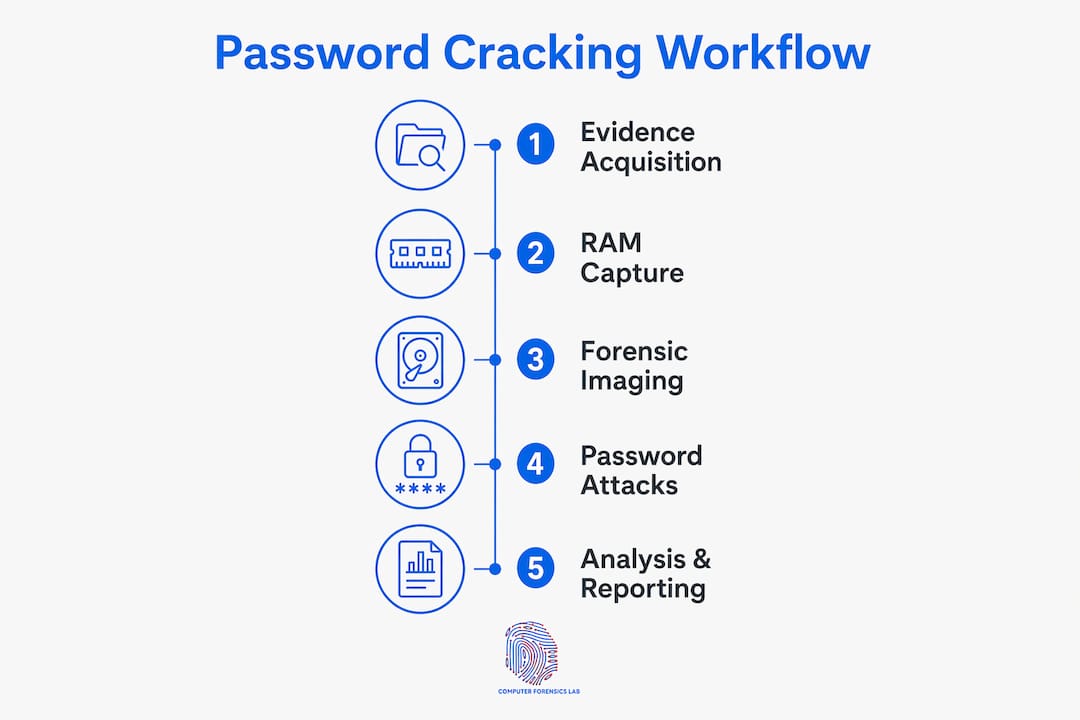
Password cracking is a secondary measure, not a starting point. Examiners first attempt less invasive forensic password analysis routes before committing to computationally intensive cracking.
The standard sequence looks like this:
- Volatile memory extraction. RAM extraction precedes device cracking because active memory frequently holds decryption keys and cleartext credentials. Capturing RAM before powering down a device can bypass the need for cracking entirely.
- Token and credential harvesting. Saved browser credentials, cached authentication tokens, and cloud backup access points can all provide entry without touching encryption.
- Forensic image creation. Once non-invasive routes are exhausted, examiners create a verified forensic image. Cracking operates on this image to maintain chain of custody and evidence admissibility.
- Attack selection. Examiners choose the appropriate attack type based on password complexity indicators, available wordlists, and computational resources.
- Reporting. Every step, including failed attempts, is documented to support the expert witness report.
This sequence reflects why password-protected phone examination requires specialist knowledge. A poorly ordered approach risks destroying the very evidence it seeks to recover.
Pro Tip: When a device is found powered on, capturing RAM immediately is the single highest-value action. Keys present in volatile memory disappear the moment the device is shut down.
What challenges arise during forensic password cracking?
Anti-forensic tools represent the most serious complication in forensic password recovery. Suspects increasingly use encryption, obfuscation, and automated deletion triggers to obstruct investigators.
Anti-forensic tools can cause irreversible data loss if forced cracking is attempted without first identifying their presence. A device configured to wipe after a set number of failed login attempts will destroy evidence the moment an automated brute-force attack begins. Identifying these risks early is not optional; it is a prerequisite for responsible forensic practice.
Key challenges examiners face include:
- Encryption strength. Full-disk encryption using AES-256 makes brute-force attacks practically infeasible without a key or vulnerability.
- Anti-tamper mechanisms. Devices with hardware security modules or secure enclaves limit the number of attempts before locking or wiping.
- Legal constraints. Password recovery methods must comply with the legal authority granted by a warrant or court order. Exceeding that authority renders evidence inadmissible.
- Data corruption risk. Incorrect forensic procedures during cracking attempts can corrupt file systems, destroying evidence permanently.
- Obfuscation. Suspects may use misleading file names, hidden partitions, or steganography to conceal protected data, complicating the examination stage.
Understanding anti-forensics tactics and countermeasures is therefore a core competency for any forensic examiner working on password-protected evidence. SWGDE guidance explicitly addresses these risks and sets out best practices for identifying anti-forensic indicators before any access attempt begins.
What are the latest advances in forensic password cracking in 2026?
Machine learning now plays a direct role in improving forensic password analysis. The most significant development is the application of clustering algorithms to generate mangling rules automatically, replacing the manual rule-writing that previously required expert time.
MDBSCAN clustering methods achieve an 11.67% higher hit ratio compared to earlier automated rule-generation tools. That improvement translates directly into faster case resolution and lower computational cost per investigation.
| Advancement | Benefit | Practical impact |
|---|---|---|
| MDBSCAN clustering | 11.67% higher hit ratio | Faster recovery, lower compute cost |
| ML mangling rule generation | Automated rule creation | Reduces expert time per case |
| Demographic-aware rule sets | Higher contextual accuracy | Fewer iterations needed |
| Integration with forensic toolchains | Unified workflow | Consistent chain of custody |
Evolving password policies also shape cracker strategies. As organisations enforce longer, more complex passwords, examiners must adapt rule sets to reflect current composition patterns. Research confirms that custom rule-based cracking tailored to user context significantly reduces cracking time compared to generic wordlists. The practical implication is that forensic teams investing in demographic research before cracking begin with a measurable advantage.
The outlook for 2026 points toward tighter integration between machine learning rule generation and established forensic toolchains, with a growing emphasis on balancing computational efficiency against the legal requirement to document every step of the process.
Key takeaways
Forensic password cracking is most effective when it follows a disciplined workflow: volatile memory first, forensic imaging second, and targeted attack selection third.
| Point | Details |
|---|---|
| Forensic images are mandatory | All cracking must occur on bit-for-bit copies to preserve chain of custody and admissibility. |
| RAM extraction comes first | Volatile memory often holds decryption keys, bypassing the need for lengthy cracking. |
| Rule-based attacks lead on efficiency | Tailored rule sets reduce computational iterations by approximately 40% versus generic methods. |
| Anti-forensic risks must be assessed early | Forced cracking on protected devices can trigger irreversible data destruction. |
| Machine learning improves hit ratios | MDBSCAN clustering raises success rates by 11.67% over previous automated tools. |
The discipline that separates good forensics from costly mistakes
Password cracking gets treated as a technical problem. In my experience, the failures happen because of process, not technology.
The cases that go wrong share a common pattern: an examiner reaches for a cracking tool before completing acquisition, or skips RAM extraction because the device appears locked. Both shortcuts destroy options. Once a device is powered down without a memory capture, any keys held in volatile memory are gone. Once a brute-force attempt triggers a wipe mechanism, the evidence is gone too.
What I have observed at Computerforensicslab is that the examiners who produce the most reliable results are not necessarily the ones with the fastest hardware. They are the ones who treat the workflow as non-negotiable. They document every step, they assess anti-forensic indicators before touching the device, and they exhaust non-invasive routes before committing to cracking.
The technology is advancing quickly. Machine learning rule generation and MDBSCAN clustering are genuine improvements, not marketing claims. But they amplify good process. Applied to a poorly preserved image or an undocumented chain of custody, they produce faster results that are still inadmissible. The discipline of forensic password recovery is not about cracking speed. It is about producing evidence that holds up.
— Computer
Computerforensicslab: specialist forensic password recovery services
Computerforensicslab provides professional digital forensics services for legal professionals, law enforcement, and businesses requiring access to password-protected digital evidence. The team applies the full forensic workflow, from volatile memory extraction and forensic imaging through to targeted password recovery, with every step documented for court use. Whether the case involves an encrypted device, a locked mobile phone, or cloud-stored data, Computerforensicslab maintains chain of custody throughout. For complex cases where standard recovery methods have failed, specialist consultation is available. Contact Computerforensicslab to discuss the specifics of your investigation.
FAQ
What is the difference between password cracking and password recovery in forensics?
Password cracking refers to systematically attacking an unknown password using dictionary, brute-force, or rule-based methods. Password recovery is the broader term that includes non-invasive techniques such as RAM extraction, token harvesting, and credential retrieval from backups.
Is forensic password cracking legal?
Forensic password cracking is legal when conducted under proper legal authority, such as a court order or warrant, and performed by a qualified examiner following SWGDE standards. Evidence obtained outside this authority is inadmissible.
Why do forensic examiners use forensic images rather than the original device?
Forensic cracking on images preserves the original evidence and maintains chain of custody. Working on the original device risks altering data and rendering evidence inadmissible in court.
What makes rule-based attacks more effective than simple dictionary attacks?
Rule-based attacks apply transformation rules to dictionary entries, such as character substitution or number appending, producing far more candidate passwords from the same wordlist. This approach reduces computational iterations by approximately 40% compared to untransformed dictionary attacks.
Can machine learning improve forensic password cracking success rates?
Machine learning clustering methods such as MDBSCAN generate mangling rules automatically and achieve an 11.67% higher hit ratio than earlier automated tools, making them a practical advancement for forensic investigations in 2026.