
One overlooked detail can unravel months of careful investigation in London courts. Accurate forensic documentation forms the backbone of successful cybercrime cases, underpinning evidence authenticity and protecting against legal challenges. For digital forensics professionals and legal practitioners, understanding the importance of a systematic chain of accountability is vital for maintaining the credibility of expert opinions and ensuring evidence withstands scrutiny. This guide clarifies the essential documentation practices that support prosecution and defence in the United Kingdom’s legal system.
Table of Contents
- Definition And Purpose Of Forensic Documentation
- Types Of Documentation In Digital Investigations
- Maintaining Chain Of Custody And Legal Admissibility
- Risks Of Inadequate Documentation In Forensics
- Best Practices For Documenting Digital Evidence
Key Takeaways
| Point | Details |
|---|---|
| Importance of Documentation | Forensic documentation is crucial for maintaining evidence integrity and supporting legal proceedings. Without it, investigations may collapse under scrutiny. |
| Types of Documentation | Multiple layers of documentation, including acquisition logs and chain of custody records, are essential to ensure evidence is admissible in court. Each type serves a specific purpose in validating evidence. |
| Consequences of Poor Documentation | Inadequate documentation can render evidence inadmissible, undermine expert credibility, and lead to wrongful convictions. Consistency and thoroughness are vital. |
| Best Practices | Begin documentation at the scene, use unique identifiers for evidence, and maintain comprehensive records throughout the investigation to avoid gaps. Standardised checklists can aid in this process. |
Definition and Purpose of Forensic Documentation
Forensic documentation is the systematic recording, preservation, and presentation of evidence in a way that maintains its integrity throughout an investigation. At its core, it’s about creating an unbreakable chain of accountability from the moment evidence is discovered to when it appears in court.
What forensic documentation actually does
It serves three critical functions for legal professionals and investigators in London dealing with digital and physical evidence:
- Preserves evidence authenticity. Documentation records the original state of evidence before analysis, ensuring nothing has been altered or contaminated
- Supports legal proceedings. Detailed records demonstrate that evidence was collected and handled according to proper procedures, making it admissible in court
- Provides expert credibility. Thorough documentation backs up expert opinions and allows defence counsel to verify your methodology
When you document forensic findings properly, you’re essentially creating a visual and written trail that proves your investigation followed established protocols. Forensic document examination methods involve analysing evidence characteristics whilst maintaining precise records of each step.
The legal and investigative context
In the United Kingdom, solicitors and barristers depend on forensic documentation to build cases that will survive cross-examination. A single gap in your documentation can undermine months of investigative work. The Crown Prosecution Service expects reports that clearly show how evidence was handled, who accessed it, and what conclusions were drawn from it.
According to scientific methods for maintaining evidence integrity, comprehensive documentation is essential for supporting law enforcement and judicial proceedings. This isn’t bureaucratic busywork. It’s your defence against challenges to the evidence’s validity.
Why this matters to your investigations
Without proper documentation, you cannot prove that a digital file came from the suspect’s device, that a recovered deleted email wasn’t fabricated, or that a mobile phone analysis followed forensically sound procedures. Opposing counsel will exploit any inconsistency or missing detail.
Documentation also protects you professionally. It demonstrates that you followed industry standards and best practices, which is precisely what courts expect from expert witnesses.
Documentation isn’t just about recording what you found. It’s about proving how you found it and ensuring that proof survives scrutiny.
Pro tip: Start documenting before you touch any device or evidence. Photograph the scene, the equipment’s state, and the immediate environment. These initial records often matter most in court.
Types of Documentation in Digital Investigations
Digital investigations require multiple layers of documentation, each serving a distinct purpose in building an evidence trail that courts will accept. You cannot rely on a single document type to cover everything. Each record captures different critical information about how evidence was handled.
The main documentation categories
Digital investigations typically involve these key documentation types:
- Device identification records. Details about the equipment examined, including make, model, serial number, and current state
- Acquisition logs. Complete records of how data was copied or extracted from the original device, including hardware and software used
- Forensic imaging reports. Technical documentation showing that digital copies are exact, byte-for-byte replications of original evidence
- Metadata analyses. Documentation of file properties, creation dates, modification times, and other hidden information that proves authenticity
- Chain of custody records. The critical document tracking who accessed evidence, when, and for what purpose
- Forensic reports. The final analysis that links recovered data to suspects or events in the investigation
According to standards for digital forensics documentation, detailed capture of device data, recovered materials, and any alterations is mandatory. ISO/IEC 27037 guidelines provide the framework for these practices across investigations.
Why each type matters separately
You might think one comprehensive report covers everything. It doesn’t. When a defence solicitor challenges your evidence in court, they’ll cross-examine each documentation type individually. Weak acquisition logs, for example, can undermine an otherwise solid forensic report.
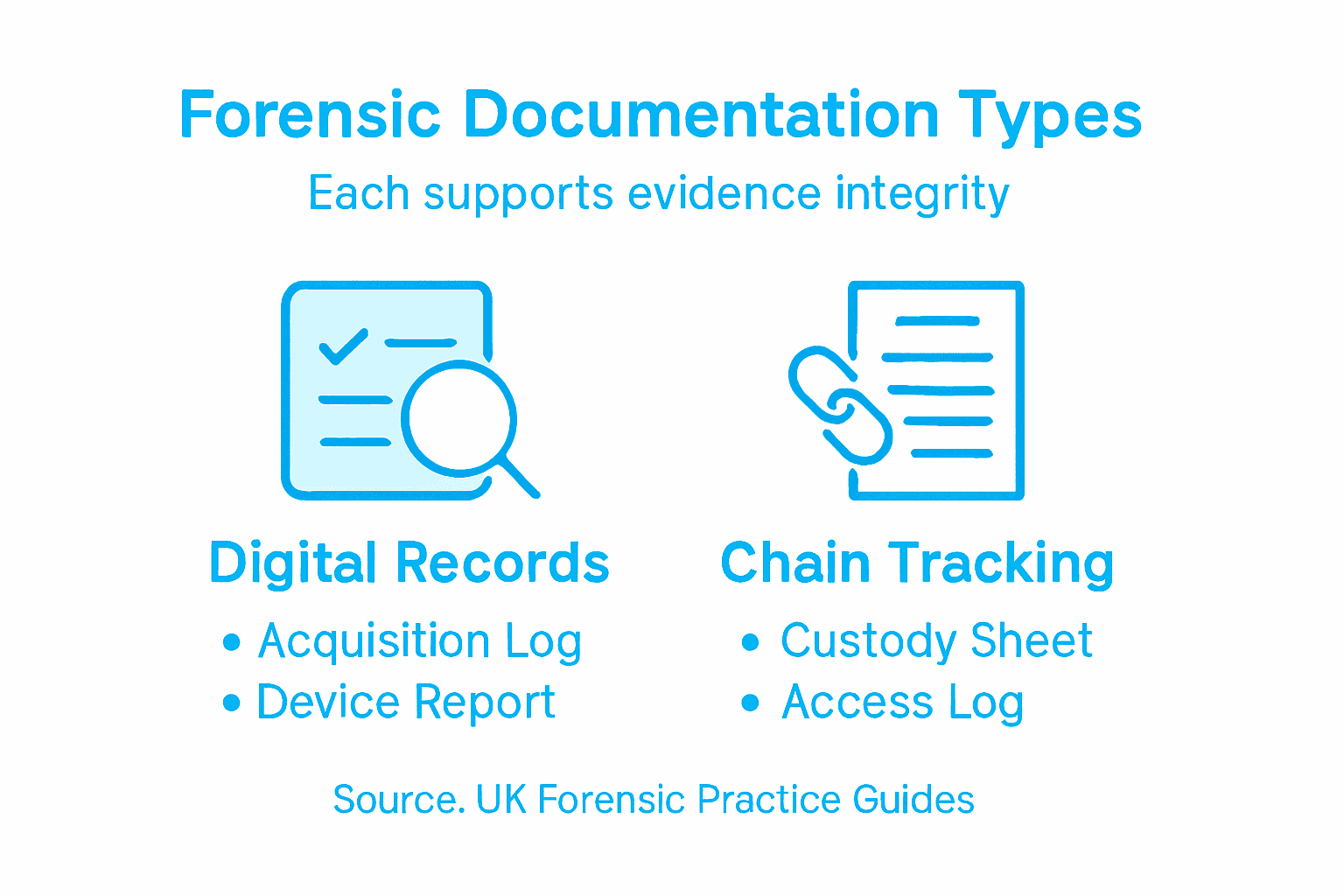
Why documenting digital evidence matters for legal integrity is particularly relevant when you understand how courts view evidence credibility. Raw data logs and imaging reports provide the technical proof. Metadata analyses add verifiable detail. Your forensic report connects those dots.
According to recent guidance on digital evidence handling, systematic recording of all collection and handling steps is essential for investigations globally. Online service providers increasingly play a role in evidence provision, making documentation of third-party data sources critical.
Each documentation type serves as a building block. Remove one, and the entire evidence structure becomes questionable in court.
Pro tip: Create documentation templates before you begin an investigation. Standardised formats ensure you capture all required information consistently and reduce the risk of omitting crucial details during high-pressure examinations.
This table summarises key documentation types and their primary focus areas in digital investigations:
| Documentation Type | Main Focus | Example Content |
|---|---|---|
| Device identification record | Establishing device identity | Make, model, serial number |
| Acquisition log | Capture extraction process | Tools used, steps taken |
| Chain of custody record | Trace evidence handling | Names, signatures, time stamps |
| Forensic imaging report | Prove data integrity | Hash values, comparison results |
| Metadata analysis | Reveal hidden attributes | Timestamps, author information |
| Forensic report | Link evidence to cases | Analytical findings, context |
Maintaining Chain of Custody and Legal Admissibility
Chain of custody is the chronological record that documents every person who has handled evidence, when they handled it, and why. Without it, your entire investigation collapses in court. A judge will reject perfectly analysed evidence if you cannot prove it remained secure and unaltered from collection to trial.
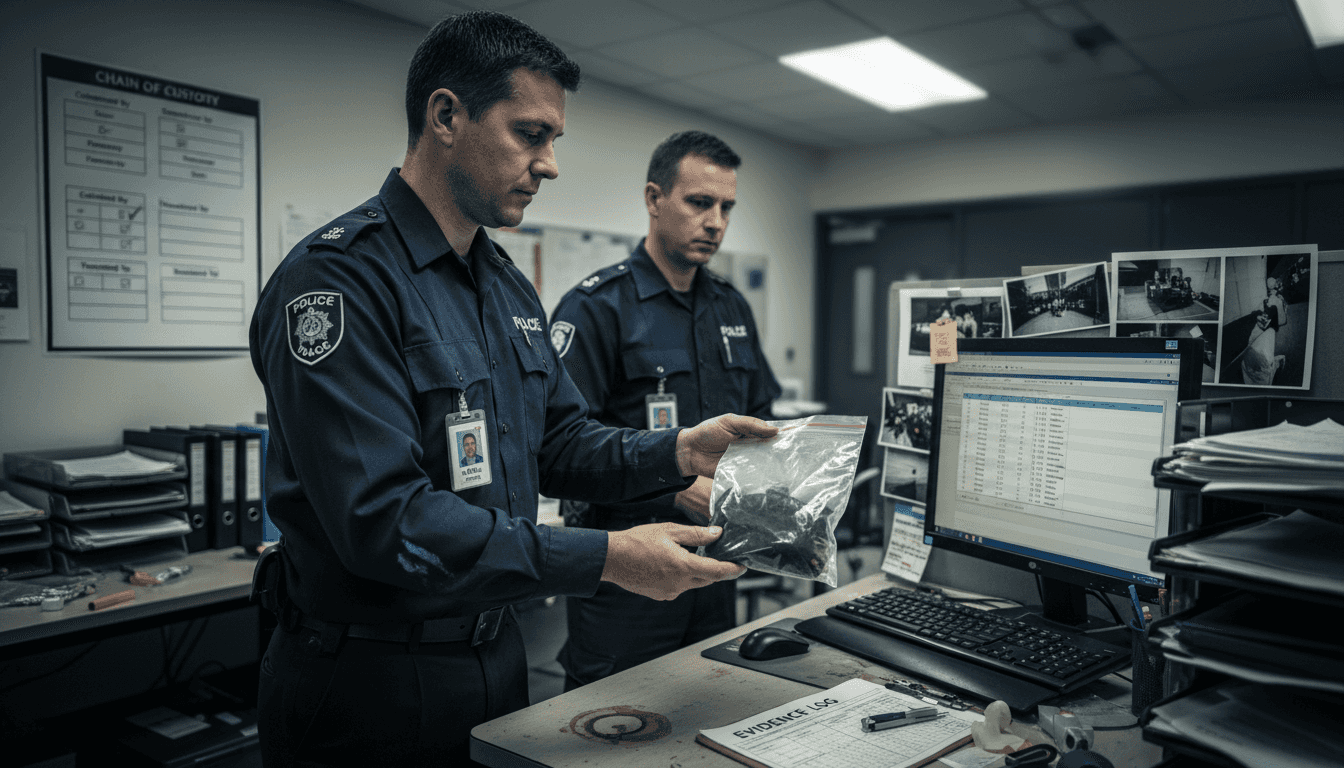
What chain of custody actually protects
This documentation serves three critical protective functions:
- Proves evidence authenticity. Shows that the digital file in court is identical to what was seized from the suspect’s device
- Prevents contamination claims. Demonstrates that evidence was not accessed by unauthorised personnel or altered during storage
- Establishes accountability. Records exactly who touched the evidence, eliminating reasonable doubt about tampering
Maintaining an unbroken chain of custody ensures evidence integrity and legal admissibility in digital forensic investigations. Every individual who handles evidence must be documented with the time, date, and purpose of transfer.
The practical reality in London courts
Defence solicitors will scrutinise chain of custody records line by line. If you cannot account for evidence for even one hour, they will argue contamination occurred. If you failed to record who accessed it, they will claim tampering is possible.
According to chronological documentation of evidence handling, the chain guarantees that evidence presented is the same as collected. Detailed labels and transfer logs are vital for admissibility in court and ensure fairness in the justice system.
Creating effective chain of custody records
Your documentation must include:
- Who collected the evidence (full name and signature)
- The date and time of seizure
- Detailed description of evidence (device model, serial number, storage media type)
- Who transferred it and to whom (receiving party signature)
- Purpose of each transfer (examination, storage, court appearance)
- Current storage location and security measures
- Any testing or analysis performed
Gaps in this chain give defence counsel ammunition. Missing signatures, unclear timestamps, or undocumented transfers undermine the prosecution’s case.
One missing signature or unclear timestamp can invalidate months of forensic work and allow guilty evidence to be excluded from court.
Pro tip: Use sequential evidence labels and maintain a master log where every movement is recorded immediately, not retrospectively. Handwritten signatures on transfer forms carry more weight than digital records if a defence challenge arises.
Risks of Inadequate Documentation in Forensics
Poor documentation doesn’t just create paperwork headaches. It undermines investigations, allows guilty parties to walk free, and in the worst cases, contributes to wrongful convictions. The consequences extend far beyond a single case.
How documentation failures compromise evidence
When documentation is inadequate, several critical problems emerge:
- Evidence becomes inadmissible. Judges exclude poorly documented evidence from trial, regardless of its actual reliability
- Metadata is lost. File creation dates, modification times, and other crucial information disappears without proper records
- Authenticity cannot be verified. Without documentation, you cannot prove that evidence recovered in court is identical to what was seized
- Contamination occurs undetected. Unauthorised access or handling goes unrecorded, allowing reasonable doubt about integrity
- Expert credibility collapses. Cross-examination reveals gaps in your procedures, undermining your entire testimony
Inadequate documentation in digital forensics risks compromising evidence integrity and admissibility. Poor records result in loss of crucial metadata, contamination, or inability to verify authenticity. Evidence is challenged or dismissed in court, undermining investigations and prosecutions.
Real consequences for cases and convictions
This isn’t theoretical. Forensic science reform organisations have documented how documentation errors in forensic investigations directly contributed to wrongful convictions. Misinterpretation of evidence, contamination, and loss of traceability all stem from inadequate records.
Once a case collapses due to documentation failures, the reputational damage follows you. Other defence solicitors will challenge your methods in future cases. Prosecutors will hesitate to use your expertise.
The cascading failures
One missing document creates a domino effect:
- Defence requests chain of custody records
- You cannot locate or complete documentation
- Judge rules evidence inadmissible due to procedural failure
- Case is dismissed or conviction is overturned on appeal
- Your credibility as an expert witness is permanently damaged
Documentation failures don’t just lose cases. They damage reputations, waste prosecution resources, and can result in guilty parties remaining free to commit further crimes.
Pro tip: Establish documentation protocols before your first case and audit them quarterly. Use the same templates, labelling systems, and storage procedures consistently across all investigations. Consistency demonstrates professionalism and makes documentation failures harder to argue in court.
The table below contrasts the impact of strong versus inadequate forensic documentation:
| Aspect Assessed | Strong Documentation | Inadequate Documentation |
|---|---|---|
| Evidence admissibility | Consistently accepted in court | Frequently challenged or excluded |
| Investigator credibility | Enhanced professional reputation | Credibility damaged, expertise questioned |
| Case outcome reliability | Greater likelihood of conviction | Risk of wrongful acquittals or convictions |
| Defence counsel’s approach | Fewer successful challenges | Many procedural avenues for appeal |
Best Practices for Documenting Digital Evidence
Documenting digital evidence requires a systematic approach that captures every detail from the moment you encounter a device through final analysis. The difference between a case that stands up in court and one that collapses often comes down to documentation quality.
Start at the scene
Your documentation begins before you touch any device. Photograph and video record the physical environment where evidence was seized. Capture the device’s position, surrounding items, and any visible conditions. These initial records establish context that defence counsel cannot dispute.
When photographing, use multiple angles and ensure scale is visible in images. Poor crime scene photography undermines even solid forensic analysis.
Label and identify evidence correctly
Every device needs a unique identifier that you record consistently throughout the investigation. Use sequential numbering, device serial numbers, or a combination of both. This identifier must appear on:
- Physical labels attached to the device
- All documentation and reports
- Chain of custody forms
- Forensic imaging reports
- Analysis records
Inconsistent labelling creates confusion and gives defence counsel ammunition to challenge evidence authenticity.
Document collection methodology
Best practices in documenting digital evidence focus on recording detailed and accurate information about the evidence source, collection method, and environment. This includes photography, videos, sketches, and comprehensive notes at the collection site. Adhere to international standards like ISO/IEC 27037 to improve evidence reliability and court acceptance.
Your documentation must specify exactly how you acquired the evidence. Did you use a write blocker? What software did you use? How long did acquisition take? These details matter during cross-examination.
Maintain physical security records
Document where evidence is stored, who has access, environmental conditions, and any security measures. Temperature, humidity, and handling notes protect you against contamination claims. If a device sits in an evidence locker for three months, record that period explicitly.
Create comprehensive forensic reports
Your final report should stand independently. Someone unfamiliar with the case should understand exactly what you examined, how you examined it, and what you found. Include references to all supporting documentation.
Documentation is not a bureaucratic formality. It is your legal defence against every challenge defence counsel raises during cross-examination.
Pro tip: Use a standardised documentation checklist for every investigation. Before you begin any examination, tick off items as you complete them: scene photography, device labelling, acquisition parameters, storage location, transfer signatures. This prevents gaps and demonstrates systematic professionalism.
Safeguard Your Digital Evidence with Expert Forensic Documentation
Ensuring the integrity of digital evidence is a challenge faced by many legal professionals and investigators. This article highlights critical concerns such as maintaining an unbroken chain of custody, detailed acquisition logs, and thorough forensic reporting. These steps are essential to prevent evidence contamination, support legal admissibility, and reinforce your credibility during cross-examination. Without precise and comprehensive documentation, even the most compelling evidence risks being dismissed by the courts.
At Computer Forensics Lab, we understand these challenges deeply. Our expert team specialises in Digital Document Forensics, adhering strictly to best practices that uphold evidence authenticity and legal standards. By meticulously tracking every step of evidence handling through our Chain of Custody Tracking services and applying rigorous forensic science principles (Forensic Science), we provide unbeatable support for your investigations. Delay can jeopardise your case. Contact us now at Computer Forensics Lab for expert assistance that ensures your digital evidence remains unassailable in court.
Frequently Asked Questions
What is the purpose of forensic documentation?
Forensic documentation is designed to systematically record, preserve, and present evidence while maintaining its integrity throughout an investigation. It ensures authenticity, supports legal proceedings, and provides credibility to expert opinions.
Why is maintaining a chain of custody important in forensics?
Maintaining a chain of custody is crucial as it documents every person who handles evidence, ensuring that it remains secure and unaltered from collection to court. A proper chain of custody helps prove evidence authenticity and prevents claims of contamination.
What types of documentation are essential in digital investigations?
Essential types of documentation in digital investigations include device identification records, acquisition logs, forensic imaging reports, metadata analyses, chain of custody records, and forensic reports. Each type serves a distinct function in building a credible evidence trail.
What are the consequences of inadequate documentation in forensic investigations?
Inadequate documentation can lead to evidence becoming inadmissible in court, loss of crucial metadata, inability to verify authenticity, and potential contamination claims. It can ultimately result in wrongful convictions or acquittals, damaging the reputation of the forensic expert.