
Nearly every British court case now hinges on the digital trail left by mobile devices, with over 90 percent of investigations involving smartphone data. The surge in complex mobile forensics challenges traditional approaches, pushing London’s digital forensics community and criminal defense attorneys to update their strategies. This guide cuts through persistent myths, offers practical insights, and highlights best practices for extracting and leveraging robust mobile evidence to safeguard legal outcomes.
Table of Contents
- Mobile Forensics Explained And Common Myths
- Types Of Mobile Forensic Analysis Methods
- Legal Standards For Evidence Admissibility
- Practical Applications For Litigation And Defence
- Risks, Limitations And Common Mistakes
Key Takeaways
| Point | Details |
|---|---|
| Understanding Mobile Forensics | Mobile forensics is a complex discipline requiring specialised skills and rigorous protocols beyond simple data extraction. |
| Myths and Realities | Contrary to popular belief, deleted data may be recoverable, and different forensic tools can produce varying results. |
| Evidence Admissibility | Digital forensic evidence must adhere to strict legal standards, including maintaining an unbroken chain of custody. |
| Challenges and Risks | Investigators must navigate technological risks, including device encryption and inadequate documentation, to ensure evidence integrity. |
Mobile forensics explained and common myths
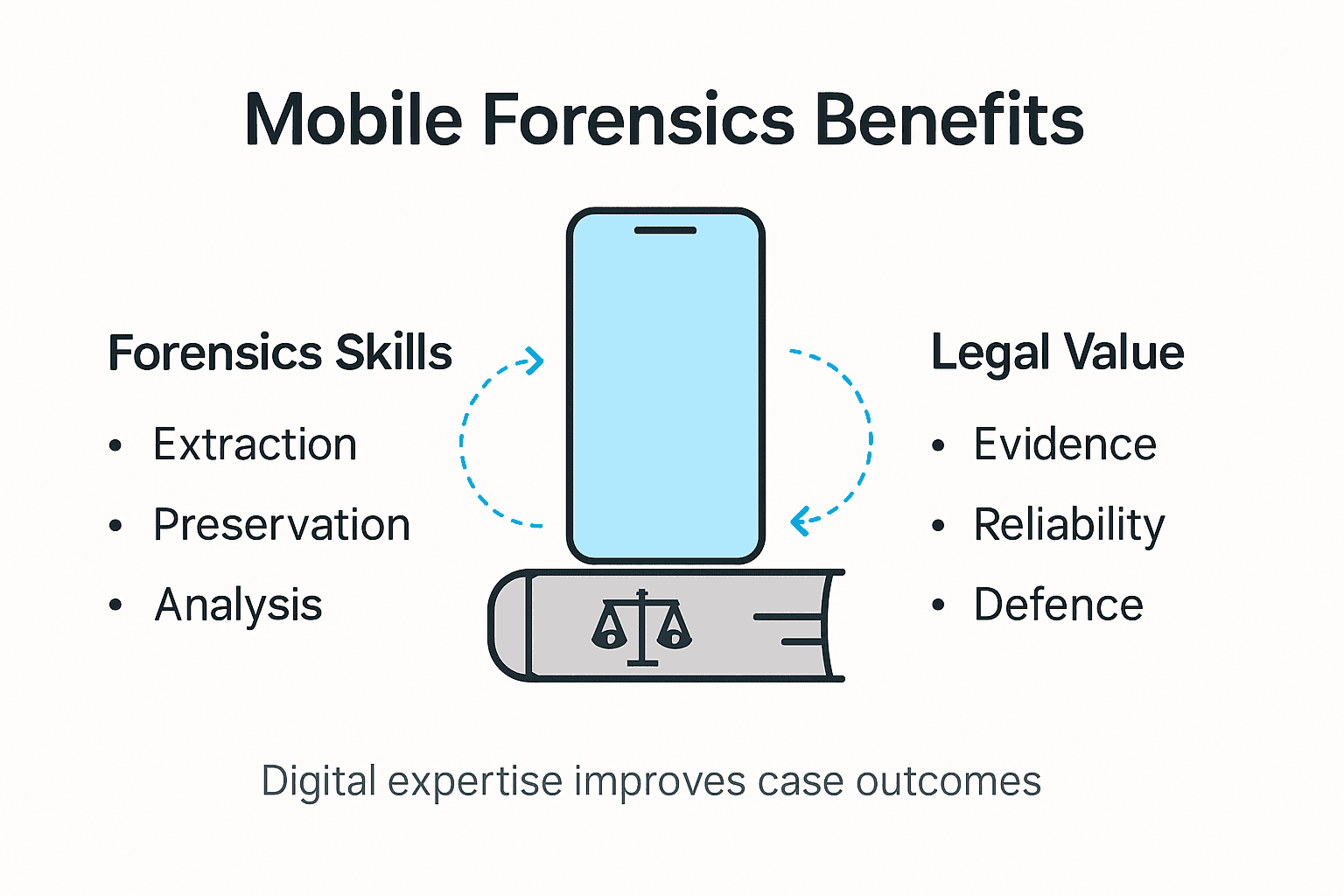
Mobile forensics represents a sophisticated digital investigation discipline designed to extract, preserve, and analyse data from mobile devices such as smartphones, tablets, and wearable technology. The principles of mobile forensics extend far beyond simple data retrieval, encompassing complex methodologies that require specialised technical expertise and rigorous forensic protocols.
Contrary to popular misconceptions, mobile forensics is not a straightforward process of plugging in a device and extracting information. Forensic investigators must navigate intricate technical challenges, including device encryption, diverse operating systems, and rapidly evolving mobile technologies. Advanced forensic tools and techniques are essential for successfully recovering and authenticating digital evidence that can withstand legal scrutiny.
Several persistent myths surround mobile forensics that can mislead legal professionals and investigators. Many believe that deleted data is permanently lost or that all mobile forensic tools produce identical results. In reality, skilled forensic experts can often recover seemingly erased information through specialised techniques, and different forensic tools may yield varying levels of data extraction. Understanding these nuanced realities is crucial for legal professionals relying on mobile device evidence.
Pro Legal Investigator Tip: Always consult digital forensics experts who use multiple extraction methods and can provide comprehensive, court-admissible reports when investigating mobile device evidence.
Types of mobile forensic analysis methods
Mobile forensic analysis encompasses several sophisticated methods designed to extract and analyse digital evidence from mobile devices. Systematic forensic approaches categorise these techniques into distinct extraction strategies, each with unique capabilities and investigative applications.
The primary mobile forensic analysis methods include logical extraction, which retrieves accessible data directly through the device’s operating system; physical extraction, which captures complete device memory and raw data sectors; and advanced techniques like JTAG and chip-off methods for accessing devices with significant technical barriers. Each method requires specialised hardware, sophisticated software tools, and expert-level technical skills to maintain evidence integrity and legal admissibility.
Logical extraction typically involves connecting the mobile device to forensic workstations and retrieving user-accessible data like contacts, messages, and application records. Physical extraction goes deeper, capturing entire device memory sectors, including deleted or hidden data. More complex methods such as JTAG and chip-off techniques become critical when devices are locked, damaged, or have robust security mechanisms preventing standard data retrieval. Advanced forensic frameworks demonstrate the nuanced approaches required to navigate diverse mobile platforms like iOS and Android.
The table below compares key mobile forensic extraction methods and their primary characteristics:
| Method | Data Depth | Typical Uses | Technical Complexity |
|---|---|---|---|
| Logical Extraction | User-visible data recovery | Routine investigations | Moderate |
| Physical Extraction | Entire device, deleted content | Advanced or criminal cases | High |
| JTAG | Access via hardware interface | Locked or damaged devices | Very high |
| Chip-off | Direct chip data removal | Severely damaged handsets | Expert-level |
Pro Forensic Investigator Tip: Always document every step of your forensic extraction process, ensuring a comprehensive chain of custody that can withstand rigorous legal scrutiny and potential cross-examination.
Legal standards for evidence admissibility
Digital forensic evidence requires meticulous adherence to stringent legal standards to ensure its admissibility in court proceedings. Comprehensive legal guidelines establish critical protocols that forensic investigators must follow to maintain the integrity and reliability of mobile device evidence.
The primary legal standards for evidence admissibility revolve around several key principles: maintaining an unbroken chain of custody, documenting every step of the forensic examination, using validated and repeatable extraction methods, and ensuring the evidence remains unchanged from its original state. Investigators must demonstrate that the digital evidence has not been tampered with, altered, or compromised during the collection and analysis process. This requires detailed forensic logs, verifiable extraction techniques, and expert testimony explaining the methodological approach used to retrieve and analyse the mobile device data.
Global forensic investigation models highlight the importance of scientific reliability and jurisdictional considerations when presenting mobile forensic evidence. Different legal systems may have varying requirements, but fundamental principles remain consistent: the evidence must be authentic, relevant, and obtained through scientifically sound methodologies. Forensic experts must be prepared to explain their technical processes, demonstrate the reliability of their tools, and show how the extracted data directly relates to the legal investigation at hand.
Pro Legal Evidence Specialist Tip: Always create comprehensive forensic examination reports that include detailed methodology, tool validation certificates, and a complete audit trail to strengthen the admissibility and credibility of your digital evidence.
Practical applications for litigation and defence
Mobile forensics has emerged as a critical tool for both prosecution and defence strategies in modern legal proceedings. Comprehensive case studies demonstrate how digital evidence extracted from mobile devices can fundamentally transform legal investigations, providing unprecedented insights into complex criminal and civil cases.

In criminal defence scenarios, mobile forensics offers powerful capabilities for verifying alibis, reconstructing event timelines, and challenging prosecutorial evidence. Lawyers can leverage detailed metadata, location records, communication logs, and application usage patterns to build robust defensive arguments. For instance, timestamp analysis might reveal discrepancies in witness statements, or deleted messages could provide crucial context that supports a defendant’s narrative. Similarly, in civil litigation, mobile forensic techniques can uncover critical evidence in cases involving workplace misconduct, intellectual property disputes, or contractual breaches.
Structured forensic investigation frameworks highlight the strategic importance of mobile forensics across multiple legal domains. Beyond traditional criminal investigations, these techniques prove invaluable in corporate litigation, family law proceedings, and regulatory compliance investigations. Digital forensic experts can extract and authenticate communication records, track financial transactions, identify potential evidence of harassment or discrimination, and provide scientifically validated documentation that meets stringent legal standards.
Pro Legal Strategy Tip: Always engage a certified digital forensics expert early in your legal preparation to ensure comprehensive and strategic evidence collection that maximises the potential of mobile forensic techniques.
Risks, limitations and common mistakes
Mobile forensic investigations face numerous complex challenges that can significantly impact the reliability and admissibility of digital evidence. Comprehensive research on forensic risks reveals the intricate landscape of potential pitfalls that investigators must carefully navigate to maintain evidence integrity.
The most critical risks emerge from technological diversity and rapid digital evolution. Modern mobile devices present multifaceted challenges, including advanced encryption protocols, cross-platform compatibility issues, and sophisticated cloud synchronisation mechanisms. Investigators frequently encounter roadblocks such as proprietary device architectures, regional legal restrictions, and constantly changing operating systems that can compromise forensic extraction techniques. Common mistakes include inadequate tool validation, failure to document comprehensive forensic processes, and overlooking volatile data sources that might disappear during traditional extraction methods.
Global forensic investigation reviews highlight significant limitations that can undermine digital evidence collection. These include inconsistent forensic methodologies, insufficient understanding of device-specific security features, and challenges in preserving the original state of digital evidence. Forensic experts must be acutely aware of potential data contamination risks, the importance of maintaining strict chain of custody protocols, and the need for continuous professional development to keep pace with emerging technological complexities.
This summary highlights major risks in mobile forensics and ways to mitigate them:
| Risk | Impact on Evidence | Mitigation Strategy |
|---|---|---|
| Tool incompatibility | Data loss or errors | Use validated tools regularly |
| Incomplete documentation | Evidence inadmissible | Maintain detailed process logs |
| Device encryption | Inaccessible data | Employ advanced extraction tools |
| Rapid OS updates | Process obsolescence | Continuous professional training |
Pro Forensic Investigation Tip: Regularly update your forensic toolkits, participate in ongoing professional training, and develop a comprehensive understanding of device-specific forensic challenges to mitigate potential risks in digital evidence collection.
Unlock the Full Potential of Mobile Forensics for Your Legal Investigation
Navigating the complexities of mobile forensics is essential to overcoming challenges like encrypted devices, fragmented data, and volatile digital evidence. The detailed analysis methods covered in this article highlight the need for expert handling to extract reliable, court-admissible information that strengthens your legal position. At Computer Forensics Lab, we understand how crucial it is to maintain evidence integrity through rigorous forensic protocols while using advanced extraction techniques tailored to your case needs.
Discover how our Mobile Forensics Investigations and Forensic Mobile Specialists bring specialised knowledge and technology to deal with everything from routine data recovery to highly complex extractions like chip-off and JTAG methods. Do not let missed evidence or technical obstacles compromise your case. Act now to partner with experts who provide detailed reports, maintain chain of custody, and deliver testimony-ready digital evidence. Visit Computer Forensics Lab today to secure the mobile forensic support you need to win your case.
Frequently Asked Questions
What is mobile forensics and how does it benefit legal investigations?
Mobile forensics is the discipline of extracting, preserving, and analysing data from mobile devices. It benefits legal investigations by providing critical digital evidence that can verify facts, establish timelines, and support or challenge alibis in both criminal and civil cases.
What types of data can be recovered through mobile forensics?
Mobile forensics can recover a wide range of data, including messages, call logs, contacts, application data, GPS location history, and even deleted files, all of which can be crucial in a legal context.
How does mobile forensics ensure the admissibility of evidence in court?
Mobile forensics maintains evidence admissibility by adhering to stringent legal standards, including maintaining a clear chain of custody, using validated extraction methods, and ensuring that the evidence is preserved in its original state throughout the examination process.
What are the common challenges faced in mobile forensic investigations?
Common challenges in mobile forensic investigations include device encryption, varying operating systems, and the rapid evolution of technology, which can impact the effectiveness of data extraction methods and the overall reliability of the evidence collected.